An MGA due diligence checklist is the list of things an insurer verifies before it gives a managing general agent (MGA) authority to bind risks or settle claims in its name, together with the duties that start the day the relationship does. In US states that follow the NAIC's Managing General Agents Act, the law sets much of the list: a written contract with required terms before any business is placed, a producer licence, audited financial statements showing positive net worth, a surety bond, notice to the commissioner within 30 days of appointment, and an on-site review of underwriting and claims, which Florida requires within six months of engaging a new MGA. Everything else, from the MGA's systems to its claims staff and its exit plan, is the insurer's judgement. Botminds' MGA & Coverholder Audit is an agentic solution for auditing MGAs and coverholders: a new delegate joins the audit plan from its first bordereau, every risk and claim it reports is tested against the binder, and the first review starts from that evidence.
The examples use the solution's fictional sample data, in which Harrowgate Specialty audits 14 delegates, one of them new. The day counts below are our plan, not a regulator's.
Where a new delegate's first 180 days go
Days 1–180 after engagement
- Notices, set-up, first bordereau · 17%
- Two months of bordereaux tested as they arrive · 33%
- First review prepared: request, tests, sample · 33%
- On-site review and report · 17%
What is MGA due diligence?
MGA due diligence is the insurer's check that a firm it is about to authorise can be trusted with its pen and its money, and that the arrangement will meet the law. It has two halves. Before signing: who the MGA is, whether it is licensed, solvent and competent, what it will write and how, and what the contract says. After signing: the duties the law imposes on the insurer from day one, which is where many carriers fall behind.
Regulators have said for years that this half is weak. The FCA's 2015 review of delegated authority in the UK found: "Insurers do not always treat delegated arrangements as outsourcing and improvements are needed to due diligence and the way they manage such arrangements" (FCA TR15/7, June 2015); the FCA has since marked that review historical, but its 2026 work returns to delegated authority oversight. In the US, a 2025 California examination found an insurer had not given the commissioner written notice of its MGA's appointment, alongside four other MGA-act failures (California Department of Insurance, Topa exam report, filed June 2025).
What should an MGA due diligence checklist include?
It should include every precondition the state's MGA law sets, every document the insurer must hold, and the insurer's own tests of the MGA's competence and controls, each with its source. The checklist below follows the NAIC model, with the state differences noted where they change the task.
An MGA due diligence checklist, with the rule behind each item
- Does the firm meet the statutory MGA test?
Managing the business and writing at least 5% of the insurer’s surplus, plus claims over $10,000 or reinsurance, makes it an MGA whatever it calls itself (Model #225 §2D).
- Licensed as a producer where it will act
No person may act as an MGA in the state without a producer licence (Model #225 §3).
- Written contract signed before any business
With the required terms: accounts, fiduciary funds, records access, underwriting guidelines, claims provisions, no assignment (Model #225 §4).
- Audited financial statements on file
Two most recent years proving positive net worth; officer-certified GAAP statements for a younger firm (Model #225 §5A). Florida: an independent financial examination in a form the regulator accepts.
- Surety bond obtained
At least $100,000 or 10% of the MGA’s prior-year premium for the insurer, at most $500,000; the insurer keeps it on file (Model #225 §4G, §5H).
- Fiduciary account set up for the insurer
At an FDIC-insured institution, used for all payments on the insurer’s behalf, not owned by the MGA (Model #225 §4C).
- Underwriting guidelines written as testable limits
Premium volume, rates, risk types, limits, exclusions, territories, cancellation, maximum policy period (Model #225 §4F).
- Settlement authority and claim triggers set
The amount, the files the insurer must receive, and the surplus cap above which approval is needed (Model #225 §4I, §4M).
- Commissioner notified of the appointment
Within 30 days under the model, with a statement of duties and lines; 15 days in North Carolina (Model #225 §5E).
- First on-site review scheduled
Within six months of engagement in Florida; on a semi-annual clock under the model (Fla. Stat. §626.7454(3); Model #225 §5C).
- Actuary lined up if the MGA will set reserves
An annual opinion on the reserves it establishes (Model #225 §5B).
- Exit plan agreed
Termination for cause, suspension of authority during a dispute, and who keeps the claim files (Model #225 §4A, §4I).
What documents does a carrier need from an MGA?
At minimum: proof of licence, the signed contract, audited financial statements, the bond, and the documents the MGA will operate under: underwriting guidelines, rating guide, claims procedures, referral rules, sanctions screening procedure, business continuity plan. The financial statements are the one the model law is most specific about: "The insurer shall have on file an independent audited annual financial statement or reports for the two (2) most recent fiscal years that prove that the MGA has a positive net worth" (Model #225, §5A). A newer MGA files officer-certified statements prepared under GAAP for its completed years and months instead.
States vary the form. Florida asks for "an independent financial examination in a form acceptable to the office" for each MGA the insurer has done business with (Fla. Stat. §626.7454(1)), and exempts MGAs that are controlled or controlling persons from that and the review duty. North Carolina wants each MGA's audited report on file by 1 June every year and a copy with the Commissioner within 15 days of receipt (N.C. Gen. Stat. §58-34-2(e), read from an Internet Archive copy of the General Assembly's page captured in May 2026).
What bond does an MGA need?
Under the NAIC model, a surety bond for the insurer's protection of "at least $100,000 or ten percent (10%) of the managing general agent’s total annual written premium nationwide produced by the MGA for the insurer in the prior calendar year, but in no event greater than $500,000" (Model #225, §4G). The drafting note expects one bond per insurer represented, and the insurer must keep it on file for the commissioner. The insurer may also require errors and omissions cover. A new MGA has no prior-year premium with the insurer, so in its first year the floor of $100,000 governs.
The bond is the item most often taken on trust. In California's 2025 examination, the MGA had not maintained a fidelity bond for the insurer's protection as its own agreement required, and the examiners recommended one "for the sole benefit of the Company" or naming the company as an additional insured.
Model law, Florida and North Carolina: the same new MGA, three rulebooks
A carrier onboarding an MGA that will act in several states works to the strictest version of each duty. Three versions show how far they differ.
A new MGA's first-year duties under the model and two state versions
NAIC Model #225: Within 30 days, with duties and lines.
Florida and North Carolina: Florida: within 30 days, to the department and the office. North Carolina: within 15 days.
NAIC Model #225: Audited statements for two years proving positive net worth; officer-certified GAAP statements for a younger MGA.
Florida and North Carolina: Florida: an independent financial examination in a form the office accepts. North Carolina: audited report on file by 1 June each year, copy to the Commissioner within 15 days.
NAIC Model #225: No express first-review rule; the semi-annual clock applies.
Florida and North Carolina: Florida: within 6 months of engagement, then at least annually. North Carolina: at least semiannually, with a written report.
NAIC Model #225: No more than three months of estimated claims and expenses.
Florida and North Carolina: Florida: up to 60 days.
NAIC Model #225: Interim profits held back 1 year for property, 5 for casualty, and verified.
Florida and North Carolina: Florida: the same hold-backs, with IBNR named in the reserves that trigger them.
How do you onboard a new MGA? The first 180 days
Onboarding runs in two lanes at once: the carrier's duties and the delegate's first months of business. The carrier's lane is set by law and by the audit plan; the delegate's lane is when the habits form, which is why the first bordereaux are the best time to test hard.
The first 180 days with a new delegate, carrier and delegate side by side
- Notice and set-upNotice and set-up
- Each bordereau tested on arrivalBordereaux tested monthly
- First review: request, tests, sampleFirst review prepared
- Visit and reportVisit, report
- First risks boundFirst binds
- Monthly bordereaux and remittanceMonthly bordereaux, remittance, first claims
- Responds to findingsActions
Days 1 to 30. Notify the commissioner, confirm the bond and the fiduciary account are in the insurer's name as required, read the binder's limits into the tests, and agree the bordereau format and deadline. Days 31 to 90. Test each monthly bordereau when it lands: territory, class, limits, aggregates, screening before bind, issue dates, remittance. Raise exceptions with the delegate as they appear rather than saving them for the visit. Days 91 to 150. Prepare the first review: the information request, the whole book to date, the sample. Days 151 to 180. Visit, report, agree actions. A delegate that reaches its first review with a clean run of tested bordereaux has earned a lighter one; one that has not has given the auditor a scope.
How soon must a new MGA be reviewed?
Within six months in Florida, which says so expressly: the insurer must review a newly engaged MGA's underwriting and claims operations on site within six months of engaging it (Fla. Stat. §626.7454(3)). The NAIC model has no separate rule for a new MGA, but its semi-annual clock points to a first review in the first half-year. The state-by-state rule is set out in the MGA compliance audit guide.
The model adds a duty that catches delegates nobody onboarded: the insurer "shall review its books and records each quarter to determine if any producer as defined by Section 2D has become, by operation of Section 2D, a MGA" (Model #225, §5F). A producer whose volume and claims authority grew past the test becomes an MGA without a signing ceremony, and the insurer then has 30 days to comply with the whole act.
The money: a fiduciary from the first premium
The premium a new MGA collects is the insurer's from the moment it is paid, and the law treats the MGA as a fiduciary over it. A federal appeals court made the point in a case over an MGA's handling of premium, decided under Texas law: the contract made the MGA a fiduciary for every dollar from the moment it accepted the money until the money left its control, which the court found consistent with the Texas Insurance Code (Lincoln General Insurance Co. v. U.S. Auto Insurance Services, 5th Cir., 2015). The district court had held otherwise for premium not yet in the trust account; the Fifth Circuit reversed.
Premium is the insurer's money from the moment the MGA takes it, including the minutes in which the MGA works out its own commission.
For due diligence that means checking the account structure before the first bind, not at the first audit: whose name is on the account, who can move money out, how commissions are deducted, how quickly premium reaches the insurer. Remittance at least monthly is the model's floor. A trust account statement in the first month's information request is cheap; discovering in month nine that the MGA owned the accounts is not.
Plan the exit on the way in
The best time to agree how a delegate relationship ends is before it starts. The PRA told London Market insurers in 2026 that delegated authority business is set to grow and that firms need strong oversight of how those arrangements perform, including a plan for leaving the unprofitable ones (Prudential Regulation Authority, Insurance supervision: 2026 priorities; quoted in MGA termination notice). The US model gives the contractual tools: termination for cause on written notice, suspension of underwriting and settlement authority during a dispute, and claim files that are the joint property of insurer and MGA, becoming the insurer's alone on liquidation.
Exit planning also shapes what to collect in the first 180 days. Bordereaux in a usable form, claim files the insurer can open, and a record of every finding and action are what let an insurer move a book to another administrator without losing it. The model already gives the insurer the right to the MGA's records in a form it can use; the first months are when to exercise it.
Where Botminds' MGA & Coverholder Audit fits a new delegate
A new delegate goes onto the audit plan with its first review scheduled, and its bordereaux are tested against the binder from the first month, so the first review starts with evidence rather than with a request for it. The solution does not do the pre-signing due diligence: assessing the MGA's management, financial strength and systems, and deciding whether to sign, stay with people. Nor does it file the notice to the commissioner or obtain the bond; it can carry those items on the request and show whether the evidence arrived.
A new delegate on the audit plan, with its first review booked
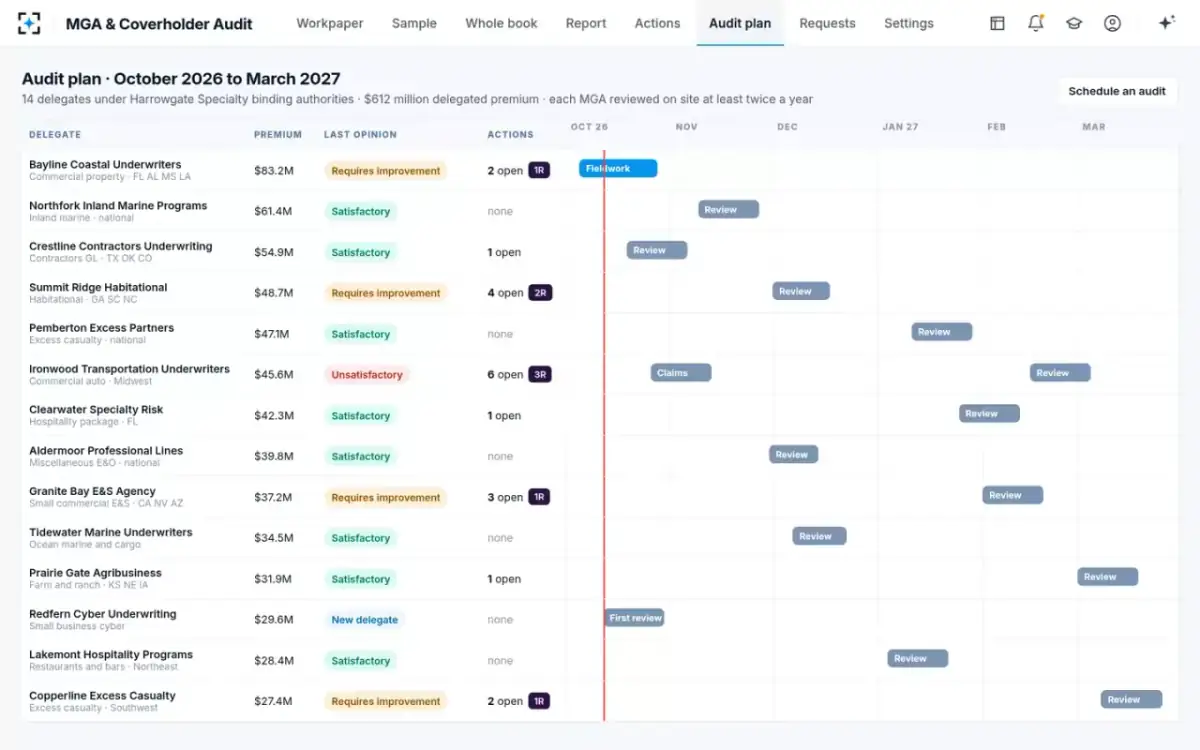
Every agreed action from that first review then has an owner and a due date, and the action tracker reopens an action if a later test finds the same exception. The checklist of tests the first review runs, with the source of each, is in the MGA audit checklist; who does each part of the review is in the delegated authority auditor guide.
Questions people ask
What is the difference between MGA due diligence and an MGA audit?
Due diligence happens before and around the start of the relationship: should the insurer appoint this MGA, and are the legal preconditions met? The audit happens throughout it: did the MGA do what the binder allowed, and did the insurer meet its review duties? The first review of a new MGA is where the two meet.
Can an MGA start writing before the contract is signed?
Not under the model act, which bars an MGA from placing business with an insurer unless a written contract with the required provisions is in force. A September 2026 NAIC licensing handbook draft says the same of most states: MGAs are not allowed to place business until a written contract exists among all parties.
What if the MGA is less than two years old?
The model accepts financial statements certified by an officer of the MGA and prepared under GAAP for its completed fiscal years and months, in place of two years of audited statements. That makes the first review and the testing of early bordereaux more important, not less.
Does the insurer have to tell the regulator when it appoints an MGA?
Yes, in states following the model: written notice within 30 days of entering into or terminating the contract, with the MGA's duties and lines of insurance. North Carolina shortens it to 15 days, and California's examiners cited one insurer in 2025 for not sending it.
Can an MGA appoint other agents?
It may appoint producers only if they are lawfully licensed for the business, and it may not appoint a sub-MGA at all under the model act. Due diligence should ask for the list of producers the MGA intends to use and how it checks their licences.
What should a carrier ask an MGA about its claims capability?
Whether it will handle claims at all, up to what settlement authority, with what staff and system, and how it will send the insurer the files the law requires: claims that may exceed its authority, coverage disputes, and claims open more than six months. Then test those answers on the first claims bordereaux.