A coverholder in insurance is a company that has been given authority to enter into contracts of insurance on an insurer's behalf, so it can quote, bind and issue cover without referring each risk back. The term comes from the Lloyd's market, where HM Revenue & Customs puts it in one line: "A managing agent may delegate to another company, including to a Lloyd’s broker, its authority to enter into contracts of insurance on behalf of a syndicate it manages. The recipient of the authority is known as a ‘coverholder’" (HMRC Lloyd's Manual, LLM1100). The coverholder holds the pen; the syndicate or insurer carries the risk. In the US the nearest equivalent is the managing general agent, defined in state law. Because a delegate writes business the insurer has never seen, the insurer must audit it, and Botminds' MGA & Coverholder Audit is an agentic solution for that audit: it tests every risk and claim a coverholder or MGA reports against the binding authority.
The vocabulary of delegated authority is small but slippery. The same word can mean a document in one market and a temporary cover note in another, and US statute defines terms that London defines by contract. Each term below gives its source, so a reader can check the definition against the rule that sets it.
The person to whom a binding authority is granted is often known as a coverholder, but the nature of the arrangement is essentially that of an underwriting agent.
AmTrust Europe v MD Insurance Services, High Court, 2025, quoting a professional negligence encyclopaedia
What is a coverholder in insurance, in one paragraph?
A coverholder is an underwriting agent with a written authority: a binding authority that says which risks it may accept, at what rates, up to what limits, in which territories and for how long. HMRC's manual adds the second half of the definition: "The document setting out the terms of the coverholder’s delegated authority is known as a ‘binding authority’." Everything an auditor later tests comes from that document and its schedules.
Coverholders range from Lloyd's brokers with a small binder for one class to specialist firms writing thousands of policies a year across several countries, some with authority to settle claims as well. In a 2025 High Court case, for example, the court described a coverholder appointed "to manage the underwriting process and claims handling" for latent defect policies on new homes, with a binder that ran from 2011 to 2020 (AmTrust Europe v MD Insurance Services, [2025] EWHC 1468 (Comm)).
Is the coverholder the insurer?
No. The coverholder acts for the insurer but is not the insurer, and the risk stays on the syndicate's or insurer's books. HMRC states the agency relationship directly: coverholders act as agent of the Lloyd's managing agent, not of the policyholder. That has practical consequences. A policyholder's contract is with the insurer, so a claim is the insurer's to pay even if the coverholder mishandles it; and the insurer is answerable to its regulator for what the coverholder did in its name.
The money follows the same logic. The FCA Handbook explains that an agency agreement can let the intermediary commit the insurer to risk, settle claims or handle premium refunds, and calls these binding authorities; under such an authority the intermediary holds premiums as the insurer's agent (FCA Handbook, CASS 5.2.2G). Premium paid to the coverholder is, for the customer, premium paid to the insurer. If the coverholder then fails to pass it on, the gap is the insurer's.
What does a coverholder do?
A coverholder does whatever its binding authority allows, and reports it. A typical authority lets it quote and bind risks inside set classes and limits, issue policy documents, collect premium and pay it over, and send the insurer a regular schedule of what it wrote. Some authorities add claims: acknowledging, reserving and settling claims up to an amount, with larger or disputed ones referred. The reporting is the insurer's window into the book. In one Lloyd's-style binder read out in a 2022 judgment, the coverholder had to keep sending premium bordereaux at the scheduled interval until every policy it had bound had expired or been cancelled (XL Insurance v IPORS, [2022] EWHC 2093 (Comm); the clause is quoted in what bordereaux reporting is).
That window is only as good as the delegate's reporting. In the same case, once the coverholder's bank statements were analysed alongside information from third parties, it emerged that it had substantially under-declared the premium it received, and the court found it liable for the shortfall. That is why an audit tests the bordereau against the files and the bank, not just the bordereau against itself.
Thirty terms of delegated authority, with their sources
The thirty terms below are the ones that come up in every delegate audit, grouped by what they describe. Where a statute, regulator or court defines the term, the source is named; where no rule does, the definition is marked as our usage.
Thirty terms of delegated authority, and where each is defined
Who holds the pen
- Coverholder
- A company given authority by a Lloyd’s managing agent to enter into insurance contracts for a syndicate it manages.
- HMRC, LLM1100
- Managing agent
- The firm that manages a Lloyd’s syndicate and may delegate its authority to bind, including to a Lloyd’s broker.
- HMRC, LLM1100
- Syndicate
- The unit at Lloyd’s through which members accept risk; a cover holder has delegated authority from a syndicate.
- HMRC, VATINS4620
- Lloyd’s broker
- An accredited broker that places business with Lloyd’s underwriters; it may not also be a managing agent.
- HMRC, LLM1100
- Managing general agent (MGA)
- In US law, a person who manages an insurer’s business and underwrites premium equal to at least 5% of the insurer’s surplus in a quarter or year, and adjusts or pays claims over $10,000 or negotiates reinsurance.
- NAIC Model #225 §2D
- Underwriting agent
- The legal character of most delegated arrangements: whoever holds the binding authority underwrites as the insurer’s agent.
- AmTrust v MDIS, 2025
The authority
- Binding authority
- The document setting out the terms of a coverholder’s delegated authority; in the FCA Handbook, authority to commit an insurer to risk, settle claims or handle premium refunds.
- HMRC LLM1100; FCA CASS 5.2.2G
- Binder
- Shorthand for the binding authority agreement in delegated authority work; elsewhere it can mean temporary evidence of cover.
- Our usage
- Underwrite
- The power to accept or decline risks for the insurer.
- NAIC Model #225 §2F
- Underwriting guidelines
- The limits a US MGA contract must contain: premium volume, rates, risk types, limits, exclusions, territories, cancellation, policy period.
- NAIC Model #225 §4F
- Settlement authority
- The amount up to which a delegate may settle claims without the insurer; it can be ended for cause on written notice.
- NAIC Model #225 §4I
- Sub-MGA
- An MGA appointed by an MGA. The US model forbids it outright.
- NAIC Model #225 §4M
The money
- Fiduciary account
- The account in which a US MGA holds funds collected for the insurer, at an FDIC-insured institution, used for all payments on the insurer’s behalf.
- NAIC Model #225 §4C
- Risk transfer
- Premium is treated as received by the insurer when the agent receives it, so a customer who has paid the agent has paid the insurer.
- FCA CASS 5.2
- Client money
- Money a UK intermediary holds for clients; premium held as the insurer’s agent under a binding authority is ordinarily not client money.
- FCA CASS 5.2.2G
- Remittance
- Paying over the premium due to the insurer, with an account of the transactions, at least monthly under the US model.
- NAIC Model #225 §4B
- Surety bond
- The bond a US MGA keeps for the insurer’s protection: at least $100,000 or 10% of the prior year’s premium for that insurer, capped at $500,000.
- NAIC Model #225 §4G
- Interim profits
- A profit share the MGA can influence through reserves or claims; held back one year for property and five for casualty.
- NAIC Model #225 §4L
Reporting and oversight
- Premium bordereau
- The periodic schedule of risks bound and premium, produced by the coverholder in a format the underwriters agreed in advance.
- XL v IPORS, 2022 (binder clause)
- Claims bordereau
- The same schedule for claims, produced by the coverholder where claims bordereaux are due from it under the binder.
- XL v IPORS, 2022 (binder clause)
- On-site review
- The insurer’s review of an MGA’s underwriting and claims operations at its premises: twice a year under the US model, yearly in Florida.
- NAIC Model #225 §5C; Fla. Stat. §626.7454
- Delegated authority
- Handing underwriting, claims handling or product design to a third party; the FCA expects insurers to manage it as outsourcing.
- FCA TR15/7 (2015, historical)
- Manufacturer
- A firm that designs an insurance product; where co-manufacturers appoint a lead, since December 2025 the lead must be an insurer or a managing agent.
- FCA PS25/21
- Third-party administrator (TPA)
- In the NAIC guideline, a person who underwrites, collects premium or settles claims for life, annuity, health, stop-loss or workers’ compensation cover.
- NAIC GL-1090
The audit
- Delegate audit
- The insurer’s audit of one delegate for a period: request, testing, sample, visit, rated findings and agreed actions.
- Our usage
- Audit sampling
- Applying an audit procedure to less than 100 percent of the items in a population, to judge the whole.
- PCAOB AS 2315
- Sampling risk
- The chance that a sample leads to a different conclusion than testing every item would; it grows as the sample shrinks.
- PCAOB AS 2315
- Whole-book testing
- Running the same tests on every risk and claim the delegate reported, rather than on a sample of files.
- Our usage
- Finding
- A rated statement of what was wrong: the condition, the criteria it breaks, the effect, and the recommendation.
- Our usage
- Agreed action
- What the delegate commits to do about a finding, with an owner and a due date, closed only on evidence.
- Our usage
Coverholder vs MGA: what is the difference?
A coverholder and an MGA do the same job in two legal systems. Both hold delegated underwriting authority and often claims authority; the difference is where the rules come from. A coverholder is defined by its binding authority and the London market's arrangements around it. An MGA in the US is defined by statute, and only firms that pass the statute's test count: the NAIC model warns that a firm calling itself a managing general agent is not necessarily one under the act (NAIC Model #225, drafting note to §2D).
Coverholder vs MGA: one job, two rulebooks
Coverholder (London Market): A Lloyd’s managing agent, for a syndicate it manages, or a company market insurer.
Managing general agent (US states): A licensed insurer, under a written contract the statute requires before any business is placed.
Coverholder (London Market): Holding a binding authority: the document is the definition.
Managing general agent (US states): A statutory test: manages the insurer’s business, underwrites premium of at least 5% of the insurer’s surplus in a quarter or year, and pays claims over $10,000 or negotiates reinsurance.
Coverholder (London Market): The managing agent’s, not the policyholder’s.
Managing general agent (US states): The insurer’s; the MGA’s acts are treated as the insurer’s, and the regulator may examine it as if it were the insurer.
Coverholder (London Market): Not conferred by the binding authority, which is a contract; authorisation and market approval sit outside it.
Managing general agent (US states): A licensed producer in the state, under the model act.
Coverholder (London Market): Held as the insurer’s agent; for the customer, paid to the insurer on receipt.
Managing general agent (US states): Held as a fiduciary in an FDIC-insured account, remitted at least monthly.
Coverholder (London Market): The managing agent or insurer, under FCA and PRA expectations for outsourcing and delegated authority.
Managing general agent (US states): The insurer, with statutory duties: audited statements, an on-site review, an actuary where the MGA sets reserves, notice to the commissioner.
One more difference matters to anyone designing UK products. The FCA's December 2025 rules let co-manufacturers of an insurance product appoint a single lead firm, but the lead "must be, either:" "an insurer; or" "a managing agent." The FCA declined to let intermediaries lead because "where products were developed and designed by intermediaries it was more likely that firms could not demonstrate these products delivered fair value and good outcomes" (FCA PS25/21). An MGA can design a product in London; it cannot carry the manufacturer's duties alone.
Same word, different meaning: five terms to pin down
Five terms cause most of the confusion between markets and between teams. Pinning them down at the start of an audit, or a contract negotiation, saves arguments later.
Five delegated authority terms that change meaning between markets
| Term | In delegated authority work | Elsewhere |
|---|---|---|
| Binder | The binding authority agreement and its schedules | In US commercial and personal lines, often a temporary evidence of cover issued before the policy |
| MGA | A delegated underwriter that holds the pen, often with claims authority | In some life insurance markets, a distribution firm that recruits and supervises agents |
| Audit | The insurer’s review of a delegate’s underwriting, claims and money | A regulator’s examination of the insurer, or a premium audit of an insured’s payroll or sales |
| Bordereau | The delegate’s periodic schedule of risks, premium or claims | In reinsurance, a cedant’s schedule of ceded business for the reinsurer |
| Referral | A risk outside the delegate’s authority, sent to the insurer for approval before binding | Inside an insurer, a case passed up an underwriter’s own authority levels |
What is a coverholder agreement, and what is in it?
A coverholder agreement is the binding authority itself, usually with schedules that carry the commercial terms. Its content is what makes delegated business auditable. US law spells out the minimum for an MGA contract: underwriting guidelines covering the maximum annual premium, the basis of rates, the types of risk, maximum limits, exclusions, territory, cancellation provisions and the maximum policy period (NAIC Model #225, §4F; the eight items are quoted in what a binding authority agreement is). A London binding authority covers the same ground through its schedule, with bordereaux, accounts and settlement terms in their own section.
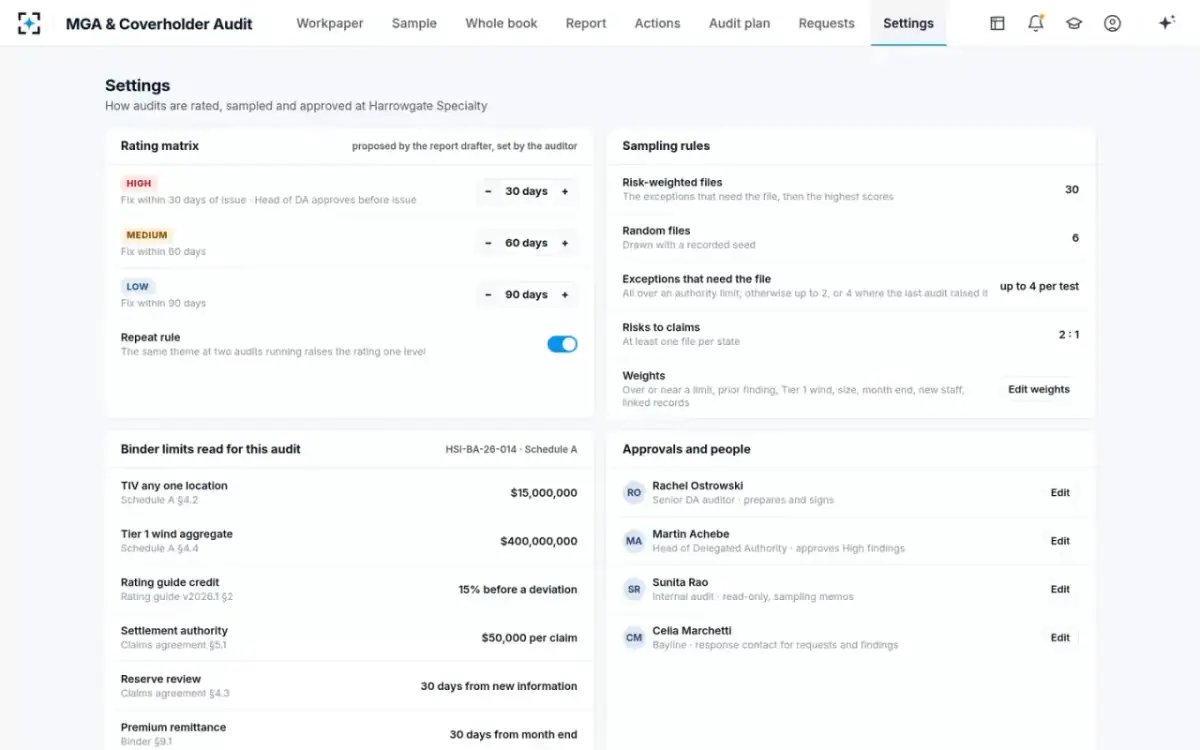
Each of those clauses becomes a test. A per-location limit becomes a check on every risk's insured value; a territorial limitation, a check on every risk's state; a settlement authority, a check on every claim payment. In Botminds' MGA & Coverholder Audit, the limits are read from each delegate's own binding authority before the tests run, so the auditor can see the exact clause every exception rests on.
A binding authority's limits, read into the audit
Why the vocabulary matters in an audit
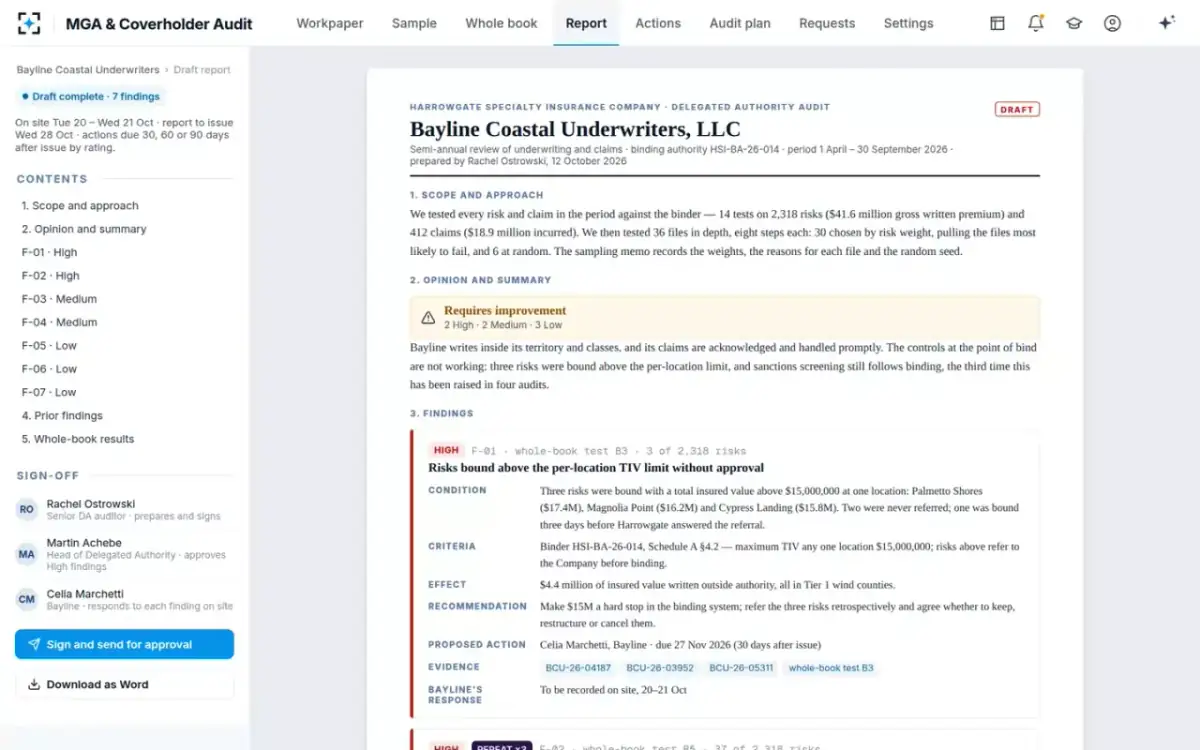
An audit finding is only as strong as the definition it rests on. "Bound over the limit" means nothing until the limit is named, the schedule clause cited and the term "location" pinned down. A delegate that reads a term differently from its insurer will close an action that the insurer thinks is still open. The FCA's 2015 review found exactly this kind of gap at market scale: "Delegated authority is widely used in the UK general insurance market. This can include outsourcing of underwriting and claims handling to third parties and the allocation of other functions such as product design" (FCA TR15/7, June 2015, since marked historical by the FCA), and insurers did not always manage those arrangements as outsourcing.
A finding that rests on a defined term and a cited clause
What a coverholder audit covers, how long it takes and where the days go is in the coverholder audit guide; the tests themselves, each with the clause or statute behind it, are in the MGA audit checklist.
Questions people ask
What is a Lloyd's coverholder?
A Lloyd's coverholder is a company authorised by a managing agent to accept insurance for one or more Lloyd's syndicates under a binding authority. HMRC's VAT manual describes the same thing from the tax side: a cover holder "has delegated authority from a syndicate to accept business on behalf of members", sometimes called binder authority business.
Is a coverholder an insurer or a broker?
Neither, strictly. It acts as the insurer's agent for binding, and some coverholders are also brokers: HMRC notes that a managing agent may delegate its authority to a Lloyd's broker as well as to other firms. The capacity, and the risk, belong to the syndicate or insurer.
Can a coverholder handle claims?
Yes, if its binding authority or a separate claims agreement gives it that authority, usually up to a set amount per claim. In the US model act, an MGA with claims authority must report all claims to the insurer in a timely manner and send the file whenever a claim may exceed its settlement authority, involves a coverage dispute or stays open more than six months.
What is the difference between a coverholder and an MGU?
MGU, managing general underwriter, is a market term rather than a statutory one, generally used for a delegate that underwrites under an insurer's authority. In practice it describes the same kind of firm as a coverholder or MGA; whether a given firm meets a state's statutory MGA definition depends on that state's test, not on the name.
Who audits coverholders?
The insurer or managing agent that granted the authority, through its delegated authority team, sometimes with outside auditors. Regulators then hold the insurer responsible for that oversight: in the US the insurer carries statutory review duties, and in the UK the FCA is reviewing firms' oversight of outsourcers and delegated authority models, aiming to report in early 2027.
What does a binding authority not allow?
Whatever its schedule leaves out: risks outside the listed classes or territories, values above the limits, rates outside the guide, and in the US the appointment of a sub-MGA, which the model act bars outright. Those edges are exactly what a delegate audit tests.