A binding authority agreement in insurance is the written contract by which an insurer authorises an intermediary, usually a managing general agent (MGA) or, in the London market, a coverholder, to accept risks and issue policies on the insurer's behalf within stated limits. The UK's Financial Conduct Authority describes it as an agency agreement that confers "contractual authority to commit the insurance undertaking to risk or authority to settle claims or handle premium refunds (often referred to as "binding authorities")" (FCA Handbook, CASS 5.2.2G). In the United States, the NAIC's model law forbids an MGA to place business at all without such a contract and lists what it must contain (NAIC Model #225 §4). Botminds' Binder Guidelines Search reads that contract, its schedules, rating guide and endorsements clause by clause, so an underwriter can ask whether a risk fits and get back the clause that decides it.
The annotations on this page use a fictional sample binder: QF-26-PR-01, a commercial property binding authority from a fictional carrier, Brantmoor Specialty, to a fictional MGA, Quillfield Underwriting Managers, for 2026. It runs to a 64-page agreement, 20 pages of schedules, a 38-page rating guide and four signed endorsements. The law quoted is real.
One clause, annotated: what a binding authority limit looks like on the page
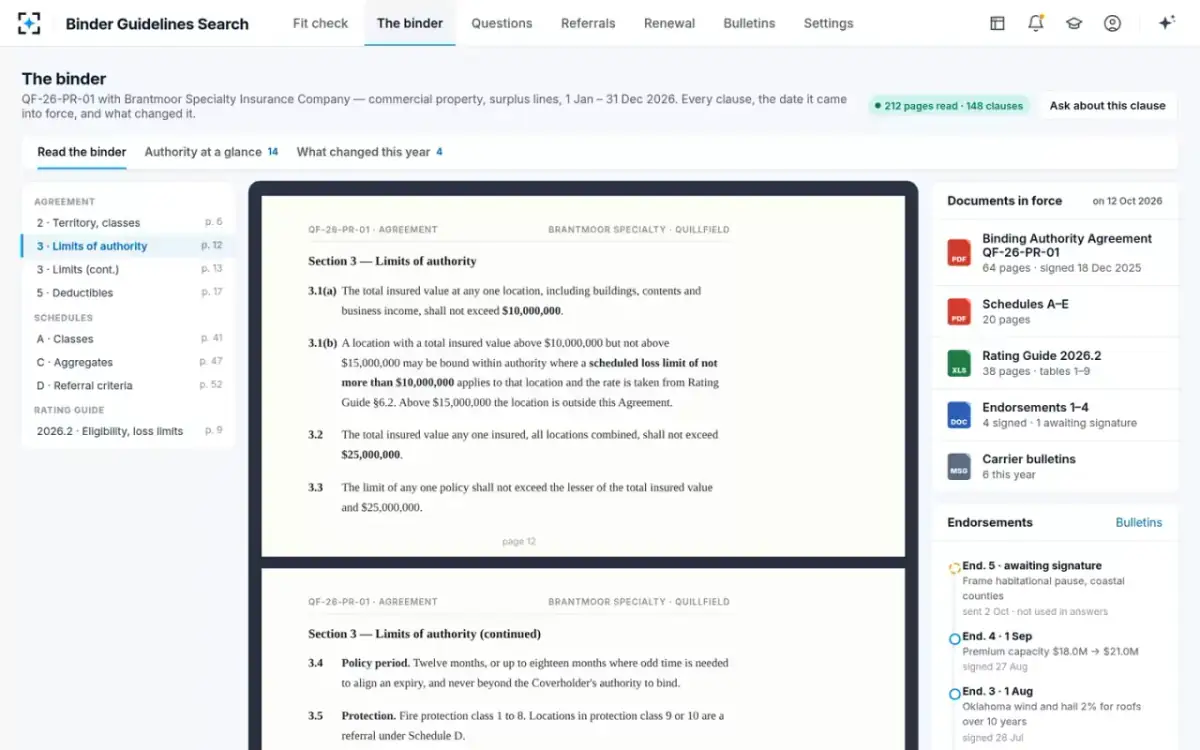
Section 3 — Limits of authority
3.1(a) The total insured value at any one location, including buildings, contents and business income, shall not exceed $10,000,000.
3.1(b) A location with a total insured value above $10,000,000 but not above $15,000,000 may be bound within authority where a scheduled loss limit of not more than $10,000,000 applies to that location and the rate is taken from Rating Guide §6.2. Above $15,000,000 the location is outside this Agreement.
- Per location, not per policy. "Any one location" means a three-site schedule is tested three times.
- What counts. Buildings, contents and business income together: a schedule of values that splits them must be added back up.
- A door, not a wall. 3.1(b) lets a $10M–$15M location in under a loss limit. A search that stops at 3.1(a) refers risks the binder allows.
- A rate condition inside a limit clause. The loss-limit route is priced from §6.2 of the rating guide; another rate is outside authority.
- Three answers in one clause. Within (up to $10M), within on a condition ($10M–$15M), outside (above $15M).
What is a binding authority agreement? The contract behind the pen
A binding authority agreement is a contract of agency: the insurer is the principal, the MGA or coverholder is its agent, and the agreement says how far the agent may commit the principal. HM Revenue & Customs puts the London version plainly: the firm to which a managing agent delegates its underwriting is the coverholder, and the document setting out the terms of that delegation is the binding authority (HMRC Lloyd's Manual LLM1100). The English Court of Appeal used the US name for the same thing in 2009, describing "an Underwriting Agency Agreement, a type of agreement generally known as a “binder”, under which QBE authorised Temple to write certain classes of insurance on its behalf" (Temple Legal Protection v QBE, [2009] EWCA Civ 453).
The word "binder" has a second, unrelated meaning in insurance: a temporary document that evidences cover on a single policy until the policy is issued. That binder is a single risk; a binding authority binder is the standing permission to bind many. Every reference to a binder in this series means the second kind.
What is binding authority in insurance? Introduce, or commit
Binding authority is the power to commit an insurer to a risk without asking it first. That is what separates an MGA or coverholder from an ordinary agent. The FCA draws the line in its client money rules: agency agreements "may be of a general kind and facilitate the introduction of business to the insurance undertaking", or they may confer the authority to commit it to risk. Only the second is a binding authority.
Two kinds of agency agreement, and what each lets the intermediary do
Introducing business: The insurer, risk by risk.
Binding authority: The agent, within the agreement’s limits, in the insurer’s name.
Introducing business: A proposal the insurer underwrites.
Binding authority: A risk the agent may bind today, refer, or decline.
Introducing business: Depends on the agreement.
Binding authority: Held as the insurer’s agent: CASS 5.2.3R requires the agreement to say so.
Introducing business: An ordinary producer appointment.
Binding authority: If the agent manages the business and writes 5% or more of the insurer’s surplus, an MGA contract under Model #225.
Introducing business: The insurer’s appetite.
Binding authority: Every limit in the agreement as amended, on the effective date of each risk.
The money follows the authority. Under CASS 5.2.3R a binding authority "must provide that the intermediary is to act as the agent of the insurance undertaking" for receiving and holding premiums where it can commit the insurer to risk. Model #225 §4C makes the US equivalent explicit: the MGA holds every dollar it collects for the insurer as a fiduciary (quoted in what a premium trust account is).
What must a binding authority agreement contain by law?
In US states that follow the NAIC model, a binding authority must contain at least thirteen kinds of provision, from termination to a list of things the MGA may never do. Only one of them, subsection F, is about what the MGA may write; the rest govern money, records, claims and control. An underwriter lives in subsection F. An auditor reads the rest.
The minimum contents of an MGA contract under NAIC Model #225 §4, and who reads each
| Provision | What it requires | Who reads it most |
|---|---|---|
| A. Termination | Insurer may terminate for cause and suspend the MGA’s underwriting authority during a dispute | Head of underwriting |
| B. Accounts | Accounts and remittances at least monthly | Finance, bordereaux team |
| C. Funds | Held "in a fiduciary capacity" in an FDIC-insured institution; at most three months of estimated claims retained | Finance |
| D. Records | Separate records, which the insurer may copy in a usable form | Auditor |
| E. Assignment | The contract may not be assigned by the MGA | Legal |
| F. Underwriting guidelines | Eight items: premium volume, rates, risk types, limits, exclusions, territory, cancellation, policy period | Every underwriter, every day |
| G–H. Bond and E&O | Surety bond of at least $100,000 or 10% of prior-year premium, capped at $500,000; E&O at the insurer’s option | Legal, finance |
| I–J. Claims | Reporting, file triggers and settlement authority if the MGA settles claims; electronic claims data | Claims |
| K–L. Advertising, profits | Insurer approves advertising; interim profits held back where the MGA controls reserves | Marketing, finance |
| M. Prohibitions | No binding reinsurance (with one exception), no claim over 1% of surplus without approval, no sub-MGA, among others | Head of underwriting, claims |
The underwriting guidelines, annotated: eight items, one sample binder
The eight underwriting items are the part of a binding authority an underwriter tests on every risk. Model #225 §4F lists them exactly: "(a) The maximum annual premium volume; (b) The basis of the rates to be charged; (c) The types of risks which may be written; (d) Maximum limits of liability; (e) Applicable exclusions; (f) Territorial limitations; (g) Policy cancellation provisions; and (h) The maximum policy period." A real binder rarely keeps them in one place. In the sample they are spread over the agreement, three schedules, the rating guide and four endorsements.
Where the model law's eight underwriting items sit in one sample binder
(a) The maximum annual premium volume
Sample clauseSchedule C, C.2 · Endorsement 4
Sample limitPremium capacity $21,000,000, raised from $18,000,000 from 1 September
How to read itA shared limit: every bind uses some of it, so the check needs the amount already written ($15.84M, 75%).
(b) The basis of the rates to be charged
Sample clauseRating Guide 2026.2 · clause 3.1(b)
Sample limitRates from the rating guide; a location bound under a loss limit is rated from §6.2
How to read itA price off the rating basis is outside authority even when the risk is inside it.
(c) The types of risks which may be written
Sample clause2.3 and Schedule A · 2.4 · 3.6
Sample limitPermitted classes, referral classes, ISO 2–6 construction (frame only inland, up to $2.5M), occupancy at least 70%
How to read itUsually split between a clause and a schedule of classes; the schedule decides most questions.
(d) Maximum limits of liability
Sample clause3.1(a), 3.1(b), 3.2, 3.3
Sample limit$10M any one location ($15M under a $10M loss limit); $25M any one insured; policy limit the lesser of value and $25M
How to read itTested per location, per insured and per policy: a schedule can pass in total and fail at one site.
(e) Applicable exclusions
Sample clause2.4 · unsigned Endorsement 5
Sample limitFrame construction outside the permitted band; a proposed exclusion of frame habitational risks in coastal counties, not yet signed
How to read itAn exclusion proposed by bulletin is not an exclusion until the endorsement is signed.
(f) Territorial limitations
Sample clause2.1 · Endorsement 1
Sample limitTexas, Louisiana, Oklahoma, Arkansas (Arkansas added by endorsement)
How to read itTerritory often changes mid-year; the effective date decides which list applies.
(g) Policy cancellation provisions
Sample clauseAgreement, cancellation clause
Sample limitNot shown in the screens on this page
How to read itThe model also keeps the insurer’s own right to cancel or non-renew any policy, subject to state law.
(h) The maximum policy period
Sample clause3.4
Sample limitTwelve months, or up to eighteen where odd time aligns an expiry
How to read itOdd time is a classic edge case: a 13-month policy is inside one binder and outside another.
Two lessons come out of the mapping. First, the guidelines are not a page; they are a network of cross-references, and an answer that quotes one clause without the endorsement that changed it is wrong in a way nobody notices until audit. Second, the items differ in kind. Territory, class and policy period are yes-or-no tests on one risk. Premium volume and catastrophe aggregates are shared limits that every bind uses up, so the answer to "does it fit?" depends on what colleagues wrote last week.
Binder Guidelines Search reads the binder clause by clause, every endorsement dated
What is a binding authority schedule?
A binding authority schedule is the part of the agreement that holds the specifics: names, numbers, classes and lists, while the clauses hold the rules that use them. Courts read them together. In Markel v Surety Guarantee Consultants, the Commercial Court described sections of a surety binding authority that "imposed limits on the period of the bonds, on the maximum liability that could be written under the bonds and on territories", and added: "Those limits were particularised in the Schedule" ([2008] EWHC 1135 (Comm)).
The sample binder follows the same pattern. Schedule A lists the permitted classes and the referral classes; Schedule C holds the first-tier coastal aggregate ($60,000,000) and the premium capacity; Schedule D holds the referral criteria, among them "Any location with a total insured value above $10,000,000, unless bound under clause 3.1(b)" and the carrier's promise to "answer a referral within two business days of receiving it complete." An underwriter who reads only the agreement misses most of what decides a risk.
What is a binding authority endorsement?
A binding authority endorsement is a written amendment to the agreement, signed by both parties, that changes a clause from a stated date. Endorsements are how a binder moves during the year: the sample added Arkansas to the territory, raised the named storm deductible in first-tier coastal counties to 5% from 1 June, set a 2% wind and hail deductible on older Oklahoma roofs from 1 August, and raised premium capacity from $18.0 million to $21.0 million from 1 September.
A carrier bulletin is not an endorsement. Bulletins announce appetite; endorsements change the contract. In the sample, a bulletin proposing to exclude frame habitational risks in coastal counties arrived on 2 October with its endorsement sent for signature, and until it is signed the binder is unchanged. Which version of the binder applied on the day works through what that means for a risk bound in the gap.
A binding authority is a contract of agency first and a schedule of limits second: who may commit the insurer, to what, and on whose money.
Who signs a binding authority agreement, and who may use it?
The insurer (or, at Lloyd's, the managing agent for its syndicate) and the MGA or coverholder sign the agreement; the binder then names the individuals inside the MGA who may use it. The Markel judgment records both steps. The binder was signed on 12 and 13 January 2005, by one signatory "on behalf of Markel" and one "on behalf of SGC". Its Section 3 then named, in a schedule, "the person(s) responsible for the overall operation and control of the Agreement", the persons authorised "to sign and issue surety bonds" and those authorised to exercise claims authority, and required the coverholder to notify the underwriters if any of them would cease to be able to act "within 30 days".
In the United States the regulator hears about the signature too: Model #225 §5E requires the insurer, "Within thirty (30) days of entering into or terminating a contract with an MGA", to notify the commissioner in writing, including "the lines of insurance for which the applicant is to be authorized to act". Inside the MGA, most firms add a further layer, a personal letter to each underwriter; an underwriting authority letter example shows what it contains.
How do you read a binding authority agreement? The order that saves a morning
Read a binding authority in the order a risk meets it, not in page order. The definitions and recitals come first in the document and last in usefulness; the schedule of classes and the referral criteria decide most questions and sit near the back.
Reading a binding authority in the order a risk meets it
- Period, parties and the version in force
The agreement’s dates, then every signed endorsement in date order. Note what is pending signature and leave it out.
- Territory and classes
The territory clause and the class schedule, including which classes are permitted and which are referral-only.
- Construction, protection and occupancy
The physical risk tests; these often carry conditions, such as frame only inland or below a value.
- Limits: per location, per insured, per policy
And any clause that allows a larger location in under a condition, such as a scheduled loss limit.
- Deductibles by peril and zone
Named storm, wind and hail and earthquake minimums by county or tier, as amended.
- Aggregates and premium capacity
Shared limits: find out what is already written before testing a new risk against them.
- Referral criteria
What must go to the carrier even when every limit is met, such as loss history or protection class.
- Rating basis
Which rating guide edition applies, and which section prices a conditional route.
- Reporting, money and audit clauses
Not tested on each risk, but they decide what the MGA must keep about each risk it binds.
Binding authority agreement template: why a template is not your binder
A template gives the structure; the binder that governs a risk is the template as negotiated, scheduled and endorsed. Two binders on the same model wording can differ on every number that matters, and the same binder can differ from itself between January and October. That is why searches for a binding authority agreement template end in the same place: the useful document is the one signed with your carrier, with its schedules and every endorsement since.
Side documents are a trap the Markel case shows well. Alongside the signed binder, the parties agreed "another document described as a Binding Authority Agreement but sub-titled “Modus Operandi”", which the court found "does not purport to be an amendment to the Binding Authority" but "a description of how the Binding Authority is to be operated". An underwriter's library should hold the operating documents too, marked for what they are, so that nobody mistakes a working note for a change in authority.
How Binder Guidelines Search reads a binding authority agreement
Binder Guidelines Search splits the agreement, schedules, rating guide and endorsements into clauses, each with its page, the endorsement that changed it and the date it came into force. In the sample that is 212 pages and 148 clauses. When an underwriter asks whether a risk fits, the agents take the version in force on the risk's effective date, test each condition at each location and return the clause that decides each line, quoted in the binder's own words. They never paraphrase a limit, never use an unsigned endorsement or a bulletin, and never bind: the underwriter does.
The binders in force, the answer rules and the alternatives the binder allows
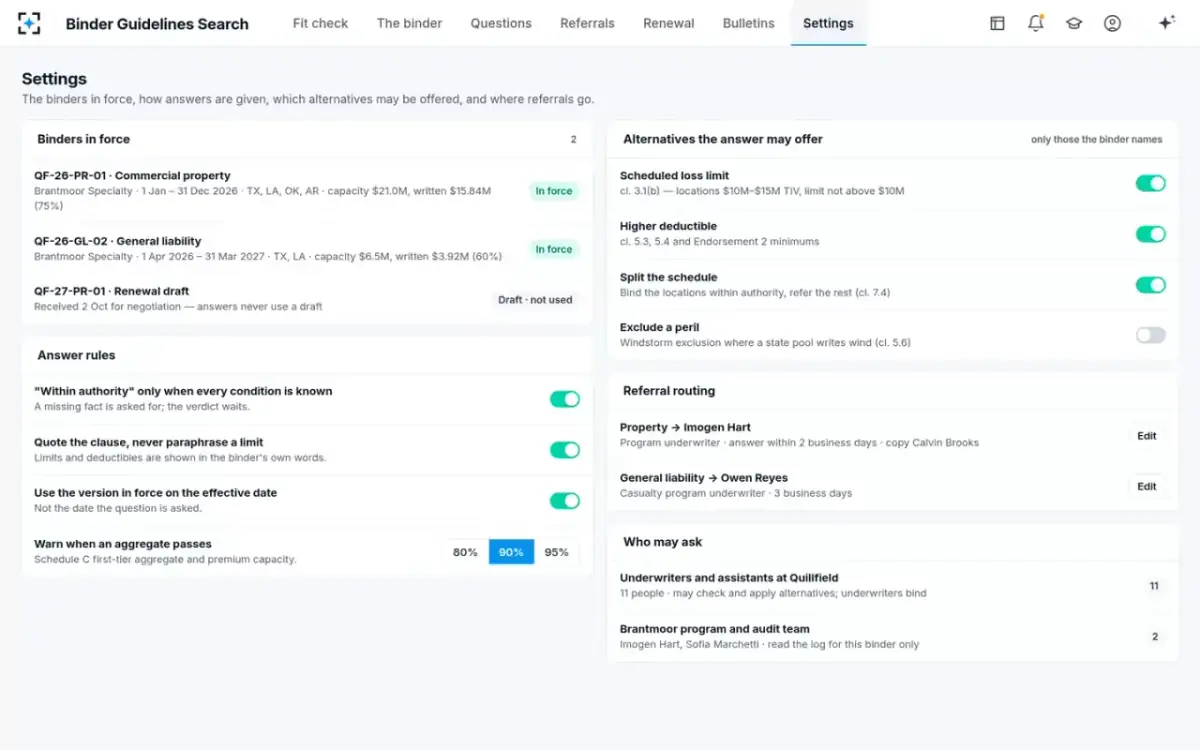
The design choice that matters is the last one in that list. A binder search that answers "no" is easy to build; the useful answer is "not as submitted, but clause 3.1(b) lets you write it at a $10 million loss limit", re-rated from the rating guide, for the underwriter to decide. See it on the sample binder at Binder Guidelines Search.
Questions people ask
Is a binding authority the same as an MGA agreement?
In practice, yes: an MGA agreement that lets the MGA bind risks is a binding authority. In US model-law states the contract must meet Model #225 §4 if the agent qualifies as an MGA; in the London market the same document is called a binding authority and the agent a coverholder.
How long does a binding authority agreement last?
Usually one year, renewed by negotiation, but the term is whatever the parties agree. The binder in Temple Legal Protection v QBE was expressed to run for three years, to 31 December 2008, unless terminated earlier under its own termination clause.
Can a binding authority be suspended?
Yes. Model #225 §4A requires the contract to let the insurer terminate for cause on written notice and to suspend the MGA's underwriting authority while any dispute about that cause is pending. Florida's version also lets the MGA terminate for cause, and requires both sides to fulfil their obligations on policies regardless of the dispute.
Does the binder say what the MGA may not do?
The law does, in Model #225 §4M: the MGA may not bind reinsurance except under an obligatory facultative agreement, commit the insurer to syndicates, pay a claim over 1% of the insurer's surplus without approval, jointly employ an insurer employee, or appoint a sub-MGA, among other limits.
What is the difference between a binding authority and a lineslip?
Under a binding authority the MGA or coverholder decides within the limits. Under a lineslip, insurers authorise one or more leading underwriters to accept risks presented by a particular broker, so the decision stays with an insurer. Lineslip vs binder compares the two in full.