An underwriting authority letter is the document that gives a named underwriter personal authority to bind risks, stating the classes, limits and conditions within which that person may say yes without asking anyone. At an MGA it is the second of two layers. The binding authority delegates the insurer's pen to the MGA; the letter then delegates part of that authority to each underwriter, usually less than the whole. The law treats the layers differently: NAIC's model act forbids an MGA to "Appoint a sub-MGA" (NAIC Model #225 §4M), but says nothing against the MGA setting tighter limits for its own staff, which is what a letter does. Botminds' Binder Guidelines Search checks the outer layer, whether a risk fits the binder as amended, with the clause that decides it; the letter is the MGA's own control inside it.
The example letter below is illustrative: we wrote it for the fictional underwriter and MGA that appear in the solution's sample data, which does not itself include personal letters. The statutes and court records are real.
Two layers, one ceiling: how much of the binder's $15M location ceiling each person can bind alone
The binder, for the MGA
- Within authority, up to $10M · 67%
- $10M–$15M with a loss limit · 33%
Senior underwriter’s letter
- Alone, up to $7.5M · 50%
- With the head of underwriting · 50%
Underwriter’s letter
- Alone, up to $5M · 33%
- With sign-off · 67%
What is an underwriting authority letter?
It is a written grant of personal underwriting authority: who may bind, what, up to how much, and with whose sign-off beyond that. Carriers issue them to their own staff, usually as part of a ladder of authority levels; underwriting authority levels at a carrier covers that structure. MGAs issue them too, but with a difference that shapes every line of the letter: the MGA can only hand on authority it holds, and what it holds is set by a contract with someone else.
Other names for the same document include letter of authority, authority letter and delegated authority letter. In mortgage lending the phrase "underwriting authority" also appears, for a lender's or investor's delegation to underwrite loans; that is a different field with its own rules, and this guide is about insurance.
Underwriting authority letter example: one senior underwriter at an MGA
A good letter is short, refers to the binder rather than copying it, and says plainly what needs someone else's signature. The example below is written for a senior property underwriter at the fictional sample MGA, under the fictional sample binder used across this series.
An example underwriting authority letter for a senior underwriter at an MGA
To
Dana Whitlock, Senior property underwriter
From
Calvin Brooks, Head of underwriting, Quillfield Underwriting Managers
Binders covered
QF-26-PR-01 commercial property (Brantmoor Specialty), as amended by signed endorsements in force on each risk’s effective date. Not the 2027 renewal draft.
Authority to bind
Risks within the binder’s classes, territory, construction, protection and occupancy conditions, up to $7,500,000 total insured value at any one location and $15,000,000 any one insured.
Needs my sign-off before binding
Any location above $7,500,000, including a location bound under clause 3.1(b) with a scheduled loss limit; any risk that takes the first-tier aggregate past 90%.
Deductibles
At least the binder’s minimums, as amended (clause 5.4 and Endorsement 2). Not restated here, so this letter follows the binder when it changes.
Referrals
May prepare and send referrals to the carrier under Schedule D; may not bind a referred risk before the carrier answers.
Never
Bind a referral class in Schedule A, price off the rating guide, or delegate this authority to anyone.
Period and review
From 1 January 2026 until withdrawn; reviewed at each binder renewal and whenever an endorsement changes a limit above. May be suspended at any time.
Acknowledged
Signed by the underwriter, dated, and kept with the binder library.
Three choices in the example do most of the work. The letter names the binder and says "as amended by signed endorsements in force on each risk's effective date", so it never authorises more than the binder does that day. It sets personal limits below the binder's on the two numbers that drive most large losses, value per location and per insured. And it routes the binder's conditional door, clause 3.1(b), the loss-limit route for $10 million to $15 million locations, through the head of underwriting, because a conditional route is where an experienced eye matters most.
What should an underwriting authority letter include?
Everything an auditor would need to decide, months later, whether the underwriter acted within authority: who, under which binders, which risks, what limits, what needs sign-off, what is never allowed, from when, and how it ends.
What to put in an underwriting authority letter at an MGA
- The person and the signatory
The underwriter by name and role; the person at the MGA entitled to grant authority.
- The binders it covers
By reference and carrier, as amended on each risk’s effective date; renewal drafts excluded.
- Classes and conditions
By reference to the binder’s schedules, plus any classes the MGA keeps for senior staff.
- Personal limits
Per location, per insured, per policy, set at or below the binder’s limits.
- What needs sign-off, and from whom
Conditional routes in the binder, risks near shared aggregates, anything unusual the MGA wants a second look at.
- Referrals
Whether the underwriter may send referrals to the carrier, and that a referred risk is never bound before the answer.
- Prohibitions
No further delegation, no binding of excluded or referral classes, no pricing off the rating basis.
- Dates, review and suspension
From when, reviewed at each renewal and endorsement that changes a limit, and withdrawable at once.
- Acknowledgement
Signed by the underwriter and kept where the auditor will look.
Who issues underwriting authority at an MGA?
The person the binder makes responsible for operating it, usually the head of underwriting or chief underwriting officer, and a binder may name that person. The binding authority in Markel v Surety Guarantee Consultants set out in a schedule who could do what: one item named the people authorised to administer the bond business, and another, "The person(s) authorised to exercise any claims authority granted by the Agreement is(are) named in item 3.4 of the Schedule" ([2008] EWHC 1135 (Comm)). Where the binder names people, an authority letter cannot add anyone the carrier has not accepted.
The carrier's interest is direct. Model #225 §4A lets the insurer suspend the MGA's underwriting authority during a dispute over termination for cause, and §5C requires it to review the MGA's underwriting operations on site at least twice a year. An insurer reviewing those operations will ask who bound each risk and on what authority; the letter is the answer to the second half.
"The person(s) authorised to administer surety bond business hereunder is(are) named in item 3.2 of the Schedule"
Markel v Surety Guarantee Consultants, [2008] EWHC 1135 (Comm), quoting the binding authority
Can an MGA sub-delegate its authority?
In US model-law states, not to another firm acting as an MGA: the MGA "shall not" appoint a sub-MGA, and New York's regulation repeats the ban (11 NYCRR §33.5(k)). The model also bars the MGA from appointing any producer "without assuring that the producer is lawfully licensed to transact the type of insurance for which he is appointed". An internal letter to the MGA's own employee is not sub-delegation in that sense; it is the MGA deciding how its own staff use the authority it holds.
Under a London market binder the answer depends on the contract. In Temple Legal Protection v QBE, the binder's Section 4 "authorised Temple to delegate underwriting authority to any other person, firm or company accepted by Temple who was authorised by the Financial Services Authority", and required Temple "to send QBE each month a list of all persons to whom authority had been delegated" ([2009] EWCA Civ 453). Even where onward delegation is allowed, the carrier keeps a list of who holds its pen.
Internal authority letter or sub-delegation: what each one is, and what the rules say
Internal authority letter: An underwriter employed by the MGA.
Sub-delegation to another firm: Another firm, which then binds for the insurer.
Internal authority letter: Not addressed; it is the MGA’s own control.
Sub-delegation to another firm: "Appoint a sub-MGA" is prohibited (Model #225 §4M).
Internal authority letter: Usually expected; binders may name the persons.
Sub-delegation to another firm: Only if the binder allows it, as Temple’s did, often with a monthly list.
Internal authority letter: No: the MGA cannot give what it does not hold.
Sub-delegation to another firm: No, for the same reason.
Internal authority letter: The MGA, to the carrier.
Sub-delegation to another firm: The MGA and, through it, the insurer.
In the UK the regulator's outsourcing rules follow the same logic: a firm that outsources an important function keeps full responsibility for its regulatory obligations (FCA Handbook, SYSC 8.1.6R). Delegation moves the work, not the accountability.
How the two layers stack, and which one to check first
Check the binder first, because it decides whether the MGA can write the risk at all; then check the letter, because it decides whether this underwriter can write it alone. The order matters for the answer the underwriter gets. A risk outside the binder is a referral or a decline whatever the underwriter's letter says; a risk inside the binder but above the letter is an internal sign-off, not a referral to the carrier.
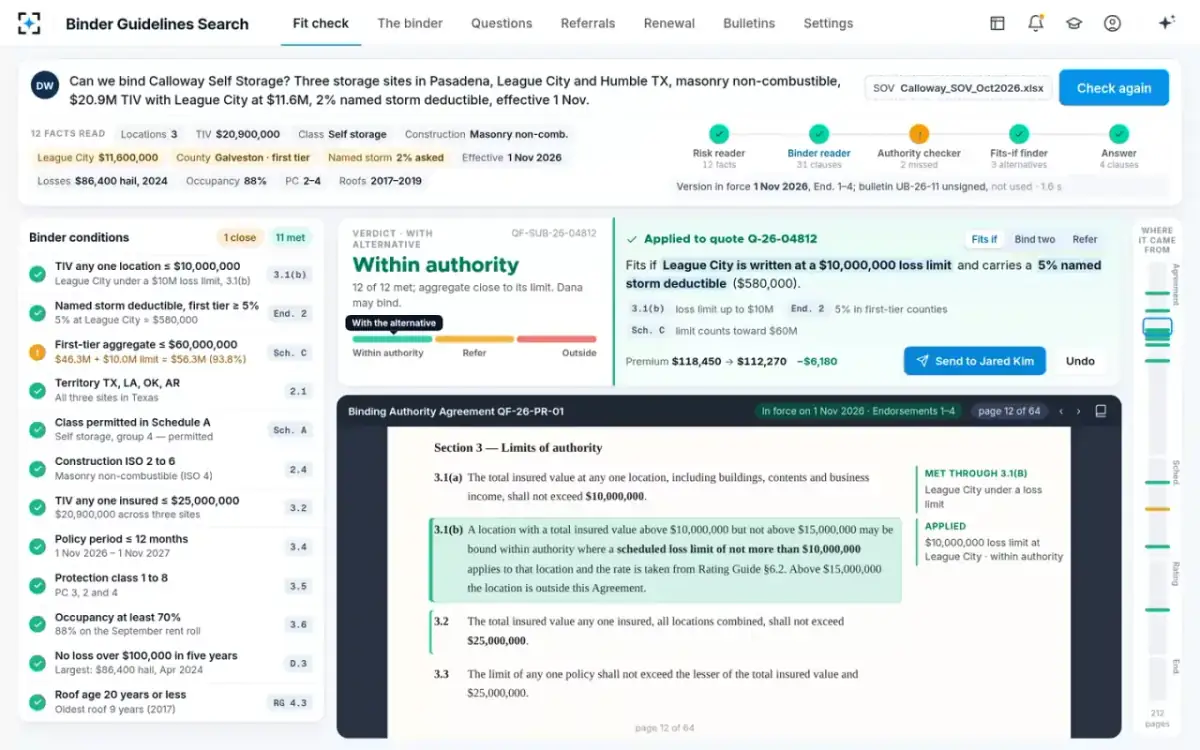
Take the sample storage risk. As submitted, League City is $11.6 million, over the binder's $10 million location limit: a referral, whoever asks. With the loss-limit alternative the binder allows, League City comes in at $10 million under clause 3.1(b): within the binder. Under the example letter, that location still needs the head of underwriting's sign-off, because it is above $7.5 million and uses the conditional route. Three different answers, and only the first involves the carrier.
Binder Guidelines Search answers the binder layer: within authority with the alternative applied
The trap: a letter that restates the binder goes out of date
A letter that copies the binder's numbers becomes wrong the day an endorsement changes them. The sample binder's named storm deductible minimum in first-tier coastal counties rose to 5% from 1 June by endorsement. A letter written in January that said "named storm deductible at least 2%" would, from June, authorise an underwriter to bind what the binder forbids, and the underwriter following it in good faith would be binding outside the MGA's authority.
The fix is drafting, not vigilance. Refer to the binder's clauses for everything the binder sets, restate only the limits the MGA sets more tightly, and review the letters whenever an endorsement changes a clause they rely on. Which version of the binder applied on the day explains how to date those changes; the MGA underwriter's day shows where the letter fits in practice.
Underwriting authority letter template: what a template cannot do
A template can give the headings; it cannot give the limits, because those come from two places no template knows: the binders the MGA holds, as amended, and the MGA's own view of each underwriter. Start from the checklist above, fill the binder references from the signed binder, set personal limits from the MGA's risk appetite and the underwriter's experience, and have the person the binder names sign it.
Who may ask and who may bind in Binder Guidelines Search, beside the binder
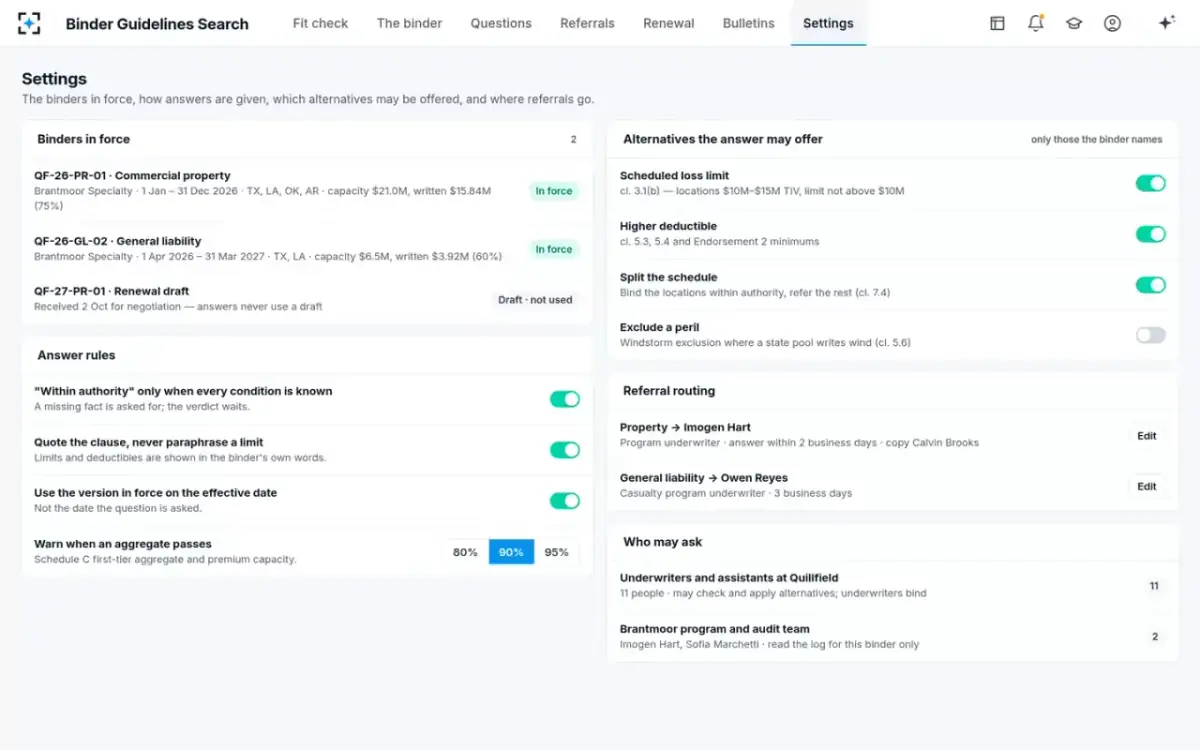
To see the binder layer answered for any risk, with the clause that decides it, start from Binder Guidelines Search.
Questions people ask
Is an underwriting authority letter a legal requirement?
Not as such in the NAIC model act, which regulates the contract between the insurer and the MGA rather than the MGA's internal controls. But the insurer must review the MGA's underwriting at least semi-annually under Model #225 §5C, and a written letter for each underwriter is the simplest evidence of who was allowed to bind what.
Can an underwriting authority letter allow more than the binder?
No. The MGA cannot give an underwriter authority it does not hold. A letter that appears to allow more, often because it restates a limit an endorsement has since tightened, does not widen the binder; it leads the underwriter to bind outside authority.
Who signs an underwriting authority letter at an MGA?
The person entitled to manage the binder for the MGA, usually the head of underwriting or chief underwriting officer, and ideally a person the binder itself names. The underwriter countersigns to acknowledge it.
How often should authority letters be reviewed?
At least at each binder renewal and whenever an endorsement changes a limit the letter relies on, plus whenever an underwriter's role changes. Binders that name responsible persons may require the carrier to be told within a set time if one of them can no longer act.
Does an underwriting assistant need an authority letter?
Only if the assistant may bind. In the sample MGA, assistants may run checks and apply a permitted alternative to a quote, but only underwriters bind, so an assistant's role description is enough.