The MGA referral process is the route by which an MGA underwriter sends a risk that falls outside the MGA's binding authority to the carrier for a decision: the underwriter finds the condition the risk misses, writes a referral quoting it, the carrier's program underwriter answers within the time the binder allows, and the MGA binds only what the carrier approves. Each step costs something. The underwriter writes, the carrier reads, and the broker, who wants an answer for a client, waits and may place the risk elsewhere. No regulator or research body publishes industry referral volumes or turnaround times, so this guide prices a referral as a method you can fill with your own figures. Botminds' Binder Guidelines Search attacks the part of the cost that should not exist: referrals the binder never required, because a permitted way to write the risk was missed.
The sample figures come from a fictional MGA, Quillfield Underwriting Managers, and a fictional carrier, Brantmoor Specialty, over one binder year in the solution. The method is ours; the law cited is real.
One storage risk, two routes: referred as submitted, or written within authority the same morning
- Write it½ day
- Carrier answers, under Schedule D2 business days
- Bindhours
- Check and offer½ day
What is the MGA referral process, step by step?
An MGA referral moves through five steps, and three of them happen before the carrier sees anything. The underwriter recognises that a risk may be outside authority; finds the clause, schedule or endorsement that decides it; looks for a version of the risk the binder allows; writes the referral for whatever still needs the carrier; and, once the carrier answers, binds on the terms approved and records the answer with the risk.
The first three steps decide most of the cost. An underwriter who cannot find the deciding clause quickly refers to be safe. An underwriter who finds the limit but not the clause that offers a way past it refers a risk that could have been written today. The carrier's answer time, which the binder sets, is the visible delay; the hidden one is the hour spent before the referral exists. What an underwriting referral means under a binder covers the first step in depth.
What risks must an MGA refer to the carrier?
The binder decides: risks that miss a limit the referral criteria route to the carrier, risks that hit a named referral trigger even inside the limits, and acts the law reserves for the insurer. NAIC's model act requires every MGA contract to set underwriting guidelines, from premium volume to the longest policy period, and forbids the MGA, without the insurer's prior approval, to commit the insurer to a claim over 1% of its policyholder surplus (NAIC Model #225 §4F, §4M).
In the sample binder, Schedule D names the triggers: a location over $10,000,000 unless written under the loss-limit clause, a protection class of 9 or 10 or a referral class, and a single loss above $100,000 or total losses above $250,000 in five years. Everything else outside the limits is either excluded or, often, writable another way.
Who approves MGA referrals, and how long do they take?
The carrier's program underwriter approves or declines them, inside the time the binder sets. The sample MGA routes property referrals to the carrier's program underwriter, who must answer "within two business days of receiving it complete", with the head of underwriting copied; general liability referrals go to a casualty program underwriter with three business days. That clock is a promise in the contract, not a law, and it starts when the referral is complete: a referral that prompts a question back starts again.
The referral desk in Binder Guidelines Search: the draft, how it was written, every open clock
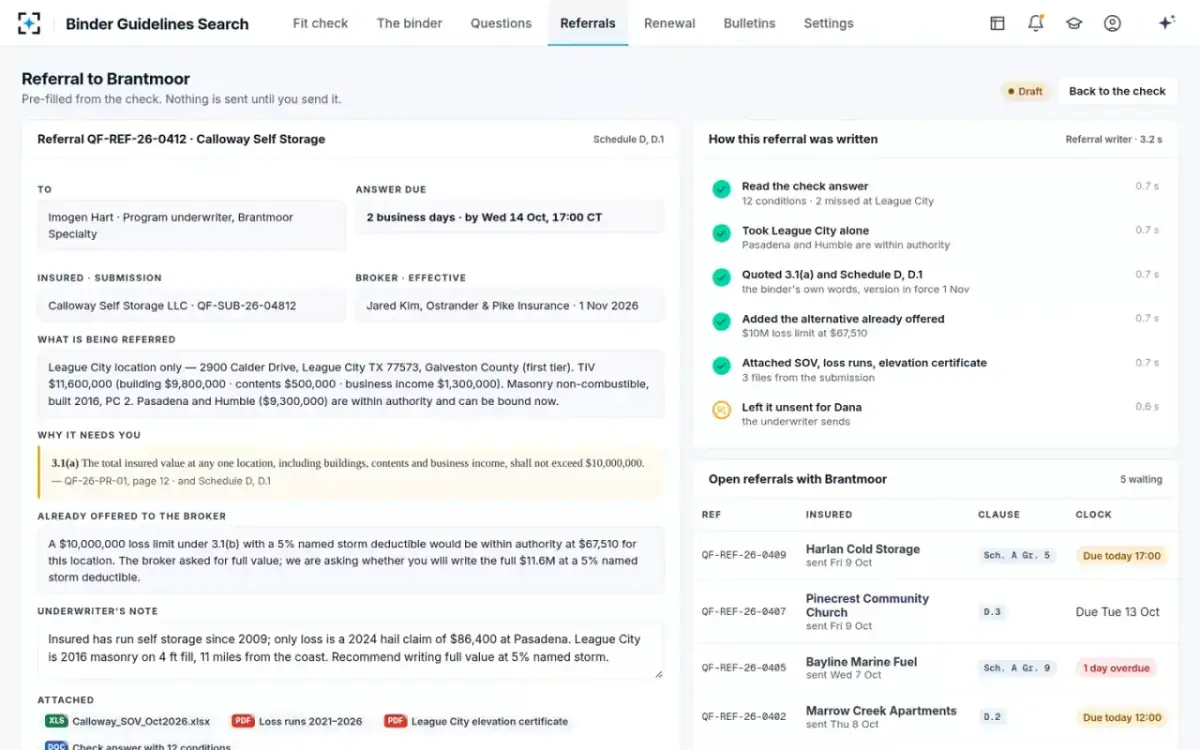
Neither side is idle while a referral waits. The broker has a client asking for terms. The carrier's program underwriter has a queue. And the MGA's underwriter has to remember to chase. The open-referral list in the sample shows the shape of it on an ordinary Monday: five waiting, one due at 17:00 that day, one already a day late.
What does a referral cost an MGA? A method, not a benchmark
A referral costs the MGA its own time, the carrier's time, and the chance of losing the risk while it waits; it can also be worth something at renewal. No published source gives these numbers for MGAs, and any benchmark that claims to is a guess about someone else's business. What a head of underwriting can do is price a referral from four terms, each filled from the MGA's own records.
What one referral costs: four terms you can fill from your own year
Underwriter time
hours to find, test and write × loaded hourly cost
BLS puts the median underwriter wage at $81,370 (May 2025), about $39 an hour over 2,080 hours before benefits and overhead.
MGA head of underwriting
Carrier time
hours to read and decide × the carrier’s cost
Borne by the carrier, but it shapes how generous the next binder is.
Carrier program team
Risk of losing the risk
share of referred risks the broker places elsewhere × commission on them
Measure it: compare referred and non-referred quotes that did not bind.
MGA distribution
Evidence for renewal
referrals on a clause the carrier approves × the case for wider authority
A clause whose referrals are nearly all approved is the strongest renewal argument an MGA has.
Head of underwriting
The method shows where the money is. The first term is small per referral and large per year: an hour of underwriter time on each of several hundred referrals is a meaningful share of a small team. The third term is usually the largest and the least measured, because a lost risk leaves no trace unless someone compares quotes that did not bind. The fourth is the reason not to aim for zero referrals: a referral the carrier approves is evidence.
How many referrals did the binder never require? What a sample year shows
In the sample year, more than four in ten referrals as asked were never needed: the binder allowed a version of the risk the MGA could write. Of 1,284 checks, 318 were referrals as asked. A permitted alternative, usually a scheduled loss limit, a higher deductible or a split schedule, was taken on 147 of them, and those risks were bound within authority. The carrier received the other 171 and approved 139.
From 318 referrals as asked to 171 sent: what happened to the rest
Read the 81% approval rate carefully. It means the carrier's appetite is wider than the binder's limits in several places, which is a renewal conversation, not a reason to bind first and ask later. And the 147 are not free: each took a change the insured had not asked for, and some insureds will not accept one.
Fits-if or refer: what each route gives the broker
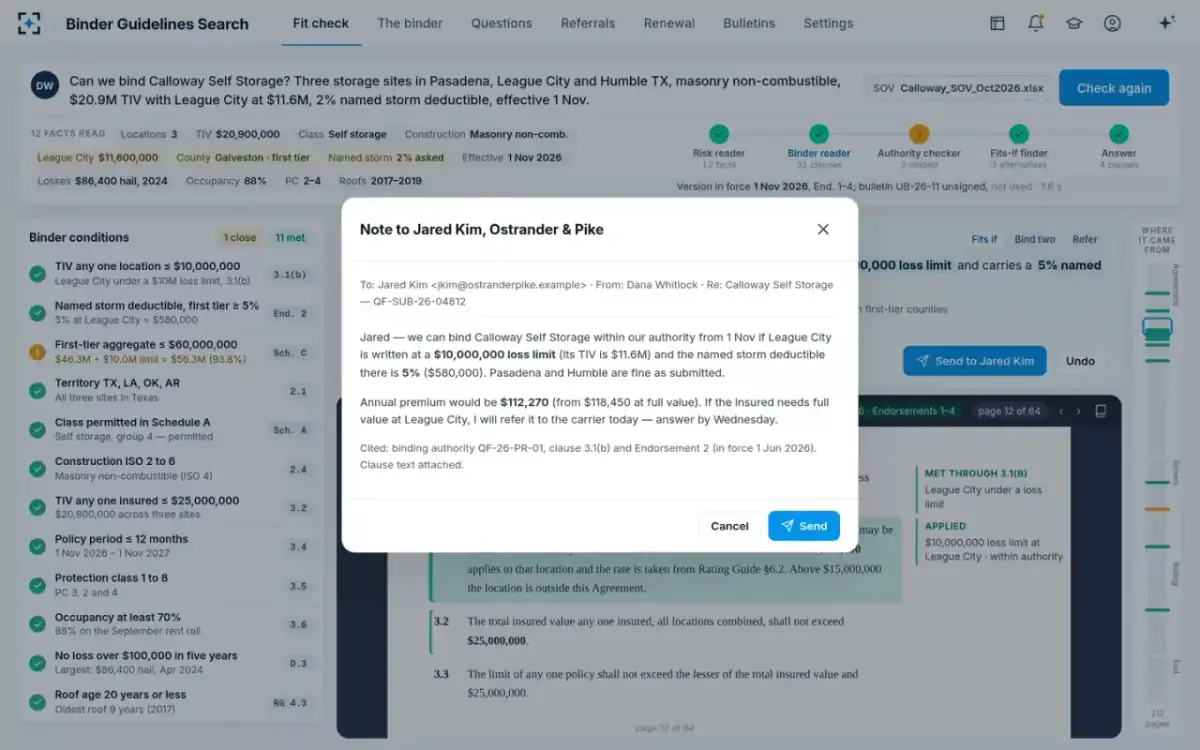
A permitted alternative is a trade, and the underwriter should offer it as one. On the sample storage risk, the binder allows League City in at a $10,000,000 scheduled loss limit with a 5% named storm deductible; the insured asked for full value and 2%.
The same storage risk, offered two ways
Refer at full value: When the carrier answers: by Wednesday 17:00 under the sample binder.
Write within authority, fits-if: Monday morning, with the clause attached.
Refer at full value: Full value, $11,600,000, if the carrier approves.
Write within authority, fits-if: Loss limit of $10,000,000 on that location.
Refer at full value: As the carrier decides; the binder minimum is 5%.
Write within authority, fits-if: 5%, $580,000 at League City, as the endorsement requires.
Refer at full value: $118,450 as rated at full value, subject to the carrier.
Write within authority, fits-if: $112,270, re-rated from the rating guide.
Refer at full value: One referral for the location.
Write within authority, fits-if: None; the first-tier aggregate still shows as close at $56.3M of $60M.
Refer at full value: This is the route.
Write within authority, fits-if: The underwriter can still refer it the same day.
The note to the broker, written from the check and cited
How do you reduce underwriting referrals without binding outside authority?
Reduce the referrals the binder did not require; leave the ones it did. The levers are all on the MGA's side of the line, and none of them involves stretching a limit.
Seven ways an MGA cuts needless referrals and keeps the rest clean
- Check the binder before the quote, not after
An assistant who tests every limit while building the quote catches the miss before the underwriter is committed to it.
- Look for the permitted way in
Loss-limit clauses, deductible options and split schedules are written into many binders and missed under time pressure.
- Split the schedule
Bind the locations that fit today and refer only the one that does not; in the sample, two of three storage sites were within authority.
- Send complete referrals
The clause in the binder’s words, the exact miss, the alternative already offered and the files. An incomplete referral restarts the clock.
- Use the version in force
A June endorsement can turn a January referral into a within-authority risk, or the reverse.
- Never bind pending
A referred risk bound before the answer is bound outside authority, and the carrier’s auditor will find it.
- Take the evidence to renewal
A clause the carrier approves nearly every time should become wider authority, not a permanent queue.
Turning approved referrals into authority at renewal
The best long-run cure for referrals is a better binder, and the best case for a better binder is a year of clause-by-clause evidence. The sample MGA's question log groups every check by the clause that decided it. Clause 3.1, the $10,000,000 any-one-location limit, caused 214 checks; 35 went to the carrier and 31 were approved, 89%, while 61 more were bound under a loss limit the insured did not want. The renewal proposal writes itself: raise 3.1(a) to $12,500,000 for sprinklered masonry.
Renewal evidence: which clauses cost business, and what the carrier approved
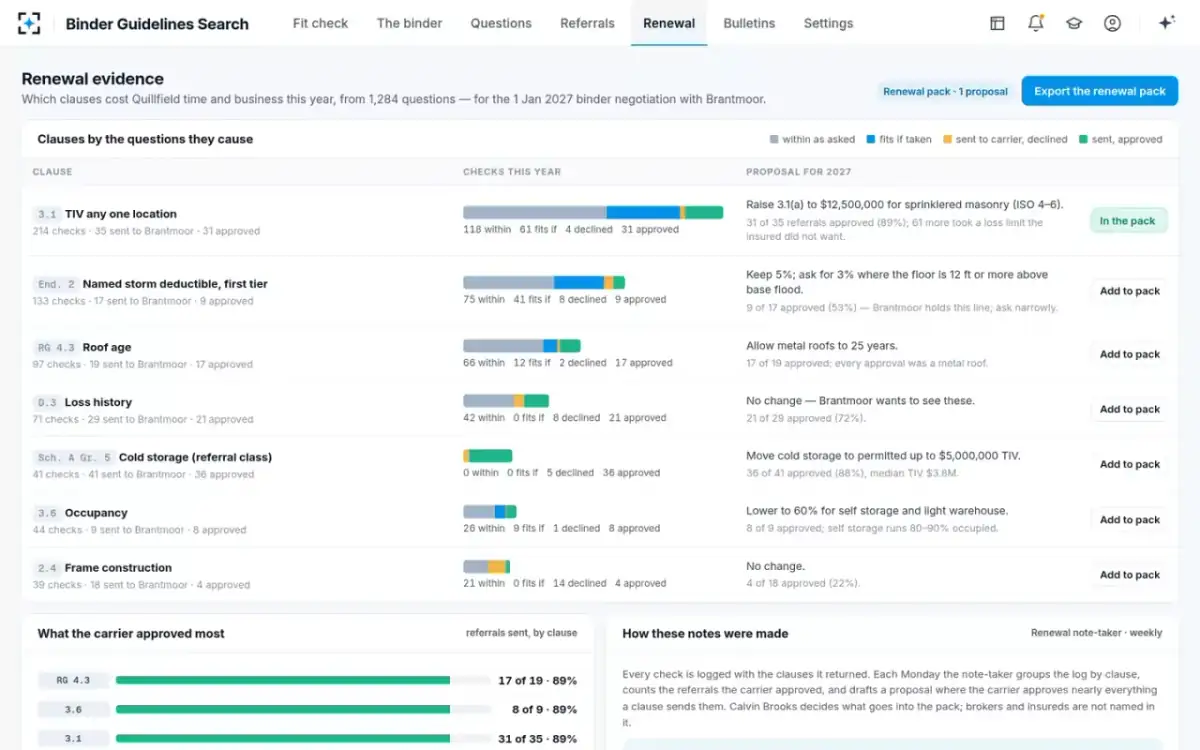
Regulators expect the carrier to be watching the same numbers from its side. The Prudential Regulation Authority told London market firms in January 2026 that delegated authority business is likely to keep growing there, and that growth adds to the risk of under-pricing and under-reserving wherever it is not properly overseen (PRA, Insurance supervision: 2026 priorities). An MGA that arrives at renewal with evidence of what the carrier approved, and what it declined, is answering that concern before it is asked. Frame construction, approved 4 times out of 18, is evidence too: that limit is doing its job.
Where Binder Guidelines Search fits in the referral process
The solution works on the three steps before the carrier sees anything, and on the trail it leaves afterwards. It finds the deciding clause in the version in force, tests every condition at every location, names the smallest change the binder itself permits and re-rates it, and pre-fills a referral for only the locations that need the carrier, quoting the clause and stating the alternative already offered. It does not decide referrals, send them, or bind. Those stay with the underwriter and the carrier's program underwriter.
The sample year's 318-to-171 drop is sample data, not a promise; the honest way to size it is to run last month's submissions against your own binder. Two other guides help: an AI underwriting assistant tool compared with PDF search and the referral desk, and the documents an MGA underwriting platform needs on day one. To see the referral desk on the sample binder, start from Binder Guidelines Search.
Questions people ask
How long does an MGA referral take?
As long as the binder allows, from the moment the referral is complete. The sample binder gives the carrier two business days for property and three for general liability. No regulator publishes an industry figure, so measure your own: time from question to referral, and from referral to answer.
Can an MGA bind while waiting for a referral answer?
Not the referred risk or location. It can bind the parts of a schedule that fit, as the sample did with two of three storage sites, and refer the rest. Binding a referred risk early is binding outside authority.
What is a referral form in insurance?
The document an MGA sends the carrier to ask for a decision: the risk, the clause it misses in the binder's words, the exact amount of the miss, any alternative already offered, the underwriter's view and the files. Many carriers prescribe a format in the binder or its schedules.
Is a high referral approval rate good or bad?
It is a signal. In the sample year the carrier approved 81% of referrals, and on some clauses nearly all. That suggests the binder is tighter than the carrier's appetite on those clauses, which is a case for wider authority at renewal, backed by the approvals.
Who pays for the time a referral takes?
Both sides. The MGA pays in underwriter hours and in risks lost while the broker waits; the carrier pays in program underwriter hours. Neither cost appears on an invoice, which is why the method above asks for each to be measured.