An AI underwriting assistant tool is software that reads an insurer's or MGA's underwriting documents and answers an underwriter's questions about them, quoting the passage it relied on. For an MGA or coverholder the question that matters most is narrower than "what does the manual say?": it is whether a specific risk fits the binding authority, as amended, at every location. The realistic alternatives are the ones most MGAs use today: search the binder PDF, or send the question to the carrier's program underwriter. Tested on the same risk, the three approaches differ less in whether they reach the right answer than in how long it takes, who spends the time and whether the answer can be shown to an auditor. Botminds' Binder Guidelines Search is an AI underwriting assistant built for that one question, and this guide is honest about the limits of all three.
The test risk and binder are fictional sample data: a three-site self storage schedule under a commercial property binder from a fictional carrier. The regulatory sources are real.
Three ways to answer 'can we write this?', tried on one storage risk
Search the binder PDF
Who answers
The underwriter, alone
Time to an answer
Most of an hour for three sites and four documents
What it found
Clause 3.1(a), the $10M location limit, on page 12. The deductible minimum sits in Endorsement 2, a separate file; the aggregate needs today’s written exposure, which no PDF holds.
How it goes wrong
Stopping at the first limit found: a refer that clause 3.1(b) made unnecessary, or a yes that missed the June deductible change.
Ask the referral desk
Who answers
The carrier’s program underwriter
Time to an answer
Up to two business days under Schedule D, after the referral is complete
What it found
A correct decision, from the person whose decision it is.
How it goes wrong
The carrier spends its time on a risk the MGA could have written; the broker waits and may place it elsewhere.
Ask an AI assistant built for the binder
Who answers
Agents, then the underwriter decides
Time to an answer
8.1 seconds to a cited answer in the sample
What it found
Twelve conditions at three locations; misses at 3.1(a) and Endorsement 2; aggregate close at 96.5%; a permitted way in under 3.1(b) at $112,270.
How it goes wrong
Only as good as the binder it was given and the rules it keeps: unsigned changes, missing details and alternatives the binder does not name.
What is an AI underwriting assistant?
An AI underwriting assistant is a tool that does the reading and checking around an underwriting decision so the underwriter can make it faster: it extracts the details of a submission, finds the rules that apply and tests the risk against them, then shows its work. It is a fast-growing category. EIOPA's survey of 347 European insurers, published in February 2026, found that "The majority of the reported use cases (64%) target back-end productivity tools such as data extraction from invoices, audio recordings or medical reports, content generation for emails, contracts or marketing materials, or coding and underwriting assistants" (EIOPA, February 2026).
The category is broad, and the label hides a big difference. Some tools are general chat interfaces with documents attached. Others are built around one decision with fixed rules about what they may say. For a delegated underwriter, the decision is authority, and the rules that matter are the binder's: which version, which location, which clause.
How does an AI underwriting assistant work on a binder?
A binder-aware assistant works in four moves: it turns the submission into testable details, takes the binder as amended on the effective date, tests each condition at each location, and, where a condition is missed, looks in the binder for a permitted alternative. In Binder Guidelines Search those moves are separate agents, and the underwriter can open each one to see what it did. In the sample run, the binder reader took the version in force on 1 November 2026, with endorsements 1 to 4, pulled 31 clauses and set aside a carrier bulletin whose endorsement was not yet signed.
The fourth move is the one generic tools skip. Clause 3.1(a) of the sample binder caps any one location at $10,000,000; clause 3.1(b), on the same page, lets a location of up to $15,000,000 in "where a scheduled loss limit of not more than $10,000,000 applies to that location and the rate is taken from Rating Guide §6.2." A tool that stops at the first limit says refer. A tool that reads the next paragraph says: within authority, if the broker accepts a loss limit.
Binder Guidelines Search with the permitted alternative applied: 12 of 12 met, premium re-rated
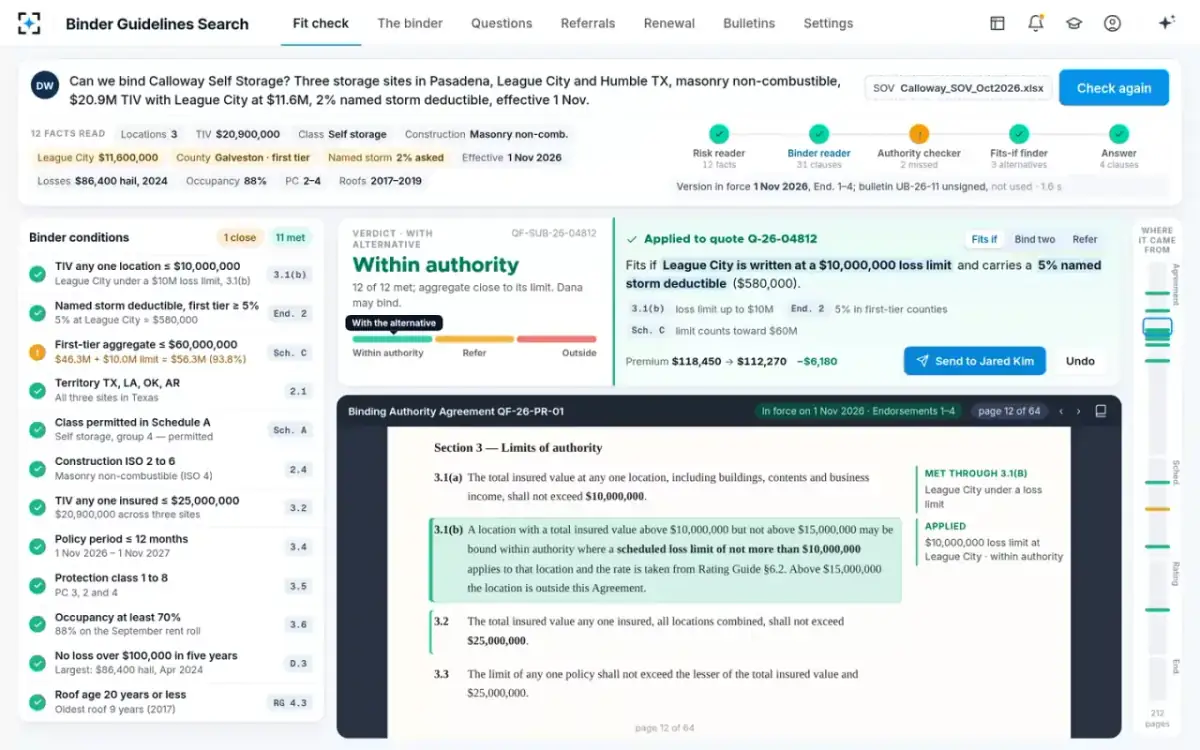
Three approaches, one risk: how each one compares
The fair comparison is not speed alone. A referral desk is slow but authoritative; a PDF search is fast for one clause and slow for four; an assistant is fast but only trustworthy if it keeps the binder's rules. The table below compares the three on what an MGA's head of underwriting and its carrier both care about.
PDF search, the referral desk and an AI underwriting assistant tool, on the criteria that matter
| Criterion | Search the PDF | Ask the referral desk | AI assistant built for the binder |
|---|---|---|---|
| Finds the conditional clause (3.1(b)) | If the underwriter reads on | Yes, but may not offer it | Yes: searches for the smallest change the binder names |
| Uses the version in force | Only if every endorsement file is open | Yes | Yes, by effective date; unsigned changes shown, not used |
| Tests per location | By hand | Yes | Yes, every condition at every location |
| Knows the shared aggregates today | No: needs written exposure | The carrier knows | Yes, from what has been bound |
| Who spends the time | The MGA underwriter | The carrier and the waiting broker | Seconds of machine time; the underwriter decides |
| What the auditor sees later | Nothing unless written down | The referral and the answer | Every check, verdict, clause and version |
| Who decides | The underwriter | The carrier | The underwriter |
The desk column deserves respect. When a risk truly needs the carrier, the desk is the right answer and no tool replaces it. The case for an assistant is that, in the sample year, 147 of the 318 risks that were referrals as asked were bound within authority after a change the binder permits: those never needed the desk at all. The MGA referral process prices what each of those referrals would have cost.
Can an AI underwriting assistant bind a risk?
It should not, and a well-built one cannot. Binding is an act of authority: the binder gives it to the MGA, and the MGA gives it to named underwriters. The NAIC model law treats underwriting itself as an authority, the power to accept or reject a risk for the insurer (NAIC Model #225 §2F), and that authority belongs to people the carrier has agreed to. Handing it to software would change who holds the pen without the carrier's consent.
Responsibility does not move either. Where a UK firm outsources an important function, the FCA's rule is that it "remains fully responsible for discharging all of its obligations under the regulatory system", and that outsourcing may not shift senior managers' responsibility onto someone else (FCA Handbook, SYSC 8.1.6R). An assistant can find the clause, test the risk and draft the note; the underwriter binds, and the carrier decides referrals.
"the outsourcing must not result in the delegation by senior personnel of their responsibility"
FCA Handbook, SYSC 8.1.6R
What to look for in an AI underwriting assistant tool
Look for a tool that keeps the binder's rules even when they make it slower to say yes. The checklist below is written for an MGA's head of underwriting choosing a tool; every item can be tested in a pilot on the MGA's own binder.
Buying criteria for an AI underwriting assistant at an MGA or coverholder
- It reads the whole binder, not just the agreement
Schedules, rating guide, endorsements and referral criteria: in the sample, one answer turned on the agreement, an endorsement and a schedule.
- It knows which version applied on the effective date
And shows a pending endorsement or bulletin as coming, never as in force.
- It tests per location and per shared limit
Any-one-location, any-one-insured, catastrophe aggregates and premium capacity, using what is already bound.
- It offers only alternatives the binder names
Loss limits, deductibles, splitting the schedule: each switchable, none invented.
- It never says yes on a missing detail
A question back is the correct answer when a roof year or a county tier is unknown.
- It drafts but does not send
Broker notes and referrals pre-filled for the underwriter, with the clause attached.
- The carrier can read its own binder’s log, and only that
Every question, verdict, clause and version, ready for the delegated authority auditor.
- You can see and change its rules
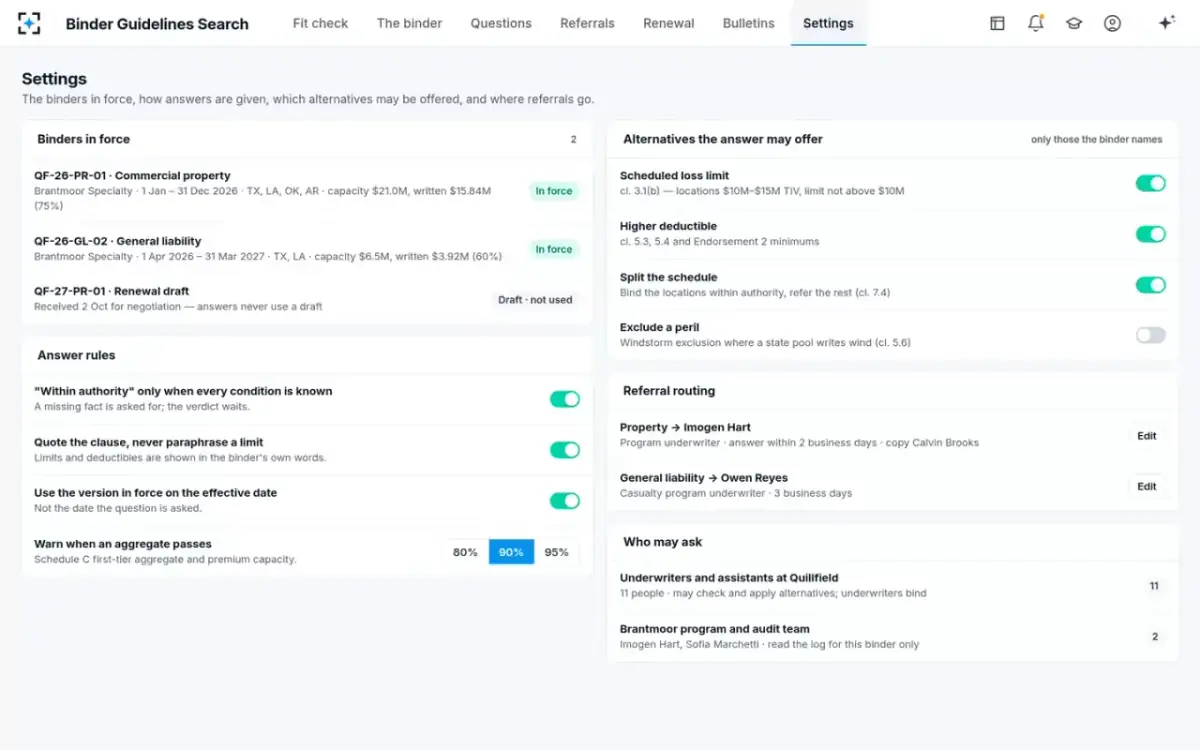
Which binders are in force, the aggregate warning level, who may ask, where referrals go.
The rules an MGA sets: binders in force, answer rules, permitted alternatives, routing
Is there a free AI underwriting assistant?
General-purpose chatbots have free tiers, and they will answer binder questions if you paste the binder in. The cost is not the subscription; it is the checking. A free tool that answers from an incomplete paste, without the endorsements, and without a log, leaves the underwriter to verify every line, which is the work the tool was meant to save. Before pasting a carrier's binder into any outside service, check the binding authority's confidentiality terms and the carrier's data rules.
Accuracy is the other hidden cost. In EIOPA's 2026 survey, insurers named inaccurate outputs as the risk of generative AI that worried them most, and a 2025 academic study found even legal research tools built on retrieval wrong on 17% to 33% of queries. Whether ChatGPT's binder answers can be trusted sets out the four tests to run before relying on any of them.
AI underwriting assistant vs underwriting assistant: the tool and the person
An underwriting assistant is a person; an AI underwriting assistant is a tool the person can use. At an MGA, the underwriting assistant builds quotes from schedules of values, chases missing details and, without a tool, sends the underwriter one-line emails asking whether a risk can be written. With a binder-aware tool, the assistant runs the check against every limit before the quote reaches the underwriter, so the underwriter starts from a cited answer instead of a question.
That shift changes the assistant's job more than the underwriter's. The underwriter still decides; the assistant moves from asking to checking. In the sample MGA, eleven people, underwriters and assistants, may run checks and apply alternatives to a quote; only underwriters bind.
How do you evaluate an AI underwriting assistant tool? A pilot on your own binder
Evaluate it on last month's real submissions against your own binder, with answers your underwriters have already given. A pilot of that shape answers the only question that matters, whether the tool reaches the same verdicts as your best underwriter, for the right reasons, faster, and it exposes the cases where the tool and the underwriter disagree, which are the most instructive of all.
A pilot that tests an AI underwriting assistant on your own binder, not the vendor's
- Gather, date documents4 days
- Load, check3 days
- Run submissions2 days
- Compare with decisions4 days
- Score, decide2 days
Score every disagreement, not just the totals. Where the tool said refer and the underwriter bound, did the underwriter find a permitted alternative the tool missed, or bind outside authority? Where the tool found a way in that the underwriter referred, was the alternative one the insured would have accepted? Where both agreed, did the tool cite the clause the underwriter would have cited? A pilot that ends with a list of those cases, each with its clause, is worth more to a carrier than any accuracy percentage.
Where Binder Guidelines Search fits, and where it does not
Binder Guidelines Search fits MGAs and coverholders writing under a binding authority, and the carriers who oversee them: its job is to answer whether a risk fits the binder, with the deciding clause, the version in force and the closest permitted alternative. It is not a rating engine beyond re-rating an alternative from the binder's own rating guide, not a policy administration system, and not a risk-quality judge. A carrier managing its own staff's authority levels has a different problem, covered in underwriting authority levels at a carrier; a personal lines desk answering agents' eligibility questions has another, covered in an underwriting knowledge management system.
The way to decide is a pilot on your own documents: your binding authorities, schedules, rating guide, endorsements and last month's submissions, scored on the criteria above. What to bring to an MGA underwriting platform on day one lists the documents. To see the three approaches side by side on the sample binder, start from Binder Guidelines Search.
Questions people ask
What is the best AI underwriting assistant tool for an MGA?
The one that passes a test on your own binder: cited, correct, current and complete answers, per location, with alternatives limited to what the binder names. A demonstration on the vendor's documents shows the interface, not the accuracy; twenty questions from your binder, answered in advance by your senior underwriters, show both.
Does an AI underwriting assistant replace underwriters?
No. It replaces the lookup. The Bureau of Labor Statistics projects underwriter employment to fall 4% from 2025 to 2035 and names automated underwriting software as the reason, but a delegated underwriter's decisions at the edge of authority remain the underwriter's, and the binder gives the authority to people.
Can an AI assistant send referrals to the carrier?
It can draft them; it should not send them. In Binder Guidelines Search the referral writer pre-fills the referral for only the locations that need the carrier and leaves it unsent; the underwriter sends it, and the carrier's program underwriter decides.
How long does it take to set up an AI underwriting assistant?
It depends mostly on the documents. A tool that reads binders needs the agreement, schedules, rating guide and every endorsement with its dates; gathering and dating those is usually the longest step. Answers can then be tested on a sample of past submissions before anyone relies on them.
Is an AI underwriting assistant safe for the carrier?
It can make the carrier safer if it keeps a log the carrier can read. The carrier's delegated authority auditor gets every check, verdict, clause and version for its own binder, instead of a sample of bound risks reconstructed months later.