The difference between a lineslip and a binder is who decides each risk. A binder, or binding authority, lets an intermediary such as an MGA or coverholder accept risks in the insurer's name within written limits. A lineslip keeps that decision with the insurers: as the English Commercial Court described it, several insurers authorise one or more leading underwriters to accept, on their behalf, risks that one broker presents within an agreed scope (Involnert Management v Aprilgrange, [2015] EWHC 2225 (Comm)). Both are standing arrangements for business that has not been written yet, and both are full of limits. Botminds' Binder Guidelines Search is built for the first: it answers the delegated underwriter's question, does this risk fit the binder, with the clause that decides it.
The court cases on this page are public records from the courts' own site. The sample screens show a fictional MGA and carrier.
Lineslip vs binder: the same idea of pre-agreed terms, a different hand on the pen
Lineslip: A leading underwriter, or a set of them, acting for the insurers on the slip.
Binder (binding authority): The MGA or coverholder, as the insurer’s agent.
Lineslip: "a particular broker" (Involnert, 2015).
Binder (binding authority): Any broker or agent the MGA deals with, within the binder’s territory and classes.
Lineslip: A declaration to the lineslip, signed by the leader and any second underwriter required.
Binder (binding authority): A policy or certificate issued by the MGA, reported to the insurer on a bordereau.
Lineslip: Not a contract of insurance; a standing offer by the insurers (MacGillivray, quoted in Involnert).
Binder (binding authority): A contract of agency; in US model-law states, an MGA contract under Model #225.
Lineslip: The leading underwriter, against the slip’s scope and the insurer’s own appetite.
Binder (binding authority): The MGA’s underwriter, against the binder as amended, before binding.
Lineslip: Off the slip: to the open market or a separate placement.
Binder (binding authority): A referral to the carrier, or a decline.
What is a lineslip? A standing offer to one broker
A lineslip is a facility, arranged by a broker, under which several insurers agree in advance to take shares of risks that fall within a stated scope, and let one or more leading underwriters accept those risks for all of them. The Involnert judgment adds the legal character, quoting the leading insurance law text: such a facility "is not a contract of insurance but “is in the nature of a standing offer by subscribers to be bound to particular risks by their designated underwriter.”" The contract of insurance comes later, one risk at a time.
The court also gave the commercial reason for it. A lineslip "assists the broker in placing insurance as it avoids the demands of having to broke each risk individually to each insurer. It is also convenient for insurers as it provides them with simple access to business." That is the lineslip insurance meaning most people are searching for: pre-arranged capacity for one broker's flow, with an insurer's underwriter still saying yes to each risk.
"A lineslip is a facility whereby a number of insurers authorise one or more leading underwriters to accept on their behalf risks presented by a particular broker, provided the risks fall within a pre-defined scope."
Commercial Court, Involnert Management v Aprilgrange (2015)
What is the difference between a lineslip and a binder?
Under a binder the decision is delegated outside the insurers; under a lineslip it is delegated among them. HM Revenue & Customs describes the binder side: a managing agent may delegate its authority to write insurance to another firm, a Lloyd's broker included; that firm is the coverholder, and it acts as the managing agent's agent, not the policyholder's (HMRC LLM1100; the definition is quoted in what a coverholder is). The coverholder or MGA is not an insurer, but it commits one.
On a lineslip, the person who commits the following insurers is itself an insurer's underwriter. That changes who carries the knowledge. Under a binder, the delegate's underwriters must know every limit, because nobody at the insurer sees the risk before it is bound. Under a lineslip, the broker presents and the leader underwrites, so the scope of the slip is something a professional underwriter at an insurer applies to each declaration. The documents look alike; the risk of a limit being missed sits in a different building.
The two are close enough that contracts treat them as alternatives. The binder in Temple Legal Protection v QBE allowed termination in several cases, "one of which was Temple’s entering into any lineslip or binder with another insurer" ([2009] EWCA Civ 453): either would have moved the same business elsewhere.
Who binds risks under a lineslip? The leader, or a set of leaders
The lineslip names who may bind, and it is rarely one person. In Involnert, the yacht lineslip designated one insurer as "slip leader", and "To bind or alter an insurance contract written under the lineslip required the agreement of both the slip leader and the second defendant", another insurer. In Rendall v Combined Insurance, a personal accident lineslip authorised "the Leading Underwriter and/or any first 3 Underwriters" to bind business from one broker, with that business "automatically binding upon all other Underwriters" once the leaders agreed ([2005] EWHC 678 (Comm)).
Some slips define the leader as a quorum. In Beazley v Travelers, the primary lineslip "authorised the Leading Underwriter (as defined) to accept and rate declarations for 3 year PI cover up to £ 50 million", and "For UK risks any two out of five specified underwriters would constitute the Leading Underwriter" ([2011] EWHC 1520 (Comm)). The question "who can bind this?" therefore has an answer on a lineslip, but it is a rule about insurers' underwriters, not about the broker's staff.
What is a declaration under a lineslip?
A declaration is the document that attaches one risk to the lineslip and binds it. The Involnert judgment describes the sequence on a yacht facility: the broker would "draw up a quotation slip and take it to" the leader "to review and rate"; if the client accepted the quote, the broker "would then prepare a formal declaration to bind the risk"; after the leader signed, the declaration went to the second insurer to sign, and once it accepted, "the following market would be bound."
How one risk is bound under a lineslip, as the Commercial Court described it
A person decides
BrokerDraws up a quotation slip for the risk and takes it to the slip leader.
A person decides
Slip leaderReviews and rates the risk against the lineslip’s scope and the insurer’s own view.
A person decides
Client and brokerClient accepts the quotation; the broker prepares a formal declaration to bind the risk.
A person decides
Slip leaderSigns the declaration.
A person decides
Second underwriterSigns too, where the lineslip requires a second agreement.
A person decides
Following marketBound automatically for their shares once the required leaders have signed.
Declarations are dated and numbered like policies. In Feasey v Sun Life, a master lineslip was "signed earlier for 100%" by a syndicate's underwriter, and "The first declaration under the Master Lineslip was accepted on 16 June 1995" ([2003] EWCA Civ 885). Under a binder, the equivalent of the declaration is the MGA's own policy or certificate, which no insurer signs before it is issued.
Lineslip vs binding authority vs open market: three ways to place a risk
A broker with a risk in the London market has three common routes, and big programmes use more than one. In Standard Life v Oak Dedicated, successive covers "were placed, in part, under brokers’ lineslips" and "were also partly placed on the open market" ([2008] EWHC 222 (Comm)). On the open market, HMRC explains, the broker "prepares a ‘slip’ with the details of the insurance, which is signed by each of the underwriters that have agreed to accept part of the risk".
Open market, lineslip, binder: who says yes to one risk
| Route | Who says yes to the risk | What is agreed in advance | What the person deciding must check |
|---|---|---|---|
| Open market | Each underwriter who signs the slip, for its own share | Nothing beyond the broker relationship | The risk and the insurer’s own guidelines |
| Lineslip | The slip leader or leaders, for all the insurers on the slip | Scope, limits, period and shares for one broker’s business | The declaration against the slip’s scope, plus the insurer’s own appetite |
| Binder (binding authority) | The MGA or coverholder, for the insurer | The whole underwriting framework: classes, limits, territory, rates, period, referral criteria | Every limit in the binder as amended, at every location, on the effective date |
Do limits on a lineslip work like limits in a binder?
Yes, and the court records show the arithmetic is just as unforgiving. In Beazley v Travelers, a syndicate's scratch on a £75 million cover was first written at 75% of the whole under a lineslip with a £50 million limit. The judge set out why it was cut to 66.666%: "75% of £ 75 million (£ 56.25 million) would exceed the limit. 66.666% would reach it." The judge read the balance as meant to come off a separate excess lineslip.
Period limits work the same way. The Rendall lineslip allowed a "maximum period of 3 years any one risk regardless of the expiration of [the] Lineslip", and no declaration was to "exceed 36 months plus odd time". That is the same kind of test as the sample binder's clause 3.4 (twelve months, eighteen with odd time). What differs is who applies it: on the lineslip, the leading underwriter at the moment of signing; under a binder, the delegate's underwriter, alone, before anyone at the insurer has seen the risk.
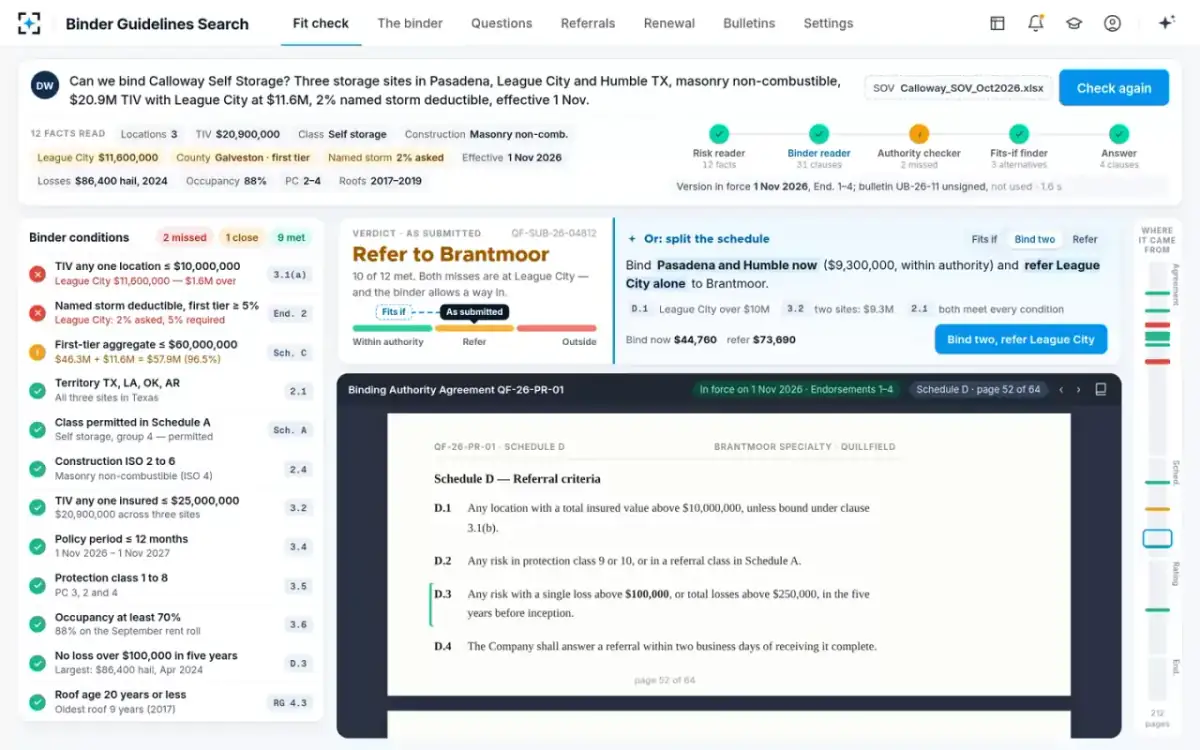
A Binder Guidelines Search answer that splits a schedule: two sites bound, one to the carrier
When do you use a lineslip, and when a binder?
Use a lineslip when a broker has a steady flow of similar risks and the insurers want to keep underwriting each one; use a binder when the insurers are willing to let a specialist outside their walls underwrite within limits. The Involnert court's reason for lineslips, saving the broker from broking "each risk individually to each insurer", is about placement efficiency. A binder delegates the underwriting itself: in the Temple case, the binder appointed a specialist legal expenses underwriter as the insurer's agent and let it delegate underwriting authority further, to firms of solicitors who granted cover to their own clients.
In the United States, the choice is shaped by statute. Where the intermediary manages the business and writes 5% or more of an insurer's surplus, NAIC Model #225 treats it as an MGA and requires a written contract with underwriting guidelines before any business is placed (NAIC Model #225). Delegated underwriting by a US MGA therefore runs on a written MGA contract, and the lookup problem sits with the MGA's underwriters. What a binding authority agreement contains sets out that contract item by item.
What each underwriter can look up before deciding
On a lineslip, the leading underwriter looks up two things: the slip's scope and the insurer's own appetite, and both are documents the insurer controls. Under a binder, the MGA's underwriter looks up a contract written by another company and amended by endorsement through the year, plus the MGA's own limits on that underwriter. That is the harder search, and the one most likely to be done from memory at nine in the morning.
What the person holding the pen should be able to answer before saying yes
- Is this risk within scope?
Class, territory and period: the slip’s scope on a lineslip, the binder’s classes and territory under a binding authority.
- Which version applies?
A lineslip and a binder can both be amended; the version in force on the risk’s effective date decides.
- Which limits apply, and at what level?
Any one risk, any one location, any one insured, aggregate. A schedule can pass in total and fail at one site.
- Is another signature needed?
A second leader on a lineslip; a referral to the carrier under a binder. Both are written down in advance.
- Is there a permitted way in?
A reduced line on a lineslip (as in Beazley); a loss limit, higher deductible or split schedule under a binder, if the binder names it.
- Will someone be able to see why?
The clause or scope wording that decided it, kept with the risk.
Where Binder Guidelines Search fits: the binder side
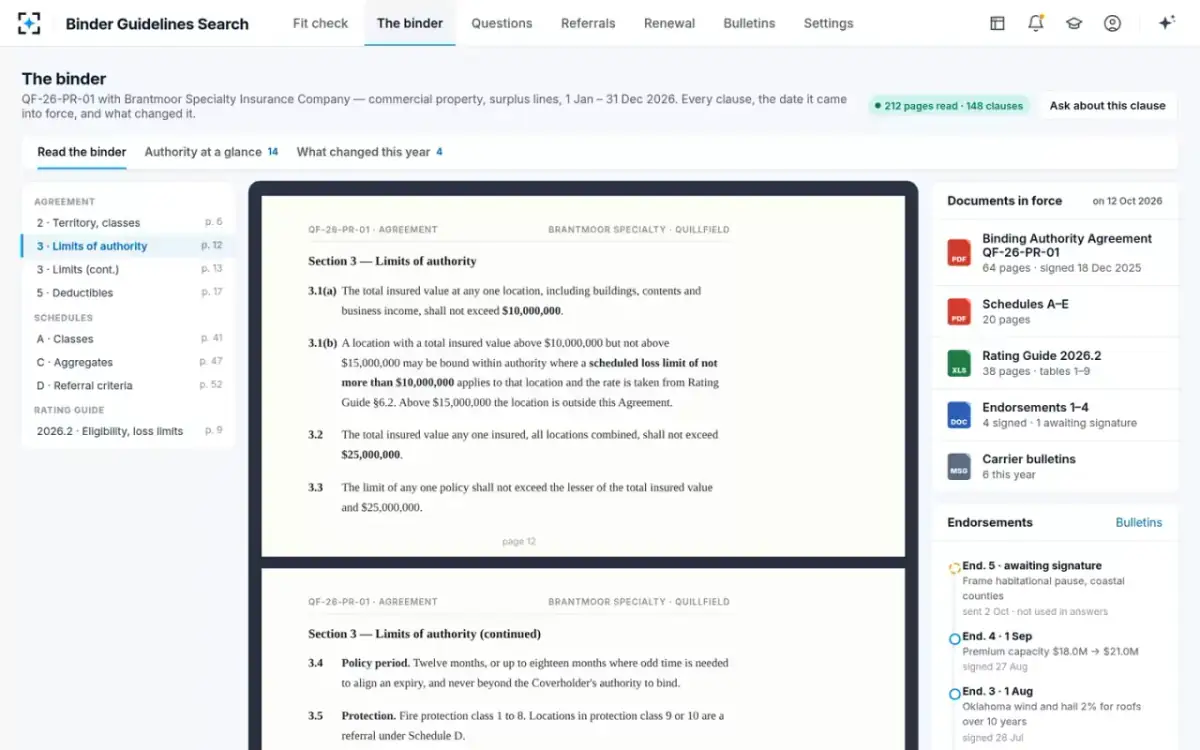
Binder Guidelines Search is built for the delegate under a binder: the MGA or coverholder underwriter who must answer "does this fit?" alone, against a contract that changes by endorsement. It reads the binding authority, schedules, rating guide and endorsements clause by clause; tests every condition at every location in the version in force on the effective date; and, when the answer is not yes, names the smallest change the binder itself permits. It does not run a lineslip's declarations or a leading underwriter's signing workflow, and it does not bind under either.
The binder behind every answer: documents in force, endorsements dated, one still unsigned
For a lineslip leader, the same discipline applies even without the software: read the scope as amended, test the declaration against it, and keep the wording that decided it. To see it done on a binder, start from Binder Guidelines Search.
Questions people ask
Is a lineslip a contract of insurance?
No. The Commercial Court in Involnert (2015), quoting MacGillivray on Insurance Law, said a lineslip facility is not itself a contract of insurance but is in the nature of a standing offer by the insurers to be bound by their designated underwriter. The contract of insurance is made when a declaration is signed.
What is the difference between a lineslip and a facility?
A lineslip is one kind of facility: courts use the word for the arrangement as a whole. Involnert calls a lineslip a facility under which several insurers let leading underwriters accept a broker's risks; a binder can be called a facility too, as the surety binding authority was in the Markel case (2008), which is why the question of who holds the pen matters more than the label.
What is a slip leader?
The insurer's underwriter designated on a lineslip to agree declarations for the following insurers. Some slips require a second underwriter too, as in Involnert, and some define the leader as any two of five named underwriters, as in Beazley v Travelers (2011).
Can a coverholder hold a lineslip?
A coverholder holds a binding authority; a lineslip is held by a broker and led by insurers. HMRC describes coverholders as agents of the managing agent, which is the binder relationship. In Involnert the lineslip was "operated by the placing broker" and led by insurers.
Is a binder in insurance the same as a binding authority?
In delegated underwriting, yes: "binder" is common shorthand for a binding authority agreement, and the English Court of Appeal used it that way in Temple v QBE (2009). The same word also names a temporary evidence of cover on a single policy, which is unrelated.