Binder underwriting guidelines are the rules in a binding authority that define what an MGA or coverholder may write for the insurer: in states that follow the NAIC model act, at least the premium volume, the basis of rates, the types of risk, limits, exclusions, territory, cancellation and policy period (NAIC Model #225 §4F). They are not fixed for the year. Endorsements change them from a stated date, carrier bulletins announce changes that are not yet in force, and a renewal draft sits beside the current binder for months. So the practical question about any risk is never just "what do the guidelines say?" but "what did they say on this risk's effective date?" Botminds' Binder Guidelines Search answers from the version in force on the effective date, names the endorsements it applied, and says which pending changes it set aside.
The examples follow one fictional sample binder through 2026: QF-26-PR-01, from a fictional carrier to a fictional MGA. The statutes and court record are real.
One binder year, five versions: the sample binder's wording from January to December
- Agreement + End. 1Jan–May
- End. 2: storm 5%from 1 Jun
- End. 31 Aug
- End. 4: $21M capacityfrom 1 Sep
- No change proposedJan–Sep
- End. 5 unsignedOct–Dec
What are binder underwriting guidelines?
They are the written limits of the MGA's authority, and in model-law states they are a required part of the contract, not a separate manual. The model act lists eight items, from the maximum annual premium volume to the maximum policy period, and requires the contract to contain them. In practice they spread across the agreement, its schedules, the rating guide the binder names, and every endorsement since signature.
States adopted the list with small but telling differences of wording. Florida says "The contract shall specify appropriate underwriting guidelines" (Fla. Stat. §626.7451(6)). New York says "The MGA will follow appropriate insurer underwriting guidelines" (11 NYCRR §33.5(f)), which makes them the insurer's guidelines that the MGA follows. Texas asks only that the contract "addresses", where applicable, "premium volume limits" and "underwriting" (Tex. Ins. Code §4053.102).
Do state laws require underwriting guidelines in an MGA contract?
Yes, in states that adopted the NAIC model or something like it, though the detail differs. The table compares the model with four states this series cites; check your own state's current text before relying on it.
Underwriting guidelines in MGA contracts: the model act and four states compared
| Source (as read) | How the duty is phrased | What the guidelines must cover |
|---|---|---|
| NAIC Model #225 §4F (October 2002 edition) | The contract contains "Appropriate underwriting guidelines" | Eight items: premium volume, rate basis, risk types, limits of liability, exclusions, territory, cancellation, maximum policy period |
| Florida Stat. §626.7451(6) (2025) | The contract must specify the guidelines | The same eight items |
| New York 11 NYCRR §33.5(f) (amended 2020) | The MGA follows the insurer’s guidelines | The same eight items, framed as the insurer’s guidelines |
| North Carolina G.S. §58-34-2 (archived copy, May 2026) | The contract contains "Appropriate underwriting guidelines" | The same eight items, in one sentence |
| Texas Ins. Code §4053.102 (effective 1 April 2005) | The contract "addresses", if applicable, underwriting | Premium volume limits, appointment of agents, claims settlement, underwriting and reinsurance, without a list of guideline items |
None of the texts says when a change to the guidelines takes effect. That is left to the contract, which is why the endorsement's own wording, and its dates, decide it.
What is a binder year?
A binder year is the period of a binding authority: the dates between which the MGA may bind risks under it. The sample binder runs from 1 January to 31 December 2026. Risks attach to the binder year in which they incept, and the policies outlive it: the sample binder allows a policy period of "Twelve months, or up to eighteen months where odd time is needed to align an expiry", so a risk bound in December 2026 can run well into 2028.
That is why one MGA often has to answer questions about two binders at once. Underwriters quoting in October for a 1 January effective date are writing under next year's binder, which may still be a draft; the sample MGA holds its 2027 renewal draft, received on 2 October, as a draft that answers never use. And a carrier's auditor testing a policy bound in November 2025 will test it against the 2025 binder, not the 2026 one.
What is a binder endorsement, and how do binder changes take effect?
A binder endorsement is a signed amendment that changes the binding authority from a date it states. Two dates matter: when it was signed, and when it comes into force. In the sample, the endorsement raising premium capacity from $18.0 million to $21.0 million was signed on 27 August and took effect on 1 September; the Oklahoma wind and hail endorsement was signed on 28 July and took effect on 1 August. A risk effective on 31 August sits under the old capacity, whatever day the underwriter asks.
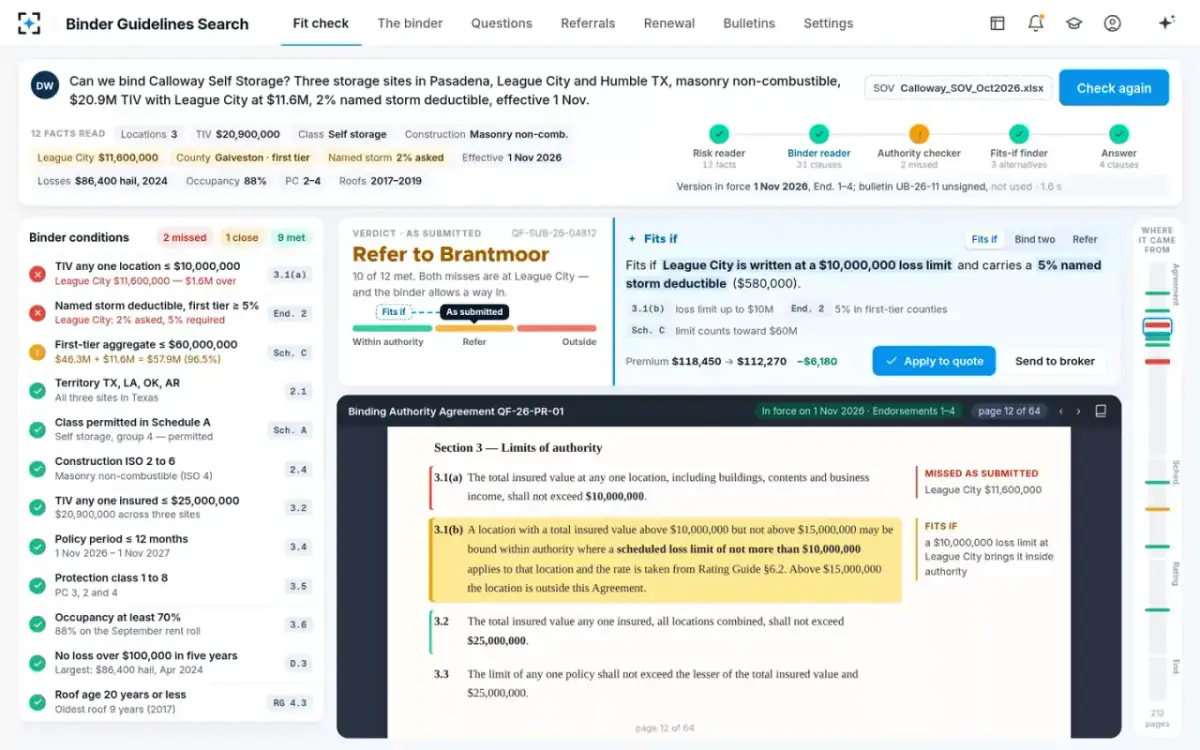
The effective date of the risk, not the date of the question, selects the wording. On 12 October an underwriter asks about a storage risk effective 1 November. The 5% named storm minimum in first-tier counties applies, because Endorsement 2 took effect on 1 June. The proposed frame exclusion does not, because Endorsement 5 is unsigned, even though it would take effect on 15 October if signed. The answer has to say both.
What Binder Guidelines Search's binder reader did: the version in force, and what it set aside
Bulletins are not endorsements: appetite is not authority
A carrier bulletin tells the MGA what the carrier wants; an endorsement changes what the MGA may do. Mixing them up causes errors in both directions: an underwriter who treats a bulletin as in force refers or declines risks the binder still allows; one who ignores a bulletin binds risks the carrier is about to exclude, at the edge of a relationship the MGA needs.
Carrier bulletin or binder endorsement: what each one does to the guidelines
Carrier bulletin: A notice from the carrier: appetite, a proposed change, a reminder.
Signed endorsement: An amendment to the binding authority, signed by both parties.
Carrier bulletin: None by itself.
Signed endorsement: Changes the clause it names, from the date it states.
Carrier bulletin: UB-26-12, 9 October: cold storage welcome as a referral class, an appetite note.
Signed endorsement: Endorsement 4, signed 27 August: premium capacity $21.0M from 1 September.
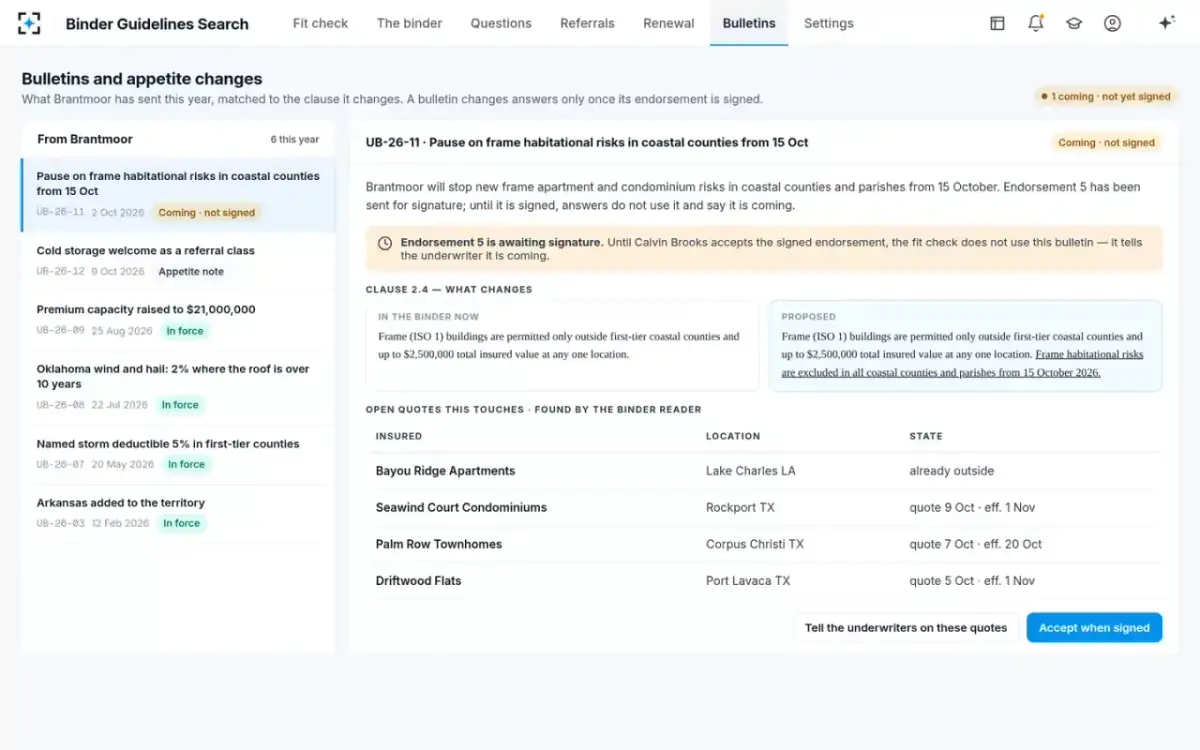
Carrier bulletin: UB-26-11, 2 October: frame habitational risks in coastal counties excluded from 15 October.
Signed endorsement: Takes effect only when Endorsement 5 is signed and accepted.
Carrier bulletin: That it is coming, and which open quotes it would touch.
Signed endorsement: That the clause has changed, and from when.
A pending change matched to its clause and the open quotes it would touch
What happens if a risk is bound under an old binder?
If the old wording was more generous, the risk was bound outside authority, and the breach is easy to miss. A bordereau lists the risk with its deductible, value and dates; nothing on it says which version of the guidelines the underwriter checked. A 2% named storm deductible on a first-tier risk effective in July looks like any other deductible unless the reader knows that Endorsement 2 set a 5% minimum from 1 June.
Sample audits are weak at finding errors that do not look like errors. In Markel v Surety Guarantee Consultants, the carrier's audit picked 14 files at random, its auditor reported no significant issues with the bordereaux, and the court found that the bonds written above the limits had gone undiscovered ([2008] EWHC 1135 (Comm); the passage is quoted in audit sampling methods). The breach in that case was deliberate, which a version error usually is not, but the lesson for both is the same: a check at the point of binding catches what a sample months later may not.
A clean sample audit says the files checked were clean. It says nothing about the version of the guidelines used on the files nobody opened.
The consequence runs both ways. The carrier may face a loss on a risk it never agreed to write on those terms, and the MGA faces a breach of its contract. Under Model #225 §4A the insurer can terminate for cause and suspend the MGA's underwriting authority while the cause is disputed. A version error found at audit is a poor start to a renewal.
Shared limits move with the date too
Version errors are not limited to wording. Shared limits, such as premium capacity and catastrophe aggregates, have two moving parts: the limit itself, which an endorsement can change, and the amount already used, which every bind changes. Both must be read as of the risk's date.
The sample binder shows both. Premium capacity was $18.0 million until Endorsement 4 raised it to $21.0 million from 1 September; by 12 October the MGA had written $15.84 million, 75% of the higher figure. A large risk effective in late August had to fit under the old capacity, with August's written premium. The first-tier coastal aggregate is the other kind: its $60 million limit did not change, but the storage risk tested on 12 October would have taken it from $46.3 million to $57.9 million at full value, or to $56.3 million under the loss limit, both past the MGA's 90% warning level. An answer that uses this year's limit with last month's exposure, or the reverse, is wrong in a way no one will notice until two large risks land in the same week.
How to reconstruct the version in force for any risk
List every document with its dates, order them, and read the wording as it stood on the risk's effective date; then keep that wording with the risk. Done by hand for one risk, it takes a careful hour. Done at the point of binding, by rule, it takes seconds and leaves the evidence behind.
Reconstructing the binder underwriting guidelines in force on a given date
- Gather every document
The signed agreement, schedules, the rating guide edition, every endorsement and every bulletin, plus side documents such as operating notes.
- Date each one twice
Signed, and in force from. Mark pending changes and drafts so they are never applied.
- Start from the risk’s effective date
Not the quote date and not today. Policies with odd time can make the effective date unexpected.
- Apply endorsements in order
Each changes the clause it names from its date; a later endorsement can change the same clause again.
- Test the risk against that wording
Every condition, at every location, including shared aggregates as they stood that day.
- Keep the wording with the risk
The clause text and version used, so an auditor can see what the underwriter saw.
The renewal adds one more dimension. When the sample MGA's head of underwriting takes evidence to the carrier for the 2027 binder, every proposal rests on checks made under the 2026 wording in force on each day. The MGA referral process shows how that evidence becomes wider authority; what a binding authority agreement contains covers the documents being dated.
Where Binder Guidelines Search fits
Binder Guidelines Search splits the binder, schedules, rating guide and endorsements into clauses, each with its page, the endorsement that changed it and the date it came into force. Every answer uses the version in force on the risk's effective date and says which endorsements it applied. A bulletin or unsigned endorsement is matched to the clause it would change and the open quotes it touches, shown as coming, and used only once the head of underwriting accepts the signed endorsement. Each check is logged with the version in force that day, so the carrier's auditor can read what applied rather than rebuild it. The design target is that every answer cites its clause and version; see it on the sample binder at Binder Guidelines Search.
Questions people ask
Are binder underwriting guidelines the same as the carrier's underwriting manual?
Not necessarily. The binder's guidelines are part of a contract and set the MGA's authority; a carrier's manual sets its own staff's practice. New York's rule blends the two by requiring the MGA to "follow appropriate insurer underwriting guidelines", so in New York the insurer's guidelines are what the contract points to.
Can a carrier change the guidelines mid-year without an endorsement?
A carrier can always say what it wants by bulletin, and an MGA would be unwise to ignore it, but a change to the contract normally needs the contract's own amendment process. Model #225 also lets the insurer suspend the MGA's underwriting authority during a dispute over termination for cause.
Which date decides the version: the quote, the bind or the effective date?
Usually the risk's effective date, because that is when the insurer goes on risk under the binder in force. Check your binder's own wording. Binder Guidelines Search uses the effective date by default, and the setting says so.
What is a renewal draft, and can underwriters use it?
A renewal draft is next year's binder under negotiation. Until it is signed, it gives no authority. The sample MGA holds its 2027 draft, received on 2 October, but answers never use it.
How long should old binder versions be kept?
At least as long as the records rules that apply to the MGA require, and as long as any policy bound under them can be audited or claimed on. Model-law states point to their own retention statutes; New York's MGA rule, for example, points to Regulation 152.