An MGA underwriter is an underwriter employed by a managing general agent who accepts or rejects risks on behalf of an insurance company, within written limits the insurer has delegated. The NAIC's model law defines the core of the job in one line, "“Underwrite” means the authority to accept or reject risk on behalf of the insurer", and requires every MGA contract to carry "appropriate underwriting guidelines": premium volume, rates, risk types, limits, exclusions, territory, cancellation and policy period (NAIC Model #225). What makes the job hard is not judging a risk; it is knowing, for every submission, what the binder as amended allows. Botminds' Binder Guidelines Search is built for that question: the underwriter asks in plain words whether a risk fits, and the answer comes back within authority, refer or outside, with the clause that decides it.
The examples below follow a fictional sample MGA, Quillfield Underwriting Managers, writing commercial property under a binder from a fictional carrier, Brantmoor Specialty. Every person, firm and figure from the sample is invented; the law and the labour statistics are real and linked where they appear.
Where an MGA underwriter's time goes on one multi-location risk that may need a referral
- Finding the clauses1 h
- Testing each condition45 min
- Finding a way in45 min
- Writing the referral30 min
- Deciding30 min
- Reading24 min
- Deciding30 min
What is an MGA underwriter, and who are they working for?
An MGA underwriter works for the MGA but binds the insurer. That split is the defining feature of the job. A September 2026 draft of NAIC's State Licensing Handbook describes an MGA as a licensed producer an insurer has authorised to manage some or all of its business, from marketing and underwriting to issuing policies, collecting premium, supervising agents, paying claims and negotiating reinsurance (NAIC State Licensing Handbook, chapter 24 draft; quoted in program administrator in insurance).
Not every firm that calls itself an MGA is one in law. Model #225 counts a firm as an MGA when it both manages the insurer's business and underwrites gross direct written premium of 5% or more of that insurer's policyholder surplus, together with adjusting claims above $10,000 or negotiating reinsurance; its drafting note warns that the title alone proves nothing. Texas uses a different test, which reaches anyone an insurer authorises to accept or process policies that other agents produced and sold (Tex. Ins. Code §4053.001). The tests are worked through, with the statutes' own words, in program administrator in insurance.
The underwriter's employer matters less to the law than the insurer's name on the policy. Model #225 §6 treats what the MGA does as the insurer's own act, and lets regulators examine the MGA as though it were the insurer. Every risk an MGA underwriter binds is the insurer's risk, priced on the insurer's rates and reported to the insurer's regulator.
What is delegated underwriting authority? The insurer lends its pen
Delegated underwriting authority is an insurer's written permission for someone outside its staff to accept risks in its name. In the United States the permission sits in the MGA contract that Model #225 §4 requires before any business is placed. In the London market the same idea has its own words: HM Revenue & Customs explains that a managing agent may delegate its authority to write insurance for its syndicate to another firm; the firm is the coverholder and the document setting the terms is the binding authority (HMRC Lloyd's Manual LLM1100).
Delegation does not move the responsibility. New York's MGA regulation opens by saying why it exists: the Department of Financial Services wrote it because delegated authority had been abused, to the harm of insurers and policyholders alike (11 NYCRR §33.0). The insurer may also take the pen back mid-dispute: Model #225 §4A lets it suspend the MGA's underwriting authority while a dispute over termination for cause runs. The document the underwriter works under is set out clause by clause in what a binding authority agreement is and what it contains.
The MGA underwriter's signature binds a company that is not their employer. Every habit of the job follows from that.
Is an MGA underwriter the same as a carrier underwriter?
The craft is the same; the boundaries are not. Both read submissions, assess exposure, price from a rating basis and decide. The carrier underwriter's limits come from the carrier's own authority structure, and a risk beyond them goes up the line inside one company. The MGA underwriter's outer limits come from a contract with another company, and a risk beyond them goes to someone the MGA does not employ.
Same craft, different walls: carrier and MGA underwriters side by side
Carrier underwriter: The employer’s.
MGA underwriter: An insurer that is not the employer; the MGA’s acts are treated as the insurer’s (Model #225 §6).
Carrier underwriter: The carrier’s internal authority levels and underwriting manual.
MGA underwriter: The binding authority’s underwriting guidelines, then the MGA’s own letter to each underwriter.
Carrier underwriter: Up the line to a senior underwriter in the same firm.
MGA underwriter: A referral to the carrier’s program underwriter, under the binder’s referral criteria.
Carrier underwriter: Manual updates and internal bulletins.
MGA underwriter: Endorsements signed by both parties; carrier bulletins that may or may not have become endorsements yet.
Carrier underwriter: Internal audit and peer review.
MGA underwriter: The carrier’s delegated authority auditor, plus regulators who may examine the MGA as if it were the insurer.
Carrier underwriter: Salary and bonus from the carrier.
MGA underwriter: Salary and bonus from the MGA, whose own income is commission and, where the contract allows, a share of profits, which Model #225 §4L holds back where the MGA controls reserves or claim payments.
The difference shows most in the referral. A carrier underwriter who is unsure walks down a corridor. An MGA underwriter who is unsure sends a written referral to a program underwriter at another company, whose answer time is set by the binder, and the broker waits. What an underwriting referral means under a binder takes that exit step by step.
What does an MGA underwriter do in a day?
Most of the day is a run of the same question in different forms: can we write this, as asked, under the binder in force on the effective date? Take one Monday at the sample MGA. Before 09:15 its underwriters had asked the binder four times: a medical office building in Spring, Texas, at $9.4 million, within authority; a machine shop in Tulsa at $7.8 million, within authority under the Oklahoma endorsement; a frame apartment complex in Lake Charles at $4.2 million, outside, because the binder's construction clause allows frame only inland; and a three-site self storage risk, Calloway Self Storage, $20.9 million in total value, a referral as submitted.
The fourth is the one that eats a morning by hand. One location, League City, is $11.6 million, over the $10 million any-one-location limit in clause 3.1(a). The named storm deductible asked is 2%, below the 5% that an endorsement has required in first-tier coastal counties since 1 June. And the binder's aggregate for first-tier counties would reach $57.9 million of its $60 million. Three clauses, two documents and one schedule decide it, and none of them sits on the same page.
The fit check in Binder Guidelines Search: twelve conditions, three locations, one deciding clause
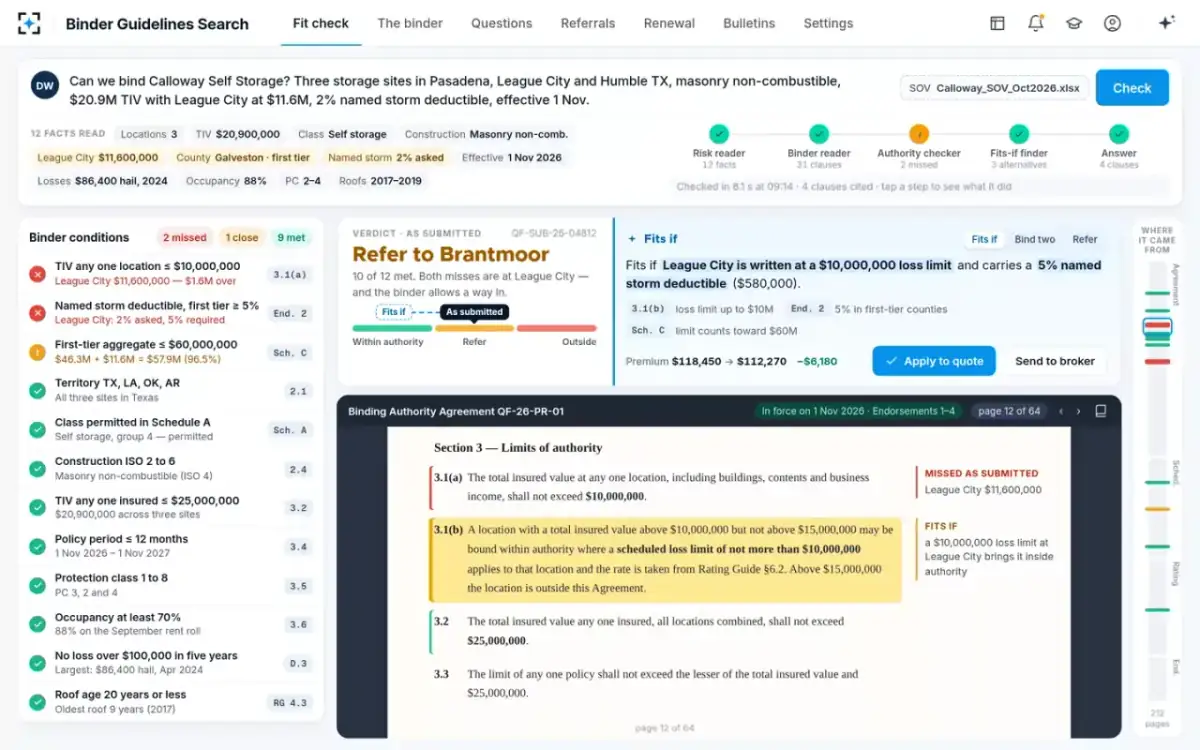
The answer that comes back is the one a senior colleague would give: refer as submitted, but the binder itself allows a way in. Clause 3.1(b) lets a location between $10 million and $15 million be bound within authority under a scheduled loss limit of not more than $10 million. Written that way, with a 5% named storm deductible ($580,000), the risk passes all twelve conditions at a re-rated premium of $112,270. The underwriter decides whether to offer it; the search only shows her that she can.
How many "does it fit?" questions does an MGA underwriter ask?
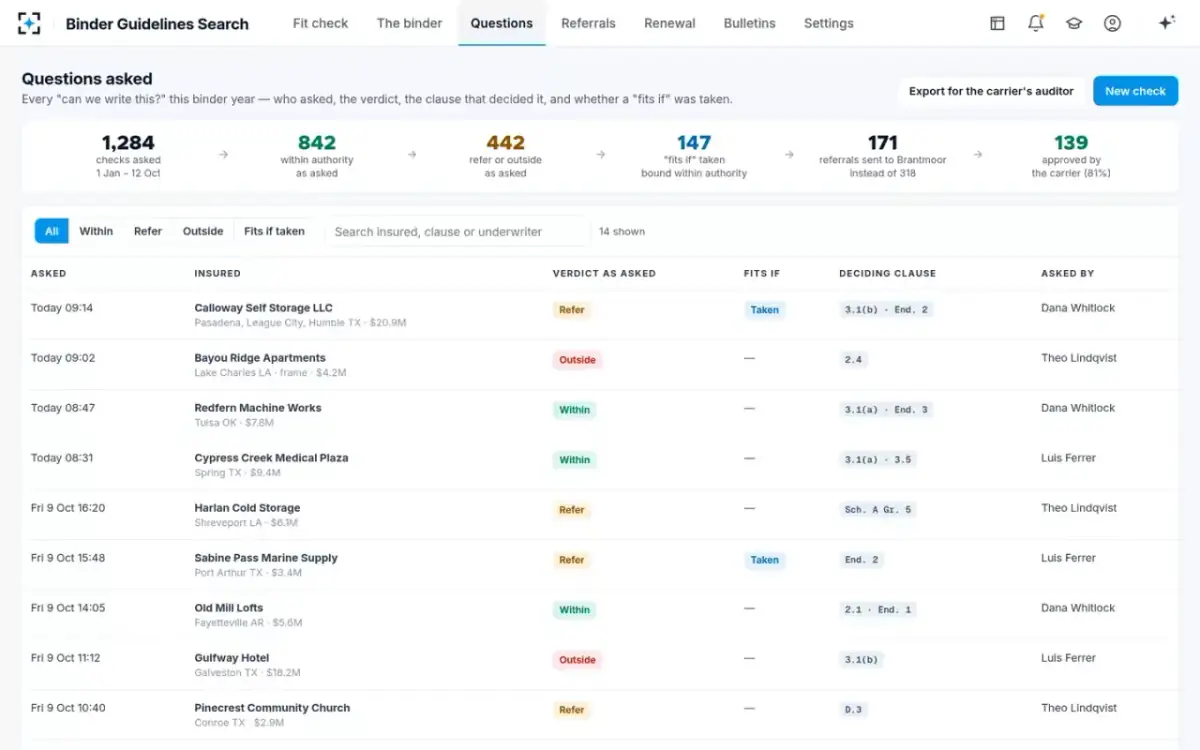
Enough that the answer quality matters more than any single answer. The sample MGA's eleven underwriters and assistants asked the binder 1,284 times between 1 January and 12 October, roughly six times a working day across the team. Most questions are easy; the expensive ones are the minority that land near a limit.
1,284 binder questions in a sample year: most fit, and a third of the rest found a way in
The bar that matters to the carrier is the third one. Every referral is a question the carrier pays its own underwriter to answer. Of the 171 it received, it approved 139, 81%. A high approval rate on referrals is a signal worth reading both ways: either the binder's limits are tighter than the carrier's appetite, or the MGA is referring risks it could have written. The MGA referral process prices each of those days.
Every question an underwriter asked, with the verdict and the clause
MGA underwriter salary, jobs and outlook
There is no separate federal statistic for MGA underwriters; they are counted with all insurance underwriters. The Bureau of Labor Statistics counts about 125,600 insurance underwriter jobs in 2025, with a median annual wage of $81,370 in May 2025 (BLS Occupational Outlook Handbook). About 52% work for direct property and casualty carriers and 24% for insurance agencies and brokerages, the industry group that sits outside the carriers.
The outlook is flat to falling. BLS projects employment of insurance underwriters to fall 4 percent from 2025 to 2035, and gives automated underwriting software as the reason: it lets fewer people process applications faster. For an MGA underwriter the useful reading is narrower. Software built to screen simple personal lines applications is not built to read a 64-page binder with four endorsements; the delegated underwriter's value is in the judgment calls at the edge of authority, which is where a search that cites the clause helps most.
What is in an MGA underwriter job description?
An MGA underwriter job description combines the standard underwriting duties with a set of contract duties a carrier underwriter rarely carries. BLS lists the general ones, among them "Screen applicants based on set criteria", "Decide whether to offer insurance" and "Determine appropriate premiums and amounts of coverage". The delegated ones come from the binder.
What an MGA underwriter is accountable for, beyond pricing the risk
- Know the binder as amended
The agreement, schedules, rating guide and every signed endorsement, with the date each came into force.
- Test every limit at every location
A schedule can pass in total and fail at one site: any-one-location value, deductibles by county, construction and protection class.
- Watch the aggregates
Premium capacity and catastrophe-zone aggregates are shared by the whole team; one large bind can use the room another underwriter was counting on.
- Refer what the binder says to refer
And only that: a referral is the carrier’s decision, made on the carrier’s time, while the broker waits.
- Price from the binder’s rating basis
Model #225 requires the contract to state the basis of the rates to be charged; a price off that basis is outside authority even when the risk is inside it.
- Leave a trail the auditor can follow
Who decided, on which clause and which version: the insurer must review the MGA’s underwriting at least semi-annually under the model law.
- Bind only within personal authority
Most MGAs give each underwriter a letter narrower than the binder itself.
The last line is a layer many job descriptions leave out. The binder sets what the MGA may write; the MGA then sets what each underwriter may write, usually by personal letter. An underwriting authority letter example shows how the two layers stack and which one a check should apply first.
Who the MGA underwriter works with: five people around one binder
An MGA underwriter's question rarely stays with the underwriter. The assistant who built the quote asked it first; the program underwriter at the carrier answers it if it becomes a referral; the head of underwriting takes it to the binder renewal; the carrier's auditor reads it months later. Each sees the same risk differently, and each loses time to the same missing answer: which clause decides this?
Binder Guidelines Search for the people on both sides of the binder
Today
Knows the binder, but not every endorsement by heart at nine in the morning; refers when unsure and waits on the carrier.
With agents
Gets a verdict with the deciding clause in seconds, and a permitted way to write the risk she can apply and send to the broker.
Still theirs: The decision to bind, refer or decline.
Today
Builds quotes from schedules of values and sends one-line emails: can we write this?
With agents
Runs the check against every limit before the quote reaches the underwriter.
Still theirs: Building the quote.
Today
Goes into the binder renewal with anecdotes about which clauses cost business.
With agents
Takes clause-by-clause evidence to the carrier.
Still theirs: What goes into the renewal, and when a signed endorsement comes into force.
Today
Answers referrals that did not need her, and digs out which clause sent each one.
With agents
Receives fewer referrals, each limited to the location that needs her, with the clause quoted.
Still theirs: Every referral decision.
Today
Samples bound risks and reconstructs which version of the binder applied on the day.
With agents
Reads every question, verdict and clause, with the version in force that day.
Still theirs: The audit opinion.
Where a search fits in the underwriter's day, and where it does not
A binder search shortens the lookup, not the judgment. In the sample check the agents read twelve details from the underwriter's question and the broker's schedule of values, take the binder as amended on the effective date (1 November 2026, with endorsements 1 to 4), test all twelve conditions at each location in 8.1 seconds, and cite four clauses. They do not decide whether a storage operator with one hail loss in 2024 is a good risk, and they cannot bind it.
Three limits are built in, and they are the ones an underwriter should insist on from any tool. "Within authority" is shown only when every condition is known; a missing detail is asked for, not assumed. An endorsement awaiting signature, or a carrier bulletin that has not yet become one, is shown as coming but never used. And the agents never bind, never apply an alternative and never send a note or a referral: the underwriter does. To see how the checks, the fits-if alternatives and the referral draft fit together, start from Binder Guidelines Search.
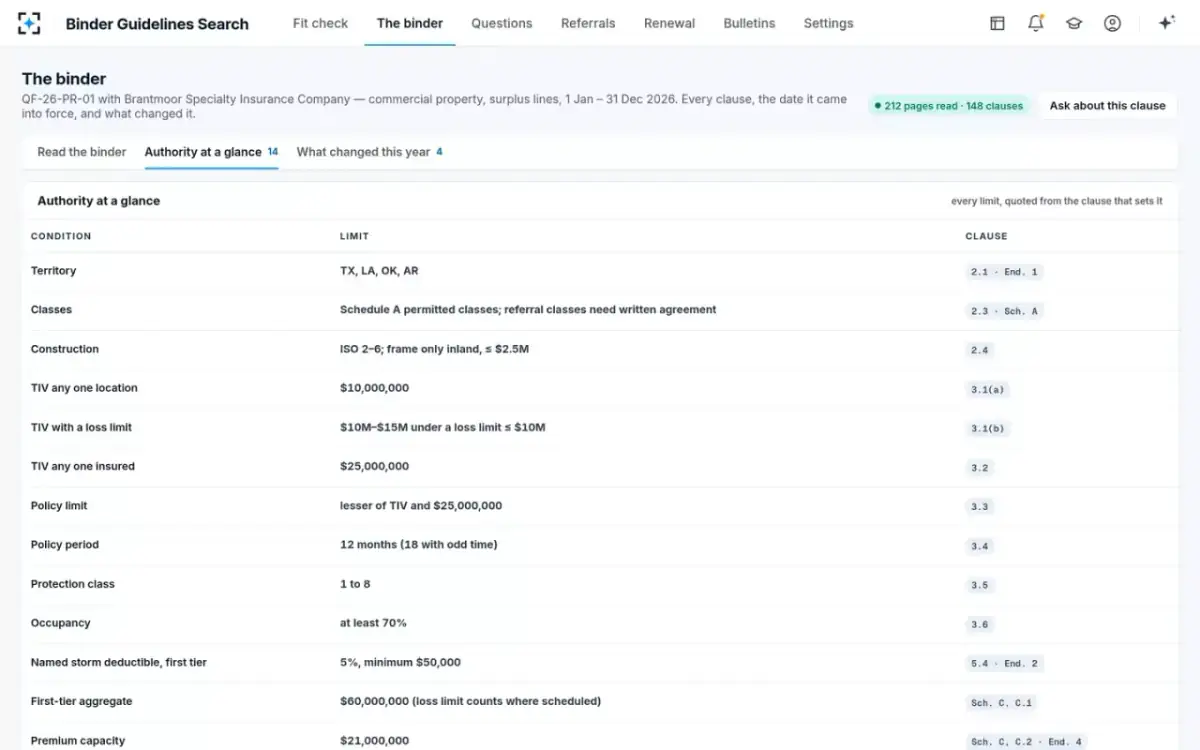
Every limit in the binder on one page, each with the clause that sets it
Questions people ask
What is the difference between an MGA and an underwriter?
An MGA is a firm; an underwriter is a person. The MGA holds delegated authority from an insurer under a written contract, and its underwriters use that authority to accept or reject risks. Under Model #225 the firm, not the individual, is the MGA, and the contract may not be assigned by it.
Do MGA underwriters need a licence?
The MGA itself must hold a producer licence: Model #225 §3 says no person may act as an MGA for risks in a state "unless such person is a licensed producer in this state". Whether each individual underwriter needs a personal licence depends on the state and on whether they solicit or negotiate insurance; check the state's producer licensing law.
Can an MGA underwriter decline a risk the carrier would accept?
Yes. The binder sets the outer limit of what the MGA may write, not a duty to write everything inside it. Under the model law, underwriting authority is the power to decline as well as to accept, and declining within authority needs no referral.
What happens if an MGA underwriter binds outside authority?
It is a breach of the MGA's contract with the insurer, and the people behind it can be personally liable. In Markel v Surety Guarantee Consultants (2008), the English Commercial Court found that bonds had been issued over the binding authority's financial limits and held four individuals liable for the sums the insurers reasonably paid out on claims under the unauthorised bonds.
Is the MGA underwriter job at risk from AI?
BLS projects underwriter employment to fall 4% from 2025 to 2035 and names automated underwriting software as the reason. The judgment at the edge of a binder, where most referrals arise, is the hardest part to automate; what software does well is find and test the clauses, which is what a binder search is for.