An MGA underwriting platform is the software a managing general agent uses to quote, bind, issue and report business under the binding authorities it holds from its carriers, and at its core is a question only the binder can answer: is this risk within our authority? Whatever platform an MGA chooses, that answer is only as good as the documents behind it: the signed binding authority agreement, its schedules and rating guide, every endorsement with the date it came into force, the referral criteria, the carrier's bulletins and the MGA's own authority letters. The law sets the floor: NAIC's model act requires separate records of the MGA's business that the insurer can copy in a form it can use (NAIC Model #225 §4D). Botminds' Binder Guidelines Search is the part of the platform that reads the binder clause by clause and answers fit questions with the clause that decides them; this guide lists what it, or any platform, needs on the first day.
The examples use a fictional MGA, Quillfield Underwriting Managers, and its fictional carrier, Brantmoor Specialty. Statutes and court records are real.
The documents an MGA underwriting platform needs to answer authority questions on day one
- The signed binding authority agreement
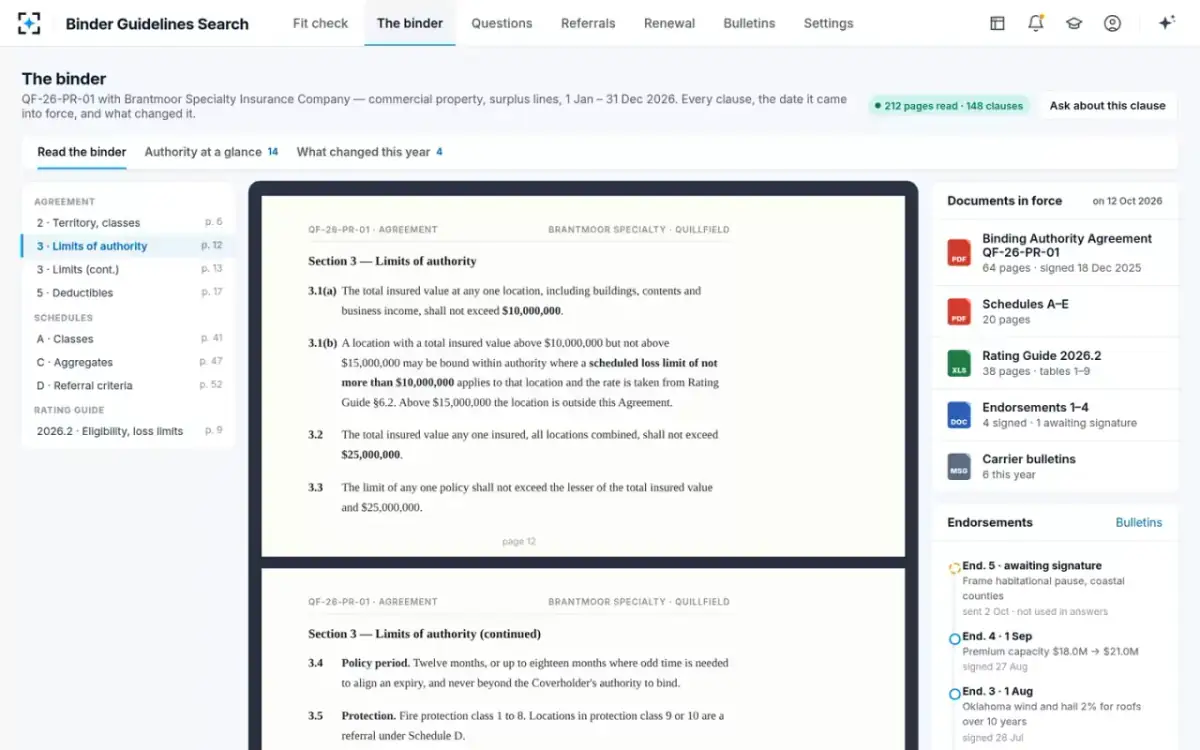
The executed copy with its signature date, not the last draft. In the sample: 64 pages, signed 18 December 2025.
- Every schedule
Classes, aggregates and capacity, referral criteria. In the sample, Schedules A to E run to 20 pages and decide most questions.
- The rating guide edition the binder names
With the sections a conditional route depends on: the sample’s loss-limit route is priced from §6.2 of Rating Guide 2026.2.
- Every signed endorsement, with two dates
The date it was signed and the date it came into force. They are not always the same.
- Pending endorsements and carrier bulletins, marked as pending
So the platform can say a change is coming without applying it.
- Referral routing and answer times
Who at the carrier decides each line, and in how many business days.
- Each underwriter’s authority letter
The MGA’s own limits per person, usually narrower than the binder. A binder check does not replace them; keep them beside it.
- Last year’s binder
Risks bound under it are still in force, and the auditor will test them against it.
- A month of real submissions
Schedules of values, loss runs and certificates, with what the underwriters decided, to test the answers before anyone relies on them.
What is an MGA underwriting platform?
An MGA underwriting platform is the set of systems an MGA runs its delegated business on, usually some mix of rating and quoting, policy issuance, document management, bordereau reporting to carriers, and the rules of each binder it writes under. Different vendors bundle those parts differently, and many MGAs run several systems. The useful question for a buyer is not which bundle, but which part answers the authority question, and from what.
That part has a legal job as well as a commercial one. A September 2026 draft of NAIC's State Licensing Handbook notes that in most states an MGA must be licensed as a producer and may not place business until all parties have signed a written contract (NAIC State Licensing Handbook, chapter 24 draft). The contract is the binder. A platform that cannot tell an underwriter what that contract allows, on the effective date of the risk in front of them, leaves the most important rule in the business to memory.
What does an MGA platform do, and which part is about authority?
Most of an MGA platform moves data: submissions in, quotes out, policies issued, bordereaux sent. The authority part decides whether a risk may be bound at all, and it is the only part whose errors the carrier treats as a breach rather than a service issue. In Markel v Surety Guarantee Consultants, the court recorded that the monthly bordereaux were how the carrier's manager was meant to check that the coverholder's business stayed within the binder's limits ([2008] EWHC 1135 (Comm)). An authority check at the point of binding catches before the fact what a bordereau can only show after it.
The authority part also has to know things no single document holds. Some limits are shared by everyone writing under the binder, and their headroom changes with every bind.
Two shared limits in one sample binder: how much is already used
Premium capacity, $21.0M
- Written, $15.84M · 75%
- Left · 25%
First-tier coastal aggregate, $60M
- Bound before this risk, $46.3M · 77%
- Left · 23%
What documents does an MGA need to set up an underwriting platform?
The binder and everything that changes it, plus the MGA's own limits, plus enough real submissions to test the answers. The checklist at the top of this page is the minimum; three points about it are where implementations go wrong.
First, executed copies, not drafts. Negotiation leaves several versions of a binder in circulation, and only the signed one governs. Second, dates on everything: an endorsement has a signature date and an in-force date, and a risk's effective date decides which wording applies, as which version of the binder applied on the day explains. Third, side documents for what they are. In the Markel case an operating document agreed alongside the binder, covering reporting and accounts, carried the binder's own title, and the court had to decide that it was not an amendment (the binding authority guide quotes it). A platform library should hold such documents, labelled, and never let them change an answer about authority.
The binder library in Binder Guidelines Search: documents in force, endorsements dated
Who owns the binder documents at an MGA?
Nobody, at many MGAs, which is the problem. The agreement sits with whoever negotiated it, endorsements arrive by email to the head of underwriting, bulletins land in an underwriter's inbox, and authority letters live in HR files. A platform forces the question of ownership, and the answer should name a person for each document and a person who decides when a change takes effect.
Who should own each part of the binder library at an MGA
Today
Receives endorsements and bulletins by email and tells the team.
With agents
Accepts each signed endorsement into the library with its in-force date; decides when a bulletin becomes a change.
Still theirs: When a change to authority takes effect.
Today
Keeps the signed agreement and the authority letters in separate places.
With agents
Owns the library: executed copies, schedules, letters, last year’s binder, side documents labelled.
Still theirs: That the library matches what was signed.
Today
Keep personal copies and notes of the limits they use most.
With agents
Ask the library, not their notes; flag a clause that reads wrongly.
Still theirs: The decision on each risk.
Today
Sends bulletins and answers referrals, unsure what the MGA has applied.
With agents
Sees the bulletin matched to the clause it would change and the open quotes it touches.
Still theirs: What the carrier signs, and referral decisions.
Today
Asks for the binder and endorsements at each review and rebuilds the timeline.
With agents
Reads the log for this binder only, each answer with the version in force that day.
Still theirs: The audit finding.
What records must an MGA keep?
Separate records of the business written for each insurer, in a form the insurer can use, kept for the period the state sets, and open to the regulator. The model act and the states that follow it agree on the core and differ on detail.
What MGA records rules say in the model act and four states
| Source | What it requires | Kept for |
|---|---|---|
| NAIC Model #225 §4D | Separate records of the MGA’s business; insurer access in a usable form; the commissioner may see all books and records | Per the state’s retention statute |
| Texas Ins. Code §4053.104, §4053.102 | Separate records for each insurer, available to the insurer and the department’s examiners; the contract must address "reports, records, and auditing" | Not stated in these sections |
| Florida Stat. §626.7451(4) | Separate records "unless the managing general agent is a controlled or controlling person"; insurer access in a usable form | According to §626.561 |
| New York 11 NYCRR §33.5(d) | Separate records; insurer access in a usable form; the superintendent may see all books, bank accounts and records | According to Part 243 (Regulation 152) |
| North Carolina G.S. §58-34-2 | Separate records; insurer access in a usable form | According to 11 NCAC 11C.0105 |
None of these rules mentions underwriting questions directly, but records in a form the insurer can use is the standard a carrier's auditor will apply to the evidence of how authority was checked. A log that shows, for each risk, the question, the verdict, the clauses returned and the version in force that day meets it far better than a folder of emails.
If the platform cannot show which version of the binder applied on the day a risk was bound, the carrier's right to usable records is a right to a puzzle.
How to mark the version in force, so the platform never guesses
Give every document three dates and one state, and never overwrite. The three dates are signed, in force from, and superseded on; the state is in force, pending or superseded. A risk's effective date then selects the wording without anyone deciding by hand. A renewal draft is held as pending and never used in answers until it is signed and in force.
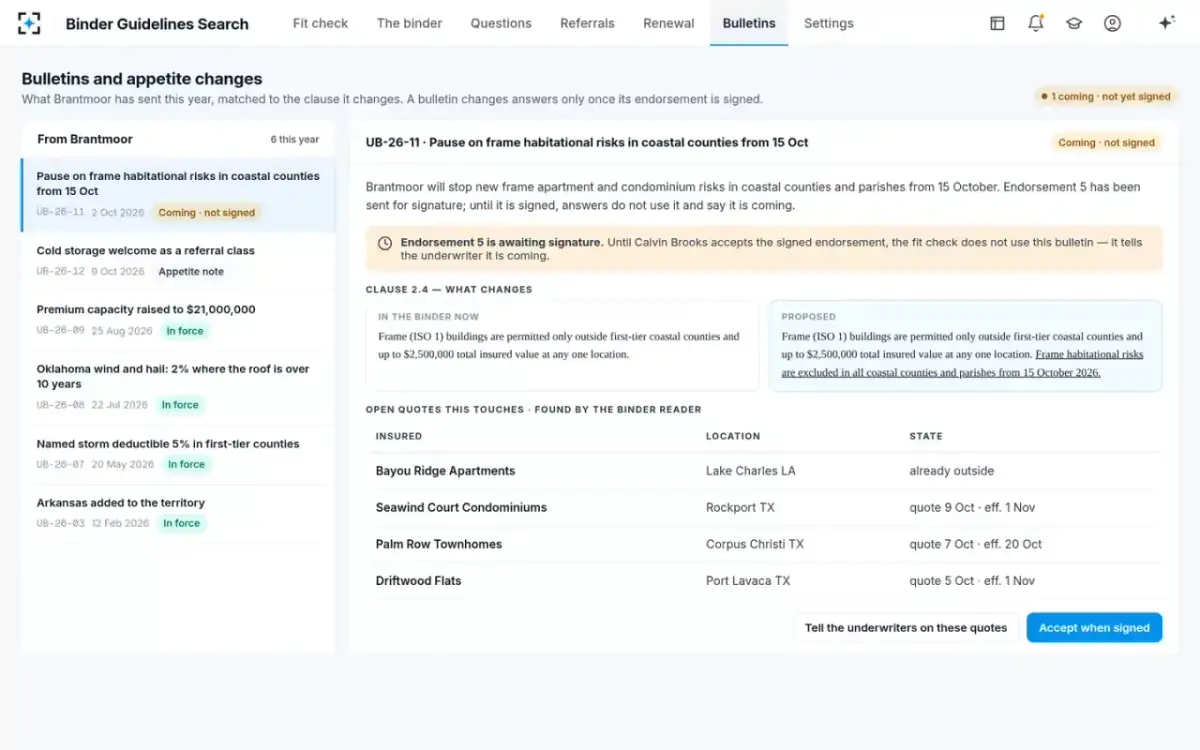
Carrier bulletins need one more mark: the clause they would change. In the sample, bulletin UB-26-11 proposes to exclude frame habitational risks in coastal counties and parishes from 15 October as a change to clause 2.4, and its endorsement was sent for signature on 2 October. Matched to the clause, it can be shown to underwriters as coming, with the open quotes it would touch, while answers keep using the signed wording.
A bulletin matched to the clause it would change, and the open quotes it touches
What goes wrong when a document is missing
A missing document does not make a platform fail loudly; it makes it answer confidently from what it has. That is why the gathering step deserves more care than the loading step. Each gap in the library produces a specific, predictable wrong answer, and each can be found in a pilot by asking a question that depends on the missing piece.
Six gaps in a binder library, and the wrong answer each one produces
| Missing | What the platform does without it | Example on the sample binder |
|---|---|---|
| A signed endorsement | Applies the old wording to a risk after the change | Accepts a 2% named storm deductible in a first-tier county after the 5% minimum took effect on 1 June |
| A schedule | Passes a risk that a referral trigger should send to the carrier | Binds a risk with a $120,000 loss in the last five years, which Schedule D refers |
| The rating guide edition | Cannot re-rate a permitted alternative, or prices it off the binder’s basis | Offers the loss-limit route without the §6.2 rate the clause requires |
| Written exposure to date | Tests shared limits against an empty aggregate | Passes a coastal risk that takes the first-tier aggregate past 90% |
| An authority letter | The MGA checks the binder but not the person | Lets an underwriter with a personal $5M limit bind a $9M location the binder allows |
| Last year’s binder | Tests risks still in force against this year’s wording | Flags a policy bound in November 2025 against a clause that changed in 2026 |
How long does it take to launch an MGA platform?
The binder part takes as long as gathering and dating the documents, and that is usually longer than loading them. There is no published benchmark for MGA platform launches, and a full platform with rating, issuance and bordereaux is a different project from a binder search on documents the MGA already has. What can be said is where the time goes: finding executed copies, matching endorsements to the clauses they change, establishing which bulletins were ever signed, and collecting the authority letters.
A sensible order is the order of risk. Load the binders in force and test them on a month of past submissions first, because that answers the authority question for every new risk. Add last year's binder next, for the auditor. Add rating detail and referral routing after that. Anything that touches issuance or bordereaux can follow without changing the authority answers.
Where Binder Guidelines Search fits in an MGA platform
Binder Guidelines Search is the authority layer: it works with binding authority agreements, rating guides, referral criteria, carrier bulletins and broker submissions, and it produces audit and renewal exports. It reads each binder clause by clause with the date each clause came into force, answers fit questions per location in the version in force on the effective date, names the closest permitted alternative and re-rates it from the binder's rating guide, and drafts referrals and broker notes for the underwriter to send. It is not a policy administration system and does not issue policies or produce bordereaux.
The fastest way to see whether it fits is to run it on your own binder and last month's submissions; an AI underwriting assistant tool compared with PDF search and the referral desk describes how to score that pilot, and what a binding authority agreement contains is a useful map of what to gather. To see the library and the answers on the sample binder, start from Binder Guidelines Search.
Questions people ask
What does an MGA platform do?
It runs the delegated business: quoting, binding, issuing and reporting under each binder, and, in the part that matters most to the carrier, checking that each risk is within the authority the binder gives. The law requires the MGA to keep separate records of that business in a form the insurer can use.
Do I need the full binder or just the limits?
The full binder. Limits rarely stand alone: in the sample, the $10 million location limit sits next to a clause allowing up to $15 million under a loss limit, priced from a separate rating guide, and the deductible that decided the answer was in an endorsement.
Should pending endorsements be loaded?
Yes, marked as pending. An underwriter should know a change is coming, and which open quotes it would touch, but answers should keep using the signed wording until the change is accepted into force.
How many binders can one platform hold?
As many as the MGA writes under, each kept separate: different carriers, lines and years have different clauses, and a carrier's auditor should see only its own. The sample MGA holds a property binder, a general liability binder and a renewal draft that is never used in answers.
Who should approve changes to the binder library?
One named person, usually the head of underwriting, for anything that changes authority. In Binder Guidelines Search a bulletin or unsigned endorsement changes no answer until that person accepts the signed endorsement into force.