Underwriting referral means passing a risk to someone with more authority because the underwriter handling it is not allowed to decide it alone. Inside an insurer, that is a senior underwriter down the corridor. At an MGA or coverholder, it means the binder itself sends the decision back to the carrier: the risk is outside what the MGA may bind, but not necessarily outside what the carrier will accept, so the carrier's program underwriter decides. NAIC's model law frames the boundary: an MGA may accept or reject risks for the insurer, but only within the underwriting guidelines its contract must set out (NAIC Model #225). Botminds' Binder Guidelines Search answers the question that comes first: does this risk need a referral at all, and if so, is there a version of it the binder lets the MGA write today?
The examples follow a fictional MGA, Quillfield Underwriting Managers, and a fictional carrier, Brantmoor Specialty, through one sample binder year. The law and court records quoted are real.
How Binder Guidelines Search answers before anything is referred: ask first, then look for a way in
Agent
Risk readerTurns the underwriter’s question and the broker’s schedule of values into the details the binder tests: values by location, construction, county and tier, deductibles asked, losses, roof years.
Never: Fills a missing detail with a default; it asks, and the verdict waits.
Agent
Binder readerTakes the binder as amended on the effective date and pulls the clauses that apply.
Never: Uses an unsigned endorsement or a carrier bulletin.
Agent
Authority checkerTests every condition at every location: met, missed or close, each line with its clause.
Never: Says “within authority” while a condition is unknown.
Agent
Fits-if finderFor each miss, searches the binder for the smallest change it permits and re-rates it from the rating guide.
Never: Proposes a change the binder does not name.
A person decides
MGA underwriterDecides: bind as submitted, offer the alternative, split the schedule, refer, or decline.
Agent
Referral writerIf a referral is chosen, drafts it for only the locations that need the carrier, quoting the clause.
Never: Sends it; the underwriter does.
A person decides
Carrier program underwriterDecides the referral.
What does underwriting referral mean under a binder?
Under a binder, a referral is the MGA asking its principal for a decision the contract does not let it make. The binding authority gives the MGA a box: classes, limits, territory, rates, period and the rest of the eight underwriting items in Model #225 §4F. Inside the box the MGA binds. Outside it there are two kinds of risk: those the binder routes to the carrier for a decision, and those it excludes outright. A referral is the first kind.
The word "refer" carries a cost the insurer's own staff rarely feel. A referral crosses a company boundary. It goes in writing, to a person whose priorities are set by another employer, with an answer time set in the binder, while the broker waits and may place the risk elsewhere. That is why the most valuable referral is often the one an underwriter did not need to send.
What does "referred to underwriter" mean?
"Referred to underwriter" means an automated or junior check could not approve an application and a human underwriter must look at it. In personal lines and mortgage lending, it usually appears on an online application when a rule fires: an answer outside the automatic range, a missing document, an unusual history. It is not a decline; it is a decision that has not been made yet.
At an MGA the same words describe a different handoff. The MGA's underwriter is the human underwriter, and "referred" means the risk has gone past the MGA to the carrier. For how referrals work inside a carrier's own authority levels, see the underwriting referral process at a carrier; this guide stays with the delegate.
When must an MGA refer a risk to the carrier?
An MGA must refer when the binder says so, and the binder says so in three places. First, the underwriting limits: a risk over a value, outside a class or beyond a period cannot be bound by the MGA. Second, the referral criteria, usually a schedule, which can send a risk to the carrier even when every limit is met. Third, the hard stops in law, where the model act requires the insurer's own approval whatever the binder says.
The sample binder shows the first two side by side. Clause 3.1(a) caps any one location at $10,000,000. Schedule D then lists the referral triggers, including "Any location with a total insured value above $10,000,000, unless bound under clause 3.1(b)", "Any risk in protection class 9 or 10, or in a referral class in Schedule A", and "Any risk with a single loss above $100,000, or total losses above $250,000, in the five years before inception." A risk with a clean schedule but a $120,000 fire loss three years ago is inside every limit and still a referral.
The third place is statutory. Model #225 §4M forbids an MGA, without the insurer's prior approval, to pay or commit the insurer to pay a claim above a set amount, net of reinsurance, which may be no more than 1% of the insurer's policyholder surplus (the clause is quoted in claims settlement authority letter), and New York's regulation repeats it (11 NYCRR §33.5). On the underwriting side, §5D keeps "Binding authority for all reinsurance contracts" with an officer of the insurer who is not affiliated with the MGA.
A surety binding authority set its maximum bond period at "3 years (unless specially accepted)": the referral route written into the limit itself.
Markel International v Surety Guarantee Consultants, [2008] EWHC 1135 (Comm)
Some agreements are referral-only from the start. In the same Markel case, a second insurer gave the same firm an underwriting management agreement that authorised it "to submit for approval Surety Bonds", while the first binder had authorised it "to bind surety bonds" ([2008] EWHC 1135 (Comm)). The difference between those two phrases is the difference between a binder and a referral desk.
Refer, decline or outside: three answers that are not yes
A good binder answer distinguishes three ways of saying "not as submitted", because each sends the underwriter somewhere different. Collapsing them into a single "refer" is the most common source of needless referrals.
Three ways a binder says 'not as submitted', and what the underwriter does next
What the binder says: The risk misses a condition the referral criteria route to the carrier, such as a location over $10M with no loss limit.
What the underwriter does: Look for a permitted alternative first; if none suits the insured, send a referral for only the part that needs the carrier.
What the binder says: The binder excludes the risk, such as frame construction near the coast, or inland over $2.5M, in the sample.
What the underwriter does: Decline under this binder. A referral asks the carrier to write what the contract says the MGA cannot offer, and should be rare.
What the binder says: Nothing: the risk fits, but the underwriter does not like it.
What the underwriter does: Decline. Underwriting authority under the model law is the power to accept or to reject; declining within it needs no referral.
What the binder says: A condition cannot be tested: roof year, county tier or a loss figure is missing.
What the underwriter does: Ask the broker. Neither yes nor refer is an answer yet.
Why the best referral answer starts with a question
The answer to "can we write this?" is only as good as the details behind it, and the worst error is a confident yes built on an assumption. If the schedule of values omits a roof year, a tool that assumes a recent roof will say within authority; a tool that assumes an old one will say refer. Both are guesses. The honest answer is a question back to the underwriter: what year is the roof at Humble?
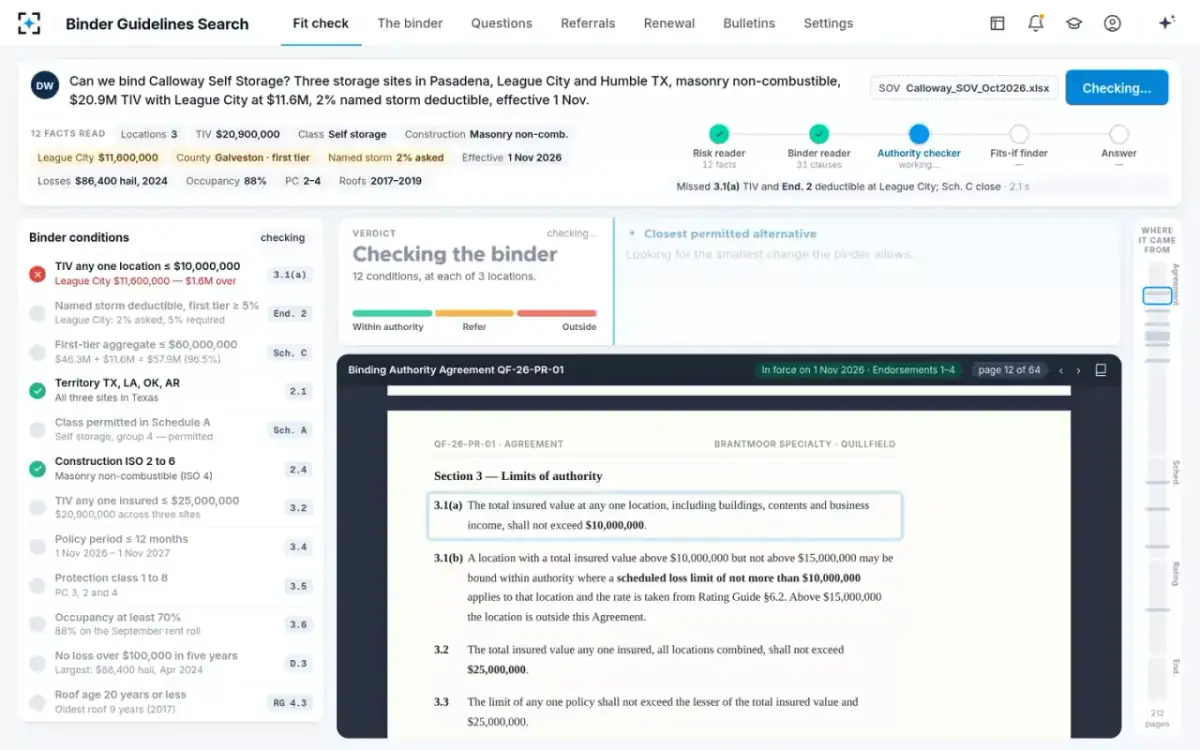
That is why Binder Guidelines Search will not show "within authority" while any condition is unknown, and why its first agent never fills a gap with a default. In the sample check on Calloway Self Storage, the risk reader turned the underwriter's question and the broker's schedule into twelve details, among them "League City $11,600,000", "Galveston County, first tier" and "2% named storm asked", and the authority checker could test all twelve conditions because none was missing. When one is, the verdict waits.
Binder Guidelines Search checking the binder: each condition ticked as it is tested
Refer as submitted, write within authority as altered
Many referrals are not about whether the carrier would take the risk but about whether the MGA can take a slightly different version of it. The sample risk is a referral as submitted: League City is $1.6 million over the any-one-location limit, and its 2% named storm deductible is below the 5% an endorsement has required in first-tier counties since 1 June. But clause 3.1(b) lets a location of $10 million to $15 million be bound "within authority where a scheduled loss limit of not more than $10,000,000 applies".
So the answer is not just refer. It reads: fits if League City is written at a $10,000,000 loss limit with a 5% named storm deductible ($580,000), re-rated from the rating guide from $118,450 to $112,270. Beside it sit two other options the binder allows: bind Pasadena and Humble now and refer League City alone, or refer the whole risk at full value. The underwriter chooses. Over the sample binder year, 318 risks were referrals as asked and 147 of them were bound within authority after a change of this kind.
What happens after an underwriting referral?
After a referral, the carrier's program underwriter decides: approve as asked, approve on conditions, or decline. The MGA then binds what was approved, on the terms approved, and keeps the carrier's answer with the risk. The decision is the carrier's. Binding a referred risk before the answer arrives is binding outside authority, and because Model #225 §6 treats the MGA's acts as the insurer's own, the insurer carries the consequence.
Not every clause sends the same kind of referral. In the sample year, the carrier received 171 and approved 139. Grouped by the clause that triggered them, the referrals show where the binder is tighter than the carrier's appetite, and where it is not.
Which clauses sent risks to the carrier in a sample year, and how many it approved
A clause whose referrals are nearly all approved, such as cold storage (36 of 41) or roof age (17 of 19, every approval a metal roof), is a candidate for wider authority at renewal. A clause whose referrals are mostly not approved, such as frame construction (4 of 18), is doing its job. The pattern only shows if every referral is kept with the clause that caused it.
How long does an underwriting referral take?
As long as the binder allows, plus however long it takes to send a complete one. No published regulator or research source gives an industry-wide turnaround for MGA referrals, so the honest answer is to read your own binder. The sample binder's Schedule D says the carrier "shall answer a referral within two business days of receiving it complete"; its general liability binder allows three. The word that matters is "complete": the clock starts when the carrier has what it needs.
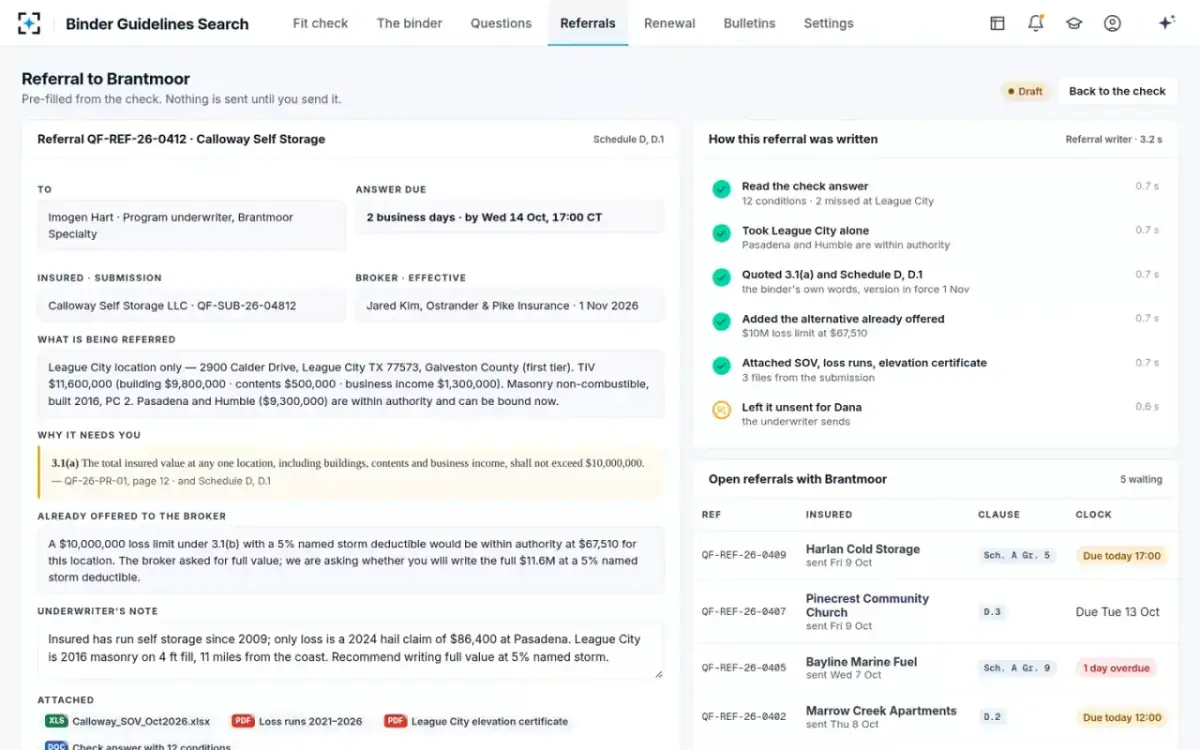
A referral for only the location that needs the carrier, with the clause quoted and the clock set
What should a referral to the carrier include?
A referral should let the carrier decide without a follow-up question, because every follow-up restarts the clock. The checklist below is what the sample referral carries; most of it can be pre-filled from the check that found the miss.
What a complete MGA referral carries
- Only what needs the carrier
The location or coverage that missed, not the whole schedule; the rest can often be bound now.
- The clause, in the binder’s words
With the page and the version in force on the effective date. A paraphrased limit invites a dispute about the limit.
- The exact miss
$11.6M against $10M, not "over the limit"; 2% asked against 5% required.
- What was already offered
The permitted alternative and its premium, so the carrier is deciding the gap, not the whole risk.
- The underwriter’s view
Why the MGA thinks the carrier should accept: construction, elevation, loss history, the insured’s record.
- The files
Schedule of values, loss runs, surveys or certificates the decision needs.
- The clock
The answer time from the binder, counted from the moment the referral is complete.
A referral built this way is also an argument for the renewal. The MGA referral process prices the days each one costs and shows how the approved ones become wider authority; which version of the binder applied on the day covers the referral that turns on a mid-year endorsement. To see the whole path from question to referral, start from Binder Guidelines Search.
Questions people ask
Is a referral a decline?
No. A referral moves the decision to someone with more authority; a decline ends it. In the sample year the carrier approved 139 of the 171 referrals it received, about 81%.
Can an MGA bind a risk while the referral is pending?
Not the referred part. Binding before the carrier answers is binding outside authority. The MGA can often bind the parts of a schedule that fit, as in the sample where two of three storage sites were within authority, and refer only the third.
Who approves MGA referrals?
The carrier's program or delegated underwriting team, named in the binder or its routing schedule. In the sample, property referrals go to the carrier's program underwriter with two business days to answer; general liability referrals go to a casualty program underwriter with three.
What are referral criteria in a binding authority?
A list, usually a schedule, of risks that must go to the carrier even if they meet the limits: high protection classes, referral classes of business, loss history above a threshold, values above a level unless written on a condition. They sit alongside the limits, not inside them, which is why both must be checked.
Does the law say when an MGA must refer?
Mostly the contract does. Model #225 requires the contract to set underwriting guidelines and lists acts an MGA may not do without the insurer, such as committing it to a claim over 1% of its policyholder surplus or binding reinsurance outside an obligatory facultative agreement.