A coverholder audit is the review an insurer or Lloyd's managing agent carries out of a coverholder, a firm it has authorised to bind insurance in its name, to test whether the business written, the premium collected and the claims paid stayed within the binding authority. It covers the delegate's underwriting, claims handling, premium and money controls, reporting and governance, usually through an information request, testing of the bordereaux and a sample of files, and a visit. By Botminds' estimate, preparing one semi-annual delegate audit by hand takes about three working weeks, and the largest single block of that time goes on testing the sampled files. No regulator or research body publishes audit durations or fees, so this guide prices an audit as a method and shows where the days go. Botminds' MGA & Coverholder Audit is an agentic solution that does the preparation: agents request and read the files, test every risk and claim against the binder and draft the findings for the auditor to rate and sign.
The examples come from the solution's fictional sample data: Harrowgate Specialty, a carrier with 14 delegates, auditing Bayline Coastal Underwriters for April to September 2026. The day counts are Botminds' estimates for one mid-size delegate, not measured results; replace them with your own timesheets.
Where one delegate audit's working days go, by hand
One semi-annual audit, 15 working days
- Requesting and chasing files · 20%
- Testing bordereaux against the binder · 13%
- Choosing the sample · 7%
- Testing the sampled files · 33%
- Writing findings and report · 20%
- Chasing agreed actions · 7%
What is a coverholder audit?
A coverholder audit is the insurer's check on business it did not write itself. A coverholder acts as the insurer's agent, not the policyholder's, which HMRC's Lloyd's manual states in so many words (HMRC Lloyd's Manual, LLM1100), so every risk it binds and every claim it pays is the insurer's. The audit asks whether that business was written inside the binding authority, whether the money arrived, whether claims were handled as agreed, and whether the delegate's own controls will keep it that way.
In the US the same audit is called an MGA review, and statute sets its clock: the NAIC's model law requires an on-site review of the MGA's underwriting and claims operations at least twice a year, and Florida at least once a year (Fla. Stat. §626.7454). No UK rule read for this guide sets a fixed calendar; in London the managing agent decides the frequency under its own oversight framework. The terms on both sides are defined in thirty terms of delegated authority.
What does a coverholder audit cover?
A coverholder audit covers whatever the binding authority lets the coverholder do, plus the controls the insurer relies on. A typical scope has seven areas. Market-wide audit scopes exist, but the scope that counts is the one written from the delegate's own binder and the insurer's own rules, so that every test has a clause behind it.
Seven areas a coverholder audit scope should cover
- Authority and licences
The binding authority, schedules and endorsements in force; licences and permissions in each territory; any sub-delegation.
- Underwriting
Classes, territories, limits and aggregates; referrals approved before binding; rates and documented deviations; sanctions screening; documents issued on time.
- Claims, where delegated
Notice, acknowledgement, coverage positions, reserves and reviews, payments inside the settlement authority, files sent to the insurer.
- Premium and money
Premium declared against premium received; remittance on the binder’s terms; trust or fiduciary accounts held for the insurer.
- Reporting
Bordereaux complete, on time and consistent with the files and the bank.
- People and governance
Who may bind and settle, staff changes, training, complaints, conflicts, business continuity.
- Last audit’s actions
Whether each agreed action was closed on evidence, and whether the same exception has come back.
How long does a coverholder audit take?
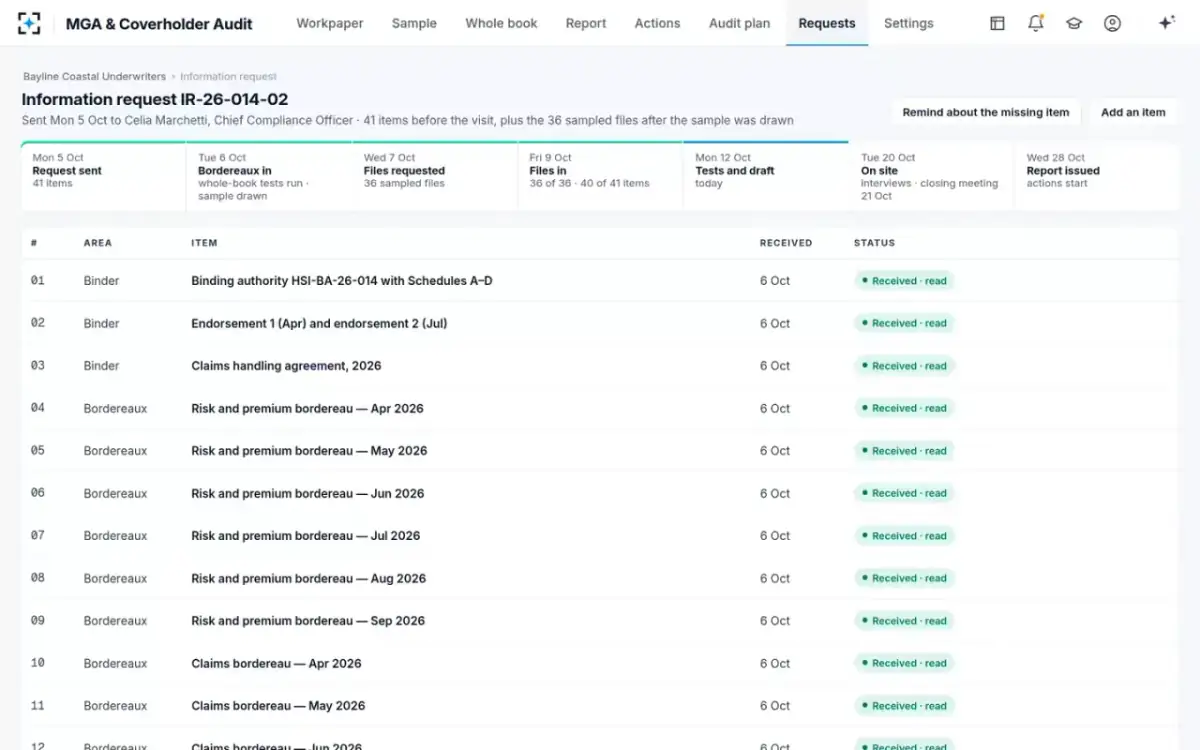
By our estimate, about three working weeks of preparation by hand for a mid-size delegate, before a visit of one or two days, with the report and actions following over the next weeks. The weeks are not one block. In the fictional Bayline audit, the information request went out on Monday 5 October, the bordereaux arrived on the 6th, the sampled files were requested on the 7th and in by the 9th, the visit was on 20 and 21 October, and the report was due on the 28th, with actions running 30, 60 or 90 days after issue depending on their rating.
The largest block by hand is testing the sampled files: opening each, finding the document that answers each test step, and writing down what it showed. The next are the request, which is mostly waiting and chasing, and the write-up, which is mostly re-typing what the workpaper already says into the report's format.
One delegate audit's preparation, by hand and with agents
- Request and chase3 d
- Bordereaux and sample3 d
- Test files5 d
- Write up, chase actions4 d
- Auditor review2.5 d
How much does a coverholder audit cost? A method, not a price
Nobody publishes a reliable price for a coverholder audit, and a single figure would mislead: the cost depends on the delegate's size, how many classes and territories it writes, whether it handles claims, and how clean its bordereaux are. What can be done is to write the cost as a sum and fill each term with your own numbers. Four terms cover most of it.
The cost of one delegate audit, term by term
Auditor preparation
days × loaded day rate
Requesting, testing, sampling, file testing, writing. Our estimate: 15 days by hand for a mid-size delegate.
DA audit manager
The visit
(people × days) × day rate + travel
Interviews and walk-throughs on site; the statutes in US MGA acts require it.
DA audit manager
Specialist time
hours × loaded hourly cost
Claims, underwriting or actuarial review of the files the auditor cannot judge alone.
Claims and underwriting leads
Follow-up
actions × hours to verify closure
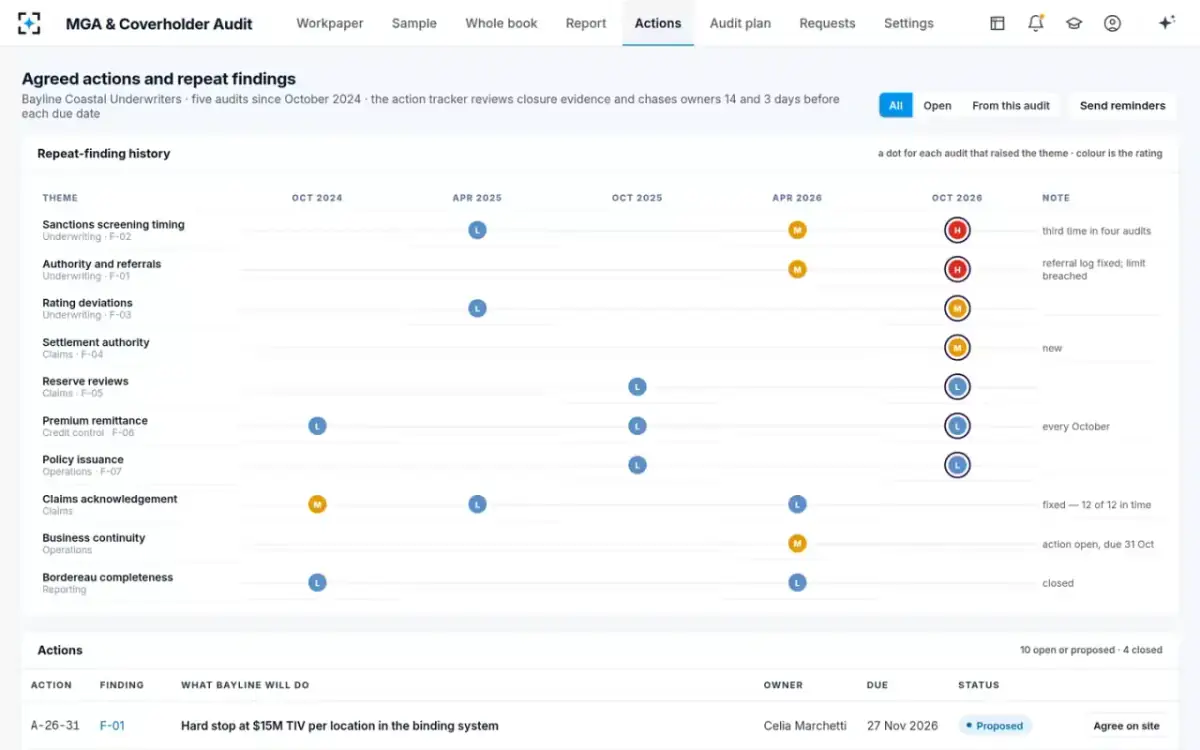
Chasing owners, reading closure evidence, re-testing; grows with every repeat finding.
DA auditor
To put an order of magnitude on the first term only: the median wage for US accountants and auditors was $83,680 in May 2025 (Bureau of Labor Statistics), about $322 for an eight-hour day before benefits and overhead. At 15 days, the preparation of one audit is about $4,800 in wages; at 28 audits a year for a 14-delegate book, about $135,000, before any visit, specialist or follow-up. That is our arithmetic on a national median for a broad occupation, not a delegated authority salary; a London team or an outside firm will cost more, and the method is the point.
Which costs grow with every delegate?
Almost all of them, which is why the cost of a delegated authority programme rises in step with the number of delegates rather than with premium. A carrier that adds a delegate adds two audits a year under a semi-annual rule, each with its own request, its own bordereaux in its own layout, its own sample and its own report. Only a few costs are paid once.
What one more delegate adds to the audit programme
| Cost | Paid | Grows with | What changes it |
|---|---|---|---|
| Reading the binder into tests | Once per binder, again at each endorsement | Delegates and endorsements | Limits read from the binder into settings, with the clause cited |
| Information request and chasing | Every audit | Delegates × audits a year | One request built from the scope, chased automatically, marked received only once read |
| Bordereau testing | Every audit | Delegates × records | Every record tested against the binder in minutes rather than days |
| Choosing and testing files | Every audit | Delegates × files | Files chosen for risk with the reasons recorded; each step tested against a cited page |
| Report writing | Every audit | Delegates × findings | Findings drafted from the workpaper in the report’s format |
| Visit | Every audit | Delegates × visits | Unchanged: the visit stays with the auditor |
| Following actions | Continuous | Findings, and repeats above all | Owners chased before due dates; actions reopened when the exception returns |
How often are coverholders audited?
As often as the governing rule or the insurer's framework requires: in US states that adopted the NAIC model, at least twice a year for each MGA; in Florida, at least once a year, with a new MGA reviewed within six months; in London, at a frequency the managing agent sets by risk. Regulators on both sides are watching the result. The FCA's 2026 insurance priorities commit it to "expand our review of firms’ oversight of outsourced claims processes, to include different delegated authority models and remuneration arrangements", and to an oversight review of outsourcers and delegated authority models "with an aim to report our findings in early 2027" (FCA, Regulatory Priorities: Insurance, February 2026).
The FCA has looked before. Its 2015 thematic review covered 12 insurers and 19 firms that held underwriting or claims authority from them, and found that insurers did not always treat delegated arrangements as outsourcing (FCA TR15/7, June 2015); the FCA has since marked that review historical. Frequency set by risk means the riskiest delegates are seen more often, which only works if the insurer can see which delegates are riskiest between audits.
Who carries out coverholder audits?
The insurer or managing agent that granted the authority is responsible, and its delegated authority team usually does the work, with specialists for claims or underwriting and sometimes an outside audit firm for capacity or independence. The delegate's own compliance officer is the counterpart: the person who answers the request, hosts the visit and owns the actions. In the fictional Bayline audit that is Bayline's chief compliance officer, who receives one request of 41 items and, later, the exact files and passages behind each finding. Who sits in each seat, and what each produces, is set out in the delegated authority auditor guide.
One information request, with the audit's calendar across the top
The most expensive audit is the one that finds nothing
An audit's cost is visible; the cost of an audit that missed something arrives later and is larger. In the Markel case, the two firms that had given the same surety coverholder its authority each audited it within months of each other, and neither audit found the bonds written over the binder's limits, because the files had been altered to match the bordereaux. The second firm's audit, by the underwriting agency that had taken over the business for another insurer, did not reveal the overwritten bonds either, "However, the audit was regarded as unsatisfactory because of the poor state of SGC’s records", and that agency terminated its agreement with the coverholder in 2006, after the unsatisfactory audit and the discovery that some bonds had been written in breach of the financial limits (Markel v Surety Guarantee Consultants, [2008] EWHC 1135 (Comm)). The full scheme came out only in the litigation that followed.
US law prices the failure into the insurer's balance sheet. If an insurer enters rehabilitation or liquidation and the receiver finds the MGA "has not materially complied" with the MGA act, "the receiver may maintain a civil action for recovery of damages or other appropriate sanctions for the benefit of the insurer" (NAIC Model #225, §7B). An audit that would stand up in that action, with the tests, the sample and the evidence recorded, is worth more than one that merely happened.
Where Botminds' MGA & Coverholder Audit changes the arithmetic
The solution takes the parts of the audit that scale with delegates and records, and leaves the parts that need judgement. In the fictional Bayline audit, the agents built and chased the 41-item request, ran 14 tests on all 2,318 risks and 412 claims in 11 minutes, drew a sample of 36 files with the reason for each, tested each sampled file's eight steps against cited pages, most of them overnight, and drafted seven findings. The auditor's days went on the exceptions, the visit and the ratings; two High findings went to the head of delegated authority for approval before the delegate saw them.
What it does not change: the visit, the specialist questions, and the delegate's own time answering the request and fixing what was found. The MGA audit checklist sets out the tests and an eight-week plan to run them on a first delegate, which is the honest way to measure the saving on your own book.
The follow-up cost, made visible: actions and repeat findings across five audits
Questions people ask
What is a coverholder audit scope?
The scope is the list of areas and tests the audit will cover for that delegate and period: authority and licences, underwriting, claims if delegated, premium and money, reporting, governance and last year's actions. It should be written from the delegate's own binding authority, so each test can cite the clause it checks.
How much does a coverholder audit cost?
No reliable public figure exists. Price it as auditor days times a loaded day rate, plus the visit, specialist hours and follow-up. On our estimate of 15 preparation days and the 2025 US median wage for accountants and auditors, preparation alone is about $4,800 in wages per audit before benefits, overhead and travel.
Who pays for a coverholder audit?
Usually the insurer or managing agent pays for its own audit team or outside auditors, and the coverholder bears its own time answering requests and hosting the visit. A binding authority may say who bears the cost of audits, including follow-up audits; check the binder's audit clause.
Can a coverholder audit be done remotely?
Much of it can: requests, bordereau testing and file testing work on documents the delegate sends. In US states with MGA acts, the statutory review is described as on site, so the visit cannot simply be dropped; in London the managing agent's own framework decides how visits and remote testing are combined.
What happens after a coverholder audit?
The insurer issues a report with rated findings, agrees actions with the delegate, each with an owner and a due date, and verifies closure on evidence. Serious or repeated findings can lead to restrictions on the authority, a follow-up audit, or the end of the binder at renewal.
How long should audit evidence be kept?
For as long as the business it covers can still produce claims and questions, and at least as long as the applicable record-retention rules require. In the fictional sample setup, audit records are kept for the life of the binder plus seven years.