A delegated authority auditor is the person at an insurer who tests whether its delegates, the managing general agents (MGAs), coverholders and other agents that bind risks or settle claims in the insurer's name, did what their binding authority allowed. The auditor requests the delegate's bordereaux and files, tests risks and claims against the binder's limits, visits the delegate, rates findings and follows the agreed actions to close. In US states that follow the NAIC's model law, the insurer must review each MGA's underwriting and claims operations on site at least twice a year, so an auditor with a dozen delegates runs two dozen audits a year, each built on a sample of perhaps thirty files out of thousands. Botminds' MGA & Coverholder Audit is an agentic solution built for that seat: agents test every risk and claim against the binder, pick the files most likely to fail and draft the findings, and the auditor rates and signs.
The job is old; the volume is not. One auditor's season is a series of near-identical audits, each one weeks of requests, spreadsheets and Word documents, and the same findings tend to come back. The examples below follow a fictional carrier, Harrowgate Specialty, as it audits one of its 14 delegates in the solution's sample data. The rules and figures come from statutes, regulators and the Bureau of Labor Statistics, linked where they appear.
Six seats around one delegate audit, and what each keeps
Today
Weeks per delegate on requests, sample picking, workpaper ticking and report drafting; tests 30 or so files and hopes they are the right ones.
With agents
Starts from every risk and claim already tested against the binder, and spends the time on the files that failed, the visit and the ratings.
Still theirs: The opinion, every rating, the signature
Today
Hears that a finding is a repeat after the report has gone to the delegate.
With agents
Approves every High finding before it leaves the carrier, with the repeat history beside it.
Still theirs: Approval of High findings; renewal and exit decisions
Today
Answers a long request, then learns about findings without the exact files behind them.
With agents
Gets one request, the files and passages behind each finding, and her own actions with due dates.
Still theirs: The delegate’s response and its fixes
Today
Takes on trust how the sample was chosen.
With agents
Reads the sampling memo: the weights, the random seed, each file’s reasons.
Still theirs: Independent review of the DA function
Today
Pulled in late to read files the auditor could not judge.
With agents
Asked about the handful of files where the test failed and the answer needs a specialist.
Still theirs: Technical judgement on a claim or a risk
Today
Reviews reserves the delegate set, separately from the audit.
With agents
Sees the claims the audit flagged for reserve reviews alongside the opinion work.
Still theirs: The annual opinion on reserves the MGA set
What does a delegated authority auditor do?
A delegated authority auditor plans and performs the insurer's reviews of each delegate and reports what was found. A season usually runs on a plan: which delegates are due, on what dates, and with what focus, weighted toward the delegates with the most premium, the weakest last opinion or the most open actions. Each audit then follows the same arc: an information request, receipt of the binder and bordereaux, testing, a sample of policy and claim files, an on-site visit with interviews, a draft report with rated findings, approval, issue, and actions tracked to close.
The tests are mostly comparisons. Was the risk inside the territories and classes in the binder's schedule? Was its total insured value under the per-location limit, or referred and approved before binding? Was the premium inside the rating guide, or the deviation documented? Was the policy issued on time, the premium remitted when the binder says, the claim acknowledged, reserved, reviewed and paid inside the settlement authority? The auditor's craft is in choosing what to look at, recognising what a file is not saying, and judging how serious a break is.
The scope is set by the binder and by statute. The NAIC's Managing General Agents Act lists what the contract with an MGA must contain, including underwriting guidelines covering premium volume, rates, risk types, limits, exclusions, territories, cancellation and policy period (NAIC Model #225, §4F). Those clauses are the auditor's test plan before any carrier adds its own.
What the law asks the audit team to produce
The law asks the insurer, not the auditor personally, for a short list of things, and the audit team usually produces most of them. The NAIC model, adopted in some form across the states, requires the insurer to hold audited financial statements showing the MGA's positive net worth, to review the MGA's underwriting and claims operations on site, to notify the commissioner within 30 days of appointing or terminating an MGA, and to keep the MGA's bond on file. Where the MGA sets reserves, the insurer must also obtain an actuary's opinion each year on whether those reserves are adequate (Model #225, §5B; quoted in MGA profit commission).
States add their own requirements. North Carolina requires the review to leave a document behind: "The insurer shall prepare and maintain a written report on the review and make it available to the Commissioner upon the Commissioner's request," and it wants each MGA's audited financial report on file "by June 1 of each year" (N.C. Gen. Stat. §58-34-2, read from an Internet Archive copy of the General Assembly's page captured in May 2026). Florida sets the review clock at least annually, with a first review within six months of engaging a new MGA (Fla. Stat. §626.7454). Where each requirement sits, state by state, is set out in the MGA compliance audit guide.
What the law asks an insurer to hold for each MGA, and who usually produces it
| Requirement | Where it is written | Usually produced by |
|---|---|---|
| On-site review of underwriting and claims processing | Model #225 §5C (at least semi-annually); Fla. Stat. §626.7454(3) (at least annually; new MGA within 6 months) | DA auditor, with claims and underwriting specialists |
| Written report of the review, available to the commissioner | N.C. Gen. Stat. §58-34-2(g) | DA auditor; approved by the head of delegated authority |
| Audited financial statements proving positive net worth | Model #225 §5A (two most recent fiscal years); N.C. by 1 June each year | The MGA’s independent accountant; reviewed by DA finance |
| Actuarial opinion on reserves the MGA sets | Model #225 §5B (annually) | An actuary; the audit supplies the claims it flagged |
| Notice to the commissioner of appointment or termination | Model #225 §5E (30 days); N.C. §58-34-2(i) (15 days) | DA manager or compliance |
| Surety bond kept on file | Model #225 §4G and §5H | DA manager; the audit confirms it is in force |
Notice what the model leaves out. It names the actuary's qualification, a member in good standing of the American Academy of Actuaries (§2A), but it names none for the person who performs the on-site review. It names the review, not the reviewer. That is why delegated authority audit teams look so different from carrier to carrier: some are former underwriters, some former claims handlers, some trained auditors, and the quality of the review depends on the method more than the title.
A season of audits: 14 delegates, two visits each
A season of audits is a capacity problem before it is a quality problem. Take Harrowgate Specialty's fictional audit plan for October 2026 to March 2027: 14 delegates writing $612 million of premium under its binding authorities, each reviewed on site at least twice a year. That is 28 audits a year. Botminds estimates that one semi-annual delegate audit takes about three working weeks to prepare by hand: three days requesting and chasing files, two testing the bordereaux against the binder, one choosing the sample, five testing the sampled files, three writing the findings and one chasing agreed actions.
At 15 days an audit, 28 audits are 420 auditor-days, about two people's working year before holidays, training and the visits themselves. With agents doing the requesting, testing and drafting, the same estimate falls to about two and a half days of auditor time per audit, most of it in reading, rating and the on-site conversation. Both are estimates for a mid-size delegate, not measured results; a carrier should replace them with its own timesheets.
Auditor-days for one season of 28 delegate audits
The work that is mechanical, and the work that is not
Most of a delegate audit is mechanical comparison, and most of an auditor's value is not. Requesting 41 items and checking that each arrived, testing whether 2,318 risks sit inside a $15 million per-location limit, ticking eight test steps against eight documents in a file: these are the parts that fill the weeks. Deciding that three risks bound over the limit and never referred are a High finding, that a sanctions-timing break seen at three of four audits is no longer a Low, that a hail claim paid $12,400 over authority to keep a hotel open was a judgement call but still a breach: these are the parts that only the auditor can do.
Who does what in one delegate audit
Agent
Audit request agentBuilds the information request from the scope and the binder, sends it to the delegate’s named contact once the auditor approves it, chases and checks each item is readable.
Never: Contacts insureds or brokers
Agent
Whole-book testerRuns 14 tests on every risk and claim against the binder limits and lists every exception with the record and the limit.
Never: Clears an exception
Agent
Risk-weighted samplerScores every record, picks the files most likely to fail plus a random set, and writes the reason for each pick.
Never: Drops the random picks
Agent
File tester and report drafterRuns each file’s test steps against cited pages, drafts findings with condition, criteria, effect and a proposed rating.
Never: Passes a step without a cited passage
A person decides
DA auditorReviews the exceptions and files, conducts the visit, sets every rating and signs the report.
A person decides
Head of delegated authorityApproves High findings before the draft goes to the delegate.
Regulators are moving the same way, toward machines on the extraction work. When EIOPA surveyed 347 European insurers about generative AI, almost two-thirds of the uses they reported (64%) were back-office productivity tools, such as pulling data out of invoices, recordings and medical reports (EIOPA, February 2026). Reading bordereaux and files is the same kind of work. Rating a finding is not.
What changes when the whole book is tested first
When every risk and claim is tested before the sample is drawn, the sample stops being a lottery. In the fictional Harrowgate audit of Bayline Coastal Underwriters, a commercial property MGA, 60 of 2,730 risk and claim records carried an exception. A random 36 files would expect to include fewer than one of them. The risk-weighted 36, built from the exceptions that needed a file and the highest risk scores plus six random picks, found exceptions in 12.
The difference matters most for the rare, serious breaks. Three of Bayline's 2,318 risks were bound above the $15 million per-location limit with no approved referral. On our arithmetic, a random sample of 24 risk files would include one of those three about three times in a hundred. A test that reads all 2,318 finds all three in minutes, and the auditor's sample then starts with them. Why a random sample misses them, and how the files are chosen instead, is the subject of the risk-based audit approach.
The auditor's workpaper, mostly done before the visit
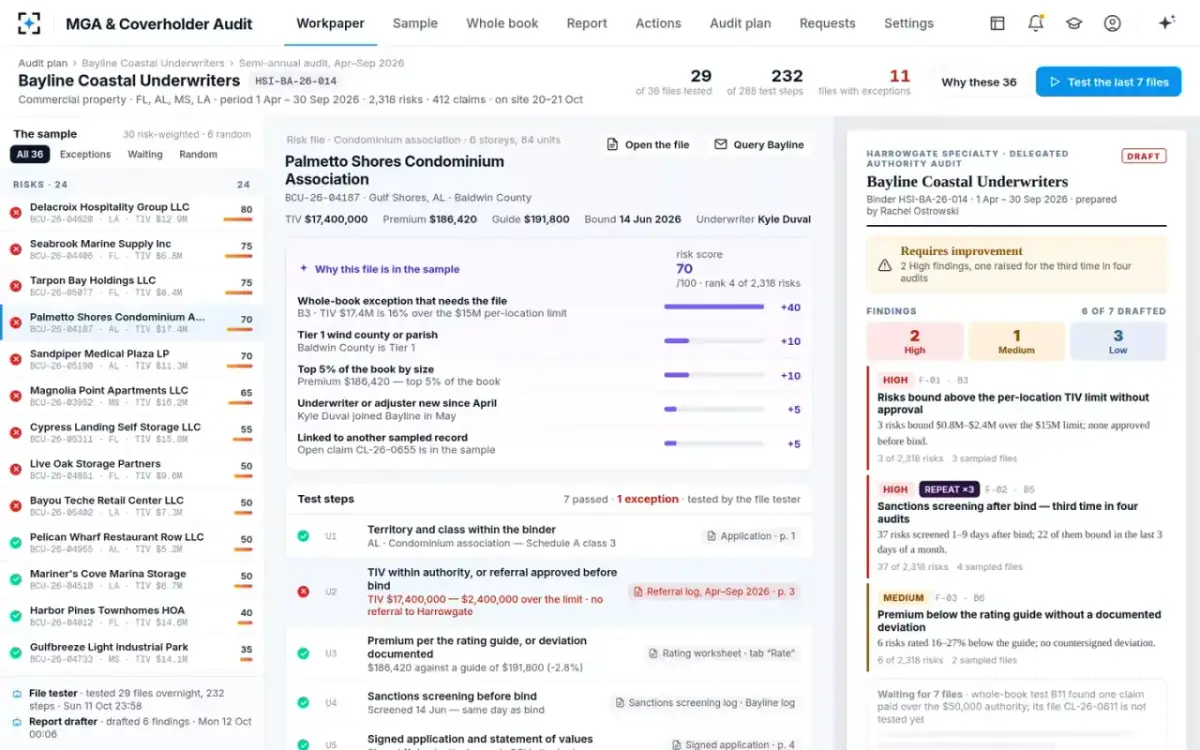
The failed step names its evidence: the referral log, page 3, has no entry for this risk in June.
Delegated authority auditor salary and jobs: what the data says
No official statistic counts delegated authority auditors or reports their pay, so any single salary figure for the title should be treated with care. The Bureau of Labor Statistics has no occupation for the seat; it sits between two that it does count. "Accountants and auditors held about 1.6 million jobs in 2025", and their median annual wage was $83,680 in May 2025, with employment "projected to grow 5 percent from 2025 to 2035" (BLS Occupational Outlook Handbook). The handbook says internal auditors "identify ways to improve the processes for finding and eliminating waste, fraud, and other financial risks".
Many delegated authority auditors come from underwriting instead. Insurance underwriters held about 125,600 jobs in 2025, with a median wage of $81,370 in May 2025, and BLS expects their employment to fall 4 percent from 2025 to 2035 as automated underwriting software lets fewer people process applications (BLS Occupational Outlook Handbook). The two lines point in opposite directions, and the delegated authority auditor sits where they meet: underwriting knowledge applied as audit.
The two occupations a delegated authority auditor sits between (US, May 2025)
What qualifications does a delegated authority auditor need?
No statute or regulator names a qualification for the role; what the work needs is a blend of underwriting, claims and audit method. A team hiring for the seat can test for the skills that the audit actually uses, which are visible in what goes wrong when they are missing: a test plan that misses a binder schedule, a sample nobody can defend, a finding the delegate can argue away.
Eight skills a delegated authority auditor uses every audit
- Reading a binding authority and its schedules
Limits, classes, territories, referral triggers and endorsements are the test plan; a missed endorsement is a wrong test.
- Underwriting judgement
Knowing when a rating deviation is documented and reasonable, and when it is a pattern.
- Claims handling
Acknowledgement, reserving, coverage positions and settlement authority, and the files the law says the insurer must see.
- Premium and money
Remittance terms, fiduciary accounts and how premium reaches the insurer.
- Sampling method
Choosing files, recording why, and saying what a sample can and cannot show.
- Writing findings
Condition, criteria, effect, recommendation: a finding the delegate can act on and cannot argue away.
- Data handling
Bordereaux arrive in many layouts; the auditor needs them in one shape to test anything across months.
- Independence and tact
The delegate is a partner and the subject of the audit at the same time.
Who audits MGAs, and who checks the auditor?
The insurer audits its MGAs; regulators then check the insurer, and can examine the MGA directly. The duties in the model law are the insurer's, which is why a regulator testing an insurer's oversight of its delegates asks for the audit reports, not the delegate's self-assessment. The model also lets the regulator examine an MGA as if it were the insurer. What examiners ask for, and what happened to insurers that skipped the reviews, is in the MGA compliance audit guide.
In the London Market the delegate is a coverholder. HM Revenue & Customs describes the arrangement plainly: the coverholder acts for the Lloyd's managing agent, not for the policyholder (HMRC Lloyd's Manual, LLM1100), so the managing agent that grants the authority carries the oversight duty. Inside the insurer, internal audit is the check on the checkers: it reviews whether the delegated authority function plans its audits on risk, samples defensibly and follows actions to close.
The model act names the review, not the reviewer. What makes a delegate audit good is the method: what was tested, on how much of the book, and whether anyone can see why each file was chosen.
Where Botminds' MGA & Coverholder Audit fits the team, and where it does not
The solution takes the preparation and the mechanical testing; the team keeps everything that needs a person. Six agents build and chase the information request, test every risk and claim against the binder, score and sample the files, test each file against cited pages, draft the findings and track the agreed actions. None of them clears an exception, sets a rating, issues a report or closes an action, and none contacts anyone but the delegate's named response contact.
It does not replace the visit. The law asks for an on-site review of underwriting and claims processing, and the interviews, the walk-through of how a referral really works and the conversation about a repeat finding stay with the auditor. Nor does it decide the commercial questions, such as whether to keep a delegate that has broken the same control three times; that belongs to the head of delegated authority, with the evidence in front of them.
High findings go to the head of delegated authority first
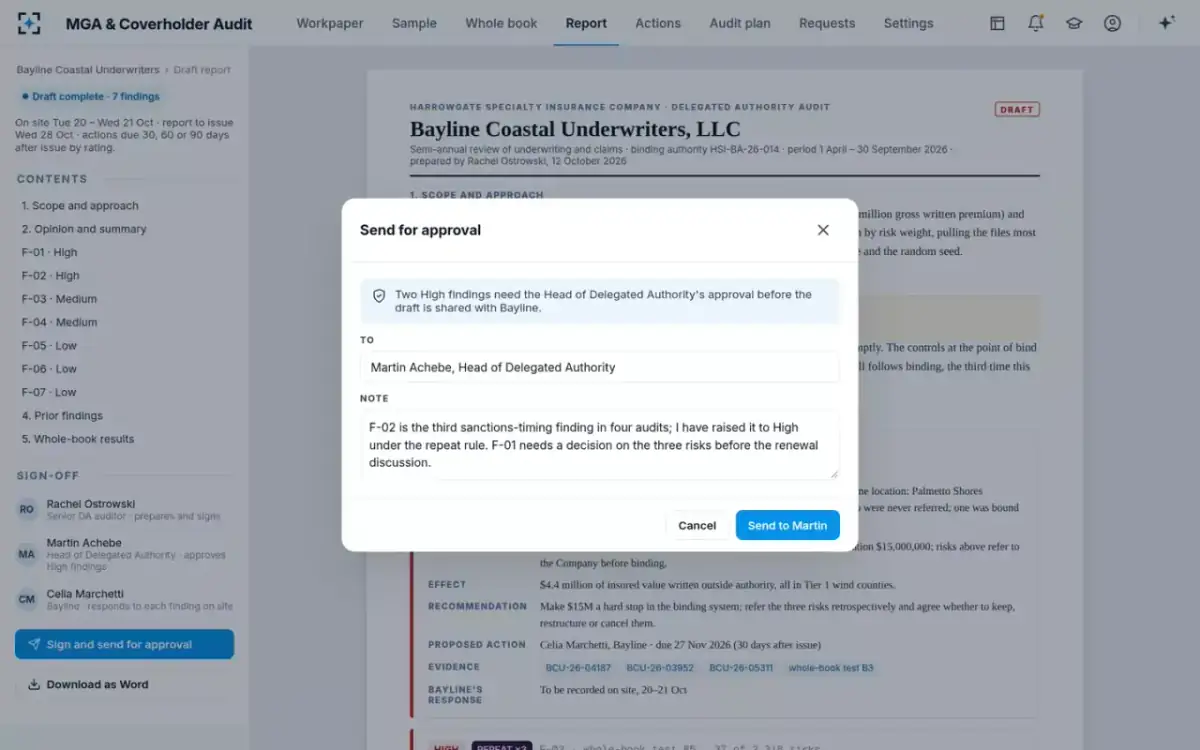
How the cost of a single audit breaks down, and which parts scale with the number of delegates, is worked through in what one coverholder audit costs.
Questions people ask
What is a DA auditor?
A DA auditor is a delegated authority auditor: the person at an insurer, or at a managing agent in the London Market, who audits the MGAs, coverholders and claims administrators that act under its authority. The title varies, from delegated underwriting auditor to binder auditor, but the work is the same: test the delegate's business against its binding authority and report what was found.
What is a delegated authority audit manager?
A delegated authority audit manager runs the audit plan across all delegates: decides which are due and with what focus, assigns auditors, reviews their reports and owns the action log. In many carriers the manager also approves the most serious findings, or passes them to a head of delegated authority who does.
Is a delegated authority auditor an internal auditor?
Usually not. Most delegated authority auditors sit in the business, in a delegated authority or underwriting oversight team, and their audits are part of the insurer's day-to-day control. Internal audit is a separate, independent function that may review how well the delegated authority team does that job.
How many delegates can one auditor cover?
It depends on the review clock and the hours an audit takes. Under a twice-yearly clock, and Botminds' estimate of about 15 working days to prepare one audit by hand, a single auditor reaches capacity at roughly seven delegates before any visits or follow-up. Testing the whole book with agents changes the arithmetic more than any amount of overtime.
Do delegated authority auditors need a certification?
No law requires one. The NAIC model act requires an actuary for opinions on MGA-set reserves, defined as a member of the American Academy of Actuaries, but sets no qualification for the person who reviews the MGA's operations. Auditing, underwriting and claims qualifications all help; the method is what an examiner will look at.
What does a delegated authority auditor ask for before a visit?
The binding authority with its schedules and endorsements, the claims handling agreement, the risk, premium and claims bordereaux for the period, trust account statements, procedures, licences and the last audit's actions. In the fictional sample audit the request ran to 41 items, with the 36 sampled files requested once the sample was drawn.