Bordereaux reporting in insurance is the regular reporting by which a delegated underwriter, such as a managing general agent (MGA) in the US or a coverholder in the London market, lists for the insurer every risk it bound, the premium it collected and, where it handles claims, every claim, under the binding authority the insurer granted. Each report is a bordereau (plural bordereaux): in practice a spreadsheet, sent monthly in most binders. It is how a carrier sees business written in its name by someone else, which is why the law requires it, and why it is hard: each delegate sends its own layout. Botminds' Bordereaux Management is a bordereaux solution that maps each delegate's file to one standard layout and checks every row against the binder.
The word comes from French, where a bordereau is a schedule or itemised list. In insurance it names three files with three jobs, and the clearest way to tell them apart is by the duty each one discharges.
Three bordereaux, one duty each
Risk bordereau
What it lists
Every policy bound in the period: insured, location, class, sum insured, limits, deductibles, inception and expiry, transaction type.
The duty it serves
Lets the carrier test what was written against the underwriting guidelines the contract must state: types of risk, limits, territory, policy period.
Model #225 §4F
Premium bordereau
What it lists
The premium for each of those policies: gross, commission, taxes and fees, and the net owed to the carrier, with the totals settled.
The duty it serves
Carries the monthly account of "all transactions" and the funds remitted with it; the money is held as a fiduciary until it is.
Model #225 §4B–4C
Claims bordereau
What it lists
Where the delegate settles claims: each claim with paid, reserved and recovered amounts, dates and status.
The duty it serves
Reports claims "in a timely manner" and flags the ones the carrier must see in full: coverage disputes, claims over authority, claims open six months.
Model #225 §4I
Bordereau or bordereaux: risk, premium and claims bordereaux defined
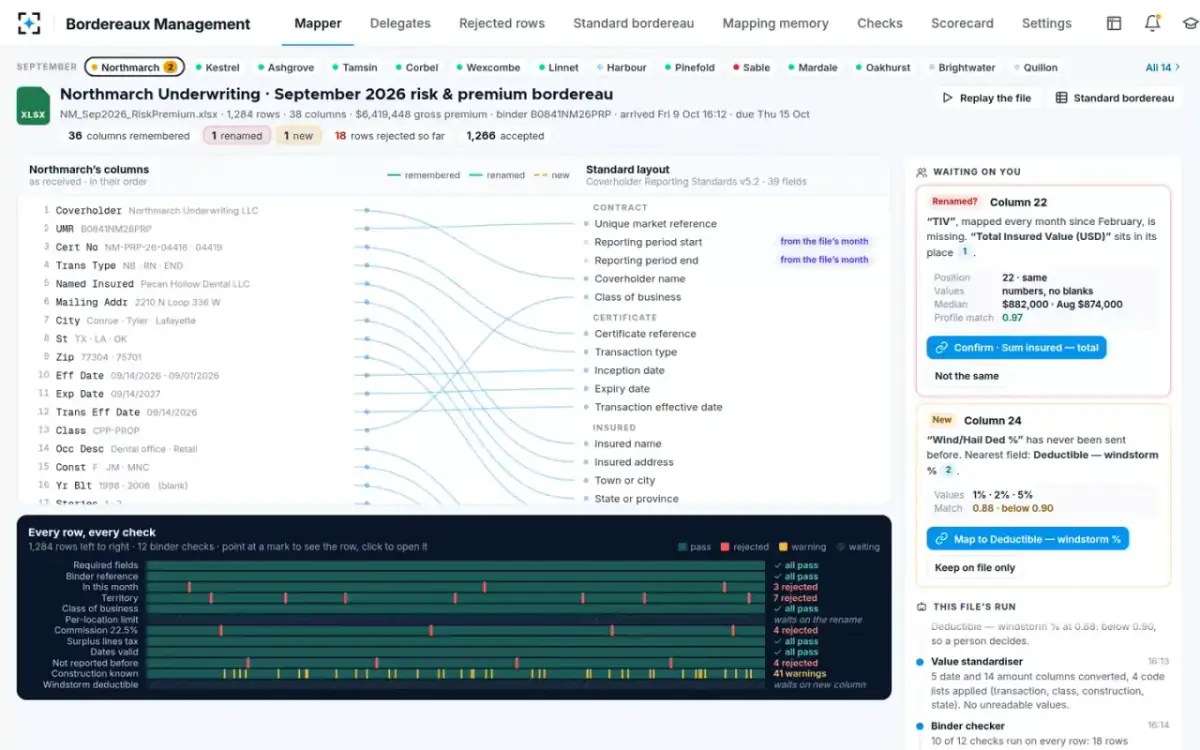
A bordereau is one report; bordereaux is the plural, and the word most teams use for the whole activity. A risk bordereau lists the policies bound, a premium bordereau the money due on them, and a claims bordereau the claims the delegate handled. Some binders call the combined monthly file a "risk and premium bordereau"; the sample delegate in Bordereaux Management sends exactly that, 1,284 rows and 38 columns for September.
Each file answers a different question for a different reader. The underwriter and the head of delegated authority read the risk bordereau to see whether every risk was inside the binder. Finance reads the premium bordereau to see what is owed and when. Claims and actuarial teams read the claims bordereau to see what is being paid and reserved on the carrier's behalf. One spreadsheet can carry all three, but the tests applied to it are three different sets.
Why bordereaux reporting is a legal duty, not a market habit
In the US, bordereaux reporting is the working form of a statutory duty. The NAIC Managing General Agents Act, adopted in 1989 and last amended in 2002, says no MGA may place business with an insurer without a written contract, and lists what the contract must contain. The first money term is the one bordereaux exist to satisfy: the MGA must account to the insurer for every transaction and pay over all funds due at least monthly (Model #225 §4B; quoted in premium remittance meaning).
The monthly bordereau is the working form of a one-line statutory duty: account for every transaction, and pay over what is due, every month.
States enacted the duty in their own words. Florida requires accounts at least monthly (Fla. Stat. §626.7451(2)). Texas, which defines an MGA differently, sets a quarterly floor and lists the content: an account report "at least once each calendar quarter" stating written, earned and unearned premiums, losses and loss expenses paid and outstanding, losses incurred but not reported and management fees (Tex. Ins. Code §4053.103). The monthly bordereau is the raw material from which a report like that is built. MGA reporting requirements by state sets the state versions side by side.
The contract duty matters because of what sits behind it. Under §6 of the model, the MGA's acts count as the insurer's own, and a regulator may examine the MGA as if it were the insurer. A carrier that does not receive usable monthly accounts is answerable for business it cannot see.
What a binder says about bordereaux: one clause set from a court record
Binders turn the duty into dates and formats, and the best public example is in a court judgment. In XL Insurance Company SE v IPORS, decided by the English Commercial Court in 2022, the judge set out the bordereau clauses of the binding authorities between the insurer and its coverholder ([2022] EWHC 2093 (Comm)). They show, clause by clause, what a bordereau obligation contains.
The bordereau clauses of one binder, and what each obliges the coverholder to do
| Clause (2012 binder) | What it says | What it means in practice |
|---|---|---|
| 24.1 | "All premiums, paid claims, outstanding claims and expenses relating to insurances bound shall be allocated and declared to the Agreement" | Nothing bound under the binder may be left off the bordereau. |
| 24.2 | "The Coverholder shall prepare premium bordereaux at the interval stated in the Schedule until every insurance bound has expired or has otherwise been cancelled or terminated" | Reporting outlives the binder: it runs until the last policy expires. |
| 24.5 | Bordereaux go to the London broker within the days stated in the Schedule; with no activity, the coverholder must "advise the London Broker accordingly" | A month with nothing to report still owes a report: the nil return. |
| 24.7 | "Settlements shall be remitted via the London Broker within the maximum number of days of the end of each such bordereaux interval(s)" | The bordereau sets the clock for the money. |
| 24.8 | Agreed fees or charges "shall be deducted from the premium bordereaux" | Deductions appear on the face of the bordereau, where they can be checked. |
Two details in that wording are easy to miss and often cause disputes. Reporting continues until every policy bound has expired, so a binder that ends in November still owes bordereaux into the following year. And a quiet month is not a free month: the coverholder must say there was no activity, within the same deadline, so the carrier can tell a nil return from a missing one.
How often are bordereaux due?
Most bordereaux are due monthly, within a number of days after month end that the binder's schedule sets; 15 days is common, and it is the deadline in both the court-recorded binder above and the sample carrier in Bordereaux Management. The US model law sets a monthly minimum for accounts and remittance, Florida says monthly or more often, and Texas adds a quarterly account report on top. A binder can ask for more frequent reporting, never less than the statute.
Claims bordereaux can run on a different clock. Where the delegate settles claims, the model act requires that "All claims must be reported to the company in a timely manner", and some claims must go to the insurer as soon as they meet a trigger, without waiting for month end: a coverage dispute, a claim that may exceed the MGA's settlement authority, or one open for more than six months (§4I). The monthly claims bordereau is the summary, not the only report.
What a bordereau report contains, field by field
No public standard binds every delegate; the field list is whatever the binder agreed. In practice the fields fall into six families, and each family exists because a statute or a binder term needs it.
The six field families of a bordereau report, and the test each one feeds
- Contract identity
Binder or market reference, delegate name, reporting period. Ties every row to the authority it was written under and the month it belongs to.
- Policy identity
Certificate or policy number, transaction type (new, renewal, endorsement, cancellation). Feeds the duplicate test and the cancellation provisions the contract must state.
- Insured and location
Name, address, state or country. Feeds the territorial limitation, which Model #225 §4F requires every MGA contract to state.
- Cover
Class or occupancy, sum insured, limits, deductibles, construction. Feeds the types-of-risk and maximum-limit tests.
- Dates
Inception, expiry, transaction effective date. Feed the policy-period test, the reporting-month test and the choice of which binder version applies.
- Money
Gross premium, commission, taxes, fees, net due. Feed the commission test and the premium account; for claims files, paid and outstanding amounts and, in Texas reporting, losses incurred but not reported.
Bordereaux reporting in the US and in the London market
The file is much the same on both sides of the Atlantic; the legal frame around it differs. In the US the delegate is usually an MGA under a state MGA act. In the London market it is a coverholder, which HM Revenue and Customs defines plainly: a managing agent may delegate its authority to enter into contracts of insurance; the firm that receives it is the coverholder, and the document that sets out its terms is the binding authority (HMRC Lloyd's Manual, LLM1100; the definition is quoted in what a coverholder is).
Bordereaux reporting under a US MGA act and under a UK binding authority
US: MGA under a state act: The MGA, a licensed producer that manages business for the insurer.
UK: coverholder under a binding authority: The coverholder, which acts as the Lloyd’s managing agent’s agent, not the policyholder’s (HMRC).
US: MGA under a state act: In statute: the contract must provide for monthly accounts and remittance (Model #225 §4B, enacted state by state).
UK: coverholder under a binding authority: In the binding authority's own clauses, such as the bordereaux, accounts and settlements section quoted in XL v IPORS.
US: MGA under a state act: Held by the MGA "in a fiduciary capacity" (§4C); Florida makes premiums trust funds.
UK: coverholder under a binding authority: Under a binding authority, premium counts as received by the insurer once the agent receives it (FCA Handbook, CASS 5.2.1G).
US: MGA under a state act: The insurer, and the commissioner, "in a form usable" (§4D).
UK: coverholder under a binding authority: The insurer under the binder; the FCA and PRA supervise the firms.
The money row is the one that most changes what a premium bordereau means. Where premium counts as received by the insurer the moment the coverholder receives it, the bordereau is not a bill the delegate sends but an account of money that already belongs to someone else. That is why a premium bordereau that under-states what was collected is so much more serious than a late one.
Who reads a bordereau, and what each reader needs from it
A bordereau has more readers than authors, and each needs a different cut of it. The head of delegated authority needs the rows outside the binder, the same week the file lands. Finance needs the net premium due and the settlement date. The data and MI team needs every delegate in one layout, so that a loss ratio or a premium trend means the same thing across the book. Actuarial and reserving teams need the claims fields, and in Texas the MGA's own quarterly report includes losses incurred but not reported.
That is why the receiving end of bordereaux reporting is a process in its own right. Bordereaux processing describes the five steps from file to settlement; bordereaux ingestion describes the first and hardest of them, mapping a delegate's own layout to yours.
How Bordereaux Management turns each delegate's report into one layout
Bordereaux Management reads each delegate's spreadsheet or CSV, finds the header row, places every column on the carrier's standard layout from the delegate's remembered mapping, and checks every row against the binder in force on its inception date. The layout is a setting: the London market's Coverholder Reporting Standards or the carrier's own template.
Bordereaux Management's column mapper: the delegate's layout on the left, the carrier's on the right
The result: every accepted row in one standard bordereau, with the money totalled
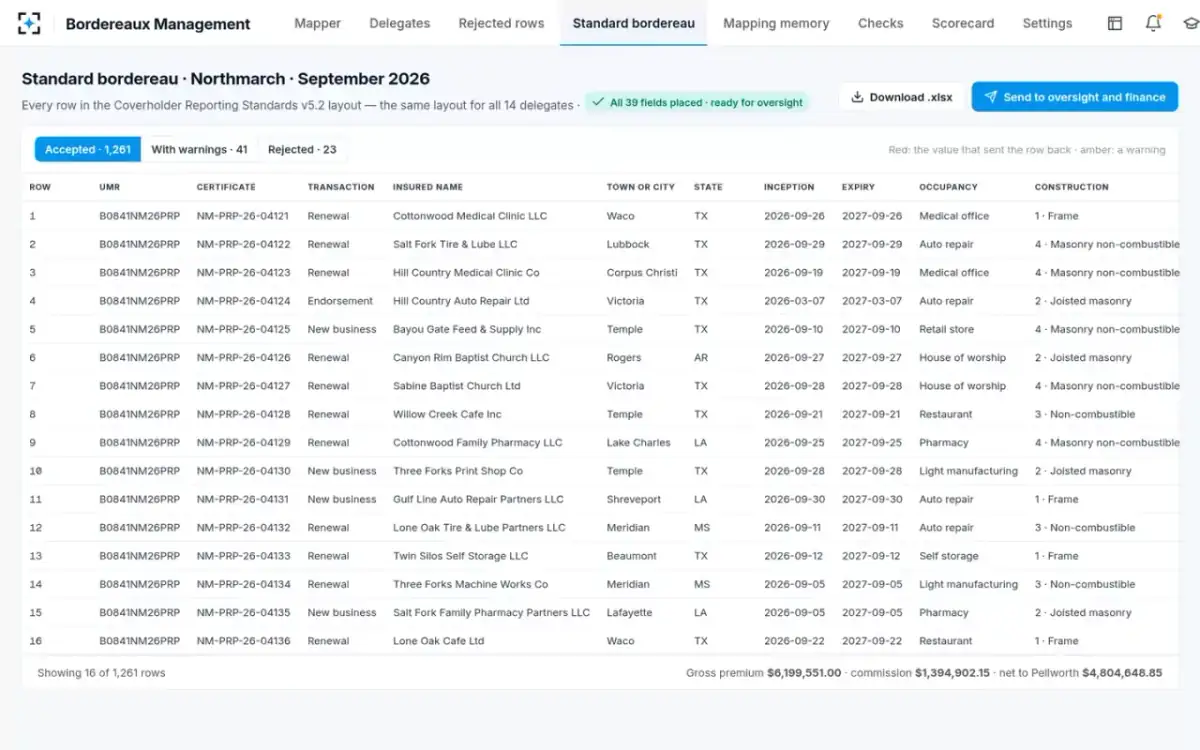
The accepted rows are what oversight and finance receive; the 23 rejected rows go back to the delegate in a drafted return the analyst reads and sends. See the whole cycle on the sample carrier at Bordereaux Management.
Questions people ask
What is a bordereau in insurance?
A bordereau is a schedule a delegated underwriter sends the insurer listing the risks it bound, the premium due on them or the claims it handled in a period, usually a month. It is how the insurer sees business written in its name by an MGA or coverholder. In US law it is the working form of the monthly accounts an MGA contract must provide for.
What is a bordereau report?
Bordereau report usually means the same monthly file, sometimes the summary account sent with it. One binder quoted in a 2022 English judgment required, alongside the premium bordereaux, a summary account showing the paid premium declared for the period, gross and net of commission, taxes and other deductions.
What is a claims bordereau?
A claims bordereau lists the claims a delegate handled in the period, with paid and outstanding amounts and status. Under Model #225 §4I, an MGA that settles claims must report them in a timely manner and send the insurer the claim file for coverage disputes, claims that may exceed its settlement authority and claims open more than six months.
What is a risk bordereau?
A risk bordereau lists the policies a delegate bound in the period, with insured, location, cover, limits and dates. The carrier uses it to test each policy against the underwriting guidelines the binder must state, such as the territory, the maximum limits and the maximum policy period.
Is a Texas MGA account report the same as a bordereau?
Not quite. The Texas account report is a quarterly statutory statement of written, earned and unearned premium, paid and outstanding losses, losses incurred but not reported and management fees. A bordereau lists individual policies or claims. A delegate with clean monthly bordereaux has most of what it needs to build the quarterly report.
What happens if a delegate has nothing to report in a month?
It usually still owes a report. The binder wording quoted in XL v IPORS required the coverholder, where there was no activity in a bordereau interval, to advise the broker within the same number of days. A nil return lets the carrier tell an empty month from a missing file.