A bordereaux analyst is the person, usually in a carrier's delegated authority team and sometimes at the MGA or broker, who receives the bordereaux that delegated underwriters send each month, maps each file to the carrier's own layout, checks every row against the binding authority and sends back the rows that fail, with a reason. A bordereau is the schedule of risks bound, premium and claims under one delegation; most carriers receive one from each delegate every month, each in that delegate's own columns, codes and date formats. That variety is what makes the job hard, and what Botminds' Bordereaux Management exists for: its agents read, map and check each delegate's file so the analyst spends the month on the renamed columns, returns and breaches that need a person.
There is no official job description for the seat. The US Bureau of Labor Statistics has no occupation called bordereaux analyst, and neither do the state insurance codes. What the law does define is the output the seat produces: the model act most states built on requires the managing general agent (MGA) to account to the insurer at least monthly, and gives the insurer the right to its records in a form the insurer can use (NAIC Managing General Agents Act, Model #225, §4D). The analyst is the person who turns the first duty into the second.
Four people carry each delegate's bordereau: what their month holds, before and after
Today
Opens each delegate's file, re-maps columns she mapped last month, then tests what time allows.
With agents
Opens each file already mapped from memory and checked on every row; confirms renamed columns and sends the drafted returns.
Still theirs: Every rename, every return, every ambiguous value.
Today
Learns that a risk was outside the binder at the on-site review, months after it was bound.
With agents
Receives territory and limit failures as breach referrals the week the file lands.
Still theirs: The decision on every possible breach, and any change to a check.
Today
Hears that the file failed, not which rows or why.
With agents
Receives the returned rows grouped by reason, each with its binder clause and a correction deadline.
Still theirs: The corrections; nobody edits the delegate's data for it.
Today
Finds out a column was mapped wrong when a report downstream goes wrong.
With agents
Sees each delegate's headers month by month, with who confirmed every change.
Still theirs: The standard layout every delegate is mapped to.
What does a bordereaux analyst do in a month?
A bordereaux analyst runs a monthly cycle with five steps: receive each delegate's file, map it to the carrier's layout, standardise the values, check every row against the binder, and send back what fails. Around those steps sit two jobs that never appear on a process chart: chasing the delegates whose files have not arrived, and explaining to finance, underwriting and the head of delegated authority what the month's files say.
The cycle starts with the binder's own deadline. In one binding authority set out in an English court judgment, the coverholder had to send each month's premium bordereau within 15 days of month end, and the money followed 30, 60 or 90 days after month end depending on the binder. Most analysts work to a calendar like that: a burst of arrivals in the second and third week of the month, a queue of files to map, and settlement dates finance cannot move. Where the analyst's month goes walks through that calendar step by step.
The volume is easy to underestimate. In the solution's fictional sample month, 12 of Pellworth's 14 delegates had sent their September files by Monday 12 October, three days before most were due, 21,080 rows between them, among them a 418-row cargo file and a 5,640-row household file. Each arrived in a different layout. None of that is unusual for a carrier with a dozen delegates, and it is the reason the job exists.
One analyst's month at a glance: 14 delegates, each with its own file and its own due date
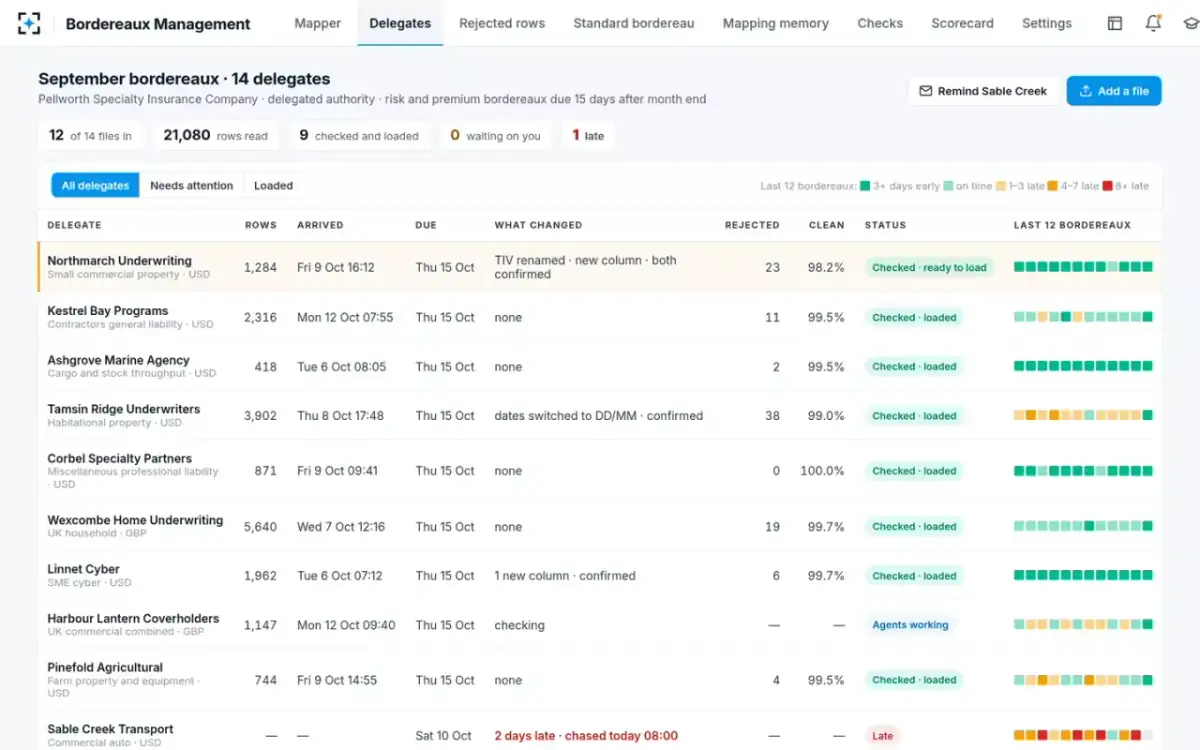
The legal duty behind the bordereaux analyst's job
The job exists because the law makes the carrier answerable for business it did not write. Under Model #225 an MGA's acts count as the insurer's own, and a regulator may examine the MGA as if it were the insurer (§6). The carrier cannot see what its MGAs bound unless the monthly accounts reach it in a form it can test, and the bordereaux analyst is the person who makes them testable.
Three parts of the model law shape the work directly. Section 4B requires the MGA to account and remit monthly. Section 4D gives the insurer access to every account and record of its business, in a usable form. Section 4F lists the underwriting guidelines every MGA contract must contain, from the types of risk to the territory and the maximum policy period, which become the tests the analyst runs on each row. Texas states the delegate's side of the same exchange in its own words: an MGA's powers include receiving and passing on daily reports and monthly accounts (Tex. Ins. Code §4053.101), and it must send each insurer a quarterly account report whose contents the statute lists.
The law gives the carrier a right to usable data. The bordereaux analyst is the person who makes the data usable.
Examiners test the same point from the carrier's side. The NAIC's market regulation standards ask whether the insurer adequately monitors every outside firm that has taken on one of its business functions or acts on its behalf (NAIC Market Regulation Handbook, examination standards). A carrier that cannot show what its delegates' files contained, and what it did about the rows that failed, will struggle to answer that standard. The analyst's checked bordereaux and returns are much of that answer.
Four handoffs the bordereaux seat sits between
The seat is defined less by its own tasks than by the four people it hands work to. Each handoff has a different deadline and a different failure, and an analyst who is good at the job is good at all four.
How Bordereaux Management divides the bordereaux seat between agents and people
A person decides
Delegate operations sends the fileRisk, premium and, where the MGA settles claims, claims bordereaux, in the format the binder agreed, by its due date.
Agent
File reader and column mapperFind the header row, tie totals to the cover sheet, place each column from the delegate's remembered mapping and flag what changed.
Never: applies a rename or maps a new column on its own.
A person decides
Bordereaux analyst confirmsConfirms renamed and new columns, settles ambiguous dates, and reads the rows the checks rejected.
Agent
Binder checker and return writerTest every row against the binder in force on its inception date; draft the return with each row's reason and clause.
Never: sends a return or decides a breach.
A person decides
Head of delegated authority decidesRows bound outside territory or over a limit are possible breaches of authority, and go to the person who owns the binder.
A person decides
Finance and MI receive the clean fileAccepted rows in one standard layout, with gross premium, commission and net due to the carrier.
The first handoff is backwards, to the delegate. The analyst returns rows that fail, and the quality of that return decides whether next month's file is better. A return that says "file rejected" teaches the delegate nothing; one that groups the rows by reason, cites the binder clause and gives a correction date usually fixes the cause. The second is upwards, to the head of delegated authority, for rows that are not just wrong data but possible breaches of authority. The third and fourth are sideways, to finance for the premium due and to the data and MI team for the standard bordereau every report is built on.
Is a bordereaux analyst an underwriting role or a finance role?
A bordereaux analyst is neither an underwriter nor an accountant, though the job borrows from both and usually reports into delegated authority, operations or underwriting operations. The analyst does not decide whether to accept a risk, which the model law reserves to the person with the pen: underwriting, in §2F, is the authority to accept or reject risk for the insurer, and does not book the premium. The job is to establish, row by row, whether what was bound and declared is what the binder allowed.
That is why official statistics cannot see the role. The Bureau of Labor Statistics counts underwriters, claims examiners, accountants and insurance clerks; a bordereaux analyst's hours fall across all of them. The nearest published figures describe the occupations around the seat, not the seat itself.
The occupations around the bordereaux seat, as the Bureau of Labor Statistics counts them
125,600
insurance underwriter jobs in 2025, 24% of them at agencies and brokerages
$81,370
median annual wage for insurance underwriters, May 2025
376,100
claims adjuster, examiner and investigator jobs in 2025
$78,000
median annual wage for claims adjusters, examiners and investigators, May 2025
What a bordereaux analyst checks on every row
Every row is tested against the binder, and the binder's terms come largely from statute. Model #225 §4F requires each MGA contract to state the maximum annual premium volume, the basis of the rates, the types of risks, the maximum limits of liability, the exclusions, the territorial limitations, the cancellation provisions and the maximum policy period. Each of those becomes a test a row can pass or fail, and binders add their own: commission, taxes, the reporting month and duplicates of earlier bordereaux.
What the analyst tests each row against, and where the rule comes from
| Binder term | What the row must show | In the sample binder |
|---|---|---|
| Types of risks (§4F) | A class of business the binder allows | Small commercial property only |
| Maximum limits of liability (§4F) | Sum insured within the limit, or a referral approval on file | $5,000,000 per location |
| Territorial limitations (§4F) | A risk location inside the territory | Texas, Louisiana, Oklahoma, Arkansas, Mississippi |
| Maximum policy period (§4F) | Expiry after inception, within the maximum term | No more than 13 months |
| Maximum annual premium volume (§4F) | Cumulative written premium below the cap | Tracked across the year's bordereaux |
| Commission (binder schedule) | Commission deducted at the agreed rate | 22.5% of gross premium |
| Reporting month (binder) | A transaction effective in the month reported | October risks belong on October's file |
| Earlier bordereaux | A certificate not already reported | Every accepted bordereau since January |
The sample month shows why every one of those tests matters. Of Northmarch's 1,284 September rows, 23 failed: seven locations in Florida, outside the territory; five over the per-location limit with no referral on file; four certificates already reported in August; four rows taking commission above 22.5%; and three effective in October. Twelve of those 23 are not data errors but possible breaches of authority, which is why they go to a different person.
Why bordereaux analysts end up sampling, and what it costs
Analysts sample because the hours run out before the rows do. If every file must first be re-mapped by hand, the time left for checking shrinks, and the checking turns into a look at the largest risks and a random handful of the rest. The risk is not that sampled files are wrong; it is that the wrong rows sit in the part nobody looked at.
The silent version of this is worse. A check that reads a column called TIV, the total insured value, stops working when the delegate renames the column without saying so; the file still loads, and every location over the limit loads with it. In the sample month that is exactly what happened: Northmarch renamed TIV to "Total Insured Value (USD)", and the per-location limit check could not run until the rename was confirmed. Once it was, five locations above $5,000,000 appeared. Nine ways a delegate's file goes wrong sets out that error and eight others, ranked by what can catch them.
Skills a bordereaux analyst needs
The skills split between data handling, reading contracts and writing to people outside the company. Spreadsheet speed matters least once agents do the mapping; judgement about what a column change means, and the ability to explain a rejected row to a delegate's operations lead, matter most.
Skills that make a strong bordereaux analyst
- Reading a binder as a set of tests
Territory, class, limits, period, commission and reporting month, with the clause behind each. Most rejections come from five or six terms.
- Recognising a changed column from its values
Same position, same type, a similar median: a rename. A new header with values unlike anything sent before: a new field that needs a decision.
- Knowing which errors are data and which are authority
A duplicate certificate is a data error; a Florida location on a Gulf-states binder is a possible breach that belongs to the head of delegated authority.
- Writing a return a delegate can act on
Rows grouped by reason, each with its clause, the original values, and a correction date the binder supports.
- Never guessing a value
A date like 04/05/2026 is ambiguous until other rows settle it. Guessing it moves risks between reporting months.
- Knowing the rules around the file
The state MGA act, the binder's reporting and settlement clauses, and, for London business, how coverholders and binding authorities work.
- Keeping the trail
Every mapping change, return and referral with a name and a date, so an auditor can see what the carrier knew and when.
How the bordereaux analyst's job changes with agents
With agents doing the reading, mapping and checking, the analyst's month moves from preparing files to deciding about them. The job does not disappear; the part of it that repeats does. In Bordereaux Management the file reader finds the header row and ties the totals, the column mapper places columns from the delegate's remembered mapping, and the binder checker runs every check on every row. What reaches the analyst is a short list: a renamed column with its evidence, a new column with its nearest field, an ambiguous date format, and the rows that failed.
In Bordereaux Management, one confirm settles a renamed column and the limit check runs
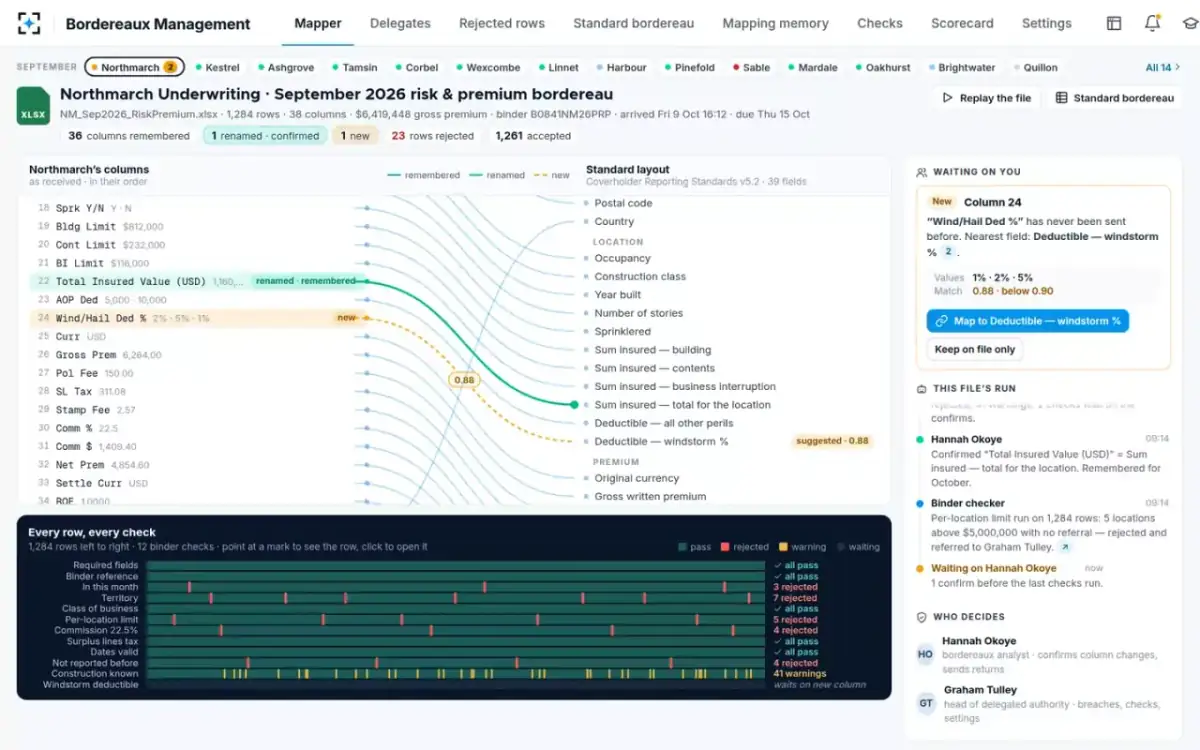
The design keeps the decisions where the law and the binder put them. Renames and new columns wait for the analyst. Returns are drafted by an agent but read and sent by a person. Possible breaches go to the head of delegated authority, who also approves any change to a check. That division is the subject of which bordereaux tasks move to agents and which stay with you; the short answer is that the agents take the mechanics and the people keep the judgement.
Bordereaux analyst salary and career path: what the official data can and cannot say
No official source publishes a bordereaux analyst salary, because no official occupation matches the job. Pay figures quoted for the role come from job boards and recruiters, and they vary with the market, the employer and whether the seat is at a carrier, an MGA or a broker. The published figures that do exist describe the neighbouring occupations: a May 2025 median of $81,370 for insurance underwriters and $78,000 for claims adjusters, examiners and investigators.
The same statistics say something about direction. BLS projects employment of insurance underwriters to fall 4 percent from 2025 to 2035, because automated underwriting software lets fewer people process applications faster (MGA underwriter sets out the figures), and projects a 6 percent decline for claims adjusters, appraisers, examiners and investigators over the same decade. For the bordereaux seat the likelier change is in content rather than headcount: fewer hours re-mapping columns, more on returns, referrals and the questions MI and oversight teams ask. The career paths out of the seat run the same way, towards delegated authority management, DA audit and data roles.
To see the seat as Pellworth's analyst sees it, with the mapper, the checks and the drafted return, start from Bordereaux Management.
Questions people ask
What is a bordereaux technician?
Bordereaux technician is another title for much the same seat, often used for the more processing-focused end of it: loading files, mapping columns and producing the standard bordereau. Analyst titles more often include the checking and the delegate correspondence. The duties behind both are the same: turning the delegate's monthly accounts into records the carrier can use, as Model #225 §4D requires.
What is a claims bordereaux analyst?
A claims bordereaux analyst handles the claims bordereaux an MGA or third-party administrator sends where it settles claims for the carrier. The tests differ from a risk bordereau: under Model #225 §4I the carrier must receive a copy of the claim file when a claim involves a coverage dispute, may exceed the MGA's settlement authority or is open for more than six months. Those triggers become checks on each claims row.
What is a delegated authority bordereaux analyst?
It is the same role named for the team it usually sits in. Delegated authority teams at carriers oversee the MGAs and coverholders that write business under a binder; the bordereaux analyst is the part of that team that handles the delegates' monthly data. The head of delegated authority owns the binders and decides breaches; the analyst finds them.
How do I become a bordereaux analyst?
Most analysts come from insurance operations, underwriting support, credit control or data roles. Employers look for spreadsheet and data skills, the ability to read a binding authority agreement, and clear writing. Knowing the state MGA act, or for London business how a coverholder acts under a binding authority, is the knowledge that separates a strong candidate from a merely fast one.
Do MGAs employ bordereaux analysts too?
Yes. The MGA has to produce the bordereau before the carrier can check it, and many employ people to assemble, reconcile and send it in the format each binder agreed. Texas, for example, requires an MGA to send each insurer an account report at least once each calendar quarter, stating written, earned and unearned premium, losses paid and outstanding, losses incurred but not reported and management fees.
How many delegates can one bordereaux analyst handle?
There is no published benchmark. The honest answer depends on rows per file, how often delegates change their formats and how much of the checking is done by hand. Count your own: files per month, rows, column changes and rows returned, and time each step for one month before deciding headcount.