A bordereau file is the spreadsheet, usually monthly, in which a managing general agent or coverholder lists for the insurer each risk it bound, the premium due on it or the claims it handled under a binding authority. It is the delegate's own statement of business written in the insurer's name, and for most carriers it is the main way they see that business between on-site reviews. That makes it evidence twice over: of what the delegate declared, and, when the declaration was false, of what the delegate concealed. Two judgments of the English Commercial Court show both, and they shape how Botminds' Bordereaux Management keeps every file, mapping, check and return.
The two cases are public records and are told here as the courts found them. In Markel International v Surety Guarantee Consultants (2008) the bordereaux misstated the limits; in XL Insurance Company SE v IPORS (2022) they understated the premium. In both, the bordereaux looked like ordinary monthly files.
Two bordereau cases side by side: what the files claimed, and what was true
Markel v SGC, 2008: A binding authority from Markel to an underwriting agent, SGC, to bind surety bonds, from 1 January 2005; a second arrangement for QBE through Amalfi from October 2005.
XL v IPORS, 2022: Binding authorities from XL to a coverholder, IPORS, for property risks in the UK and the Republic of Ireland, renewed from 2012 to 2016.
Markel v SGC, 2008: Every bond within the financial limits of £1m any one bond, apart from two shown slightly over.
XL v IPORS, 2022: Premium received in the first half of 2016 of over €4 million, owed to XL less commission.
Markel v SGC, 2008: Bonds issued far above the limits, shown as £1m exposures; some bonds not reported at all.
XL v IPORS, 2022: Premium accounts holding "nil or very modest balances"; premium substantially under-declared for years.
Markel v SGC, 2008: Not by the carrier's audit of 14 random files. In September 2006 a director of the agent wrote to QBE/Amalfi that bonds had been issued "outside the underwriting authority parameters".
XL v IPORS, 2022: Through a proprietary injunction, bank disclosure orders and forensic accountants' work on the statements.
Markel v SGC, 2008: Fraud: the bonds were "overwritten" to make a secret profit; individual defendants liable for the sums paid out on unauthorised bonds.
XL v IPORS, 2022: IPORS liable for £296,589 and €7,360,909; funds traced to its director and his company, and into a house.
What is a bordereau file? The monthly schedule, and what it claims
A bordereau file is a schedule with one row per policy, transaction or claim and one column per field the binder requires: references, insured, location, cover, dates and money. A risk and premium bordereau states what was bound and what is owed; a claims bordereau states what was paid and reserved. Each row is a claim of fact made by the delegate to the insurer, and the totals are a claim of debt.
The law gives the file its weight. Under the NAIC model act that most US state MGA laws follow, the MGA must account for all transactions at least monthly and the insurer has the right to the records in a form it can use (Model #225 §§4B, 4D). In the London market the binder does the same work: the wording in XL v IPORS required every premium, claim and expense to be "allocated and declared to the Agreement". A file the delegate is obliged to produce, about money it holds for someone else, is not an informal report.
What does a bordereau look like? One row, field by field
A bordereau looks like a wide spreadsheet: one row per risk, dozens of columns, a header row, sometimes a title block and a totals line. The row below is from the solution's fictional sample file, a 1,284-row, 38-column September risk and premium bordereau, shown in the carrier's standard layout after mapping.
One row of a risk and premium bordereau, and what each field is tested for
| Field | Value | What it is tested for |
|---|---|---|
| Certificate | NM-PRP-26-04763 · new business | Not already reported on an earlier bordereau |
| Insured and location | Hill Country Plaza Ltd, Lafayette, LA | Inside the binder's territory |
| Occupancy and construction | Strip center · class 3, non-combustible · built 1987 | A class the binder allows; complete for catastrophe modelling |
| Dates | Inception 20 Sep 2026 · expiry 20 Sep 2027 | In the reporting month; within the maximum policy period |
| Sum insured | $691,000 total for the location | Within the $5,000,000 per-location limit |
| Deductible | Windstorm 1% | At the binder's minimum for coastal locations |
| Gross premium | $5,343.00 | Ties to the file's totals |
| Commission | 22.5% · $1,202.18 | At the agreed rate |
| Net to the insurer | $4,140.82 | Gross less commission |
| Surplus lines tax | $266.41 | At the state rate |
Every field on that row is a statement the delegate can be held to. If the location were in Florida and the binder covered five other states, the row would be a breach of authority on its face. If the sum insured were really $6,910,000, nothing on the row would show it. That second kind of error is the subject of the first case.
Markel v Surety Guarantee Consultants: bordereaux that hid the limits
Markel granted the underwriting agent SGC a binding authority to bind surety bonds from 1 January 2005, with financial limits of "£1m. any one bond and £2.5m. any one group/principal". A separate "modus operandi" agreement provided for "reporting arrangements by means of monthly bordereaux", and the judge, Mr Justice Teare, found what the bordereaux were for.
The bordereaux were intended to be the means by which Mr.Smith was to check that the business produced by SGC was within the limits of the Binding Authority.
Markel International v Surety Guarantee Consultants [2008] EWHC 1135 (Comm), paragraph 29
They did not do it. The bordereaux, the court recorded, did not show any Markel exposure above the limits apart from two bonds shown slightly over £1m. In fact SGC had written bonds of £2,000,000, £2,400,000 and £10,000,000 among others, and each of those three appeared as a £1m exposure; Annex 1 to the judgment lists 33 bonds written above the financial limits between 11 February and 14 November 2005. One bond for €4.7m, written during the notice period after Markel ended the binder, "did not feature in the bordereaux". Before Markel's audit, the original bonds on SGC's files were replaced with dummy bonds.
The court found the reason. SGC "only paid to Markel and QBE/Amalfi the premium which they would expect to receive on the basis of the information contained in the bordereaux", while collecting premium on the bonds' real amounts: "The inescapable inference is that the bonds were “overwritten” in order to defraud Markel and QBE/Amalfi by making a secret profit." Three individual defendants were found liable in conspiracy and a fourth for procuring breach of contract, each liable for the sums reasonably paid out in settling claims on the unauthorised bonds.
XL v IPORS: the bordereaux said €4 million; the premium accounts said almost nothing
XL entered into the first of a series of binding authorities with the coverholder IPORS on 26 March 2012; the binders required monthly premium bordereaux within 15 days of month end and settlement within 30, 60 or 90 days. During the first half of 2016 IPORS sent its bordereaux monthly as required, XL invoiced the amounts they showed, and the invoices went unpaid. XL's first claim, issued in March 2017, was for €4,628,647.43 and £40,309.74, less €263,143.15 IPORS had paid, figures "based on the figures that IPORS had produced itself in the monthly bordereaux" ([2022] EWHC 2093 (Comm), paragraph 33).
Bank statements obtained under court orders then showed the premium accounts held "either nil or very modest balances, completely at odds with the figures provided by IPORS in the bordereaux which indicated receipt of premiums by IPORS in the first half of 2016 totalling over €4 million", and that sums equivalent to more than £3.8 million had been moved out of them between January 2016 and May 2017. Forensic analysis went further: "it emerged that IPORS had substantially under-declared the premium it had received." Between May 2012 and May 2017, £9,909,791 had moved from the premium accounts to IPORS' business account.
The court held that there was "no defence to XL's claim" and found IPORS liable for £296,589 and €7,360,909, in debt, for breach of contract and for breach of trust and fiduciary duty. It also found sums traceable to XL's premium in the director's personal account, in a company he controlled and in a house. IPORS and its director did not appear at the trial; the court still required XL to prove its case, and found that it had.
Both cases took years from the first bordereau to judgment
- Delegation in force20 months
- To judgment21 months
- Binders in force56 months
- To judgment68 months
Can a bordereau be used as evidence?
Yes, and the two cases show the two ways. In XL v IPORS the bordereaux were evidence for the insurer of a debt: the court described XL as having "a claim in debt for the premium declared by IPORS in the bordereaux in respect of which XL had issued invoices", and the forensic accountant started from "The monthly premium bordereaux provided by IPORS to XL" to measure what had not been declared. In Markel the bordereaux were evidence against the delegate: comparing them with the bonds actually issued showed exactly how they misstated the exposures.
Either way, a bordereau is only as useful as the copy the carrier kept. The file as received, unaltered, is the delegate's declaration. A file that the carrier has edited, re-keyed or "corrected" is no longer the delegate's statement, and a carrier that has fixed a delegate's figures for it has blurred the line between what was declared and what was decided. That is why a returned row should go back with the delegate's original values, and the correction should come from the delegate.
What a bordereau file must carry to stand up later
A bordereau stands up as evidence when the carrier can show what was received, what it was tested against, what was decided and by whom. That is a short list, and most of it is lost when bordereaux are processed by hand in spreadsheets that are overwritten every month.
What a bordereau file, and its trail, should keep
- The file exactly as received
Name, arrival time, sender and checksum. The delegate's declaration, never edited.
- The binder version applied to each row
The terms in force on the row's inception date, including endorsements.
- Every mapping decision
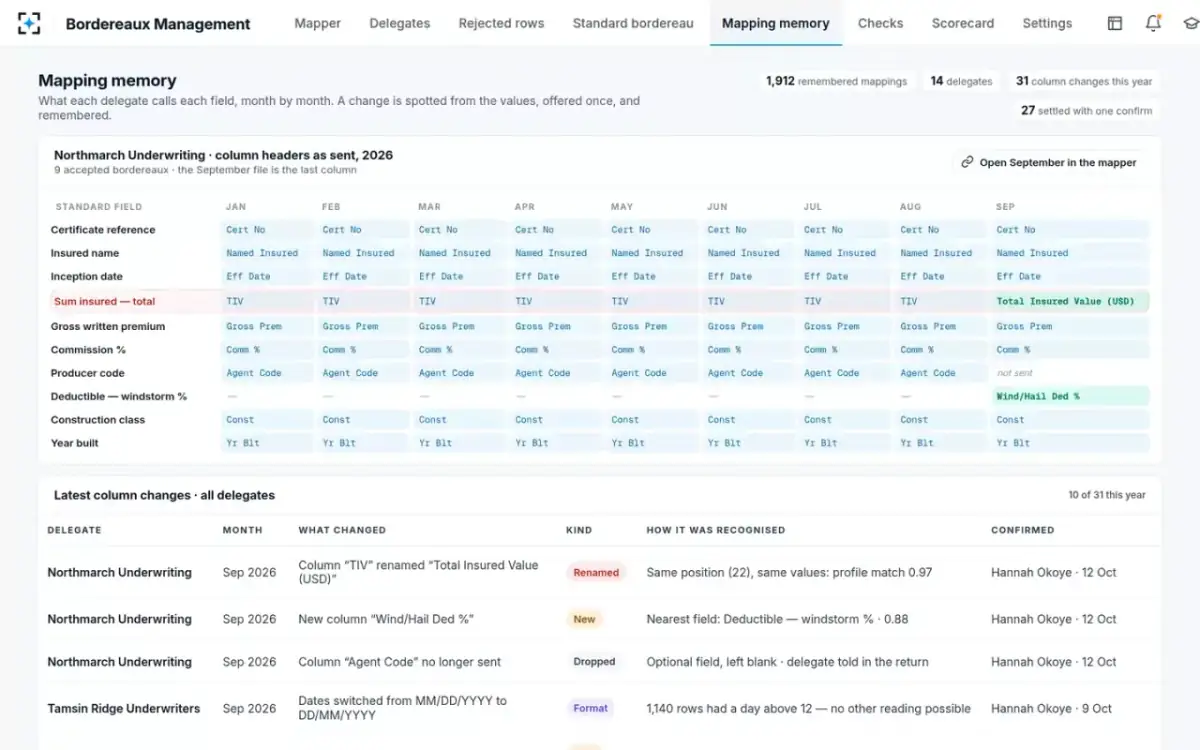
Which column became which field, how a change was recognised and who confirmed it, month by month.
- Every check result, on every row
Pass, fail or could not run, with the clause each check comes from.
- Every return as sent
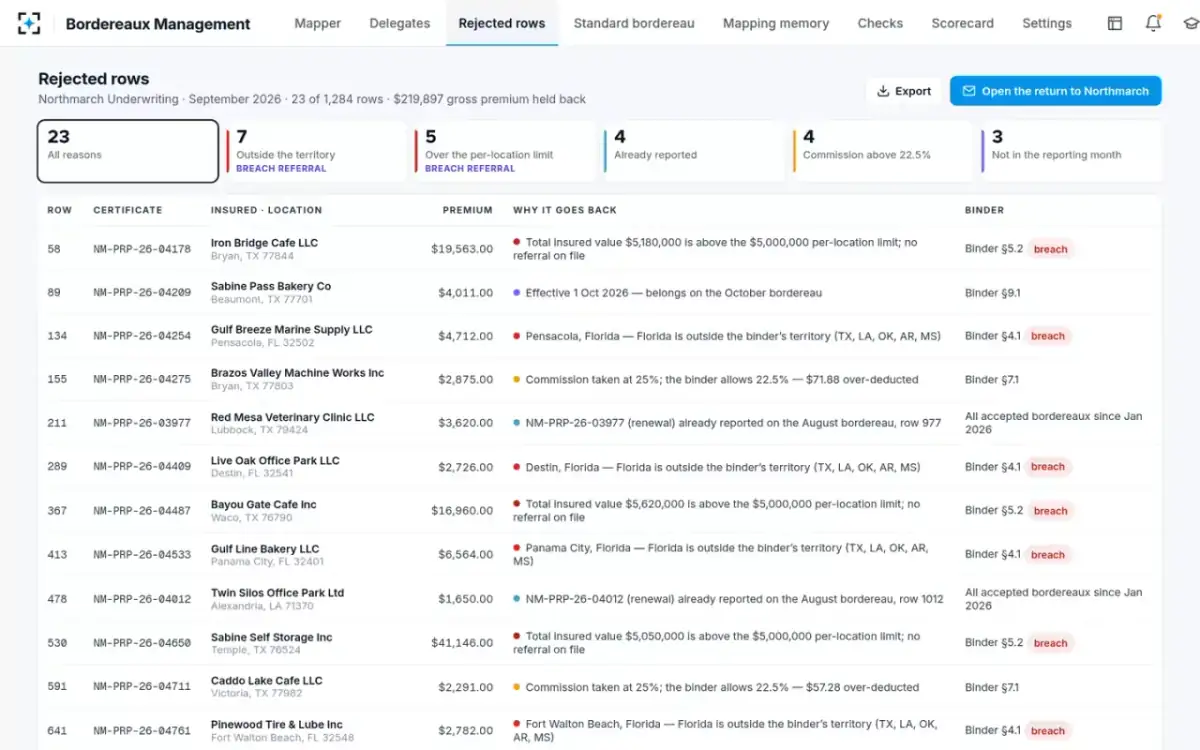
The rows returned in their original values, the reasons, the clause and the correction deadline.
- Every breach decision
Who decided what about each row outside the delegate's authority, and when.
- The totals tie and the cash tie
File totals against the cover sheet; declared premium against premium received.
Bordereaux Management's mapping memory: what each delegate called each field, and who confirmed each change
Who owns the bordereau data?
The insurer has a statutory right to it, and in the London market the binder usually says so too. The model act lets the insurer see and copy every account and record of its business in a form it can use, gives the regulator the same right to the MGA's books and records, and makes claim files the joint property of insurer and MGA until the insurer is liquidated, when they become the insurer's alone (Model #225 §§4D, 4I(3)). New York's Regulation 120 enacts the same records term (11 NYCRR §33.5(d)).
The format belongs to the binder. In Temple Legal Protection v QBE, the Court of Appeal quoted a binder that required a delegate's own coverholder agreements to "provide for standard bordereau to be maintained per QBE agreed format" ([2009] EWCA Civ 453, paragraph 46). The carrier sets the format; the delegate fills it; the carrier keeps the result.
How long should bordereaux be kept?
As long as the longest rule that applies to the records in them, which differs by state and by the kind of record. The model act leaves retention to each state's own statute; New York points to Part 243 of its regulations (Regulation 152), North Carolina to 11 NCAC 11C.0105, and Florida requires premium payment records to be kept for three years or more after payment (Fla. Stat. §626.561(2); see MGA reporting requirements by state). The binder may require longer, and reporting itself can outlive the binder: the IPORS wording required premium bordereaux until every insurance bound had expired or been cancelled.
In practice, legal retention is the floor, not the target. The XL claim reached judgment more than five years after it was issued and concerned binders going back to 2012; A carrier that keeps every bordereau as received, with its checks and decisions, for at least the life of the longest policy bound plus the limitation period that applies to claims on it is keeping what a court may later ask for.
Keeping a defensible bordereau trail with Bordereaux Management
Bordereaux Management keeps the trail as a by-product of the work. Each delegate's file is kept as received; each agent step and each human confirm is recorded on the file's run with the time and the name; every mapping change is in the mapping memory with how it was recognised and who confirmed it; and every rejected row carries its reason and the binder clause behind it, and goes back to the delegate in its original values. No agent corrects a delegate's figures.
Each rejected row in Bordereaux Management says why in a sentence and cites its clause
That trail does not make a false bordereau true; nothing in the file alone would have exposed SGC's dummy bonds or IPORS' missing premium. What it does is show, months or years later, what the carrier received, what it tested, what it found and who decided what, which is the first thing anyone asks when a delegation goes wrong. See it on the sample carrier at Bordereaux Management; nine ways a delegate's file goes wrong classifies the errors a check can and cannot catch.
Questions people ask
What happens if a coverholder misstates a bordereau?
It breaches its binder, and if the misstatement hides business or money it may breach its duties as the insurer's agent and fiduciary. In Markel v SGC, the individuals behind a misstating underwriting agent were held personally liable for the insurers' losses on bonds written outside the limits. The insurer usually also returns the rows, refers the breach and reviews the delegation.
Is a bordereau file the same as a bordereau report?
Usually yes: both mean the monthly schedule of risks, premium or claims. Some binders also require a summary account alongside it; the 2016 IPORS binder asked for one showing the paid premium declared for the period, gross and net of commission, taxes and other deductions.
Can a carrier rely on bordereaux without auditing the delegate?
No. Checking every row catches what the file shows, but not what it leaves out or misstates plausibly. The NAIC model act requires the insurer to review the MGA's underwriting and claims operations on site at least semi-annually; Markel's audit of 14 random files shows why the sample for that review should be aimed, not random.
Who prepares the bordereau?
The delegate: the MGA or coverholder that bound the risks and collected the premium, in the format the binder agreed. The carrier's bordereaux analyst receives, maps and checks it, and returns failed rows for the delegate to correct.
Should a carrier ever correct a delegate's bordereau itself?
It should not change the delegate's figures. It can map and standardise them into its own layout, but a wrong value should go back to the delegate with a reason and a deadline, so the corrected figure is the delegate's declaration rather than the carrier's assumption.