The NAIC Managing General Agents Act, Model #225, is the model law most US states drew on to regulate managing general agents (MGAs): firms that manage an insurer's business and underwrite on its paper. It does four things. It defines an MGA by volume and activity, not by job title. It requires a written contract with minimum terms, including eight underwriting guidelines that cap what the MGA may write. It lists what the MGA may never do. And it keeps the core oversight duties with the insurer, which may be examined through its MGA as if the MGA were the insurer itself. The current text dates from 2002. For a carrier, the act matters less as a statute than as a checklist: its eight underwriting guidelines are the limits a monthly bordereau should be tested against, which is the work Botminds' Binding Authority Compliance does line by line.
The section numbers below are the model's own. States enacted their own versions, often from the older text, so a carrier must read its domiciliary state's statute; the variations that matter most are set out further down.
Model #225, section by section: what each part requires and who it binds
| Section | What it says, in plain words | Who it binds |
|---|---|---|
| §1 Purpose and scope | Governs how a resident or non-resident producer comes to be treated as an MGA. | Producers |
| §2 Definitions | An MGA manages all or part of an insurer's business and, in any quarter or year, underwrites premium of 5% or more of the insurer's surplus, together with claims authority above $10,000 per claim or reinsurance negotiation. Underwriting is the authority to accept or reject risk. | Everyone: it decides whether the act applies |
| §3 Licensure | No one may act as an MGA for risks in the state unless licensed there as a producer. | The MGA |
| §4 Required contract provisions | A written contract with at least thirteen terms: termination for cause, monthly accounts, fiduciary funds, records, no assignment, eight underwriting guidelines, a surety bond, claims rules, profit-sharing hold-backs and eight prohibitions. | Both parties |
| §5 Duties of insurers | Audited MGA financials, an actuarial opinion on reserves the MGA sets, on-site reviews at least twice a year, reinsurance authority kept by an officer, 30-day notice to the commissioner, a quarterly check for new MGAs, no MGA people on the board, the bond on file. | The insurer |
| §6 Examination authority | The MGA's acts are the insurer's acts; the MGA may be examined as if it were the insurer. | The MGA, through the insurer |
| §7 Penalties and liabilities | Per-violation penalties, licence revocation, and civil actions by the commissioner, or by a receiver if the insurer fails. | The MGA and "any other person" |
| §8 Rules | The commissioner may adopt rules to implement the act. | The regulator |
| §9 Effective date | After a set date no insurer may keep using an MGA unless the arrangement complies. | The insurer |
What is the NAIC Managing General Agents Act?
The NAIC Managing General Agents Act is a model law, a template written by the National Association of Insurance Commissioners for states to enact, that sets the minimum rules for insurers that hand underwriting and often claims authority to an outside agent. NAIC members first adopted it in September 1989, amended it several times and last revised it in 2002. The model itself has no legal force; each state's enacted version does.
The 2002 revision is the one carriers usually mean. According to NAIC's project history, the working group "revised the model act to clarify the definition of an MGA, modify the bond requirements for MGAs, and update the duties of an insurer" (NAIC, Project History, 2002). Two of those changes reach the oversight desk directly: a uniform $10,000 claim threshold in the definition, and a requirement that the insurer hold audited financial statements proving the MGA has a positive net worth.
New York's version states the reason for the whole body of law more bluntly than the model does. Its preamble says the rule exists because the Department "is concerned that such delegation of authority has been subject to abuses detrimental to both insurance companies and insureds" (11 NYCRR 33.0, Regulation 120). The act is a response to that history: it does not stop delegation, it fixes the terms on which delegation is allowed.
Who is an MGA under the model act? The 5 percent rule, and the second test
Under the model act, an MGA is a person who manages all or part of an insurer's business and acts as its agent, and who meets two tests together: it produces and underwrites gross direct written premium of at least 5% of the insurer's policyholder surplus in any one quarter or year, and it either adjusts or pays claims above $10,000 per claim or negotiates reinsurance for the insurer. Title does not matter. The model's own drafting note warns that "Individuals or agents calling themselves “managing general agents” may not necessarily fall under the provisions of this Act" (Model #225, §2D).
The word "together" is the one people miss. A producer that writes a large book but has no claims authority and no role in reinsurance is not an MGA under the model's definition, however much premium it binds. A producer with claims authority above $10,000 but a book below 5% of surplus is not one either. The model also excludes the insurer's own employees, the US manager of an alien insurer's branch, an affiliated underwriting manager not paid by premium volume, and the attorney-in-fact of a reciprocal exchange.
The 5 percent rule on one illustrative insurer: two producers, one MGA
The $10,000 figure has a history worth knowing. NAIC's project history records that the prior version "provided each state insurance commissioner with the discretion to determine the claim settlement threshold amount", and that the 2002 text fixed $10,000 so states would classify producers "in a uniform manner". States that enacted the earlier text may still leave the threshold to the commissioner, which is why a carrier with producers in several states cannot apply one test everywhere.
What must an MGA contract include? The thirteen minimum terms
The model act forbids an MGA to place business with an insurer unless a written contract is in force that sets out each party's responsibilities and, where they share a function, "specifies the division of such responsibilities". Section 4 then lists the minimum terms. Most are about control and money: the insurer may end the contract for cause and suspend the MGA's underwriting authority while a dispute runs; the MGA must account for all transactions and remit funds at least monthly; premium is held in a fiduciary account at an FDIC-insured bank, with no more than three months of estimated claims and claim expenses kept back; the insurer may access and copy all records; the contract may not be assigned.
The rest set limits. The MGA must carry a surety bond of at least $100,000 or 10% of the premium it produced for the insurer the year before, capped at $500,000. If it may settle claims, it must report them promptly and send the file when a claim may exceed its authority, involves a coverage dispute or stays open more than six months. If it shares interim profits and can influence them through reserves or claim payments, the profit is held back for one year on property business and five years on casualty. And at the centre of the section, in subsection F, sit the eight underwriting guidelines.
The eight underwriting guidelines, and how to test each one
Subsection F requires "Appropriate underwriting guidelines" covering eight things. Together they are the skeleton of any binding authority agreement, and each can be tested against a bordereau line or a running total. The checklist pairs each guideline with the test a carrier can run on every bordereau.
Model #225's eight underwriting guidelines, as monthly bordereau tests
- (a) The maximum annual premium volume
Add the premium bound to date against the cap, and project when it will be reached at the recent pace. The sample binder had $14.22M of an $18.0M cap bound by 30 September.
- (b) The basis of the rates to be charged
Test each line's rate against the rating guide's minimum. Sample row 203 was rated at 0.36 per $100 against a 0.42 minimum.
- (c) The types of risks which may be written
Map each line's occupancy or class code to the permitted list. Sample row 341, a vacant building under renovation, fell in an excluded class.
- (d) Maximum limits of liability
Compare each line's total insured value or limit with the maximum line. Sample row 287 was $9.14M against $7.5M any one location.
- (e) Applicable exclusions
Check deductibles, construction, age and other exclusion terms per line. Sample row 390 carried a 1% wind/hail deductible where 2% was the minimum.
- (f) Territorial limitations
Place each location in its state and county, deriving the county from the ZIP code where the bordereau omits it, and flag the result as derived.
- (g) Policy cancellation provisions
Confirm the binder's cancellation terms appear in the policies issued, and that any cancellation the carrier orders can be executed in time.
- (h) The maximum policy period
Check each line's inception and expiry against the maximum term, and the gap between inception and binding against any backdating limit.
Two of the eight are rarely testable from a risk bordereau alone. Cancellation provisions, guideline (g), are a term of the policy form, not of each line; they are checked by reading the issued policy, and they matter most when the carrier needs to cancel a risk it never agreed to. And exclusions, guideline (e), often hide in schedules: a deductible minimum that applies only in coastal counties, or a construction class excluded only above a certain age. A check that reads only the main agreement will miss them.
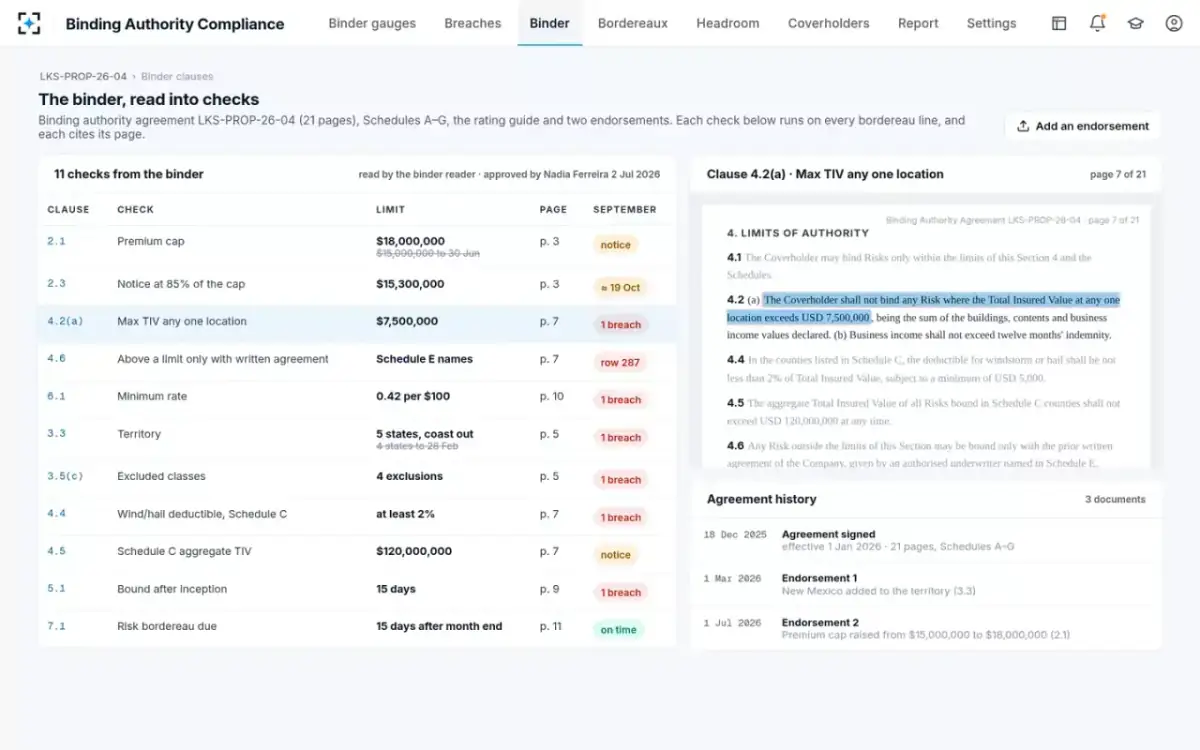
The model is silent on what most binders add on top, such as backdating limits, aggregate caps by zone, notice thresholds before the premium cap and the bordereau deadline itself. A real binder is longer than the model; the model is the floor. In Binding Authority Compliance, the sample binder's 21 pages, Schedules A to G and two endorsements produced eleven checks, each with its clause, page and effective dates, and an endorsement applies only from the date it takes effect.
One binder read into eleven checks by Binding Authority Compliance
What the MGA may never do under section 4M
Subsection M lists eight things the contract must forbid. Three of them protect the insurer's capital directly: the MGA may not bind reinsurance or retrocessions except facultative cover under written guidelines, may not commit the insurer to a syndicate, and may not, without the insurer's prior approval, pay or commit the insurer to pay a claim over a set amount, net of reinsurance, and that amount may not exceed 1% of the insurer's policyholder surplus (the clause is quoted in claims settlement authority letter). The others protect the chain of control: no appointing unlicensed producers, no collecting from reinsurers without approval, no subproducer on the insurer's board, no jointly employed staff, and the shortest clause in the act, "Appoint a sub-MGA."
The ban on sub-MGAs is the one most often tested by modern program structures. A carrier that grants authority to an MGA which then hands part of the pen to another firm has, under the model's text, a contract that must forbid exactly that. California's examiners took a related point seriously in 2025, faulting an insurer whose MGA agreement allowed joint employment of staff; the file examiners ask for sets out that exam's other findings.
What are an insurer's duties under the MGA act?
The insurer's duties are in section 5, and they are the part of the act an insurer cannot pass to anyone else: hold independent audited financial statements for the MGA's two most recent fiscal years showing a positive net worth; obtain an actuary's opinion each year on any loss reserves the MGA sets; review the MGA's underwriting and claims operations on site at least twice a year; keep binding authority for reinsurance with an officer of the insurer who is not affiliated with the MGA; notify the commissioner within 30 days of entering into or ending a contract; check the insurer's books each quarter for producers who have become MGAs; keep the MGA's people off the insurer's board; and keep the MGA's bond on file. The NAIC's own September 2026 draft licensing handbook sums them up in one line: insurers "are required to monitor the financial stability of MGAs under contract".
The list says nothing about how often to look at what the MGA bound. That is left to the contract and to the insurer's judgement, and it is the gap a monthly line-by-line check fills. The duties a capacity provider cannot hand to the MGA takes each section 5 duty in turn and shows the evidence it needs.
The acts of the MGA are considered to be the acts of the insurer on whose behalf it is acting. An MGA may be examined as if it were the insurer.
NAIC Managing General Agents Act, Model #225, §6
Section 6 is two sentences long and does more work than any other. It lets a regulator walk through the insurer into the MGA's office, and it means the insurer cannot argue, in an examination, that a breach was the MGA's alone. Section 7 adds the enforcement: penalties for each violation, revocation of the producer's licence, and a civil action by the commissioner, or by a receiver if the insurer fails, where the MGA's material non-compliance cost the insurer money.
Do all states follow the MGA model act?
No. Every state regulates MGAs in some way, but most did it from an older text of the model, and several wrote their own. NAIC's state page for Model #225, last updated in Fall 2020, files most states' MGA laws in its "previous version" column, meaning they enacted an earlier text, not the 2002 revision; Florida's §§ 626.7451–626.7454, New York's Regulation 120 and Minnesota's chapter 60H are among them, while Tennessee and West Virginia are among the few listed as adopting the current model (NAIC, Model #225 state page, Fall 2020). For how to read those columns, see NAIC model law state adoption charts.
Same act, different numbers: the MGA contract in four rulebooks
| Term | Model #225 (2002) | New York, 11 NYCRR 33.5 | Florida, § 626.7451 | Texas, ch. 4053 |
|---|---|---|---|---|
| Accounts to the insurer | Not less than monthly | Not less than monthly | Monthly or more frequent | An account report at least once each calendar quarter, with set contents |
| Claims money the MGA may keep | No more than three months of estimated claims and expenses | No more than three months | Up to 60 days | All money collected goes into an escrow account |
| When a claim file goes to the insurer | Above an amount set by the commissioner or the company, whichever is less | Potential to exceed 1% of the insurer's surplus, or the company's limit if less | Above the limit set by the insurer | The contract must address claims settlement, if applicable |
| Who may end the contract | The insurer, for cause | The insurer, for cause | Either party, for cause; obligations on policies continue | The contract must address cancellation or termination |
| The eight underwriting guidelines | Required | Required | Required | Premium volume limits and underwriting addressed "if applicable" |
The Texas row is the one that surprises carriers used to the model. Texas does not list the eight guidelines in statute; its chapter 4053 requires a written contract that addresses each party's responsibilities, termination, "reports, records, and auditing", and, if applicable, premium volume limits and underwriting. In exchange, Texas fixes the content of a quarterly account report: written, earned and unearned premium; losses and loss expenses paid and outstanding; losses incurred but not reported; and management fees. New York goes the other way, tying the claim-file trigger to 1% of the insurer's surplus rather than leaving the figure to the regulator.
What the act leaves to the binder, and how Binding Authority Compliance checks it
The act sets the minimum content of an MGA contract; it does not say how a carrier should check performance against it between on-site reviews. There is no bordereau format in the model, no deadline for a monthly risk report, no rule on how fast a breach must be found or how long a delegate has to answer. Those live in the binding authority agreement, and they differ between carriers and between programs.
That leaves a practical gap. The act entitles the insurer to records it can use, but a monthly bordereau arrives in the delegate's own layout, and the eight guidelines become testable only once each column is mapped and each clause is read into a limit with its effective date. Binding Authority Compliance closes the gap in two steps: one agent reads the binder, its schedules and every endorsement into checks, each citing clause and page; another maps each coverholder's columns to standard fields, asking a person before using any match below the confidence threshold set, 80% by default. The checks then run on every line the night the bordereau lands, and the head of delegated authority decides what each result means. The six agents and what none may do describes each step and its limits.
Questions people ask
What is the MGA model act?
It is the common name for the NAIC Managing General Agents Act, Model #225. NAIC members first adopted it in 1989 and last revised it in 2002; it is a template, and only a state's enacted version binds anyone.
What does Model 225 require of the insurer?
Audited MGA financial statements for two years, an annual actuarial opinion on reserves the MGA sets, on-site reviews at least semi-annually, written notice to the commissioner within 30 days of a contract starting or ending, and a quarterly check for producers who have become MGAs. Florida's version makes the on-site review annual, with the first within six months of engaging a new MGA.
Does the 5 percent rule use written or earned premium?
Gross direct written premium, measured against the policyholder surplus in the insurer's last annual statement, in any one quarter or year. The premium test alone does not make a producer an MGA; it must also adjust or pay claims above $10,000 per claim or negotiate reinsurance for the insurer.
Can an MGA appoint a sub-MGA?
Not under the model act: section 4M requires the contract to forbid it, and Florida's statute says the MGA shall not "Appoint a submanaging general agent". A carrier should check its state's own text and its binder, because some program structures add tiers the model did not contemplate.
Who enforces the MGA act?
The state insurance commissioner, under the state's enacted version. Section 7 of the model lets the commissioner, after notice and a hearing, impose a penalty for each separate violation, revoke or suspend the producer's licence and sue for the insurer's losses; section 8 lets the commissioner adopt rules to implement the act.