A delegated authority management system is the software a carrier uses to run its relationships with MGAs and coverholders: holding each binding authority agreement, receiving each delegate's bordereaux, checking what was bound against what was allowed, and recording breaches, decisions and reports. Most carriers already have the pieces in separate places: binders in a document store, bordereaux in an inbox or portal, approvals in email, premium in finance, claims in a claims system. Buying a new platform to hold all of it is one option. The other is a layer that reads each source where it already lives, does the checking, and writes back only its own results. Botminds' Binding Authority Compliance is the second kind: it reads the binder, the bordereaux, the claims bordereau, the referral log and the underwriting mailbox, tests every bound risk against the binder, and never alters a value it was sent.
The examples follow a fictional capacity provider, Corvane Specialty, and its five fictional coverholders as they appear in the solution. The legal requirements cited are real and linked.
What a delegated authority management layer reads, writes and must never overwrite
| Source | What the layer reads from it | What it writes | Never |
|---|---|---|---|
| Binding authority agreements and endorsements | Limits, schedules, authorised underwriters, effective dates, page and clause | Checks, each citing clause and page | Change a limit or apply an endorsement early |
| Risk bordereaux from each delegate | Every line, in the delegate's own layout, by portal, email or SFTP | A mapped copy and the check results per line | Alter a reported value |
| Claims bordereaux | Losses by address and date | Matches against bound risks | Change a reserve or a claim |
| Referral log and underwriting mailbox | Requests, approvals and who gave them | The evidence found, quoted | Treat a question as agreement |
| Rating guide and caps | Minimum rates, premium caps, aggregates | Headroom and projected cap dates, labelled as estimates | Raise a cap |
| Premium bordereau and finance | Totals to tie the risk bordereau to | A tie-out result | Post anything to the general ledger |
What is a delegated authority management system?
A delegated authority management system is an archive and a routine. The archive is everything the carrier has agreed with each delegate and everything the delegate has reported; the routine is the checking, chasing, deciding and reporting that turns those two sets of documents into oversight. The law sets the floor for the archive. The NAIC model act requires the MGA contract to provide that separate records of the MGA's business are kept and that the insurer may see and copy every account and record of its business in a form it can use (NAIC Model #225, §4D; the section is quoted in MGA data platforms). Texas puts the same duty on the MGA directly: separate records for each insurer, available for inspection by the insurer and by the department's examiners (Tex. Ins. Code § 4053.104).
Usable form is the idea a management system is built on. A delegate meets it by sending data the insurer can read; the insurer meets its own oversight duty only if it then reads it. Between those two lies the practical problem: each delegate sends its bordereau in its own layout, with its own column names and conventions, and the binder that defines the limits is a PDF with schedules and endorsements. The system's first job is to make both machine-checkable without changing either.
What systems do delegated authority teams use?
Most delegated authority teams run on five kinds of system, none of them designed for oversight: a document store for binders and endorsements; a mailbox, portal or file transfer site where bordereaux arrive; spreadsheets where analysts map, sample and track caps; the finance system where premium is booked; and the claims system, or the delegate's claims bordereau where claims are handled outside. The underwriting mailbox doubles as the referral log more often than anyone would like.
Each holds part of the answer to "is this delegate inside its authority?" and none holds all of it. The binder knows the limit; the bordereau knows the risk; the mailbox knows whether anyone agreed; the claims bordereau knows whether a loss came first. Oversight is the join between them, which is why it lives in spreadsheets: a spreadsheet is the one tool that can hold a bit of each. A management layer replaces the join, not the systems.
Replacing the systems, or reading beside them
A new platform that holds everything: Asked to submit in the platform's template, or through its portal.
A layer that reads where the data already lives: Keep sending in their own layouts; each layout is mapped once and remembered.
A new platform that holds everything: Re-keyed into the platform's fields.
A layer that reads where the data already lives: Read from the signed documents, each check citing its clause and page.
A new platform that holds everything: Must move to the platform's workflow to count.
A layer that reads where the data already lives: Found where they are, in the referral log and mailbox, and quoted.
A new platform that holds everything: Every upstream habit at once; history stays in the old tools.
A layer that reads where the data already lives: Nothing upstream: it writes only its own results and decisions.
A new platform that holds everything: After migration.
A layer that reads where the data already lives: On the first bordereau it reads.
What a management layer must never overwrite
A management layer must never overwrite what a delegate reported or what a binder says, because those two documents are the evidence in any dispute. If the insurer's copy of a bordereau has been "cleaned", the delegate can say the insurer changed its figures. If a limit was re-keyed and mistyped, a breach notice cites a limit the delegate never signed. Binding Authority Compliance therefore keeps the bordereau as sent beside a mapped copy, marks every conversion, and cites the page of the binder for every check.
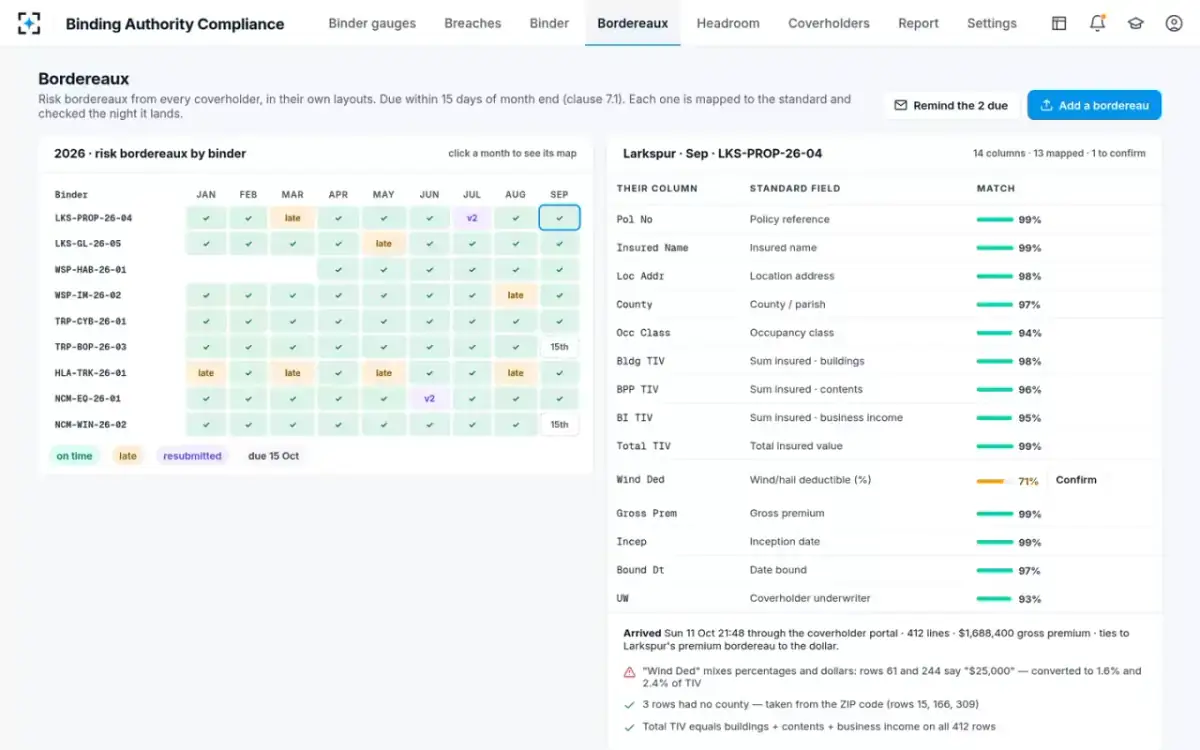
The sample September bordereau shows why the marking matters. Larkspur's "Wind Ded" column mixes percentages and dollar amounts: rows 61 and 244 say "$25,000". The solution converts them to 1.6% and 2.4% of the total insured value so the deductible check can run, and marks them as converted. Three rows had no county; the county was taken from the ZIP code and marked as derived. Any breach that rests on a converted or derived value shows that it does.
Bordereaux in Binding Authority Compliance, by binder and month, one layout mapped
Can a delegated authority system connect to the policy admin system?
It can, but for checking binding authority it rarely needs to, and a buyer should ask why a vendor wants to. Under a binder the delegate often issues the policies itself; the MGA in one Fifth Circuit case issued them in the insurer's name and handled premium and claims. The bordereau is how the carrier learns what was issued. The carrier's own policy administration system may hold the same policies only as summaries booked from that bordereau. Checking authority against the carrier's system is checking the bordereau at one remove.
Binding Authority Compliance is built around the documents the authority check needs: the agreement and endorsements, the risk and claims bordereaux in any layout as XLSX, CSV or PDF, the referral log and mailbox, and the rating guide and caps, received through a coverholder portal, email or SFTP. Where a carrier wants results to flow onward, the monthly report, breach list and decisions are outputs it can file wherever its records live. A connection that writes into a policy or finance system is a decision for the carrier's IT team, made with the rule above in mind: the oversight layer should not be able to change the record it oversees.
Do you need to replace bordereaux tools?
No. If a bordereaux tool already collects and standardises delegates' files, the checking layer can read its output as one more layout, and the work it adds is the part most bordereaux tools stop short of: reading the binder into checks and testing every line against them, with the written-agreement search behind each exception. Collecting, cleaning and reconciling bordereaux is its own job, done by Bordereaux Management (what bordereaux processing involves); tying premium and cash is done by Premium Bordereaux Reconciliation (its reconciliation report).
The distinction matters because a clean bordereau is not a compliant one. A court case from 2022 shows the gap from the money side. A coverholder's monthly premium bordereaux showed receipts in the first half of 2016 "totalling over €4 million", while its premium accounts "held either nil or very modest balances"; only when accountants analysed the bank statements alongside third-party information did it become clear that the coverholder had declared far less premium than it had received (XL Insurance Company SE v IPORS [2022] EWHC 2093 (Comm)). The bordereaux were internally consistent. They were checked against the wrong thing.
The monthly cycle a management system has to keep
The monthly cycle is set by the binders, not by the system. The binder in that 2022 case required premium bordereaux, and claims bordereaux where due, in a format the underwriters had agreed in advance (quoted in bordereaux ingestion), sent within 15 days after the end of each month, with settlement within 30, 60 or sometimes 90 days. The sample binder sets the same 15-day deadline for its risk bordereau. The system's job is to make each step of that cycle happen on the day the data allows, not when someone gets to it.
One September in Binding Authority Compliance: from month end to signed report
- To bordereau, 11 Oct11 d
- Decided; answer window15 d
- To bordereau, 11 Oct11 d
- Queue and sampling≈ 7 d
- Unsampled breaches wait to 18 Nov31 d
What is a delegated authority management plan?
A delegated authority management plan is the written plan for one delegate: why the carrier uses it, what authority it holds, how it will be monitored, when it will be reviewed on site, what triggers escalation, and how the carrier would exit. Where the oversight framework applies to every delegate, the plan applies the framework to one. The Prudential Regulation Authority's January 2026 letter to UK insurers gave a reason to write one: it had seen firms whose strategy for using delegated arrangements was not always clear (PRA, 2026 priorities; the line is quoted in what program business is).
A management system supports the plan by keeping the plan's numbers current. For the sample book that means each delegate's breaches per 1,000 risks, its average days to answer a notice, the date of its next on-site review, and how much of each binder's premium cap is used. The plan itself, and any decision it leads to, is written and owned by people. Why an insurer uses an MGA, and how it gets out covers the exit section a plan should not leave blank.
How long does it take to implement a delegated authority system?
It depends less on the software than on how many binders and layouts there are, and the honest first step is small. A layer that reads documents where they live needs, for its first binder: the signed agreement with its schedules and endorsements, the rating guide and caps, and a few months of the delegate's bordereaux. The binder is read into checks and approved by the head of delegated authority; the delegate's layout is mapped, with a person confirming any column below the confidence threshold. From then on the same layout is remembered and only changes need attention.
Before you choose a delegated authority management system: eight questions
- What must our delegates change?
Ideally nothing. Every template a delegate must adopt is a negotiation and a source of late bordereaux.
- What does it read, and from where?
Binders, bordereaux, claims bordereaux, referral log, mailbox, rating guide. List the sources and how each arrives.
- What can it write, and where?
Results and decisions in its own record. Writes into policy or finance systems should be explicit and limited.
- Does it keep the bordereau as sent?
The original must survive beside any mapped copy, with every conversion marked.
- Does every check cite its source?
Clause, page and effective dates for limits; file, sheet and row for bordereau values.
- Who decides, and is it recorded?
Names, reasons and times for every clear, refer or escalate; a second name for serious breaches.
- What happens when a layout changes?
A renamed column should wait for one confirmation, not a re-implementation.
- Can we prove it on our own files?
One binder and a few months of its bordereaux, checked before anything is signed.
The first run is also the fairest test. Running the checks over a few past months of one delegate's bordereaux shows how many breaches a sample missed, how often written agreement was claimed but not on file, and how close each cap came, using the carrier's own data instead of a demonstration. Six agents, and what none may do describes the checking in detail. To start with one of your binders, begin from Binding Authority Compliance.
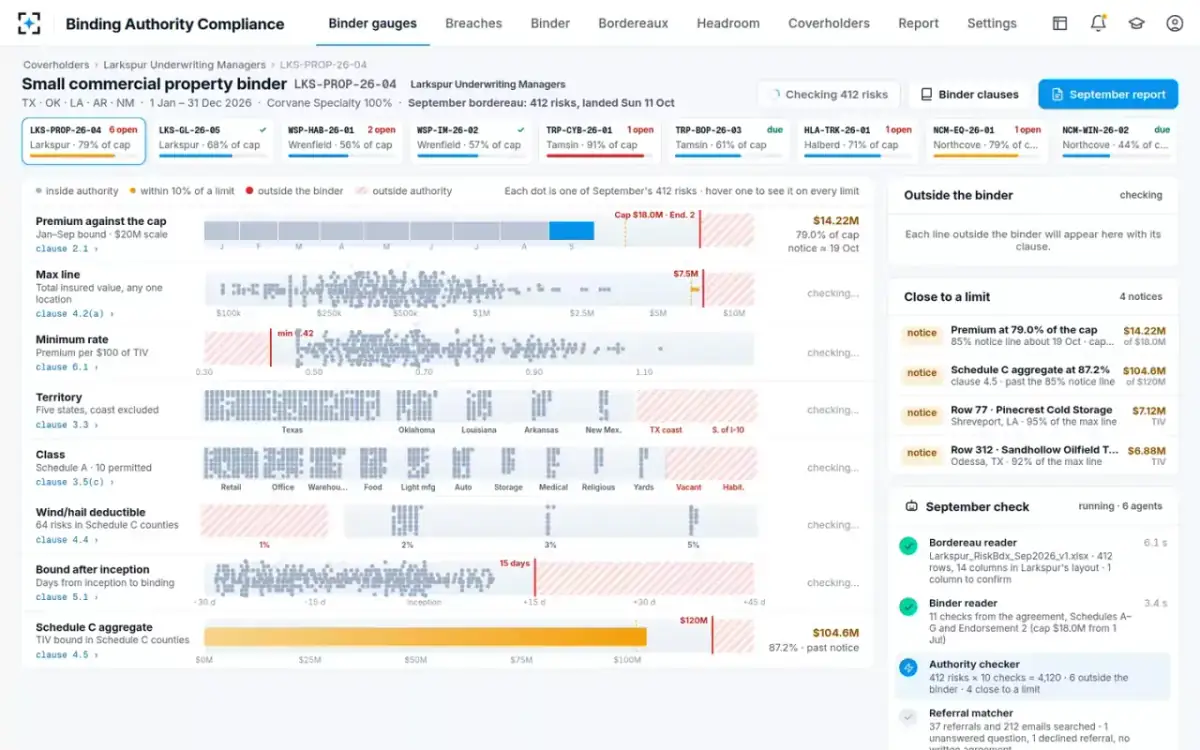
The September check running beside the binder's gauges
Questions people ask
Is a delegated authority management system the same as a bordereaux management system?
They overlap but are not the same. A bordereaux system collects, standardises and reconciles delegates' files; a delegated authority system also holds the binders and tests what was bound against what was allowed, then records the decisions. A carrier can run both, with the authority checks reading the bordereaux tool's output.
Do delegates need a login to the system?
Not necessarily. In the sample set-up delegates upload through a portal or send by email or SFTP, and the coverholder's compliance lead is a guest who receives breach notices and the monthly report. Asking delegates to re-key data into a carrier's template is the change most likely to slow bordereaux down.
What records must a carrier keep on its MGAs?
Under the NAIC model act, the MGA keeps separate records of the business it writes and the insurer must be able to access and copy them; Texas requires them to be available to the department's examiners too. The insurer keeps its own evidence of oversight: on-site review results, audited statements, actuarial opinions and, in practice, its breach decisions.
Can the system handle endorsements that change a limit mid-year?
It should apply each endorsement only from its effective date. The sample binder's premium cap rose from $15.0 million to $18.0 million from 1 July 2026; checks for months before July use the old cap, and the monthly report says which version applied.
Who owns the data in a delegated authority system?
The binders and the oversight record are the carrier's; the bordereaux are the delegate's report to the carrier under the contract. The model act makes claim files the joint property of insurer and MGA, and the insurer's sole property if it goes into liquidation, which is one reason to keep the carrier's copy complete.