An insurer might use an MGA, a managing general agent, to write business it could not write as well on its own: a specialist line where the MGA's underwriters have the expertise, a product the MGA designed and distributes, or a program the MGA can run end to end, from issuing policies to paying claims. The insurer gets premium and diversification without building the team. It does not get to hand over the responsibility. The law keeps the insurer answerable for what the MGA binds, and the UK's prudential regulator has asked insurers to plan, before they need to, how they would leave arrangements that lose money. So the decision to use an MGA is really two decisions: why to go in, and how to get out. Both depend on the same evidence: what the MGA is binding, against what the insurer allowed. Botminds' Binding Authority Compliance keeps that evidence current by checking every bound risk against the binder the night each bordereau lands.
The sample figures come from a fictional capacity provider, Corvane Specialty, and its five fictional delegates. The statutes, judgments and regulators' statements are real and linked.
How much of each binder's capacity is already used: the run-off an exit would leave
Tamsin Ridge · small business cyber
- Premium cap used · 91%
- Left · 9%
Larkspur · small commercial property
- Premium cap used · 79%
- Left · 21%
Halberd Lowe · trucking auto liability
- Premium cap used · 71%
- Left · 29%
Wrenfield · habitational property
- Premium cap used · 56%
- Left · 44%
Why might an insurer use an MGA?
An insurer uses an MGA to buy capabilities it does not have, without the time and cost of building them. A September 2026 draft of the NAIC's licensing handbook lists what an MGA's role can cover: marketing, underwriting, issuing policies, collecting premiums, appointing and supervising other agents, paying claims and negotiating reinsurance. An insurer can take any part of that list from an MGA, or nearly all of it. California's examiners described one 2023 program in which the MGA performed nearly every business function except reinsurance.
Expertise is the most common reason given, and courts have recorded it. When Markel granted a binding authority to a surety coverholder in 2005, the judge found, "The principal reason for granting this Binding Authority was that Mr. Higgins was known to have much experience in writing surety business and was regarded as being skilled and successful in doing so" (Markel International v Surety Guarantee Consultants [2008] EWHC 1135 (Comm)). Product and distribution are the other. When the FCA consulted in 2025 on letting a single firm lead a co-manufactured product, most respondents wanted MGAs to be allowed to lead, "This is because MGA-led products are common in the commercial market" (FCA PS25/21).
What are the benefits of using an MGA, and what does each cost?
Every benefit of using an MGA has a matching oversight cost, because the capability the insurer buys is one it does not control day to day. The comparison sets each reason to delegate beside what it asks of the insurer in return.
Why insurers use MGAs, and what each reason costs in oversight
What the insurer gains: Underwriters with a track record in a niche line, available at once.
What it must then oversee: Dependence on named individuals; the binder's limits must hold even when the expert disagrees with them.
What the insurer gains: A product designed by the MGA and the brokers who sell it.
What it must then oversee: In the UK, product governance stays with an insurer or managing agent; the FCA declined to let MGAs lead alone.
What the insurer gains: Policy issuance, premium collection and claims handled outside.
What it must then oversee: Fiduciary handling of premium, claims files the insurer can take back, and on-site reviews of both.
What the insurer gains: Premium and diversification without a new team.
What it must then oversee: Pricing and reserving risk the PRA flagged in 2026, and premium caps that run out early if growth outpaces the binder.
The fourth row is the one regulators now name. The Prudential Regulation Authority's January 2026 letter to UK insurers expected delegated business to keep growing in the London market and found firms' strategies for it unclear, then set out the expectation that matters for this page: strong oversight of how delegated arrangements perform, including a plan for how the firm would leave the unprofitable ones (PRA, 2026 priorities; the passage is quoted in MGA termination notice).
An exit is cheapest to plan before the first risk is bound, when every party still wants the relationship to work.
How does an insurer terminate an MGA?
An insurer terminates an MGA under the contract, and the model law requires every MGA contract to let it do so for cause. Section 4A of the NAIC act gives the insurer the right to end the contract for cause by written notice (NAIC Model #225, §4A; quoted in MGA termination notice). Florida lets either party end it for cause, and adds that both must still honour the policies already written (Fla. Stat. § 626.7451(1)). Ending without cause, on notice at expiry, is a matter for the contract's own terms.
Termination also starts a regulatory clock. Under the model act the insurer must notify the commissioner within 30 days of terminating a contract with an MGA, as it must within 30 days of entering into one. The detail of drafting and serving the notice, and the performance case that usually precedes it, is covered in the MGA termination notice guide; this page is about the levers and the data behind them.
Can an insurer suspend an MGA's authority?
Yes, while a dispute over termination for cause runs: the same section 4A lets the insurer suspend the MGA's underwriting authority until the dispute is resolved. The claims side has a matching clause. If the MGA settles claims, its settlement authority may be ended for cause on written notice and suspended while a dispute over the cause runs.
Between doing nothing and suspending everything, most binders allow narrower steps, and they are often the right first move. The sample breach notice to Larkspur asks it to "bind no further Risks of this kind pending our reply", which restricts one class of business without stopping the program. A capacity provider can also lower a premium cap by endorsement, tighten referral limits, or require prior agreement for risks above a lower threshold. Each of those needs the same evidence as a termination: what was bound, against which clause, how often, and what the MGA said when asked.
Exit levers, the rule behind each, and the data each one needs
| Lever | Rule | Data the insurer needs |
|---|---|---|
| Restrict a class or limit | The binder's own notice and endorsement clauses | The breaches by class and clause, with the delegate's answers |
| Suspend underwriting authority | Model #225 §4A, during a dispute over cause | The breaches that show cause, with dates and decisions |
| Terminate for cause | Model #225 §4A; Florida § 626.7451(1) | A file that names each risk, clause and decision, and the notices sent |
| Notify the regulator | Model #225 §5E: within 30 days of termination | The contract and termination dates |
| Take back the claim files | Model #225 §4I(3): joint property; the insurer's alone in liquidation | An index of open claims from the claims bordereau |
| Recover the money | Model #225 §4B–C: monthly accounts; fiduciary funds; at most three months of claims money held (60 days in Florida) | Premium bordereaux tied to the risk bordereaux and to cash |
| Hold back interim profits | Model #225 §4L: one year on property, five on casualty, until verified | Loss development by underwriting year, including reserves |
What happens to claims when an MGA is terminated?
The claims stay the insurer's, and the files have to come with them. The model act makes claim files the joint property of insurer and MGA, and on an order of liquidation of the insurer they become the insurer's or its estate's alone. If the MGA was settling claims, the insurer has to decide who settles them after termination: the MGA under a run-off agreement, a third-party administrator, or the insurer's own claims team. Each choice needs the open claims identified first, which is a reason to keep the claims bordereau reconciled to the risk bordereau throughout the relationship, not only at the end.
The policies stay in force unless cancelled. Ending a binder stops new business, but every policy already bound runs to its expiry, and the insurer remains liable for losses under it. That is why the Split figure at the top of this page matters at an exit: Tamsin Ridge's cyber binder, 91% used by 30 September, would leave almost a full year's book running off on the insurer's paper. The model act preserves the insurer's right to cancel or non-renew any policy, subject to the state's cancellation laws, for risks it decides not to keep.
What is an MGA run-off? The months after the exit
An MGA run-off is the period after new business stops, while policies expire, claims are settled, money is accounted for and any profit commission is finally verified. It is longer than most exits plan for, and its length depends on the line. A property book usually runs off in a year or two; a casualty book can take far longer, which the model act recognises by holding back the MGA's interim profits for one year after they are earned on property business and five years on casualty, where the MGA can influence them through reserves or claim payments.
Getting out takes longer than getting in: an illustrative run-off, property and casualty
- Run to expiry≈ 13 mo
- Profit held back1 yr
- Run to expiry≈ 13 mo
- Profit held back until verified5 yrs
The reporting does not stop at the exit either. A binder at issue in a 2022 English case required the coverholder to keep producing premium bordereaux until every policy bound under it had expired or been cancelled (the clause is quoted in what bordereaux reporting is). That case shows why the clause matters. The coverholder ended the last binder by notice effective 30 November 2016; by June 2017 the insurer had obtained a proprietary injunction over the coverholder's premium accounts, and bank records obtained afterwards showed balances far below what the bordereaux reported (XL Insurance Company SE v IPORS [2022] EWHC 2093 (Comm)). An exit plan that ends monitoring when new business ends leaves the money unwatched at the point it is most at risk.
Each delegate's breach record in Binding Authority Compliance: where an exit starts
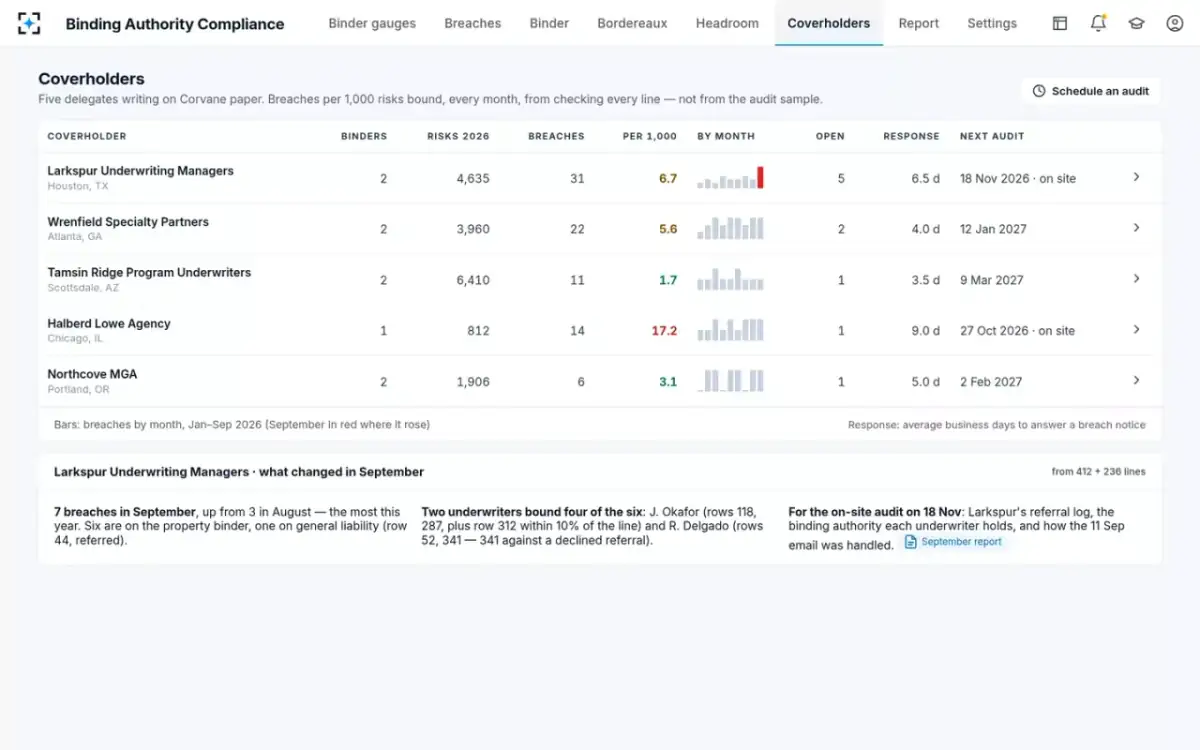
The data each exit lever needs, kept current
Every exit lever in the table above rests on evidence, and the evidence is cheapest to keep while the relationship is running. A suspension for cause needs breaches named by risk and clause. A termination needs the notices and the delegate's answers. A run-off needs the open claims and the money reconciled. An insurer that tries to assemble all of that only when it decides to leave starts the exit already behind.
Binding Authority Compliance keeps the underwriting half of that evidence as a matter of course: every bordereau line checked, every breach with its clause and row, every decision with a name and a reason, every notice with its answer date, each delegate's breaches per 1,000 risks and response times, and each binder's capacity used and projected. The monthly authority compliance report, signed by the head of delegated authority and acknowledged by the chief underwriting officer, is the period-by-period history an exit decision will be judged on. The money and claims halves are the work of Premium Bordereaux Reconciliation and Delegated Claims Audit. What one breach costs explains why a pattern of breaches is usually the cause an exit rests on, and who signs what covers the people who make the call.
The monthly report from Binding Authority Compliance: the history an exit rests on
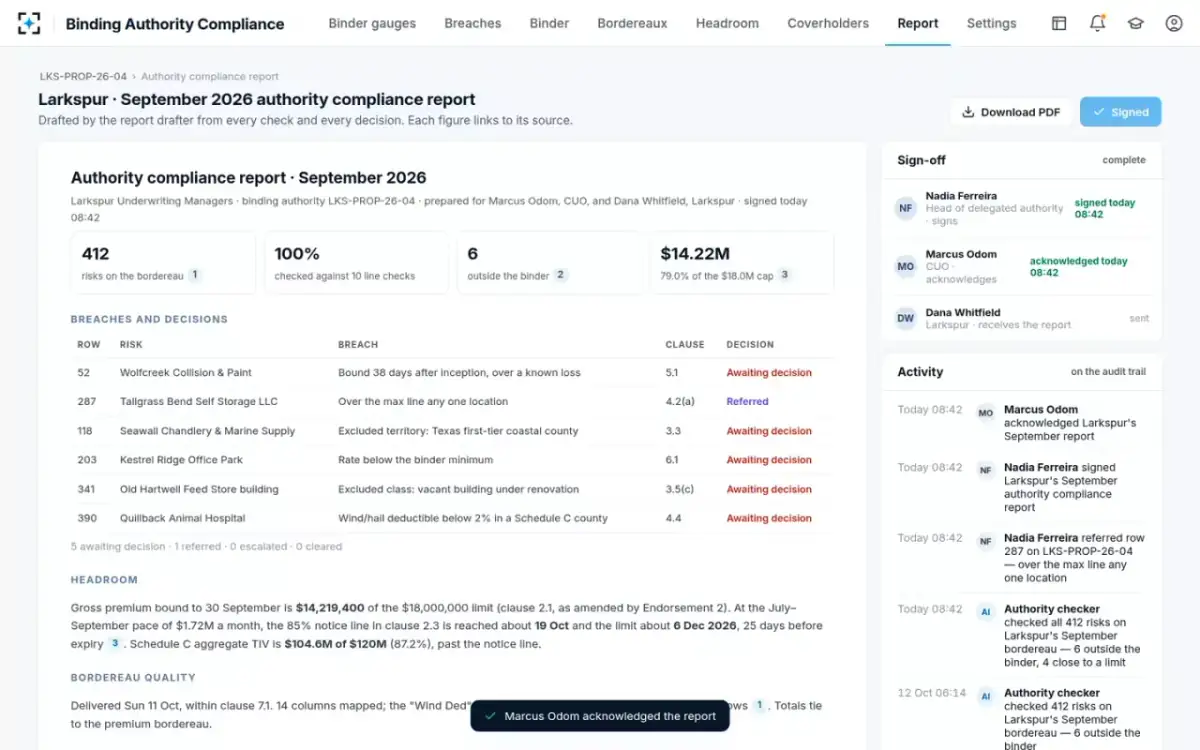
To try the checks and the monthly report on one of your binders and a few months of its bordereaux, start from Binding Authority Compliance.
Questions people ask
Why do insurers use MGAs instead of hiring underwriters?
Speed and specialism: an MGA brings a working team, a product and its distribution at once. The trade-off is control. The insurer keeps the statutory duties, such as on-site reviews at least twice a year under the model act, while the day-to-day decisions sit outside its walls.
Is an MGA an insurance company?
No. An MGA is a licensed producer acting as the insurer's agent; it issues policies, if at all, in the insurer's name. The NAIC model act requires an MGA to be licensed as a producer in the state and to have a written contract with the insurer before placing any business.
How much notice does an insurer have to give to end an MGA contract?
The model act allows termination for cause on written notice, without a fixed period; any notice period for termination without cause is set by the contract. In the Markel case, one agreement was ended by a letter of 21 August 2006 with effect from 20 September 2006. The insurer must notify the commissioner within 30 days of termination under the model act.
Can an insurer take over an MGA's policies at exit?
The policies are already the insurer's: they were issued on its paper. What the insurer takes over is their administration and the claims, and it needs the MGA's records to do so. The model act gives the insurer the right to access and copy all records of its business, in a form it can use.
What should an exit plan for an MGA include?
Who decides, on what evidence; how new business stops; who administers the policies and claims in run-off; how money and claim files come back; when the regulator is told; and how long monitoring continues. The PRA's 2026 letter asks UK insurers to consider exits in advance, before an arrangement turns unprofitable.