A capacity provider in insurance is the risk-bearing party behind a managing general agent (MGA) or coverholder: the insurer whose policies the MGA issues, a Lloyd's syndicate acting through its managing agent, or the reinsurers and other capital that take the risk off a fronting insurer's books. "Capacity" is the amount of business the MGA may write on that backing, set in the binding authority agreement as a premium cap and maximum limits. The term is commercial, not legal. In law the duties attach to the insurer that issues the paper, and they do not move when the work does: audited accounts for the MGA, an actuary's view of its reserves, on-site reviews, notices to the regulator, and examination of the MGA as if it were the insurer. Botminds' Binding Authority Compliance is built for the capacity provider's oversight team, checking every risk the MGA binds against the binder the night each bordereau lands.
The examples use a fictional capacity provider, Corvane Specialty, and five fictional delegates writing nine binders on its paper. The statutes, regulators' publications and the government manual quoted are real and linked.
Inside a capacity provider: who owns each duty that stays with the insurer
Today
Learn about a delegate's problems from the annual audit or a claim.
With agents
Are told of each critical breach the same morning and see each delegate's monthly authority compliance report, with breaches per 1,000 risks.
Still theirs: whether to grant, raise, restrict or end each delegate's capacity.
Today
Assembles evidence for each statutory duty from spreadsheets, inboxes and audit files.
With agents
Has every bordereau line checked, every breach decided on the record and every report signed in one place.
Still theirs: every breach decision, notice and signature.
Today
Picks a sample of files and hopes it includes the problems.
With agents
Arrives knowing which underwriters, classes and months produced breaches, and tests why.
Still theirs: the semi-annual review and its written results.
Today
Receives the delegate's reserve data through the claims bordereau.
With agents
Unchanged: the agents do not set or test reserves; they only flag losses at a risk's address before it was bound.
Still theirs: the annual opinion on reserves the MGA establishes.
Today
Tracks contract starts and ends, appointments and bonds by hand.
With agents
Unchanged for filings; uses the breach record as evidence of supervision in an examination.
Still theirs: the 30-day notices to the regulator and the examination response.
What is a capacity provider in insurance?
A capacity provider is whoever lends an MGA the ability to bind insurance: the balance sheet the MGA's policies rest on. In the US that is usually a licensed insurer, sometimes a fronting insurer that passes most of the risk to reinsurers. In the London market it is usually a Lloyd's syndicate, whose managing agent grants the authority. HM Revenue & Customs' manual for its own staff describes that arrangement in plain terms: a managing agent may delegate its authority to write insurance for its syndicate to another firm, a Lloyd's broker included; that firm is the coverholder, and the document setting the terms is the binding authority (HMRC Lloyd's Manual, LLM1100; quoted in what a coverholder is).
Whoever lends the pen keeps the duty: a coverholder binds in the syndicate's name, never in its own.
The same manual adds the point that matters most for the capacity provider: "Coverholders act as agent of the Lloyd’s managing agent (rather than as agent of the policyholder)." Whatever the coverholder does within its authority, it does for the syndicate. The FCA Handbook describes the same kind of agreement from the money side: an agency agreement that lets the intermediary commit the insurer to risk, settle claims or handle premium refunds, commonly called a binding authority (FCA Handbook, CASS 5.2.2G; the Handbook's wording is quoted in what a binding authority agreement is).
Who provides capacity to an MGA?
Three kinds of party provide capacity, often in combination. An insurer that keeps the risk on its own balance sheet. A fronting insurer that issues the policies and cedes most or all of the risk to reinsurers, as in the US program the Fifth Circuit described in 2015, where a reinsurer took 100% of the policies a fronting insurer issued through an MGA. And, in the London market, syndicates acting through their managing agents. Reinsurers, investors and other capital stand behind all three.
Only the first two, the insurers whose names are on the policies, carry the US statutory duties in full. A reinsurer behind a fronted program sees the MGA through what the fronting insurer reports, which is why fronting carrier vs MGA puts the oversight with the paper. For an MGA choosing capacity, the practical consequence is that its main relationship is with the issuing insurer's delegated authority team, whatever the economics behind it.
Is a capacity provider an insurer?
Usually, and the one that carries the legal duties always is. "Capacity provider" is a market term; statutes speak of the insurer. The NAIC model act defines the MGA by its relationship to "an insurer", sets the contract terms between "the parties", and lists the "Duties of Insurers" in a section of their own (NAIC Model #225, §5). A party that provides capital without issuing policies, such as a reinsurer or an investor in a program, is a capacity provider in the commercial sense but has no duties under that act toward the MGA.
That gap is why the label can mislead. A board that thinks of its company as "providing capacity" to an MGA, rather than writing insurance through one, may underinvest in the oversight the law requires of it. New York wrote its MGA regulation because delegation had been abused to the detriment of insurers and policyholders alike, and the capacity provider is the party left holding the consequences if oversight fails.
What are a capacity provider's obligations? The duties that never transfer
A capacity provider that issues the policies has duties it must perform itself, whatever it delegates. The checklist sets out each one from the model law with the evidence that shows it was done; state versions change the frequency and wording, so the current statute of each state where the insurer is domiciled or writes should be checked.
Eight insurer duties under Model #225 §5, and the evidence each one needs
- Audited accounts of the MGA
An independent audited statement for the two most recent fiscal years showing a positive net worth, on file. Evidence: the statements and the date received.
- An actuary's opinion on MGA reserves
Annually, if the MGA establishes loss reserves. Evidence: the opinion and the data it rested on.
- On-site review of underwriting and claims
At least semi-annually under the model and New York; at least annually in Florida, and within six months of engaging a new MGA. Evidence: a written report with scope, findings and actions.
- Reinsurance authority kept in house
Binding authority for reinsurance contracts rests with an officer of the insurer not affiliated with the MGA. Evidence: the delegation record.
- Notice to the regulator
Within 30 days of entering into or ending an MGA contract, with the MGA's duties and lines. Evidence: the filed notice.
- A quarterly check for new MGAs
Each quarter, review books and records for producers who have become MGAs by volume and activity. Evidence: the quarterly review.
- No MGA people on the board
No officer, director, employee, subproducer or controlling shareholder of its MGAs on the insurer's board, outside holding-company structures. Evidence: board register.
- The MGA's bond on file
The surety bond the contract requires, kept for any commissioner to review. Evidence: the bond.
Examiners test these as facts, not intentions. California's 2025 examination of an insurer whose MGA performed nearly all functions of a program found five gaps at once: no fidelity bond, bank accounts owned by the MGA, a contract allowing joint employment, no semi-annual on-site reviews, and no written notice of the appointment (California Department of Insurance, Topa Insurance Company, filed 4 June 2025). Each was a duty in the list above that the insurer could not show it had met. A file that holds up sets out the record that avoids those findings.
What is MGA capacity? The premium cap, the limits and the headroom
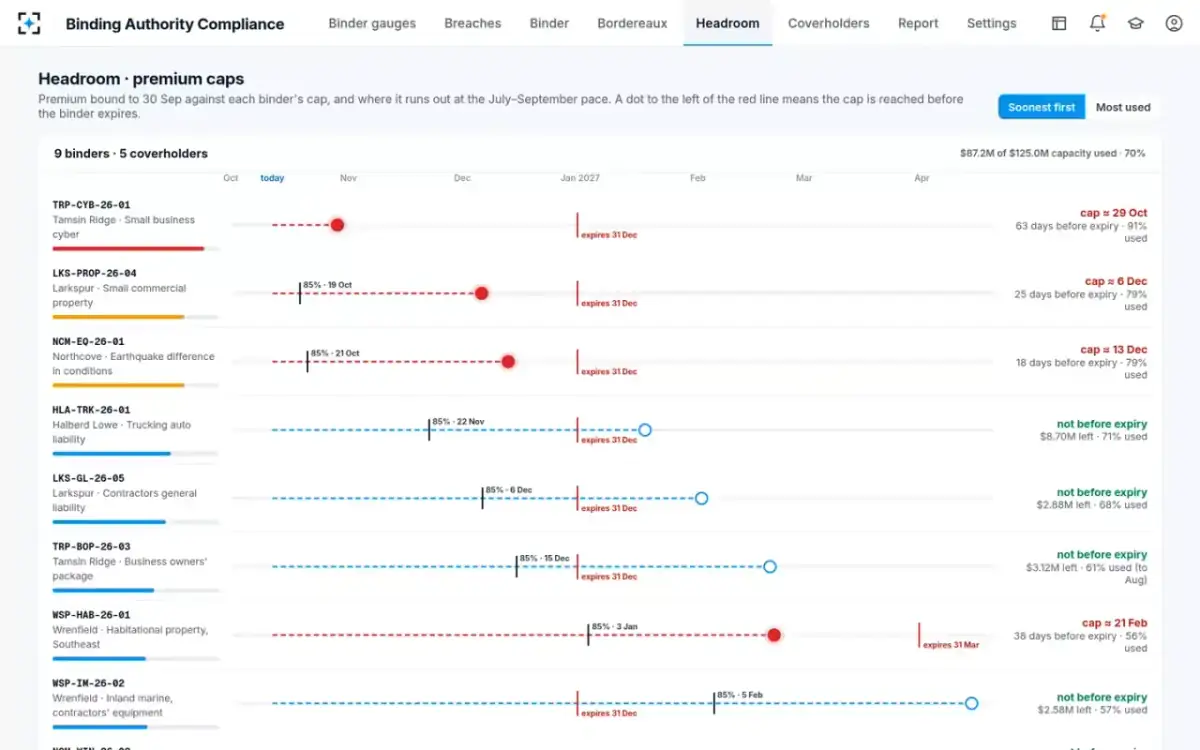
MGA capacity is how much business an MGA may write for a capacity provider, and the binding authority agreement fixes it in two ways: a maximum annual premium volume, which the model law requires as the first of its eight underwriting guidelines, and maximum limits per risk, location or zone. A binder's capacity is used as the MGA binds, and the capacity provider has to see how fast. A cap reached in October on a binder that runs to December means either an endorsement raising the cap or an instruction to stop writing; reaching it unannounced means the MGA binds past it.
On the sample book, Corvane's nine binders had $87.2 million of $125.0 million of capacity used by 30 September, 70%. Two were on course to run out early at the July–September pace: Tamsin Ridge's cyber binder about 29 October, 63 days before expiry, and Larkspur's property binder about 6 December, 25 days before. In each case the options are drafted for the program underwriter to decide; the agents never change a cap, and every projection is labelled as an estimate.
Capacity used against each binder's cap in Binding Authority Compliance
How do capacity providers oversee MGAs?
Capacity providers oversee MGAs with a mix of continuous and periodic tools: monthly checks of what was bound, referral control for anything outside authority, premium and cash reconciliation, claims oversight, and on-site reviews. The FCA's 2025 review of outsourced claims arrangements listed the mechanisms used by firms that oversaw well, among them "Regular quality assurance checks.", "Claims sample testing.", "Structured and recorded regular meetings." and "The receipt of granular outcomes-focused conduct MI.", and found that firms using a range of tools were more likely to spot problems with their third parties and act (FCA, home and travel claims handling arrangements, 2025).
The monthly check of what was bound is the one with the most room to improve, because it is where the data is largest and the time shortest. The work is mostly reading and arithmetic. Botminds estimates that by hand it takes about six hours of an analyst's time per bordereau, most of it spent opening and mapping the file and testing lines against the binder; with the line checks done by agents, about 40 minutes, most of it spent writing up the breaches that need a decision.
Where an analyst's time on one monthly bordereau goes, by hand and with agents
By hand: about 6 hours
- Opening and mapping the layout · 25%
- Testing lines against the binder · 33%
- Searching referrals and email · 17%
- Updating cap tracker · 8%
- Logging and writing up breaches · 17%
With the line checks done by agents: about 40 minutes
- Confirming the mapping · 15%
- Reviewing check results · 23%
- Reviewing the agreement search · 15%
- Reviewing headroom · 8%
- Deciding and writing up breaches · 39%
The shift in the second bar is the point. With the reading done, the largest share of the analyst's time moves to the part only a person can do: deciding what each breach means and writing it down. That is also the part the statutory duties depend on, because an examiner or court will ask for the decision, not the arithmetic.
The money side: whose premium is it?
In the UK, premium a coverholder collects under a binding authority is generally treated as already the insurer's. The FCA's client money rules say clients are protected where premiums "are treated as being received by the insurance undertaking when they are received by the agent", and require binding authorities of that kind to make the intermediary the insurer's agent for receiving and holding premium (FCA Handbook, CASS 5.2.1G–5.2.2G). In the US, the model act requires premium to be held by the MGA "in a fiduciary capacity" at an FDIC-insured bank.
Either way, the capacity provider carries the loss if the money goes missing, which is why premium oversight is a capacity provider's duty as much as underwriting oversight. Reconciling premium and cash against the bordereaux is the work of Premium Bordereaux Reconciliation; what a premium trust account is sets out the rules that money sits under. Binding Authority Compliance checks one thing on that side as part of every run: that the risk bordereau ties to the premium bordereau, so a gap between what was bound and what was billed is visible from the first night.
Each delegate's record in Binding Authority Compliance, binder by binder
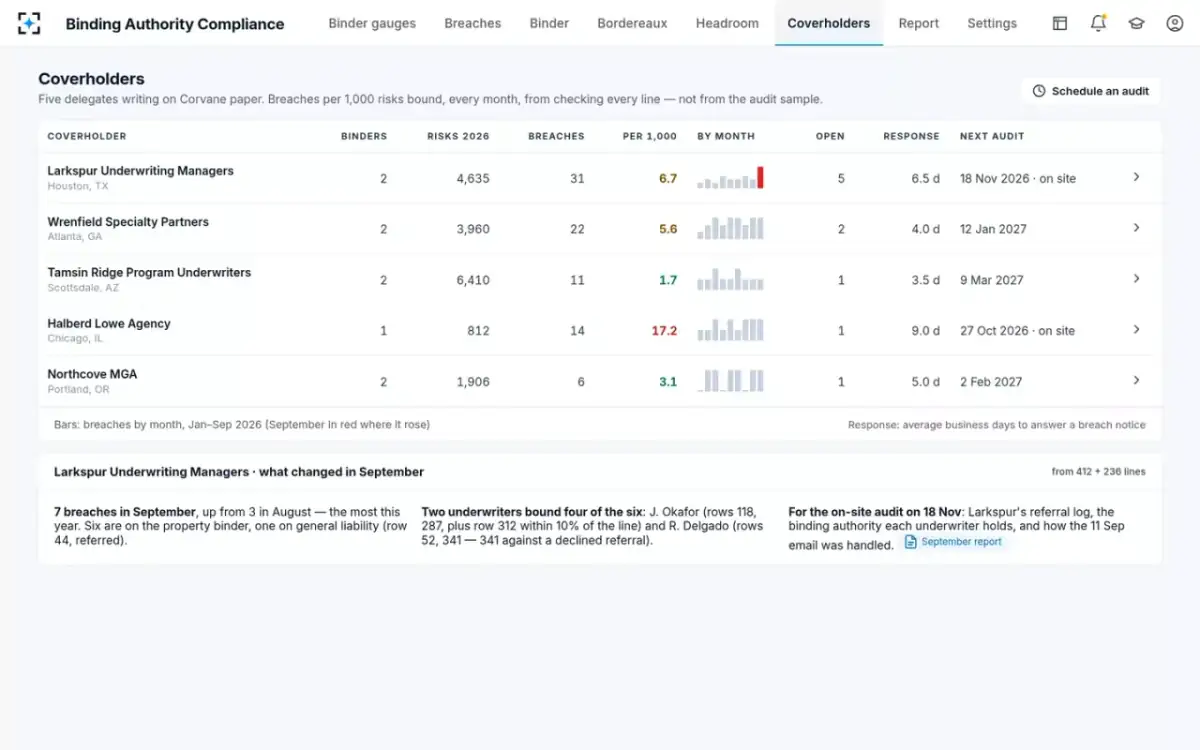
To see the checks behind those figures, six agents, and what none may do describes them, and Binding Authority Compliance shows them on the sample binder.
Questions people ask
Can a capacity provider delegate its on-site reviews?
It can use auditors or consultants to do the fieldwork, but the duty and the written results stay with the insurer. New York's insurance regulator described an insurer's duty to supervise its MGA as one the insurer may not delegate, and Minnesota requires the insurer to keep the review's results on its own records.
Does a reinsurer behind a fronted program have duties to the regulator for the MGA?
Not under the MGA act, which places its duties on the insurer that contracts with the MGA. A reinsurer's rights come from its treaty, including any audit rights it negotiated, and it relies on the fronting insurer's oversight for the rest.
How much capacity should a capacity provider give a new MGA?
No rule sets it; it is an underwriting and capital decision. Florida's statute reflects the extra risk of a new relationship by requiring the first on-site review within six months of engaging a new MGA, and a capacity provider can mirror that with a lower first-year premium cap and tighter referral limits.
What happens to capacity when an MGA breaches its binder?
The capacity provider can restrict it, for example by asking the MGA to bind no further risks of the kind that breached, as the sample breach notice does, or suspend it while a dispute over termination for cause runs, which the model act expressly allows. Ending the relationship is covered in why an insurer uses an MGA, and how it gets out.
Is "capacity provider" used in US insurance law?
Not in the NAIC model act or the state statutes cited on this page, which speak of the insurer. The term comes from market usage. When reading a statute, translate it back to the licensed insurer whose policies the MGA issues.