A fronting carrier is a licensed insurer that issues policies in its own name for a program it does not fully keep: it cedes most or all of the risk to reinsurers and earns a fee for lending its licence and paper. A managing general agent (MGA) is the firm that runs the program: it underwrites, binds and often handles claims under authority from the insurer. So in "fronting carrier vs MGA" the answer is that the fronting carrier holds the licence and the legal duties, the MGA holds the pen, and the reinsurers behind them usually hold most of the risk. The duties that matter for oversight never leave the paper. The insurer whose name is on the policy must review the MGA, answer to the regulator for it, and pay the policyholder's claims if everyone else fails. Botminds' Binding Authority Compliance is built for that insurer: it checks every risk the MGA binds against the binder, the night each bordereau lands.
The sample figures come from a fictional fronting insurer, Corvane Specialty, which writes 100% of a small commercial property binder for a fictional coverholder, Larkspur Underwriting Managers. The court record and regulators' statements are real and linked.
Fronting carrier vs MGA: the same program from two seats
Fronting carrier: A licensed insurer, in the state where the risks are, whose policies the program issues.
MGA: A licensed producer managing the insurer's business under a written contract, often with authority to bind and settle claims.
Fronting carrier: Its own.
MGA: The insurer's; the MGA may issue the policy, but in the insurer's name.
Fronting carrier: Sets the limits in the binding authority agreement; decides referrals.
MGA: Accepts or rejects each risk within those limits.
Fronting carrier: Whatever it retains after reinsurance, and all of it if a reinsurer cannot pay.
MGA: None as an insurer; it may share profit or carry its own capital in some structures.
Fronting carrier: Answers to the policyholder for them.
MGA: Often investigates, adjusts and pays them within a settlement limit.
Fronting carrier: On-site reviews, audited MGA accounts, actuarial opinion on MGA reserves, 30-day notices.
MGA: Licensing, records the insurer can use, monthly accounts, fiduciary handling of premium.
What is a fronting carrier?
A fronting carrier is an insurer that lends its licence: it issues the policies, and passes the risk on. A federal appeals court described one precisely in 2015. In the case of Lincoln General Insurance Co. v. U.S. Auto Insurance Services, the Fifth Circuit explained that the dispute arose "from a complicated series of transactions often called “fronting arrangements” in the insurance industry", and that a nonparty, State and County Insurance Co., "fronted auto insurance policies":
That means the policies were issued in S&C’s name but it bore no risk.
U.S. Court of Appeals for the Fifth Circuit, Lincoln General Insurance Co. v. U.S. Auto Insurance Services, No. 13-10589 (18 May 2015)
The rest of the arrangement, as the district court found and the appeals court recited, is the textbook structure. Lincoln General reinsured 100% of the fronting insurer's liabilities on policies issued from 2003 to 2007. U.S. Auto was the managing general agent: its job included "issuing policies in S&C’s name; collecting and handling the premiums paid by the insureds; and investigating, adjusting, and paying any claims." The fronting insurer, as nominal issuer, "would receive a small percentage off the top of the premiums collected."
"Bore no risk" describes the deal, not the law. The fronting insurer's name is on the policy, so its obligations to the policyholder do not depend on whether the reinsurer pays or the MGA behaves, and its regulator expects it to supervise the MGA as if the business were its own. That gap between commercial risk and legal responsibility is the reason fronting needs oversight.
What is the difference between a fronting carrier and an MGA?
The fronting carrier is an insurer; the MGA is not. An MGA is an agent, licensed as a producer, that manages all or part of an insurer's business under a written contract. A September 2026 draft of the NAIC's State Licensing Handbook lists what that management can include, from marketing, underwriting and issuing policies to collecting premium, appointing and supervising agents, paying claims and negotiating reinsurance (NAIC, State Licensing Handbook, chapter 24, draft; quoted in program administrator in insurance). Nothing on that list makes the MGA liable to the policyholder as an insurer.
The roles meet in the binding authority agreement. The fronting carrier writes the limits: the premium cap, the maximum line, the classes, territory, rates, exclusions and policy terms. The MGA decides each risk within them. The model law defines underwriting as the authority to accept or reject risk for the insurer, and that definition captures the relationship: the MGA's decision is made on the insurer's behalf, and the insurer answers for it (NAIC Model #225, §2F).
A fronted program, from the MGA's decision to the reinsurer's share
A person decides
MGA underwriterAccepts or rejects each risk within the binder and binds it on the fronting carrier's paper.
Never: binds outside the binder without the carrier's written agreement.
A person decides
MGA operationsIssues the policy in the carrier's name, collects premium into a fiduciary account, reports each month on a bordereau.
Agent
Checking agents at the fronting carrierRead the bordereau and the binder, test every line against every check, search for written agreement, project the premium cap.
Never: decide anything or contact the MGA.
A person decides
Fronting carrier's head of delegated authorityDecides each breach, sends notices, signs the monthly report the reinsurers and regulator may ask for.
A person decides
ReinsurersTake the share of risk the treaty cedes, and rely on the carrier's oversight of the MGA they cannot see directly.
What is a fronting arrangement in insurance?
A fronting arrangement is the combination of three contracts: the policy the fronting insurer issues, the binding authority or management agreement under which an MGA writes the business, and the reinsurance that moves most of the risk to others. Each can be ordinary on its own. What makes it a fronting arrangement is how much risk leaves the issuing insurer, and why.
Money flows tell the story. In the Lincoln General program, after the fronting insurer's small cut, the MGA was to take 20.6% of what remained for its administrative work, expected losses were set at 69.4% of the remainder as a "target loss ratio", and the remaining 10% was expected to go to the reinsurer as its profit for bearing the risk. The MGA could earn more if losses came in under target.
Where each premium dollar was meant to go in one court-described fronted program
Premium after the fronting insurer's fee, Lincoln General program, 2003–2007
- Expected losses ("target loss ratio") · 69.4%
- MGA compensation · 20.6%
- Reinsurer's expected profit · 10%
That outcome is the strongest argument for the fronting carrier's oversight. The program's underwriting worked: the court notes that actual losses for all relevant years fell below the 69.4% target. The money did not. A fronting carrier that watches only loss ratios can miss a failing program; the binder breaches, premium handling and claims are where the damage starts.
Is fronting insurance illegal?
Not in itself. What regulators object to is fronting used to get around licensing. New York's insurance regulator put it this way in 2010: its concern is authorized insurers ceding risk "for the purpose of assisting unauthorized insurers do an insurance business in New York, a practice commonly known as "fronting."", and ceding "all, or substantially all, of its risk to an unauthorized insurer" may indicate fronting that breaks state law (NY Insurance Department, OGC Opinion 10-03-02).
The test is not a percentage. In an earlier opinion the Department said "Fronting is not deemed to exist solely because a certain percentage of an insurer's business is ceded to the unauthorized insurer"; the share ceded is one factor among several (OGC Opinion 05-01-11, 2005). For a carrier running fronted MGA programs the practical reading is narrower: know who the reinsurers are and whether they are authorized where the risks are, and be able to show that the carrier, not the MGA or the reinsurer, is running the business it issues.
Why do MGAs use fronting carriers?
Because an MGA cannot issue a policy on its own account. It is an agent, so it needs an insurer licensed in the states where it writes, whose paper policyholders and their brokers will accept. Where the capital behind the program sits with reinsurers that are not licensed in those states, the pattern New York's regulator describes, a fronting carrier joins the two: its licence and paper on the front, their capital behind. In the Lincoln General program, the capital was a reinsurer that took 100% of the risk.
For the fronting carrier the business is fee income on premium it does not keep, which is why the oversight cost matters to its economics. A fronting fee leaves little room for a team that opens every bordereau by hand. It leaves even less for a breach the carrier cannot pass on, such as a risk bound outside the binder that the treaty does not follow. What one breach costs sets out how that exposure is priced.
Who is responsible for claims in a fronting arrangement?
The fronting insurer, to the policyholder, whoever handles the claim day to day. The MGA may investigate, adjust and pay claims within its settlement authority, and the model law requires the contract to send claim files to the insurer when a claim may exceed that authority, involves a coverage dispute or stays open more than six months. If the MGA fails, the claims remain the insurer's. The UK's Financial Conduct Authority made the point in December 2025 when it declined to let MGAs take sole responsibility for manufacturing an insurance product:
Ultimately, even where intermediaries are designing products, insurers are parties to the contract and responsible for ensuring claims are met.
Financial Conduct Authority, PS25/21, December 2025
Under the rules in force from 9 December 2025, firms that co-manufacture a product may choose a single lead firm to carry the manufacturer duties, but that lead must be an insurer or a managing agent, not an intermediary. The FCA's reason was its own supervisory finding: where intermediaries had developed and designed products, firms were more likely to be unable to show that those products gave fair value and good outcomes (the FCA's words are quoted in what a coverholder is).
Where oversight must sit in a fronted program
Oversight must sit with the fronting carrier, because that is where the law puts it and where the information converges. The model law's insurer duties, such as on-site reviews at least twice a year, audited MGA accounts, an actuarial opinion on reserves the MGA sets and 30-day notices to the commissioner, bind the insurer that issued the paper, whatever share of risk it kept. Reinsurers see the program only through what the carrier passes on. The Prudential Regulation Authority added in January 2026 that it expects delegated authority business to keep growing in the London Market, and asked firms to keep strong oversight of how such arrangements perform (PRA, 2026 priorities).
For a fronting carrier with several MGAs, the most useful single view is capacity: how much of each binder's premium cap is used and when each will run out. A program that will hit its cap before expiry needs a decision, either an endorsement raising the cap or an instruction to stop new business, before the MGA binds past it.
Every binder's premium cap in Binding Authority Compliance, and when it runs out
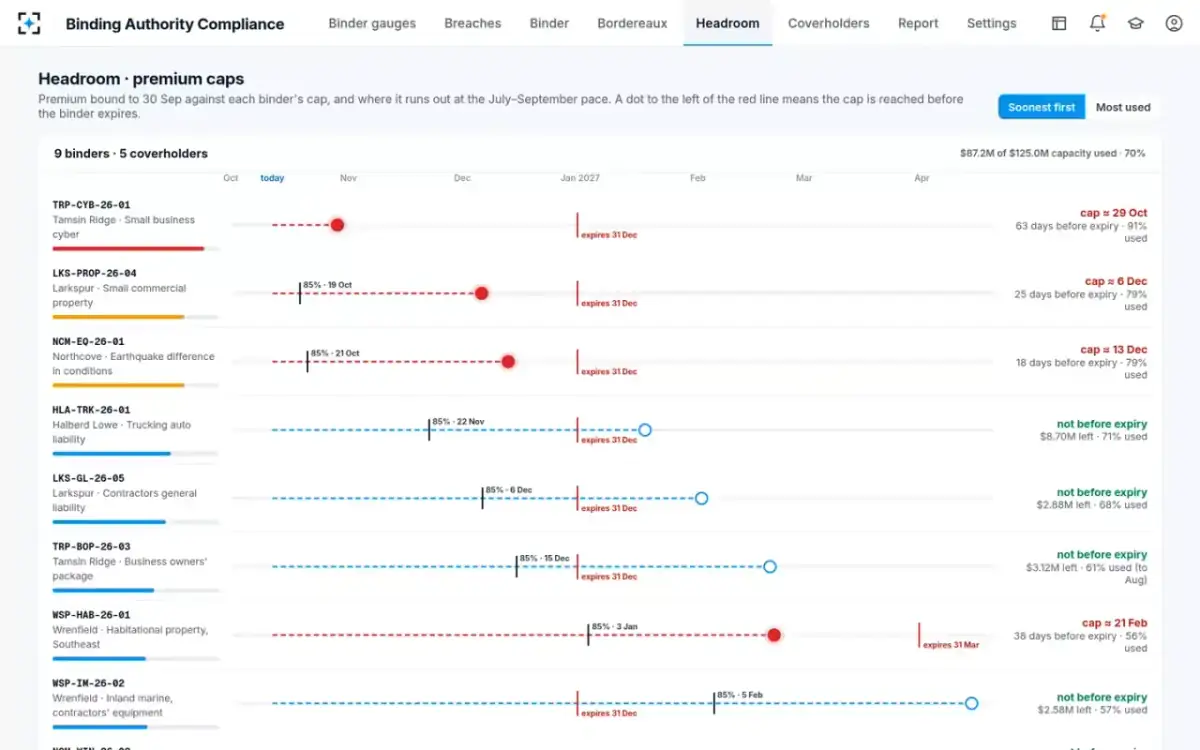
Below the capacity view sits the line-by-line one: each risk the MGA bound, tested against each limit in the binder. The duties a capacity provider cannot hand to the MGA goes through each statutory duty in turn, and the Managing General Agents Act in plain words covers the contract terms a fronting carrier must have in place. To see the checks on a fronted binder of your own, start from Binding Authority Compliance.
One fronted binder in Binding Authority Compliance: eight gauges, every risk a dot
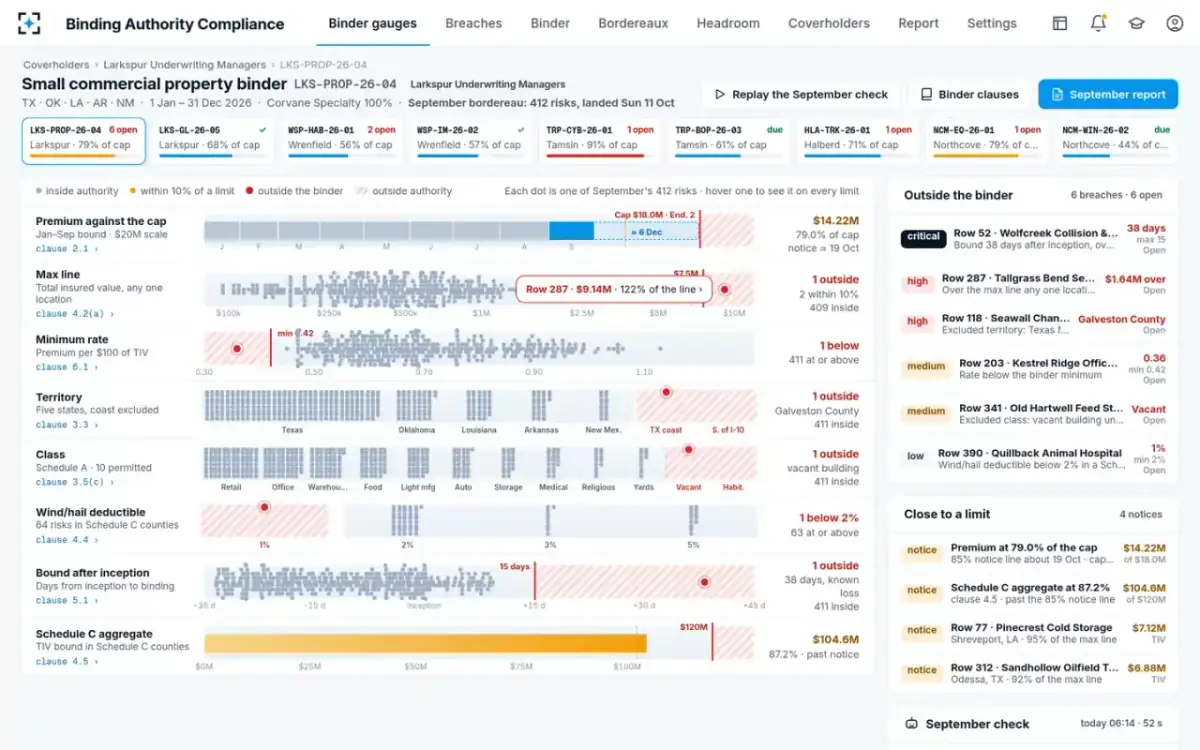
Questions people ask
What is a capacity provider?
In delegated authority, a capacity provider is whoever stands behind the MGA's pen: the insurer that issues the paper, and often reinsurers or other capital behind it. In US law the duties attach to the licensed insurer, so a fronting carrier is a capacity provider with the legal obligations, whatever share of risk it keeps.
Can an MGA be its own fronting carrier?
An MGA can own or be affiliated with an insurer, but then the affiliate is the insurer, with the insurer's duties. The model act carves out an affiliated underwriting manager under common control, subject to holding company law and not paid on premium volume; outside that carve-out the MGA rules apply.
Does the fronting carrier keep any of the risk?
Often some, by choice or because reinsurers require it, and sometimes none by contract. Even at 0% retained, it keeps the credit risk that a reinsurer cannot pay and the legal obligation to policyholders, which is why the Lincoln General opinion's "bore no risk" describes the deal and not the law.
Who audits the MGA in a fronted program?
The fronting insurer is the one the law requires to review the MGA on site, at least twice a year under the model act and at least annually in Florida. Reinsurers may audit too under their own treaties, but that does not discharge the insurer's duty.
What is a fronting fee?
It is the fronting insurer's charge for issuing the paper and carrying the obligations, typically taken off the top of premium. The Lincoln General opinion describes it only as "a small percentage off the top"; the actual rate is a commercial term that varies by program and is not published by any source we rely on.