A delegated authority oversight manager is the person at an insurer who answers for business written on the insurer's paper by someone else: a managing general agent (MGA), a coverholder or a program administrator holding a binding authority. The job exists because the law does not let the duty travel with the pen. Under the NAIC's Managing General Agents Act and the state laws built on it, the insurer must review the MGA on site, hold its audited accounts, obtain an actuary's view of any reserves it sets and tell the regulator when the contract starts or ends. What makes the seat hard is volume and timing: the manager learns what was bound only when a monthly bordereau arrives, in the delegate's own layout. Botminds' Binding Authority Compliance exists for that gap. Its agents check every bound risk against the binder the night the bordereau lands; the manager decides what each breach means.
The examples below follow a fictional capacity provider, Corvane Specialty Insurance Company, and its fictional coverholder, Larkspur Underwriting Managers, as their September bordereau runs through the solution. Everything about them is sample data. The rules come from statute, regulation and regulators' own publications, linked where they appear.
Who signs what on one breach: from the coverholder's underwriter to the regulator
A person decides
Underwriter at the coverholderBinds risks on the insurer's paper within the binder's written limits, and asks the insurer first when a risk is outside them.
Never: binds above a limit on a question that nobody answered.
A person decides
Coverholder compliance leadSends the monthly risk bordereau by the binder's deadline and answers breach notices within the agreed time.
Agent
Reading and checking agentsMap the bordereau, read the binder into checks, test every line against every check and search for written agreement.
Never: clear a breach, change a limit or send anything to the coverholder.
A person decides
Oversight analystConfirms the one column mapping the agents are unsure of, and keeps the bordereau calendar.
A person decides
Head of delegated authorityClears, refers or escalates each breach, sends the notice and signs the monthly authority compliance report.
A person decides
Program underwriterDecides whether a risk outside the binder stays, and is the second name on any decision to clear a serious breach.
A person decides
Chief underwriting officerIs told of every critical breach the same morning and acknowledges each coverholder's monthly report.
A person decides
The insurer itselfCarries the statutory duties: on-site reviews, the MGA's audited accounts, an actuarial opinion on reserves the MGA sets, 30-day notice to the regulator.
What does a delegated authority oversight manager do?
A delegated authority oversight manager makes sure that every risk a delegate binds sits inside the authority the insurer granted, and that the insurer can prove it. In practice that is five kinds of work: reading the binding authority agreement and its endorsements into limits; checking each month's risk bordereau against those limits; chasing written agreement for anything outside them; tracking how fast each binder is using up its premium cap; and turning all of it into decisions, notices and a report someone senior signs.
The seat goes by several names: head of delegated authority, DA manager, program oversight manager, fronting oversight lead, or coverholder oversight in the London market. The duties do not vary much, because they are driven by the same contract terms everywhere: a premium cap, maximum limits, permitted classes and territories, a rate basis, exclusions, cancellation terms and a maximum policy period. Those eight terms are the underwriting guidelines the NAIC model law requires in every MGA contract, and the Managing General Agents Act in plain words walks through each of them.
What the job is not: it is not underwriting the delegate's risks again, and it is not the on-site audit, though the manager usually commissions both. It sits between them. An auditor visits twice a year and samples files; an underwriter rules on individual referrals. The oversight manager is the person who knows, every month, whether the book as a whole is inside the binder.
Who is responsible for MGA oversight? The insurer, by statute
Responsibility for MGA oversight sits with the insurer whose paper the MGA uses, and the insurer cannot contract it away. The NAIC's model act lists the insurer's own duties in a section headed "Duties of Insurers": an independent audited financial statement for the MGA's two most recent fiscal years, an annual actuarial opinion on any loss reserves the MGA establishes, an on-site review of the MGA's underwriting and claims operations at least twice a year, written notice to the commissioner within 30 days of entering into or ending the contract, and a quarterly check of the insurer's own books for producers who have crossed the line into MGA status (NAIC Model #225, §5).
New York's Insurance Department, whose work is now done by the Department of Financial Services, put the principle in one sentence when an insurer's lawyer asked what the semi-annual review must contain. Its answer did not list procedures. It said the duty to supervise belongs to the insurer and stays there:
An insurer that contracts with an MGA has the duty under the Insurance Law and regulations promulgated thereunder, which the insurer may not delegate, to supervise the MGA so that the insurer is managed in a financially prudent manner, and in accordance with all laws.
New York Insurance Department, Office of General Counsel, Opinion 07-10-08 (2007)
The same opinion noted that Regulation 120 does not tell an insurer how to comply (its words are quoted in the MGA audit checklist). That gap is the oversight manager's job description. The law sets the outcome, the insurer decides the method, and the method has to stand up when an examiner asks for it.
The United Kingdom reaches the same place by a different route. In its 2025 review of home and travel claims, the Financial Conduct Authority put it plainly: firms may outsource parts of claims handling but not their regulatory responsibility (FCA, home and travel claims handling arrangements, 2025; quoted in TPA oversight manager). In December 2025 it also declined to let MGAs take sole responsibility as the "lead" manufacturer of a co-manufactured product: under the rule in force from 9 December 2025, a lead firm must be an insurer or a managing agent (FCA PS25/21).
The statutory duties that land on the manager's desk, state by state
The duties are similar across states but not identical, and the differences change the calendar. The table sets the model law beside three states whose current text we read: New York's Regulation 120, Florida's 2026 statutes and Minnesota's 2025 statutes.
Four rulebooks, one desk: the insurer's own MGA duties
| Duty | NAIC Model #225 (2002) | New York, 11 NYCRR 33.6 | Florida, § 626.7454 | Minnesota, § 60H.05 |
|---|---|---|---|---|
| On-site review of underwriting and claims | At least semi-annually | At least semi-annually | At least annually, and within 6 months of engaging a new MGA | At least semiannually, with the results kept on the insurer's records |
| Financial statements of the MGA | Independent audited statement, two most recent fiscal years | Independent financial audit on file | Independent financial examination on file | Independent financial examination on file |
| Actuarial opinion when the MGA sets reserves | Annually | Annually, by a member of the American Academy of Actuaries | Annually, on total loss reserves including IBNR | Not in this section |
| Notice to the regulator | Within 30 days of entering into or ending a contract | Not in this section | Within 30 days, to the department and the office | Within 30 days of appointment or termination |
| Quarterly check for producers who became MGAs | Each quarter | Not in this section | Quarterly | Each quarter |
Two details matter more than they look. Florida's annual review is half the model's frequency, but it front-loads the first one: a newly engaged MGA must be reviewed on site within six months. And Minnesota's requirement that the insurer keep each review's results on its records turns the review from an event into a document. A review the insurer cannot show an examiner is, for practical purposes, a review that did not happen; the file examiners ask for shows what that document should hold.
Who signs what: the accountability chain, link by link
Every breach of a binder passes through the same chain of people, and each link signs something different. The chain works only if each signature means one thing. A manager who signs a monthly report is attesting that the book was checked; a program underwriter who keeps a risk outside the binder is accepting it on the insurer's behalf; a chief underwriting officer who acknowledges a report is confirming the insurer knows.
Take one breach on the sample binder. Larkspur's September risk bordereau arrives on Sunday 11 October at 21:48: 412 lines and $1,688,400 of gross premium. Row 287 is Tallgrass Bend Self Storage LLC in Rosenberg, Texas, at a total insured value of $9,140,000: buildings $8,350,000, contents $310,000, business income $480,000. Clause 4.2(a) of the binder limits any one location to $7,500,000, so the risk is $1,640,000 over the line, 122% of the limit. Clause 4.6 allows a risk above the limit only with the insurer's prior written agreement, given by an underwriter named in Schedule E.
The signatures that follow are where the chain earns its keep. The underwriter at Larkspur had emailed on 11 September: "TIV around 9M, moving from their old carrier. OK to proceed at 0.45?" Nobody named in Schedule E replied, and the risk was bound anyway. The agents found the email and marked it for what it was: a question, not agreement. On Monday morning the head of delegated authority, Nadia Ferreira, referred the risk to the program underwriter, Callum Reyes, with two options written into the decision: keep it only with a co-insurer for the $1,640,000 above the line, or cancel on 30 days' notice under clause 8.4. The breach notice to Larkspur went out with the referral, asking for an answer within 10 business days under clause 9.2.
The monthly report the head of delegated authority signs and the CUO acknowledges
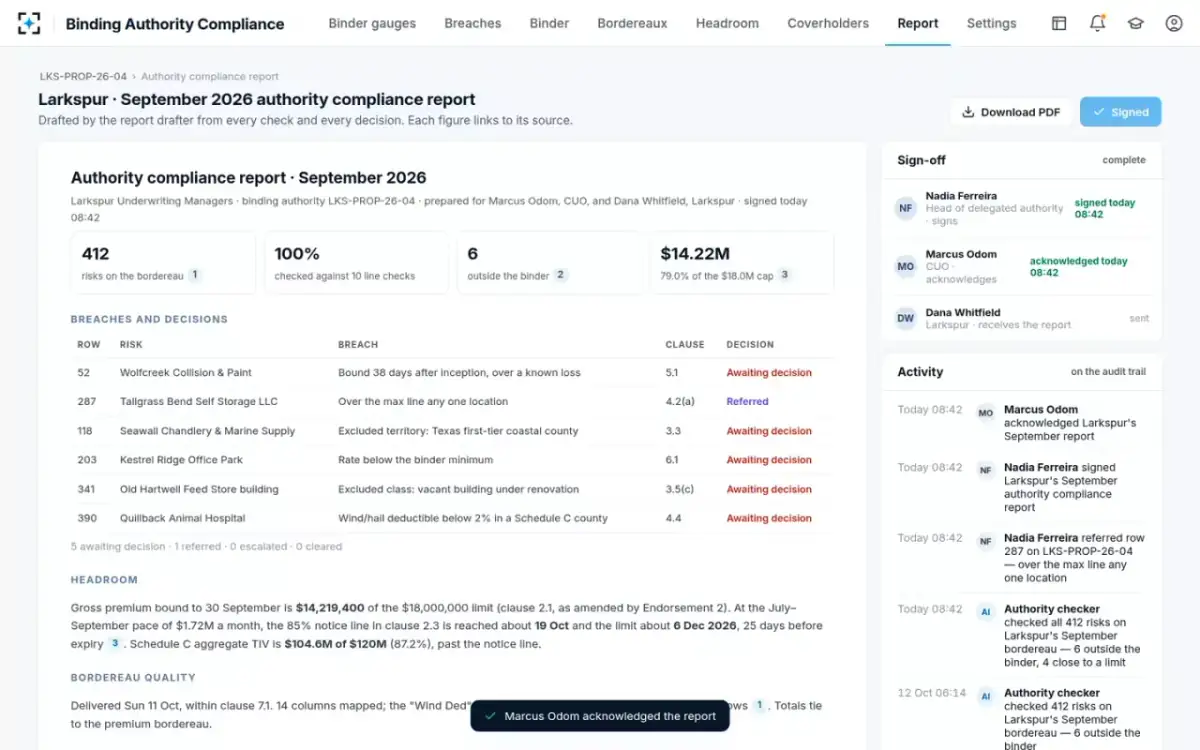
Inside the insurer the chain mirrors an underwriting authority ladder, with one difference. An underwriter's letter of authority, the subject of underwriting authority levels, caps what a named employee may sign; a binding authority agreement caps what an outside firm may bind, and the insurer learns what was bound only afterwards, from the bordereau. That lag is why the oversight manager's signature is retrospective by nature, and why the time between bind and check is the number that matters most.
What is delegated authority oversight, and what is a delegated authority framework?
Delegated authority oversight is the insurer's continuing check that each delegate is acting within its authority and in the insurer's interest; a delegated authority framework is the written policy that says how that check is done. A framework typically names the delegates and their binders, the monitoring each one gets and how often, the thresholds that trigger a notice or an escalation, who decides what, and how often the whole arrangement is reviewed.
Regulators notice when one is missing. In its 2025 review of outsourced home and travel claims, the FCA found that "Six out of 23 firms lacked a documented oversight framework or policy to ensure consistency in their claims oversight" (FCA, 2025). That finding was about claims, but its logic applies to underwriting authority too: without a written framework, two analysts looking at the same bordereau can reach different conclusions and both be following "the process".
A good framework is also specific about thresholds, because they decide the manager's week. The sample insurer's are typical of what a framework would write down: a notice when a binder reaches 85% of its premium cap, or the binder's own notice clause if lower; a "close to a limit" flag at 90% of a maximum line or aggregate; any known loss before binding treated as critical; ten business days for a coverholder to answer a breach notice; and a second name, the program underwriter's, on any decision to clear a high or critical breach.
A framework's thresholds, written down and versioned in Binding Authority Compliance
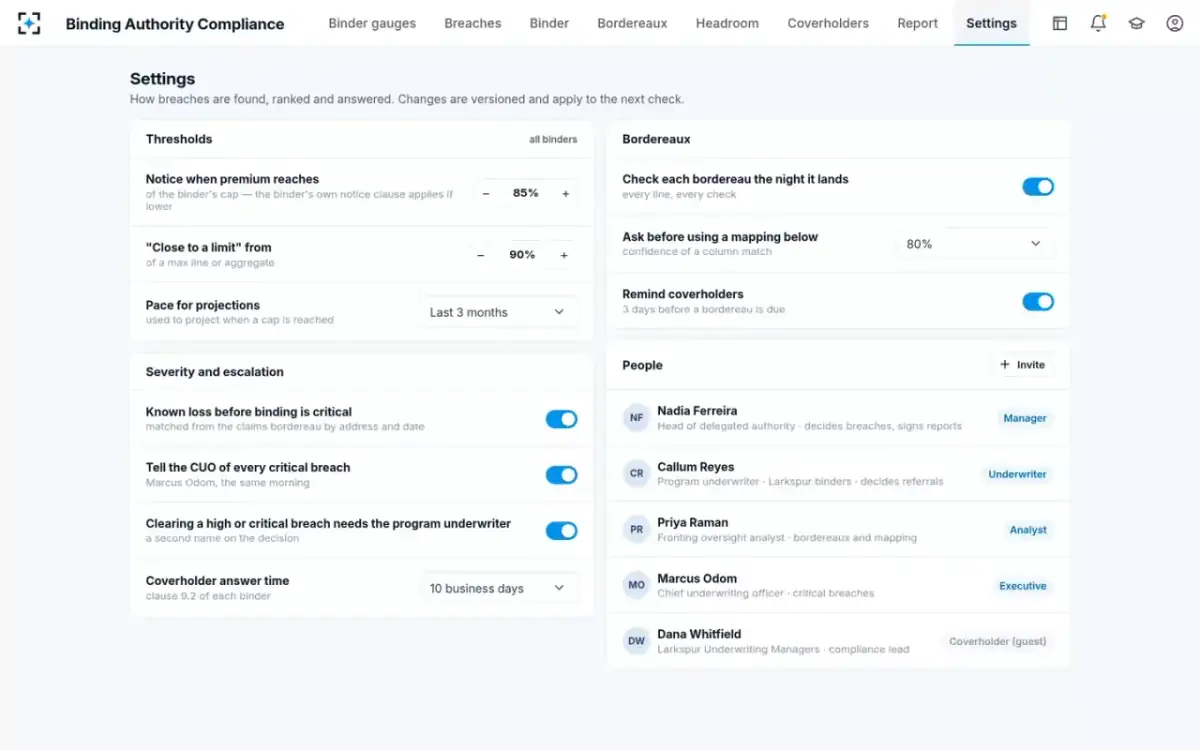
The people around the manager, and what changes for each
The oversight manager's month depends on four other people, two inside the insurer and two outside it. What changes when the line checks move to agents is less the volume of work than its timing: each person sees a breach within a day of the bordereau rather than at the next audit.
Five people who carry one binder, before and after the line checks move to agents
Today
Owns 9 binders across 5 coverholders and learns about a risk bound outside authority at the audit, after the policy has run.
With agents
Sees every bound risk on the binder's gauges the morning after the bordereau lands, with the clause and the row side by side.
Still theirs: every clear, refer or escalate decision, every notice sent and the report signed.
Today
Is asked to rule on a risk with half the facts.
With agents
Gets each referral with the clause, the coverholder's own row, the arithmetic and the unanswered email attached.
Still theirs: whether a risk outside the binder stays, and on what terms.
Today
Opens 9 spreadsheets in 9 layouts and samples about 25 lines from each.
With agents
Confirms the one column mapping the agents are unsure of; no line is sampled because every line is checked.
Still theirs: the bordereau calendar and the coverholders' saved layouts.
Today
Hears about a bad coverholder when the audit report lands.
With agents
Is told of every critical breach the same morning and acknowledges each monthly report.
Still theirs: the decision to call the coverholder, or to end the relationship.
Today
Gets an allegation months after the fact.
With agents
Gets a notice quoting the clause and her own bordereau row, with 10 business days to answer.
Still theirs: the coverholder's answer and any remedy it proposes.
The analyst's line deserves a second look. Sampling 25 lines from a 412-line bordereau tests about 6% of the risks; on the sample binder, six of the 412 were outside authority. A random sample of 25 would have missed all six roughly two times in three, by our hypergeometric arithmetic. One breach, traced back to the bind shows what that miss rate looks like over a year, using a court case in which a 14-file audit sample found nothing.
What qualifications does a delegated authority manager need?
No licence or certificate is required by statute to run delegated authority oversight at a US insurer; the requirement falls on the insurer, not on a named individual. The MGA side is different. The model act requires anyone acting as an MGA to be a licensed producer in the state, and a September 2026 draft of the NAIC's State Licensing Handbook notes that in most states an MGA may not place business until every party has signed a written contract (NAIC State Licensing Handbook, chapter 24, draft; the passage is quoted in TPA license requirements by state).
The core skill is reading a risk against a contract, which is why the seat suits someone with underwriting behind them: a manager who cannot tell whether a vacant building under renovation is an excluded class, or whether a wind/hail deductible stated in dollars clears a percentage minimum, cannot judge the breaches the checks surface. Contract reading, bordereau data and enough claims knowledge to spot a loss that predates binding complete the profile.
Delegated authority manager salary: what public data can and cannot say
No official statistic measures delegated authority managers' pay, because the federal occupation tables have no line for the role. The US Bureau of Labor Statistics counts the people closest to it as insurance underwriters: about 125,600 jobs in 2025, with a median annual wage of $81,370 in May 2025, and 24% of them worked in insurance agencies and brokerages, which is where MGA underwriters are counted (BLS Occupational Outlook Handbook). The same handbook projects underwriter employment to decline 4% from 2025 to 2035, and names automated underwriting software as one reason.
Treat the median as a floor for orientation, not a benchmark. An oversight manager who signs reports for several binders typically sits above a line underwriter, and pay surveys published by recruiters or trade bodies are not sources we can verify. The more useful number for a hiring manager is workload: how many binders and bordereaux one person can oversee when every line must be checked. Botminds estimates about six hours of analyst time per monthly bordereau by hand, to open, map, sample and log it, and about 40 minutes once the line checks are done by agents, most of it spent writing up the breaches.
Where Binding Authority Compliance fits in the oversight seat, and where it does not
Binding Authority Compliance takes over the reading and the arithmetic: mapping each coverholder's bordereau in its own layout, reading the binder and its endorsements into checks with their clause and page, testing every line, searching the referral log and the underwriting mailbox for written agreement, and projecting when each premium cap will be reached. It drafts the notices and the monthly report. It does not decide anything. The agents never clear a breach, never change a limit, never send a notice and never sign; the head of delegated authority does each of those, and clearing a high or critical breach needs a written reason and the program underwriter's name.
Nor does it replace the duties in the table above. A semi-annual on-site review, an audited financial statement and an actuarial opinion are the insurer's obligations whatever software it runs. What changes is what the manager walks into those reviews with: a year of every-line results by coverholder, breaches per 1,000 risks and response times, rather than a sample. To see the line checks, the decision screen and the report together, start from Binding Authority Compliance.
Questions people ask
Is a delegated authority manager the same as a coverholder auditor?
No. An auditor reviews a delegate at a point in time, usually on site and from a sample of files; the model law asks for that review at least twice a year. The oversight manager owns the relationship every month in between, from bordereau checks to breach decisions, and usually commissions the audits.
Can an insurer hand MGA oversight to a third party?
It can buy help with the work, but not the responsibility. New York's Department of Financial Services described the duty to supervise an MGA as one "which the insurer may not delegate", and the FCA says firms "cannot outsource their regulatory responsibilities". A third-party administrator or software can do the checking; the insurer still answers for the result.
How many binders can one oversight manager handle?
No rule sets a number; it depends on bordereau volume and how many lines are checked by hand. The fictional sample manager oversees nine binders from five coverholders, and the seven September bordereaux in by 12 October held 1,980 risks. That is workable only because the line checks run without her.
What does the oversight manager report to the board?
Typically each delegate's breaches and how they were resolved, premium against each cap, the results of on-site reviews and any delegate whose performance calls for action. The Prudential Regulation Authority told UK insurers in January 2026 that delegated business needs strong oversight of how each arrangement performs, so a board report that shows exceptions only, without the denominator of risks checked, is weaker than one that shows both.
Does the oversight manager need to be an underwriter?
Not by law. But most breaches turn on an underwriting judgment, such as whether a class is excluded or a deductible meets a minimum, and the person who decides them must be able to defend the call to a program underwriter and to the coverholder.