Exceeding binding authority in insurance means a coverholder or managing general agent binds a risk the binding authority agreement does not allow: above the maximum line, in an excluded class or territory, below the minimum rate, or backdated past the permitted window. The cost lands on the insurer first. The policyholder holds a policy in the insurer's name, and state law is written on the assumption that the insurer will honour it; the insurer's remedy is against the delegate, and it is slow and uncertain. A breach costs the exposure the insurer never agreed to carry, any loss that was already known when the risk was bound, the price of fixing it, and the cost of finding it late. The last layer is the one an insurer controls. Botminds' Binding Authority Compliance checks every bound risk against the binder the night the bordereau lands, so a breach is priced in its first weeks, not at the next audit.
The worked figures below come from a fictional capacity provider, Corvane Specialty, and its fictional coverholder, Larkspur Underwriting Managers, as they appear in the solution. The court records and statutes are real and linked.
How far over the line: three surety bonds against a £1m any-one-bond limit
What happens if an MGA exceeds its binding authority?
The risk usually stays on the insurer's books until the insurer acts, and what it can do depends on what the binder allows and how fast it finds out. Most binders give the insurer three moves for a risk outside authority: accept it after the fact, keep it on changed terms such as a co-insurer or reinsurance for the excess, or cancel it under the policy's cancellation terms. All three need time. A risk found a week after binding can be fixed before a loss; one found at the annual audit has been on risk for months.
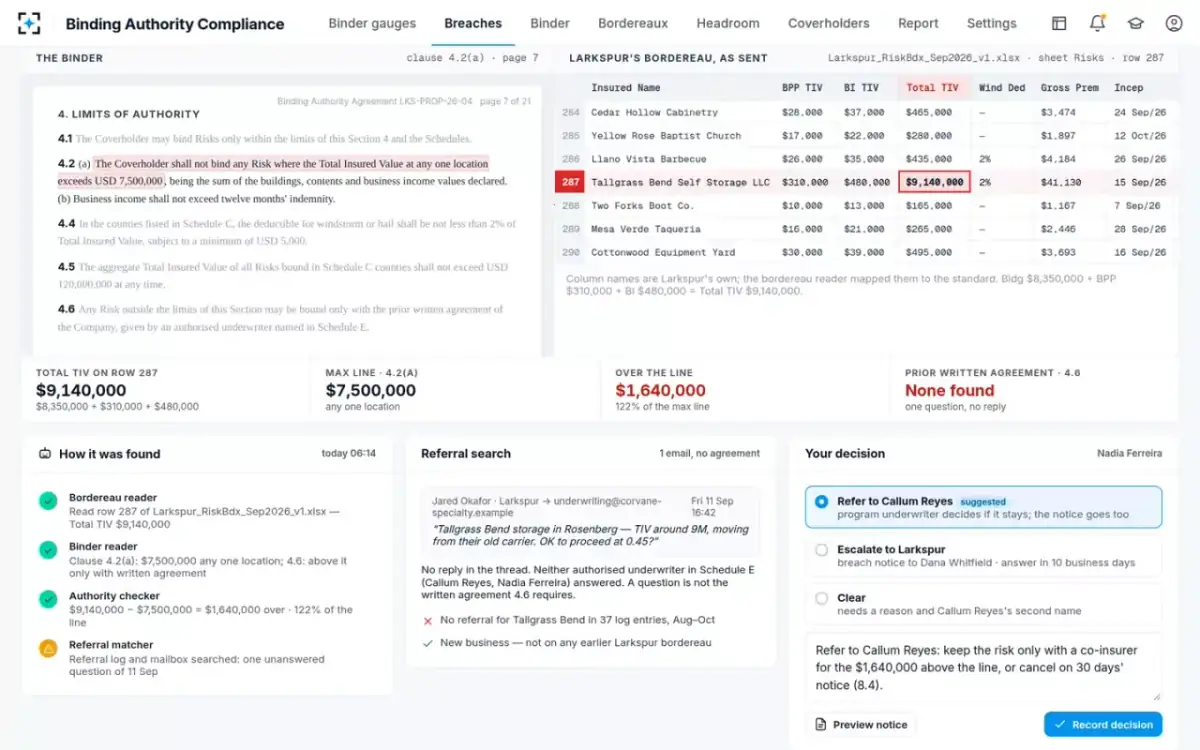
Take the sample breach. Larkspur's September bordereau, row 287, shows Tallgrass Bend Self Storage LLC in Rosenberg, Texas, at a total insured value of $9,140,000 against a binder limit of $7,500,000 any one location: $1,640,000 over, 122% of the line. The premium on the row is $41,130, a rate of 0.45 per $100, the rate the coverholder's underwriter proposed in an email nobody answered. The binder allows a risk above the limit only with the insurer's prior written agreement. Corvane's decision, made the morning after the bordereau landed: keep the risk only with a co-insurer for the $1,640,000 above the line, or cancel on 30 days' notice.
The relationship can be affected too. The model law lets the insurer end an MGA contract for cause on written notice, and suspend the MGA's underwriting authority while a dispute over the cause runs (NAIC Model #225, §4A). That is the strongest lever an insurer has, and it is reserved for patterns, not single breaches; why an insurer uses an MGA, and how it gets out covers when to pull it.
Is the insurer bound if an agent exceeds authority?
Toward the policyholder, often yes, and statutes are drafted on that footing. Florida requires every MGA contract to provide that "The insurer or managing general agent must fulfill any obligations on policies, regardless of any dispute" (Fla. Stat. § 626.7451(1)). The NAIC model treats the MGA's acts as the insurer's for examination purposes. Whether a particular out-of-authority policy binds the insurer is a question of the agent's actual and apparent authority, decided on the facts of each case; this page describes the economics, and is not legal advice.
Courts take the limits seriously when they decide those facts. In the Markel case, the defendants argued that Markel's underwriter had allowed the coverholder to exceed its per-bond limit. The judge found he had no actual authority to do so, and that the insurers had held him out as able to vary the limits only in the few ways the binder itself contemplated. An expert witness for the insurers explained why the market treats limits that way:
It is an absolute anathema that you do not go outside the terms of your reinsurance agreement or your Binding Authority. That is basically alphabet stuff that is instilled into any competent underwriter from day one.
Expert evidence quoted in Markel International v Surety Guarantee Consultants [2008] EWHC 1135 (Comm)
For the insurer's oversight team the practical answer is simpler than the legal one: assume the policy stands, and price the breach as exposure the insurer now carries without having agreed to it.
Who pays when a coverholder exceeds its limits?
The insurer pays first, and recovers from the coverholder, its people, its bond or its insurers if it can. The two sides of a breach are different contracts with different clocks: the policy, between insurer and policyholder, and the binder, between insurer and delegate.
Two contracts, two sets of consequences when authority is exceeded
Insurer and policyholder: the policy: The insurer, on a policy issued in its name. Claims are paid under the policy terms.
Insurer and coverholder: the binder: The coverholder, for breach of the agreement and, where the facts support it, of fiduciary duty.
Insurer and policyholder: the policy: Keep the risk, add a co-insurer or reinsurance for the excess, or cancel under the policy's terms.
Insurer and coverholder: the binder: Send a breach notice, require a remedy, suspend authority, end the agreement for cause, sue.
Insurer and policyholder: the policy: Fast if found early: cancellation notice periods run in days or weeks.
Insurer and coverholder: the binder: Slow: litigation over a delegate's conduct can take years, and losses may only be quantified at an inquiry.
Insurer and policyholder: the policy: A loss before the fix is the insurer's to pay.
Insurer and coverholder: the binder: The coverholder's solvency, its bond and E&O cover, the evidence on file, and limitation periods.
The bond in that caption is a useful reality check. A $500,000 ceiling covers a fraction of one breach the size of row 287 if a total loss occurred, and nothing of a book of them. Recovery beyond the bond depends on the delegate's assets, its insurance, and in fraud cases its individuals, which is where the court records below come in.
The four layers of what one breach costs
A breach of binding authority costs the insurer in four layers, and only the first is the obvious one. The figure sets them out as a sum, using the sample breach where the solution supplies a number and leaving the rest as the method an insurer can fill with its own.
The cost of one breach of binding authority, as a sum of four layers
Exposure never agreed
limit above the line × chance of a loss before the fix
Row 287: $1,640,000 above a $7.5M line, at a rate the insurer never approved.
Program underwriter
Loss already known
reserve on any loss at the address before binding
Row 52, bound 38 days after inception: a hail loss on 30 Aug, reserve $46,800.
Claims
Cost of the fix
co-insurance or reinsurance for the excess + cancellation cost + people's time
Row 287: co-insure the $1,640,000 above the line, or cancel on 30 days' notice.
Head of delegated authority
Cost of finding late
days unseen × exposure per day + recovery that fails for lack of evidence
The layer oversight controls: each week unseen adds exposure and weakens recovery.
Oversight
The second layer is the one that turns a breach into a loss. A risk backdated past the binder's window can be bound after the event it should cover. Row 52 on the sample bordereau, Wolfcreek Collision & Paint in Wichita Falls, was bound 38 days after inception against a 15-day limit, and Larkspur's own claims bordereau shows a hail loss at that address on 30 August with a reserve of $46,800. Binding Authority Compliance ranks any risk with a loss at the same address before binding as critical, and the chief underwriting officer is told the same morning.
Can an insurer recover losses from an MGA? What the court records show
Yes, but recovery comes late, through litigation, and often for less than the loss. Four routes appear in the law and the cases: a claim against the delegate and its people, a claim against the delegate's bond and insurance, a statutory action by a receiver if the insurer fails, and in Texas a reimbursement to the guaranty fund.
Routes to recovery when a delegate exceeds its authority, and what each produced
| Route | Rule or record | What it produced |
|---|---|---|
| Claim against the coverholder's people | Markel v Surety Guarantee Consultants (High Court, 3 June 2008) | Three individuals liable for conspiracy and one for procuring a breach of contract. The coverholder was in liquidation. Losses were sent to a later inquiry as to damages; Markel claimed £877,572.20 paid on unauthorised bonds, a figure the court did not decide. |
| Claim against those who took the money | Lincoln General v U.S. Auto Insurance Services (5th Cir., 18 May 2015) | A $16.5 million judgment for tortious interference upheld against two affiliates; dismissed fiduciary-duty claims against the MGA sent back for trial. |
| Action by a receiver | NAIC Model #225, §7B | If the insurer is in rehabilitation or liquidation, the receiver may sue an MGA that has not materially complied with the act. |
| Reimbursement to the guaranty fund | Texas Insurance Code § 4053.152 | If a final judgment finds an MGA's violation contributed materially to an insurer's insolvency, the MGA reimburses the guaranty fund's payments above earned premium, investment income and loss reserves. |
| Bond and E&O cover | NAIC Model #225, §4G–H | A bond of $100,000 to $500,000 per insurer; errors and omissions cover if the insurer required it. |
The Markel judgment shows how far recovery can lag the breach. The binder ran from January 2005 and was ended by Markel on 1 November 2005; the bonds over the limit came to light in 2006, when claims arrived; judgment was given in June 2008; and the losses were still unquantified, sent to a later inquiry. The judge's finding on the defendants' purpose explains why the bordereaux never showed the problem: "They shared the same object, namely, the obtaining of secret profits at the expense of Markel and QBE/Amalfi."
Lincoln General is the US counterpart, about money rather than limits. The insurer reinsured 100% of a program written by an MGA, U.S. Auto, under another insurer's paper. The district court found that in its first four years as MGA, U.S. Auto transferred about $50 million to two affiliated companies. The Fifth Circuit upheld the $16.5 million judgment against those affiliates and held that the MGA owed fiduciary duties over premiums from the moment it accepted them, not only once they reached the trust account (Lincoln General Insurance Co. v. U.S. Auto Insurance Services, No. 13-10589). Even a large judgment, the court noted wryly at the outset, left the insurer appealing.
What is exceeding binding authority, and what is not?
Exceeding binding authority is binding a risk on terms the agreement does not permit, without the insurer's agreement in the form the agreement requires. Three things look like it and are not. A risk inside the binder but close to a limit is a near miss; the sample insurer marks anything within 10% of a maximum line or aggregate as a notice. A risk outside a limit that the insurer agreed to in writing beforehand, as the binder allows, is a permitted exception. And a binder-wide cap that is about to be reached is a headroom problem, not yet a breach.
The line between a breach and a permitted exception is where most disputes start, because agreement often lives in email. On the sample breach, the coverholder's underwriter wrote on 11 September: "TIV around 9M, moving from their old carrier. OK to proceed at 0.45?" Nobody named in the binder's list of authorised underwriters answered. Binding Authority Compliance treats that as what it is, a question, and quotes it in the breach file either way, because a delegate who believes silence was consent will say so.
Binding Authority Compliance's search for written agreement, and the decision it leads to
What is the cost of a binder breach on your own book? A method
No published source we can rely on measures what binder breaches cost insurers in aggregate, so the honest number is your own. It can be built from four inputs most carriers already hold: how many risks each delegate binds; how many breach, measured on every line rather than a sample; the exposure above the limit on each; and how long each went unseen before a decision.
The fourth input is the one that moves. On the sample book, every line is checked and a breach is known the morning after the bordereau lands, so the time unseen is the bordereau lag, about two to six weeks from binding. Under a sampled audit, the time unseen for a breach the sample misses runs to the next review, and the model law sets that only at least twice a year. Multiply exposure above the line by the days it went unseen and the case for checking every line is usually made by a handful of breaches. The Prudential Regulation Authority's January 2026 letter put the wider risk in prudential terms: growth in delegated business adds to the risk of under-pricing and under-reserving across the market wherever it is not properly overseen (PRA, Insurance Supervision: 2026 priorities; quoted in rate adequacy index).
Every September breach in Binding Authority Compliance, ranked by severity
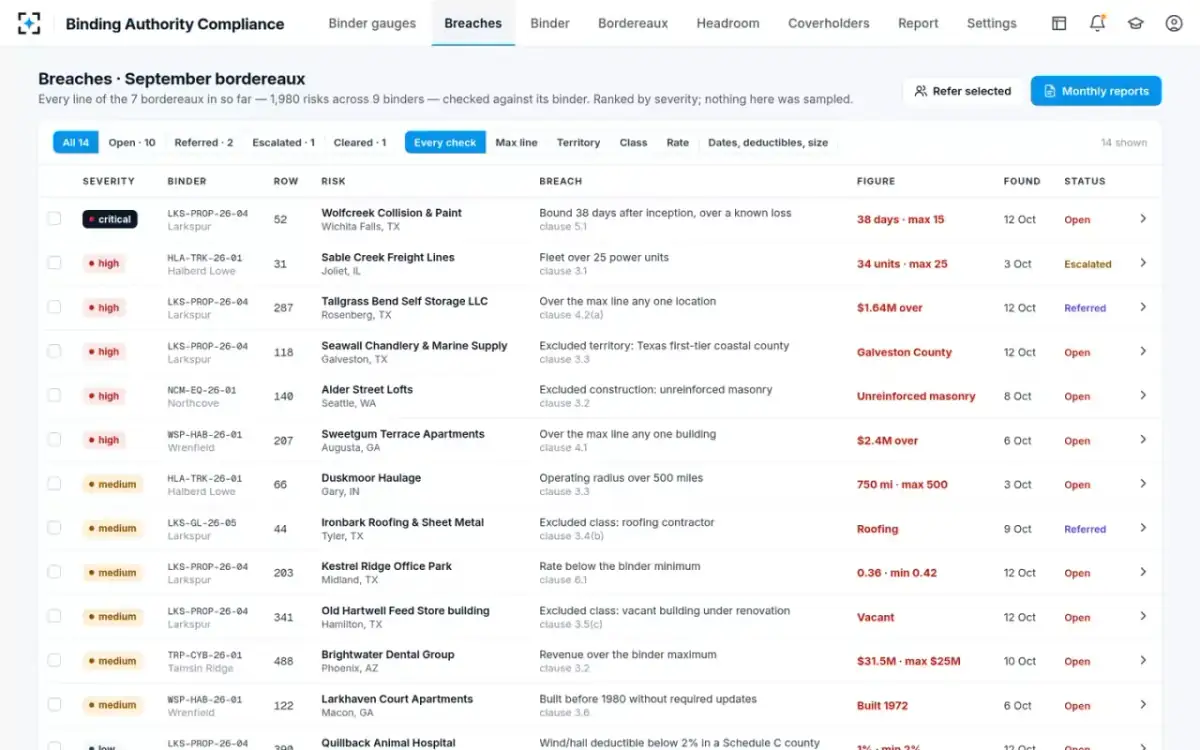
Where the solution fits is that fourth layer: finding every breach in days rather than months, with the evidence filed as it is found, so the first three layers can be managed while they are still small. It does not price the risk, decide whether to keep it or pursue recovery; those stay with the program underwriter and the head of delegated authority. One breach, traced back to the bind shows the same economics as a timeline, and a file that holds up shows the record recovery depends on. To price breaches on your own binders, start from Binding Authority Compliance.
Questions people ask
Does the insurer's reinsurance cover a risk bound outside the binder?
It depends on the treaty's wording, which differs between programs. Read the treaty before assuming the excess above the line is reinsured; if it is not, the whole of it sits on the insurer's net account.
Can the insurer cancel a risk bound outside authority?
Usually, under the policy's cancellation terms and the state's notice rules, which is why the model law requires MGA contracts to state cancellation provisions and reserve the insurer's right to cancel or non-renew. The sample binder allows cancellation on 30 days' notice. Cancelling after a loss does not undo it.
What is the difference between exceeding authority and a referral?
A referral is the coverholder asking before it binds, which keeps the decision with the insurer. Exceeding authority is binding first. A referral left unanswered is still not agreement, which is the most common way the two get confused.
How common are binder breaches?
We know of no public statistic that measures it. On the fictional sample book, checking every line found 14 breaches in 1,980 risks in September, and the five coverholders' 2026 rates ranged from 1.7 to 17.2 breaches per 1,000 risks. Your own rate can be measured only if every line is checked.
Should every breach be reported to the chief underwriting officer?
Not every one, but every serious one, quickly. The sample insurer tells the CUO of each critical breach the same morning and reports the rest in the monthly authority compliance report, which the CUO acknowledges.