A rate adequacy index measures whether the rates being charged still cover the expected cost of the business, by expressing actual premium as a percentage of a benchmark premium: 100% means premium is at the benchmark, below 100% means it is short. The Prudential Regulation Authority used exactly that definition in its market surveys: "Adequacy is defined as actual premium as percentage of benchmark premium" (PRA, June 2017). For a program written by a managing general agent (MGA), the natural benchmark is the rate guide the carrier agreed in the binder, applied to every renewal and new risk, and the index is the earliest warning a carrier gets, because it is known the day a policy is bound, years before the losses it must cover are settled. Botminds' MGA Program Performance Analytics builds it monthly: it re-rates every renewal on the program's rate guide, measures rate achieved against plan, and lists every surcharge or credit the MGA did not apply, with the premium short.
The worked examples use fictional sample data in the solution: the Brickline Habitational program, apartment property and general liability written by Corbel Program Underwriters for Harlow Ridge Specialty, as at May 2026. The definitions come from the PRA and the Casualty Actuarial Society, linked where they appear.
Why rate is the earliest signal: when each part of a program's result is known
- Bound
- Losses emerging and settling12 months
- Losses emerging, reserved, litigated and settled60 months
What is a rate adequacy index? Actual premium against a benchmark
A rate adequacy index is a ratio: the premium a book actually charged, divided by the premium a benchmark says it should have charged for the same risks. The benchmark can be a technical price from a pricing model, a filed rate, or, for a program, the binder's rate guide. Read at 100%, rates are where the benchmark says they should be; at 95%, the book is 5% short of the premium it was priced to collect.
The index matters more than a simple rate-change figure because it is anchored to a level, not a movement. A program can show rate increases every year and still be inadequate if it started too low, and the PRA's surveys found exactly that kind of disconnect in the London market. The index answers the question the carrier actually cares about: are we charging enough for what we are writing now?
What is rate adequacy in insurance?
Rate adequacy is whether a rate provides for all the costs of the risk it covers: expected claims, claim expenses, acquisition and administration, and the cost of the capital put up. The Casualty Actuarial Society states the principle in four words: "A rate provides for all costs associated with the transfer of risk" (CAS Statement of Principles Regarding P&C Insurance Ratemaking, Principle 2). An inadequate rate is one that does not.
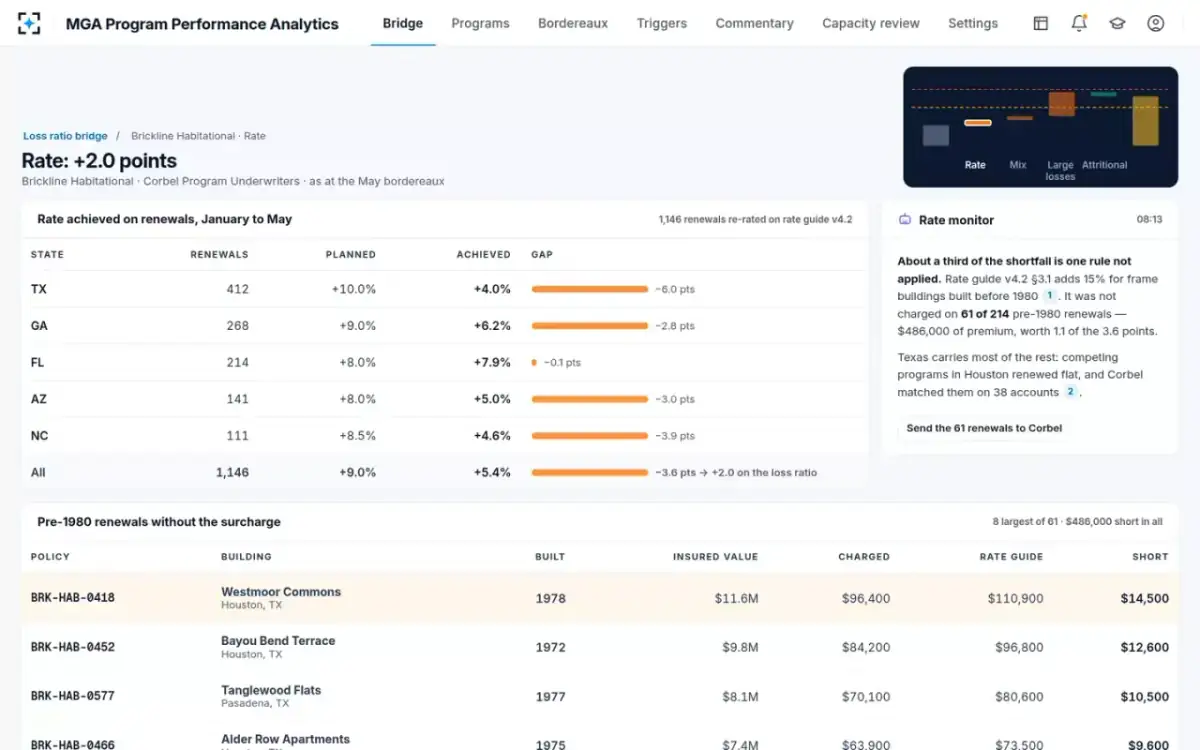
For a program carrier, adequacy has two layers. The first is whether the rate guide itself is adequate, which is an actuarial question answered when the program is priced and re-answered at each review. The second is whether the MGA is charging the rate guide, which is a monitoring question answered renewal by renewal. The second kind takes familiar forms: a surcharge not applied, a credit applied too freely, a schedule modification used on every account. In the sample, about a third of the rate shortfall came from one surcharge not applied.
What is technical rate adequacy for a delegated program?
Technical rate adequacy compares the premium charged with the technical price, the premium a pricing model says covers expected costs and the target return, rather than with last year's premium or the market rate. It is the strictest benchmark, because it ignores what competitors charge. The PRA has repeatedly asked firms to be candid about it: in 2017 it noted that "not all business can be subject to robust technical price", but warned that some firms might be "taking an overly optimistic view of current pricing" (PRA, June 2017).
For delegated business the rate guide stands in for the technical price at the level of the individual risk. That is why the binder's rate basis matters: the NAIC's model act lists the basis of the rates to be charged among the eight underwriting guidelines every MGA contract must contain (Model #225 §4F). A rate guide that is itself out of date is a pricing problem for the actuary; a rate guide that is not followed is a monitoring problem for the program team.
How do you measure rate adequacy in a program? Re-rate every renewal
Measure a program's rate adequacy by re-rating every policy the MGA writes on the rate guide in force on its effective date, and dividing the premium charged by the premium the guide gives. Summed across a month's renewals, that is the program's rate adequacy index for the month; broken down by state, segment or rule, it shows where the shortfall comes from.
Rate adequacy index for one program, from one building to the whole book
| Level | Charged | Benchmark | Result |
|---|---|---|---|
| One renewal: Westmoor Commons, Houston, 1978 frame | $96,400 | $110,900 (with the 15% pre-1980 surcharge) | Index 86.9% |
| 61 pre-1980 renewals without the surcharge, January to May | $486,000 short in all | Rate guide v4.2 §3.1: +15% on pre-1980 frame | 1.1 of the 3.6-point rate shortfall |
| Texas renewals, rate change achieved against planned | +4.0% | +10.0% | Index 94.5% of plan rate level |
| All 1,146 renewals, rate change achieved against planned | +5.4% | +9.0% | Index 96.7% of plan rate level |
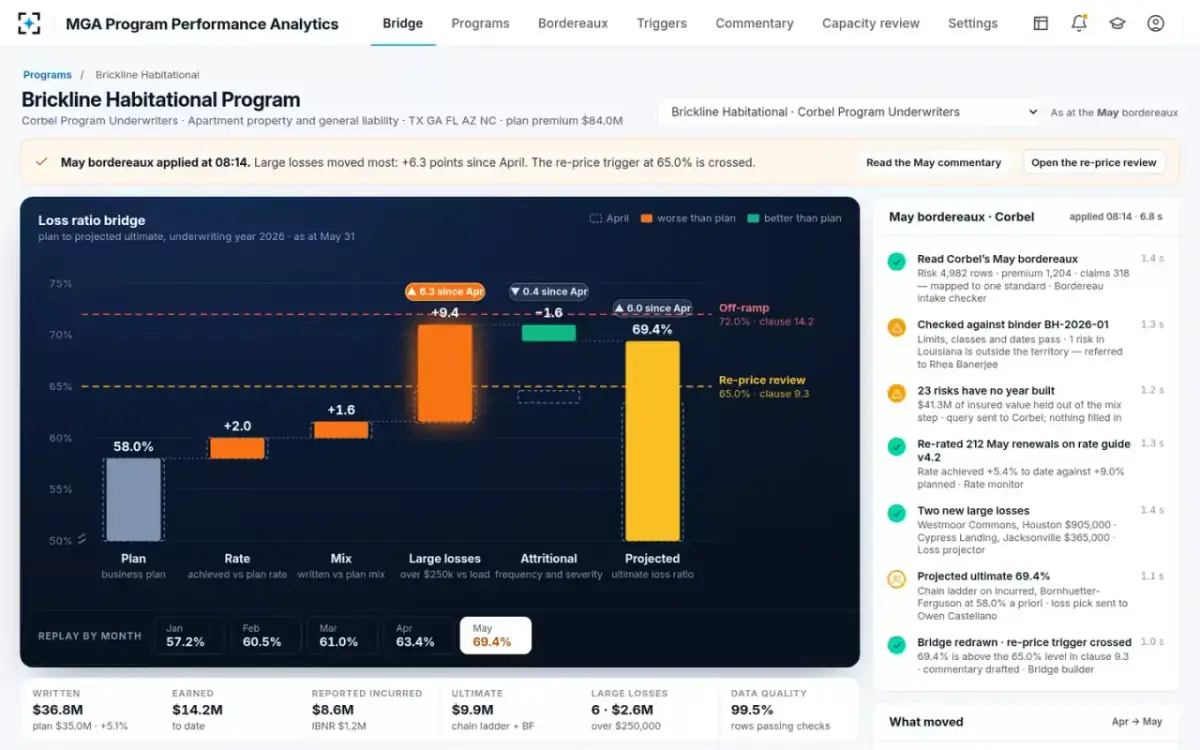
| Effect on the projected loss ratio | Plan ÷ index: 58.0% ÷ 0.967 | 58.0% plan loss ratio | +2.0 loss ratio points |
The table shows why the index should be read at several levels at once. At the book level, 96.7% sounds tolerable. At the rule level, one surcharge missed on 61 of 214 eligible renewals explains about a third of the shortfall, and at the policy level the biggest of those buildings is the one that burned in May. Each level points to a different action: re-pricing the book, enforcing a rule, or reviewing one account.
Rate achieved against plan by state, and every renewal charged without the surcharge
The rate adequacy formula, term by term
The rate adequacy formula for a program has two parts: the index itself, and the rate change it implies against the program's permissible loss ratio. The first tells the carrier whether the MGA is charging the rate guide; the second whether the rate guide, as charged, still covers the projected losses.
From the rate adequacy index to an indicated rate change
Rate adequacy index
Premium charged ÷ premium at the rate guide (or plan rate level)
Sample book: 1.054 ÷ 1.090 = 96.7%
Rate monitor, every renewal
Loss ratio effect
Plan loss ratio ÷ index − plan loss ratio
Sample: 58.0% ÷ 0.967 − 58.0% = +2.0 points
Shown as the rate step on the bridge
Permissible loss ratio
1 − expenses − target profit
Sample plan: 58.0%
From the business plan
Indicated rate change
Projected loss ratio ÷ permissible loss ratio − 1
Sample: 69.4% ÷ 58.0% − 1 ≈ +19.7% on the whole projection
Program actuary; the decision is the head of program business's
The gap between the two last lines is the point of the exercise. On the sample program the index explains 2.0 of the 11.4 points by which the projection exceeds plan; large losses explain most of the rest. A full indicated increase of about 20% would be a reaction to one bad month of large losses; the carrier in the sample chose a narrower re-price, enforcing the missed surcharge, adding 6% on the riskiest segment and capping older buildings, which its actuary projects at 60.8% for the next underwriting year.
What is rate change monitoring, and why is rate change not rate adequacy?
Rate change monitoring tracks how much the price of the same risk moved at renewal, usually adjusted for changes in cover, limits and exposure: the risk-adjusted rate change. It is useful, but it measures movement, not level, and the PRA found the two diverging in its 2017 survey of London market insurers.
"In aggregate, premium rates reduced, but overall premium adequacy, as estimated by firms, is marginally higher," the PRA wrote, and it quantified the gap: overall adequacy "has not materially changed, yet the RARC has reduced by around 3.2%" (PRA, June 2017). Among the possible explanations it listed were "firms taking credit for re-underwriting the portfolio" and "firms not adequately reflecting changes in RARC" in their technical price. A year later it returned to the point: some firms "take credit too quickly for the expected positive impact of re-underwriting a portfolio before this is justified by results" (PRA, May 2018).
For a program carrier the lesson is to keep both measures and to anchor the index to something outside the MGA's own judgment. A rate guide agreed in the binder, re-rated by the carrier on every renewal, is that anchor. Rate change reported by the MGA, adjusted by the MGA, is not.
What should a rate adequacy index account for beyond the rate guide?
Beyond the rate guide, an index needs to account for trend, mix and terms. The CAS principles list the considerations: "Consideration should be given to past and prospective changes in claim costs, claim frequencies, exposures, expenses and premiums" (CAS Statement of Principles). A rate guide written two years ago, charged in full, may still be inadequate if claim costs have risen faster than the guide assumed.
The practical answer is to keep three measures side by side rather than fold them into one number: the index against the rate guide, which the MGA controls; the mix against plan, which the MGA's underwriting controls; and the plan's own loss cost assumptions against emerging experience, which the carrier's actuary controls. The MGA KPIs and metrics guide sets out how mix is measured in loss ratio points, and the loss ratio calculation guide how the projection behind the third measure is built.
When should a program be re-priced? Triggers, notice and the risk of waiting
A program should be re-priced when its rates, as charged and as written, will not cover its projected losses at the plan's margins, and the binder should say in advance what level of evidence triggers the review. In the sample, clause 9.3 opens a re-price review when the projected loss ratio passes 65.0%, and rates can change on 60 days' notice; a separate setting marks rate achieved more than 3 points under plan in amber. The binder's notice period is the reason to act early: every month spent deciding is another month of renewals at the old rate, plus the notice period, before the new rate applies.
“Delegated authority business looks set to grow across the London Market, raising additional risks of inadequate pricing and reserving across the sector if not properly managed or overseen.”
Prudential Regulation Authority, Insurance Supervision: 2026 priorities, letter to chief executives, 15 January 2026
The supervisory context points the same way. The PRA's 2026 letter describes a softening underwriting cycle across many lines that may squeeze pricing, terms and reserves, and expects boards to ensure "that they are pricing and reserving adequately given these market trends" (PRA, January 2026). A monthly index on every delegated program is the evidence that expectation calls for.
The rate step on the bridge, against the binder's re-price and off-ramp levels
Where MGA Program Performance Analytics fits a rate adequacy index
The solution builds the index from what the MGA already sends: each renewal on the risk and premium bordereaux is re-rated on the rate guide version in force, rate achieved is measured against the plan by state and segment, and every surcharge or credit not applied is listed with the policy, the rule and the premium short. The result appears as the rate step on the program's bridge, in loss ratio points, and can carry its own trigger.
It does not set rates or change premiums. The rate guide is the carrier's and the MGA's; the re-price decision belongs to the head of program business, and the notice to the MGA is drafted for her signature. Nor does it judge whether the rate guide itself is adequate: that remains the actuary's review of the plan's loss costs. What loss ratio a program's rates should aim for is the subject of its own guide. To build the index on your own programs, start from MGA Program Performance Analytics.
Questions people ask
What is a risk-adjusted rate change?
A risk-adjusted rate change is the change in premium on renewing business after removing the effect of changes in exposure, limits, deductibles and terms, so that it measures the change in price for the same risk. The PRA abbreviates it RARC and asks firms to reconcile it with their view of adequacy from one year to the next.
What is a good rate adequacy index?
At or above 100% against a benchmark the carrier trusts. Against a program's rate guide, anything persistently below 100% means the MGA is not charging the agreed rates; against a technical price, below 100% means the book is not expected to earn its target return. The level matters less than the trend and the reason.
How often should rate adequacy be measured?
As often as business is written, which for a program means monthly, when the bordereaux arrive. Rate is the one part of a program's result known at binding, so a monthly index can catch a missed surcharge after one month of renewals instead of at the on-site review or the year-end pricing review.
Can an MGA change rates without the carrier?
Not outside the binder. The basis of the rates is one of the underwriting guidelines the model act requires in every MGA contract, so the MGA rates within the carrier's rate guide; changes to the guide follow the binder's clause and notice period. In the sample, rate is changeable on 60 days' notice.
What is a rate guide?
A rate guide is the program's rating manual: base rates, rating factors, surcharges, credits and the rules for applying them, agreed between carrier and MGA and versioned over time. In the sample, rate guide v4.2 §3.1 adds 15% for frame buildings built before 1980; re-rating each renewal against the version in force on its date is what turns the guide into an index.