An MGA data platform is the system a program carrier uses to receive each managing general agent's risk, premium and claims bordereaux and account statements, check them against the binder, put them into one standard and show every program on the same measures. The technology is the easy part. The hard part is trust: underwriters, actuaries and the head of program business have signed off quarterly reports for years, and a new number that disagrees with the old one will be argued about rather than acted on unless each figure can be traced, in seconds, to the bordereau row and the binder clause behind it. Botminds' MGA Program Performance Analytics is built on that test: every bar on a program's loss ratio bridge drills to its rows, and the first ninety days are planned around showing it.
The examples use fictional sample data in the solution: the carrier Harlow Ridge Specialty and its Brickline Habitational program written by Corbel Program Underwriters. The rules on what MGAs must send come from NAIC's model act and the Texas Insurance Code; the findings on delegated data from the UK regulators, linked where they appear.
The first ninety days: three meetings where the old report and the new view are compared
- Load binders, plans, rate guides; map each MGA's filesDays 1–20
- Meeting 1: first month in parallelDay 30
- Meeting 2: fix mappings, set triggersDay 60
- Meeting 3: decide on the old reportDay 90
- Produced as usualDays 1–60
- Produced once more, for the last comparisonDays 61–90
What is an MGA data platform, and how is it different from an MGA platform?
An MGA data platform, in the carrier's sense, is oversight infrastructure: it takes in what MGAs send, checks it and turns it into a view of each program. An MGA platform, in the MGA's own sense, is the system the MGA uses to rate, quote, bind and issue policies and to handle claims. The second produces the data the first consumes, and most carriers deal with many of them, one per MGA, each with its own export.
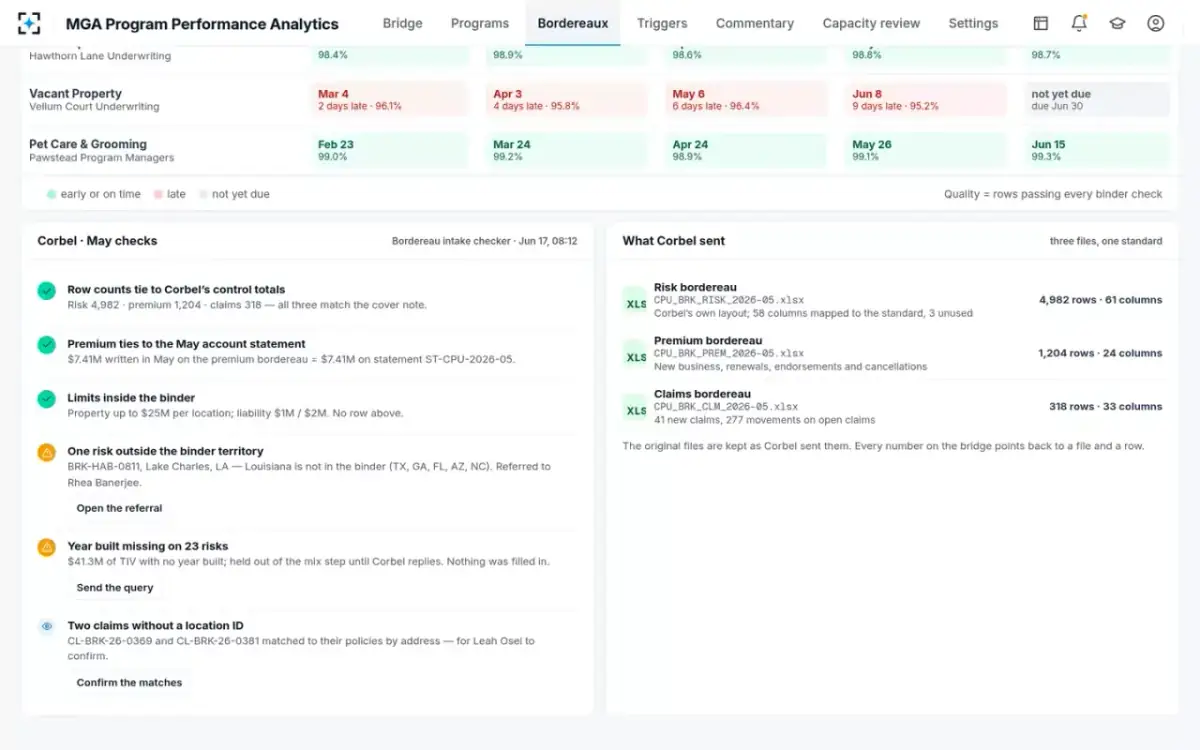
That difference explains most of the work. A carrier cannot choose its MGAs' systems, so its platform has to read whatever each one exports, in its own column names and units, and map it to one standard without losing rows or meaning. In the sample, Corbel's May risk bordereau arrived in Corbel's own layout with 61 columns; 58 were mapped to the standard and 3 were unused, and the platform shows which.
How do MGAs share data with carriers today?
MGAs share data with carriers through monthly bordereaux and account statements, claims files sent on statutory triggers, and access to their records when the carrier asks. The NAIC's model act requires the MGA to account for every transaction at least monthly (Model #225 §4B) and to send a copy of a claim file when, among other triggers, the claim involves a coverage dispute, may exceed the MGA's settlement authority or has been open for more than six months (§4I). Where claims files are electronic, the contract must address how their data is transmitted in good time (§4J).
The carrier's strongest right is access. "Separate records of business written by the MGA will be maintained. The insurer shall have access and right to copy all accounts and records related to its business in a form usable by the insurer" (§4D). In practice the bordereau is how that right is exercised each month, and its format is agreed in the binder rather than set by law.
What data does a carrier need from an MGA?
A carrier needs, at minimum, the data to calculate premium and losses for each program and to check each risk against the binder. Texas writes the financial core into statute: an MGA's quarterly account report must state written, earned and unearned premiums, losses and loss expenses paid and outstanding, losses incurred but not reported, and management fees (Tex. Ins. Code §4053.103). The binder's underwriting guidelines add the risk fields: everything needed to test premium volume, rates, risk types, limits, exclusions, territory, cancellation and policy period (Model #225 §4F).
Performance management needs a little more than oversight: the attributes the business plan was priced on, such as construction, year built, insured value band and state, so that mix can be measured against plan; and claim-level detail with dates and reserves, so that large losses can be separated and development projected. A data agreement that asks for those fields at the start of a program costs far less than a query for them after a bad quarter.
Why is trust the hard part? What regulators found in delegated data
Trust is the hard part because carriers have repeatedly been shown not to have the data they thought they had. The PRA wrote to London market firms in 2017 that, where they participate in broker facilities, MGAs or other delegated underwriting arrangements, it would assess "how they ensure that they understand the impact of business written on their overall risk profile and their results" (PRA, June 2017). A year later it reported what it had found.
“Some firms appear to lack management information to allow them to monitor effectively the use or performance of material delegated underwriting arrangements, including broker facilities.”
Prudential Regulation Authority, letter to chief executives of specialist general insurers, Anna Sweeney, 31 May 2018
The same letter recorded "increasing divergence between underwriter and actuarial views on key assumptions" (PRA, 2018): the two groups whose trust a data platform most needs were already reading the business differently. The FCA found the same pattern in outsourced claims in 2025: some firms "didn't have consistent and comparable data to identify actual and emerging trends" (FCA, 2025). And the PRA's 2026 priorities letter, on exposure management, put the principle plainly: "High-quality data remains fundamental to sound prudential risk management and to ensure a clear and current understanding of exposure" (PRA, January 2026).
Trust is traceability: one bar, traced to its rows
A number is trusted when anyone who doubts it can follow it to its source without asking an analyst. On a program's loss ratio bridge that means each step opens the rows behind it, each row names the file it came from, and each rule names the clause or rate guide section it applies. The trace below follows one step on the sample program from the chart to the documents.
One bridge step traced from the chart to the documents
| Level | What is shown | Where it comes from |
|---|---|---|
| Bridge step | Large losses +9.4 points, of which +6.3 since April | Six claims over $250,000: $2,613,000 on $14.2M earned, against a 9.0-point load |
| Claim | Westmoor Commons, Houston: dryer-vent fire in building C, 14 of 168 units out, $905,000 incurred | Claim CL-BRK-26-0362 on the MGA's claims bordereau for May, row 112 |
| Policy | A 1978 frame building, renewed on 1 January | Policy BRK-HAB-0418 on the risk and premium bordereaux |
| Rule | Charged $96,400; the rate guide gives $110,900 | Rate guide v4.2 §3.1: 15% surcharge on frame built before 1980 |
| Trigger | Projected 69.4% crosses the 65.0% re-price level | Binder BH-2026-01, clause 9.3: rate changeable on 60 days' notice |
The trace does two jobs. It lets the actuary check a reserve before signing, and it turns an argument about a number into an argument about a decision: once everyone in the room can see that the largest claim was on a building that renewed without the surcharge, the conversation moves from whether the loss ratio is right to whether the surcharge should be enforced.
Each file checked, tied and counted before any number is shown
The first ninety days: three meetings, old report beside new view
Adoption is won in three meetings, one a month, in which the old quarterly report and the new monthly view are put side by side for the same programs and every difference is explained. The aim of the first is to find the mapping errors and definitional differences; of the second, to agree the trigger levels and the earned premium and loss definitions; of the third, to decide whether the old report can stop.
Most differences in the first meeting are definitional, not errors. The old report may divide reported losses by written premium; the new view projects ultimate losses over earned premium. The old report may treat a reopened claim as new; the new view tracks it. Each difference is written down with the definition both sides will use from then on, so that by the third meeting the two numbers either agree or the reason they do not is accepted. A carrier that skips this step ends up running both for a year.
What each seat must see before it trusts an MGA data platform
Today
Doubts any projection built from files she has not reconciled to her own triangles.
With agents
Trusts it once the platform's reported losses tie to her claims data by program and month, and each large loss opens its bordereau row.
Still theirs: The method and the loss pick.
Today
Doubts a rate shortfall until he sees the policies, the rate guide version and the premium charged.
With agents
Trusts it once each missed surcharge lists the policy, the building, the rule and the premium short.
Still theirs: The referral rulings and the on-site review.
Today
Doubts a new number that disagrees with the quarterly report she has signed off for years.
With agents
Trusts it once three meetings in a row explain every difference between the old report and the new view.
Still theirs: The decision to retire the old report, and every program decision.
Today
Doubts automated mapping that might drop columns or misread a renamed field.
With agents
Trusts it once each file shows columns mapped and unused, row counts tied to control totals and every failed check.
Still theirs: Confirming matches and sending queries to the MGA.
Today
Doubts the carrier's figures because he cannot see how they were calculated from his files.
With agents
Trusts them once he sees the same bridge for his own program, drilled to his own rows.
Still theirs: His underwriting, and the reply to the carrier's asks.
How do you get actuaries to trust new data?
Actuaries trust new data when it reconciles to the data they already trust and when the method is stated beside the result. Start by tying the platform's reported losses and earned premium by program and month to the actuary's own triangles; differences should be explainable as timing or definition, row by row. Then show the projection method in words beside the number: in the sample, chain ladder on incurred losses, with Bornhuetter-Ferguson at the 58.0% plan loss ratio for months under 12.
Two further habits keep that trust. Rows the platform cannot use, such as claims without a location or risks without a year built, are counted and shown, never quietly dropped or filled. And the actuary, not the platform, signs the loss pick: the projection is a proposal with its workings, which is the only form in which a professional will put a name to it. Where an MGA sets loss reserves, the model act already requires an annual actuarial opinion on them (§5B); the monthly view is the evidence that opinion can draw on.
How to bring underwriters and the MGA itself on board
Underwriters trust the platform when its exceptions are specific enough to act on: not "rate below plan" but the policy, the building, the rate guide rule, the premium charged and the premium due. In the sample, the rate monitor listed 61 pre-1980 renewals charged without the 15% surcharge, $486,000 of premium in all, policy by policy, and the program underwriter could send them to the MGA that morning.
The MGA is the last and most important convert, because it is the one that can fix what the platform finds. Giving the MGA the same view of its own program, and no other, removes the suspicion that the carrier's numbers are built differently from its own files. In the sample, the MGA's chief executive sees his program's bridge and receives the signed monthly commentary with its asks, two months before the quarterly meeting would have raised them.
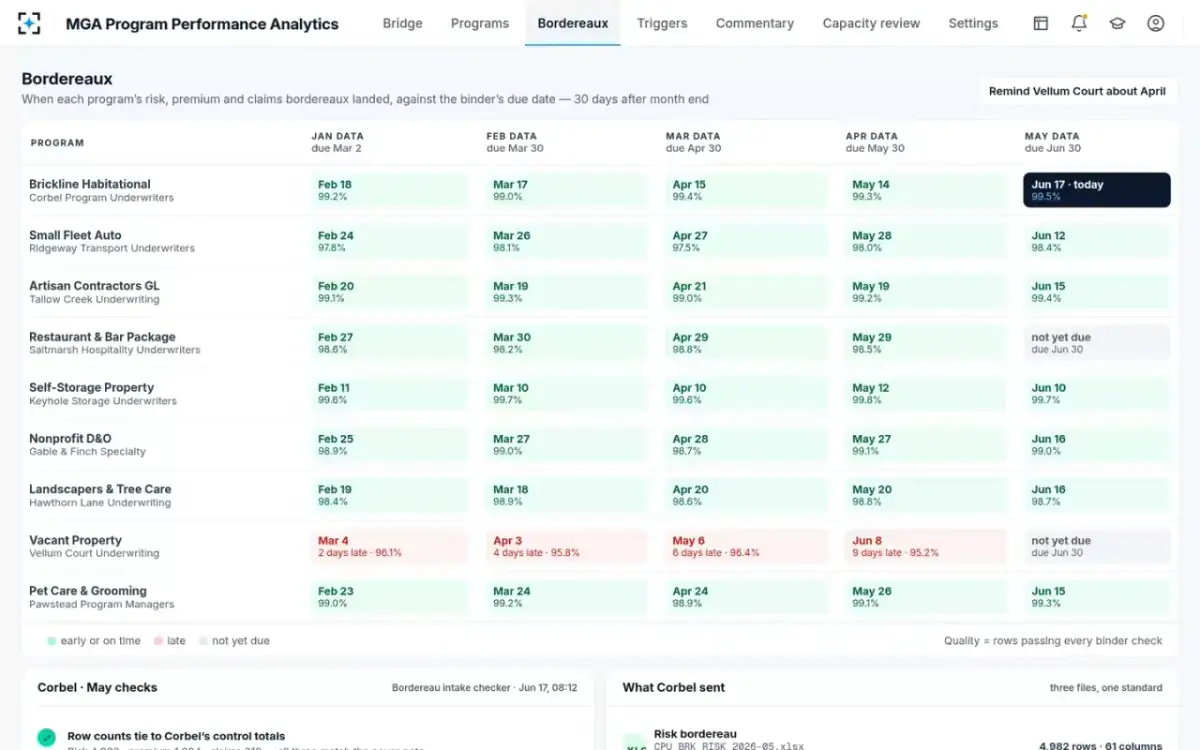
Every MGA's landing day and data quality, month by month
A data agreement with each MGA: what to write down
Most trust problems are prevented by writing down, before the first file, what the MGA will send and how the carrier will read it. The Texas Insurance Code requires every MGA contract to address "reports, records, and auditing" (§4053.102); a data schedule to the binder is the natural place to do it.
Eight lines for a data schedule to an MGA binder
- Files, frequency and due day
Risk, premium and claims bordereaux and the account statement, monthly, by a stated day after month end.
- Row-level detail
One row per risk, premium transaction and claim movement, not summaries; summaries cannot be drilled.
- Fields the plan was priced on
Construction, year built, value band, state and class, so mix can be measured against the plan.
- Control totals with every file
Row counts and premium totals in a cover note, so completeness can be proved, not assumed.
- Stable identifiers
Policy, location and claim numbers that persist across months, so movements can be linked.
- Rate guide versions with effective dates
Re-rating a renewal needs the version in force on its date.
- Change notice for layouts
Advance notice of any change to columns or codes, so mappings are updated before the file arrives.
- How queries are answered
A named contact and a reply time for missing fields; the carrier holds the rows out until then.
Where MGA Program Performance Analytics fits as an MGA data platform
The solution works as the carrier-side data platform for program performance: it takes each MGA's bordereaux as sent, maps them to one standard, checks every row against the binder, ties them to control totals and account statements, and builds each program's bridge with every bar drilling to its rows. The same view, limited to one program, can be shared with that program's MGA.
It is not the MGA's policy system, and it does not replace the carrier's general ledger, reserving system or data warehouse; it reads from the MGA's exports and can feed the carrier's other systems. It also cannot create data an MGA does not send: if a binder never asked for year built, mix by age cannot be measured until it does. Which monthly tasks the agents take and which stay with people and how to replay a year before trusting the view are covered in their own guides, and the loss ratio calculation shows the definitions the first meeting usually has to settle. To see it on your own MGAs' files, start from MGA Program Performance Analytics.
Questions people ask
What is MGA data?
MGA data is the record of the business an MGA writes and the claims it handles for a carrier: risks and their attributes, premium transactions, claims and their movements, and the monthly accounts. The carrier is entitled to it under the binder and, in states following the model act, to the MGA's records in a form it can use.
Who owns the data in a program?
The binder decides most of it, but the statutes set a floor. Under Model #225 the insurer has the right to access and copy all accounts and records related to its business, and claim files are the joint property of the insurer and the MGA, becoming the insurer's alone if the insurer is liquidated.
What if an MGA cannot send row-level data?
Then the carrier can see levels but not causes, and cannot check individual risks against the binder. The practical answer is to make row-level bordereaux a condition at the next renewal of the binder, and in the meantime to use the carrier's right to the records for the on-site review.
How long does it take to map a new MGA's files?
No published benchmark exists. The first month for a new layout takes longest, because every column must be matched to the standard and the result checked; later months reuse the mapping unless the MGA changes its layout, which is why a change-notice clause in the data schedule is worth having.
Does a data platform replace the bordereaux analyst?
No; it changes the job. In the sample the analyst no longer re-keys files but confirms the matches the platform proposes, such as two claims matched to policies by address, and decides which queries go back to the MGA. The analyst's judgment on what is a data error and what is a real exception remains the check on the platform.