MGA program performance management is how a carrier measures each program written by a managing general agent (MGA) against the business plan and binder it was written under, loss ratio, rate, mix, large losses and data quality, and decides in time whether to grow it, re-price it, cut the line or exit. Most carriers do it quarterly, from reports assembled by hand after the quarter closes, so a program can be off plan for months before anyone can act. Any tool that promises to do it monthly should be tested the same way: feed it last year's bordereaux in the order they actually arrived, see what it would have said each month, and compare that with what you know now. Botminds' MGA Program Performance Analytics redraws each program's loss ratio the morning its bordereaux land, and a replay on your own closed year is the fairest way to judge whether its monthly view deserves trust.
Where this guide shows output, it comes from fictional sample data in the solution: the Brickline Habitational program written by Corbel Program Underwriters for Harlow Ridge Specialty. The replay method is our proposal; the yardsticks are the statutes and the regulators' own words, linked where they appear.
An eight-week replay test on one closed year, and what each phase produces
- Load binders, plans, rate guidesWk 1
- Map each MGA's filesWk 2
- Replay months 1–12 in arrival orderWks 3–5
- Score against year endWk 6
- Review with actuary and underwritersWks 7–8
What is MGA program performance management? A plan, a binder, a month and a decision
MGA program performance management has four parts: a plan for each program, a binder that says what the carrier will do when the plan is missed, a monthly measurement against both, and a decision taken by a named person. The plan sets the expected loss ratio, rate change and mix; the binder sets the re-price and exit levels and the notice periods; the bordereaux supply the measurement; and the head of program business decides.
The statutes supply the floor, not the method. Under the NAIC's model act the MGA must render accounts at least monthly, the carrier must review the MGA's underwriting and claims on site at least semi-annually, and where the MGA sets loss reserves the carrier must obtain an actuary's opinion on their adequacy every year (Model #225 §§4B, 5B–C). None of that tells a carrier whether a program is on plan this month. That is the gap performance management fills.
How do carriers evaluate MGA programs, and why is a quarter too slow?
Most carriers evaluate MGA programs in a quarterly review: bordereaux are re-keyed into templates, a loss ratio is calculated, and the program is discussed against its plan. The weakness is not the frequency alone but what the review leans on. Supervisors have described the failure in plain terms.
“Some firms have reacted slowly to emerging loss development and are too reliant on managing by business plan loss ratios. These firms are at risk of taking false comfort from pricing models which appear to show business as still profitable despite emerging underwriting results.”
Prudential Regulation Authority, letter to chief executives of specialist general insurers, Anna Sweeney, 31 May 2018
The same letter found "ineffective feedback loops between pricing, claims and reserving functions" that hampered firms in acting on deteriorating trends (PRA, 2018). Eight years later the PRA's 2026 priorities letter returned to the theme, warning that some firms make assumptions about future underwriting performance "that are overly optimistic compared to their underwriting track record" (PRA, January 2026). A program view that explains each month's movement by cause, rate, mix, large losses or attritional, is a direct answer to both findings, provided it can be shown to be right.
A quarterly program review against a monthly view, side by side
Quarterly review, re-keyed: After the quarter closes and the templates are filled.
Monthly view, from the bordereaux: The morning the month's bordereaux land, if the files are usable.
Quarterly review, re-keyed: A level, often reported rather than projected.
Monthly view, from the bordereaux: A projection, with the move since last month split by cause.
Quarterly review, re-keyed: At the on-site review, in a sample of files.
Monthly view, from the bordereaux: On every renewal re-rated against the rate guide.
Quarterly review, re-keyed: Whether the number is right and why it moved.
Monthly view, from the bordereaux: What to do about the step that moved.
Quarterly review, re-keyed: Late sight; arguments about inputs.
Monthly view, from the bordereaux: False alarms from immature months; trust that has not been earned. The replay test is for this.
How do you test program analytics? Replay a closed year the way it arrived
Test program analytics by replaying a year whose outcome you already know. Take the last fully developed underwriting year you can, load the binders, business plans and rate guides as they stood then, and feed the tool each month's bordereaux in the order and on the day they actually arrived, with no later corrections. After each month, freeze what it shows: projected loss ratio, the bridge by cause, the triggers crossed, the exceptions raised.
The discipline is in the "as they arrived". A replay that uses cleaned, final files is testing hindsight. The files as received carry the late months, the missing fields and the re-sent bordereaux that a real monthly process has to cope with, and they are what the tool will see after go-live. Keep a copy of each month's frozen output; the score comes from comparing them with the year end.
Choose programs with something to find. A program that ran to plan all year tests only false alarms. Include at least one that crossed a re-price level or was re-priced, cut or exited, so the replay can show when the tool would have seen it compared with when your quarterly process did.
What to score in a replay: five measures, and how to read them
Score a replay on how early, how right and how explainable its monthly view was. The five measures below need no industry benchmark, because each compares the tool with your own year end and your own quarterly process; no published source gives a standard for them, so set the bar before the test, not after it.
Five measures for a program analytics replay, defined
| Measure | How to calculate it | What it tells you |
|---|---|---|
| Lead time | Month the replay first crossed a trigger, minus the month your quarterly process first flagged the same program | How much earlier a decision could have been taken |
| Projection error by age | Each month's projected ultimate loss ratio minus the year-end actuarial estimate, in points, by months of development | Whether early months can be read as projections or only as warnings |
| Explanation that held | Share of the year's movement the bridge attributed to rate, mix, large losses or attritional that the year-end review agrees with | Whether the causes shown are causes, not noise |
| Exceptions found | Rows outside the binder, missed surcharges and data gaps the replay raised, against those found at the on-site reviews | Whether whole-file checking finds what sampling found, and what it missed |
| False alarms | Triggers crossed that reversed within two months without action | Whether the trigger levels and maturity rules are set sensibly |
Read projection error by age, not as one number. A projection for a month with three months of development is mostly plan and should be judged by direction; one with twelve months should be close. The Casualty Actuarial Society's ratemaking principles make the general point: "Credibility is a measure of the predictive value that the actuary attaches to a particular body of data", and it rises with volume (CAS Statement of Principles). A young program's month is a small body of data; a tool should say so rather than print an ultimate with false confidence.
Comparing the replay with the year-end actuarial view
The yardstick for a replay is the actuarial view of the same programs at year end, because that is the view the carrier books and, where an MGA sets reserves, the view an actuary signs. New York requires that opinion from a member of the American Academy of Actuaries in good standing, covering the adequacy of the reserves for losses incurred and outstanding on the MGA's business (11 NYCRR §33.6(b); the model's version is quoted in MGA profit commission).
The year-end view moves too, so compare like with like. Use the estimate made at the year end you are replaying to, not today's, when scoring how the monthly view tracked the carrier's own thinking; use today's more developed estimate when scoring how close the monthly projections came to the truth. The gap between the two is itself information about the program, and a carrier-wide method for it is set out in the guide to actual vs expected in actuarial reserving.
What a replay produces: one program's projection, month by month
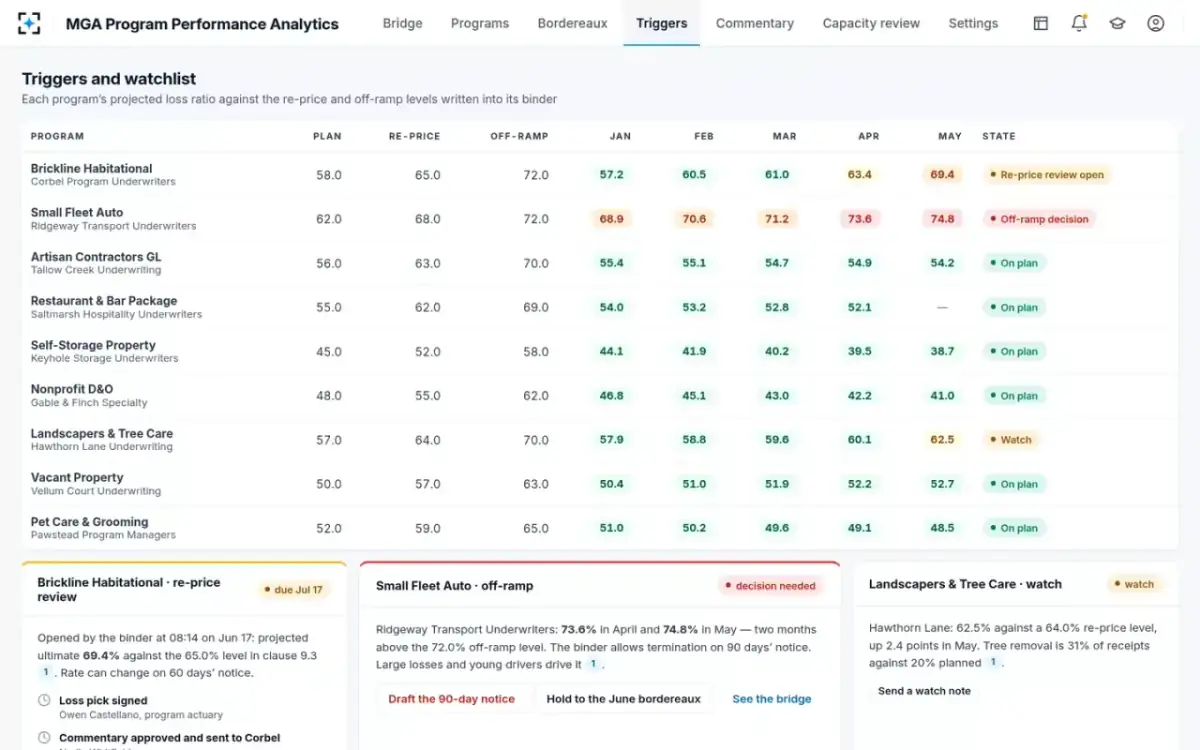
A replay's main output is a row of frozen monthly projections for each program, set against its plan and trigger levels. The sample program below is in its current year rather than a closed one, but the shape is what a replay shows: a plan, a drift and a month in which a level is crossed.
One program's projected loss ratio by month, against its 58.0% plan and 65.0% re-price level
Read in replay, three questions follow. Would the February move to 60.5% have prompted a question to the MGA? Was April's 63.4%, 1.6 points from the re-price level, a warning anyone acted on? And did May's jump come from causes that held: in the sample, two new large losses moved the large-loss step from +3.1 to +9.4 points, while rate, mix and attritional together moved by only −0.3. On a closed year, the answers can be checked against what happened next.
Every program's projection by month against its own binder levels
What is an MGA program performance review, and how often should it happen?
An MGA program performance review is the meeting, or the report behind it, in which carrier and MGA go through a program's results against plan and agree what changes. US law sets the on-site review clock, semi-annual under the model act and New York's rule, annual in Florida, but not the frequency of performance reviews, which the binder sets. In the UK the FCA now ties review frequency to risk: from 9 December 2025, where a non-investment insurance product carries more potential for customer harm, the firm should review it more often, which can mean more than once a year (FCA PROD 4.2.36AD).
A sensible rhythm separates watching from meeting. Watch monthly, because the bordereaux arrive monthly and a missed surcharge or a large loss is cheaper to address in the month it appears. Meet when a trigger is crossed or at the agreed quarterly date, with the monthly commentary as the agenda, and keep the on-site review for the things only a visit can test: underwriting files, claims handling, controls.
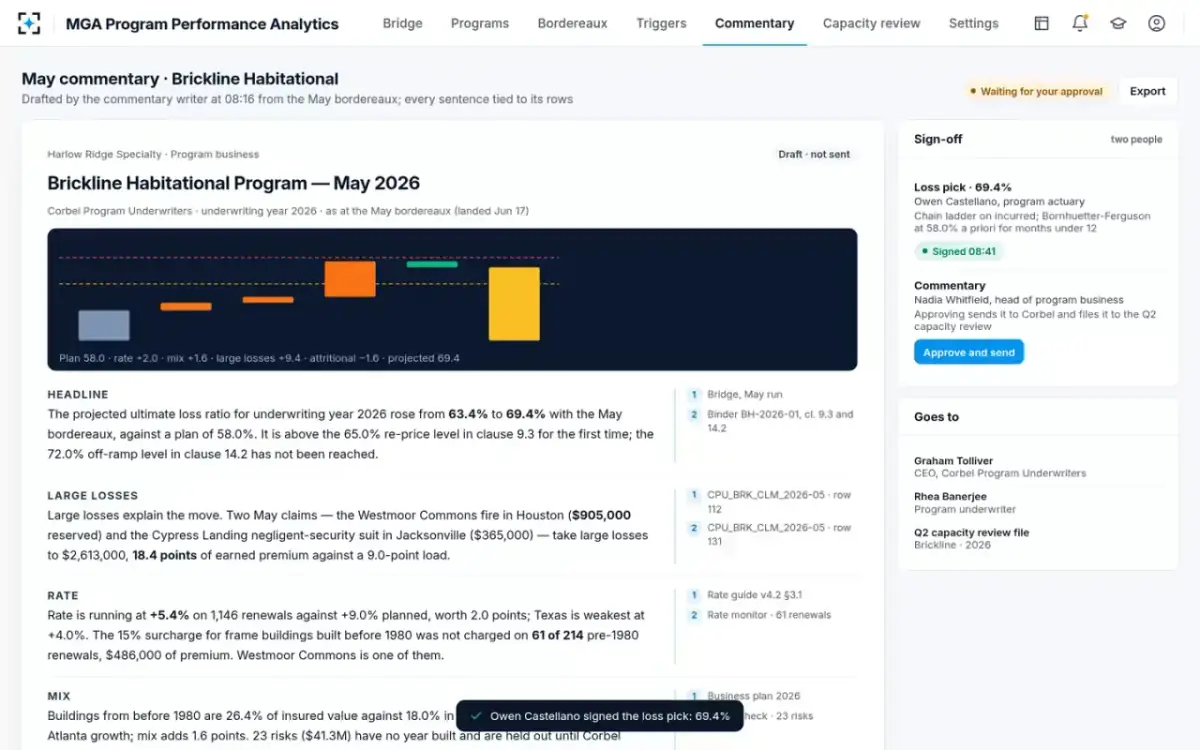
A monthly program commentary, each sentence tied to its source
Questions to put to any vendor before a replay
A buying decision on program performance software should rest on the replay, but some questions settle whether a replay is worth running at all. The checklist below is ours; each item is something the replay will expose anyway, so it is fairer to ask first.
Before you replay: seven questions for program performance software
- Can it take each MGA's files in the layout they arrive in?
If every file must be re-keyed into the vendor's template first, the replay tests your analysts, not the tool.
- Does every number open the rows behind it?
An actuary will not sign a loss pick that cannot be traced to claims; an underwriter will not act on a rate miss without the policies.
- Does it hold out rows with missing data, and say how many?
A tool that fills gaps silently will look better in a replay and worse in an examination.
- Can the binder's own levels be set per program?
Re-price and off-ramp levels, months-running rules and large-loss thresholds differ by binder.
- Does it separate the projection from the decision?
The actuary signs the loss pick; the head of program business decides and signs notices. The software should not send anything.
- Can it replay with files dated as received?
Without arrival dates and versions, the test turns into hindsight.
- Who is responsible for the output?
The carrier is. EIOPA's 2025 opinion says undertakings are ultimately responsible for AI systems they use, however supplied; ask what the vendor documents to help you carry that.
Where MGA Program Performance Analytics fits a replay, and where it does not
MGA Program Performance Analytics fits a replay because it is built to take each MGA's risk, premium and claims bordereaux as sent, map them to one standard, check every row against the binder, re-rate renewals on the rate guide and redraw the program's bridge from plan to projected loss ratio. In the sample, applying one month's files for one program took 6.8 seconds, so a twelve-month replay of several programs is a matter of loading the files, not of weeks of processing. The design target is that a live program's view moves the same day its bordereau lands.
It does not fit every program. Where an MGA sends only quarterly summaries without claims detail, there are no rows to drill to and the bridge can show levels but not causes. It is not a reserving system and does not replace the actuarial opinion on MGA reserves; it proposes a loss pick that the program actuary signs. And it will not make a decision: when a trigger is crossed it opens a review, and the notice, if any, is drafted for the head of program business to sign. The replay is the right place to find out whether those limits matter for your book. Which monthly tasks the agents take and which stay with people is set out task by task, and how to get underwriters and actuaries to trust the new view after go-live has its own guide. To run a replay on your own programs, start from MGA Program Performance Analytics.
Questions people ask
What is a program performance report?
It is the periodic report on one program's results against plan: written and earned premium, reported and projected loss ratio, rate achieved, mix, large losses, data quality and the binder triggers. A useful one explains why each figure moved since the last report and ends with what the carrier asks of the MGA, rather than listing numbers alone.
How long does a replay test take?
Our suggested plan is eight weeks for one to three programs: two to load binders and map files, three to replay twelve months, one to score against year end and two to review with the actuary and underwriters. Most of the time goes on assembling last year's files as they arrived, not on running them.
What data does a replay need?
Last year's risk, premium and claims bordereaux with the dates they arrived, the binders, business plans and rate guides in force at the time, the account statements, and the actuary's year-end estimates for the same programs. The on-site review findings are useful for scoring the exceptions the replay raises.
Can a replay be run on a program the carrier has already exited?
Yes, and an exited program is often the most informative, because the carrier knows how the story ended and when it first acted. The claim files and records stay available to the carrier: under Model #225 claim files are joint property of the insurer and the MGA, and the insurer has the right to copy the program's accounts and records.
Does a good replay prove the tool will predict next year?
No. A replay shows how the tool behaves on real files and whether its explanations held on one year; it cannot prove future accuracy, and settings tuned to make last year look perfect will overfit. Fix the trigger levels and maturity rules before the replay, and judge the results against them.