The loss ratio calculation in insurance divides incurred losses by earned premium: NAIC's glossary defines the loss ratio as "the percentage of incurred losses to earned premiums" (NAIC glossary). A program with $14.2 million of earned premium and $8.6 million of reported incurred losses has a reported loss ratio of 60.6%. The hard part is everything behind the two numbers: whether losses include claims not yet reported, whether claim expenses are in, whether premium is earned or written, and which policies and accident dates are counted. For a program written by a managing general agent (MGA), every input arrives in the MGA's own bordereaux, in its own layout. Botminds' MGA Program Performance Analytics calculates each program's loss ratio from those files the morning they land, and shows how it moved from plan to projected, step by step.
The figures for one program come from fictional sample data in the solution: the Brickline Habitational program, apartment property and general liability written by Corbel Program Underwriters for Harlow Ridge Specialty, as at its May 2026 bordereaux. The industry figures are NAIC's.
The industry's net loss ratio moved nearly ten points between 2022 and 2025
How is a loss ratio calculated in insurance? Losses over earned premium, then four choices
A loss ratio is calculated by dividing the losses incurred on a body of business by the premium earned on it over the same period. The formula is short; the definitions are where analysts disagree. Before comparing any two loss ratios, four choices have to match.
First, which losses: paid only, reported (paid plus case reserves), or ultimate (reported plus a provision for claims not yet reported and for development on known claims). Second, whether loss adjustment expenses are added to losses. Third, which premium: earned, which matches the cover already provided, or written, which does not. Fourth, which period and which policies: calendar year, accident year or underwriting year. The Casualty Actuarial Society's ratemaking principles accept all of the last: there are "several acceptable methods of organizing data including calendar year, accident year, report year and policy year", and each "presents certain advantages and disadvantages" (CAS Statement of Principles Regarding P&C Insurance Ratemaking).
The loss ratio formula in insurance, term by term
Paid losses
Claim payments made to date
From the claims bordereau, payment movements
Reported by the MGA or TPA
Case reserves
+ Estimates still held on open claims
Paid + case = reported (case incurred) losses
Set by the claims handler
IBNR and development
+ Claims not yet reported, and growth on known claims
Turns reported into ultimate losses
Estimated by the actuary
Earned premium
÷ Premium for cover already provided
Written premium less unearned premium
From the premium bordereau
What is earned premium, and why not divide by written premium?
Earned premium is the part of written premium that pays for cover already given. NAIC's glossary calls it the "portion of insured's prepaid premium allocated to the insurance company's loss experience", with the rest held as unearned premium until the cover is provided (NAIC glossary). Premiums written, by contrast, are the "total premiums generated from all policies (contracts) written by an insurer within a given period of time".
The difference matters most for a growing program. An annual policy written on 1 March for $12,000 has earned three months, about $3,000, by the end of May, and its losses so far come from those three months only. Divide losses by the full $12,000 and the program looks far better than it is. In the sample, Brickline had written $36.8 million by May but earned only $14.2 million, so a loss ratio on written premium would understate the true figure by more than half. The distinction is worked through in detail in the guide to written premium vs earned premium.
Expenses are the exception. Commissions, premium taxes and other acquisition costs are spent when a policy is written, so they are usually measured against written premium. Texas's rate filing exhibit, for example, sets out underwriting expenses "as Percent of Direct Premiums Written" (TDI form PC367, Exhibit E), and NAIC's industry expense ratio of 25.8% for 2025 is underwriting expenses of $252.2 billion over $976.8 billion of net premiums written.
Does the loss ratio include IBNR? It depends which loss ratio, and who is paid on it
A reported loss ratio does not include IBNR; an ultimate loss ratio does. NAIC defines pure IBNR as "claims that have occurred but the insurer has not been notified of them at the reporting date" (NAIC glossary). Early in a program year almost all of the eventual losses are still unreported or under-reserved, so a reported loss ratio for a young underwriting year is a floor, not an estimate.
For a program the question is also contractual, because MGA commissions and profit shares are often calculated on a loss ratio. Which one the contract names decides how much the MGA is paid and when. A federal appeals court described what happened in an auto program when the MGA changed the answer on its own. The program's formula for incurred losses "included an adjustment based on projected 'incurred but not reported' losses", and the MGA's extra commission was earned only if incurred losses came in below a target.
Take IBNR out of a loss ratio and the program looks better on paper exactly when its claims have not yet arrived.
That is what the Fifth Circuit, describing the trial court's findings, said the MGA in Lincoln General did: it left IBNR out of its commission calculations and so made incurred losses look smaller (Lincoln General Insurance Co. v. U.S. Auto Insurance Services, 18 May 2015; the court's sentence is quoted in profit commission reserves).
The court explained the consequence: the change inflated the MGA's commission "at Lincoln's expense, because when claimants eventually reported those losses, the money to pay them was not in the trust account" (5th Cir. 2015). The model act addresses the same risk from the other side: where an MGA can influence its profit share through reserves or claim payments, interim profits cannot be paid until one year after they are earned on property business and five years on casualty, and only once verified (Model #225 §4L).
What is a loss and LAE ratio, and how does it differ from the loss ratio?
A loss and LAE ratio adds loss adjustment expenses, the cost of investigating, defending and settling claims, to losses before dividing by earned premium. NAIC defines LAE as the payments expected for the cost of adjusting and recording losses (NAIC glossary). It is the version most carriers use to judge whether rates are adequate, because a claim that costs $100,000 to pay and $15,000 to defend costs the carrier $115,000.
NAIC's headline "net loss ratio" is a loss and LAE ratio. For 2025, net losses of $551.8 billion and loss expenses of $86.0 billion over $958.7 billion of earned premium give 66.5%; losses alone give 57.6% (NAIC 2025 analysis). A trap follows when LAE is quoted as a share of losses rather than premium. Industry LAE was 15.6% of losses in 2025, but adding 15.6 to 57.6 gives 73.2, not 66.5: the correct step multiplies, 57.55% × 1.156 = 66.5%.
Loss ratio vs combined ratio: adding the expenses back
The combined ratio adds the expense ratio to the loss ratio to show whether underwriting made money before investment income. NAIC describes it as "an indication of the profitability of an insurance company, calculated by adding the loss and expense ratios" (NAIC glossary). Below 100% is an underwriting profit; above 100% is a loss that investment income must cover.
NAIC's 2025 table shows a 66.5% net loss ratio, a 25.8% expense ratio and a 92.9% combined ratio, the best in the ten years shown (NAIC 2025 analysis). Add the first two and you get 92.3%, not 92.9%: a reminder that a published combined ratio may carry items and bases a quick sum does not, so the definitions should be read before any comparison. For a program, the combined ratio the carrier cares about uses the program's own commission and fees as the expense ratio, which is why a program with a 60% loss ratio can still lose money if the MGA's commission and the carrier's own costs together exceed 40% of premium.
Which year? Calendar, accident and underwriting year loss ratios
A calendar year loss ratio takes all loss movements booked in the year, on any policy and any accident, over premium earned in the year. It is quick and ties to the accounts, but a reserve increase on a claim from six years ago lands in this year's ratio. An accident year ratio counts only losses from accidents in the year, against premium earned in the year, so it matches cause and cost better but keeps developing as claims are reported.
An underwriting year, or policy year, ratio follows the policies written in a year until they have all expired and their claims are settled. It is the natural unit for a program, because a program's rates, binder and business plan are set by underwriting year and the MGA's profit share is usually calculated on it. Its weakness is time: an annual policy written in December earns until the following December, so an underwriting year is not fully earned for two years, and its claims take longer still. The sample program is measured on underwriting year 2026, which is why its projected ultimate relies on development factors and, for its youngest months, on the plan.
A loss ratio insurance example: one program from bordereau to board
Here is one program's calculation at the end of May, as the solution performs it from the MGA's files. Every figure on the left comes from the premium or claims bordereau; the projection is the solution's method, which the program actuary signs.
Loss ratio calculation for one program, step by step
| Step | Calculation | Result |
|---|---|---|
| 1. Written premium, underwriting year 2026 to date | Premium bordereau, new business and renewals less cancellations | $36.8M (plan $35.0M) |
| 2. Earned premium | Each policy's written premium × share of its term elapsed by 31 May | $14.2M |
| 3. Reported incurred losses | Claims bordereau: paid to date + open case reserves | $8.6M |
| 4. Reported loss ratio | $8.6M ÷ $14.2M | 60.6% |
| 5. Projected ultimate loss ratio | Chain ladder on incurred; Bornhuetter-Ferguson at the 58.0% plan for months under 12 | 69.4% |
| 6. Not yet reported or not yet fully reserved | 69.4% − 60.6% | 8.8 points |
| 7. Of which large losses | 6 claims over $250,000: $2,613,000 ÷ $14.2M, against a 9.0-point plan load | 18.4 points |
Two things stand out. The reported ratio, 60.6%, is close to the 58.0% plan and would not alarm anyone reading a summary. The projected ratio, 69.4%, is past the program's 65.0% re-price level. The gap between them is the part of the year's losses that has not yet been reported or fully reserved, which is why a carrier that steers programs by reported loss ratios learns about a bad year late. And within the reported losses, six claims over $250,000 account for 18.4 points, twice the load the plan allowed for them.
The same program as a bridge from plan to projected loss ratio
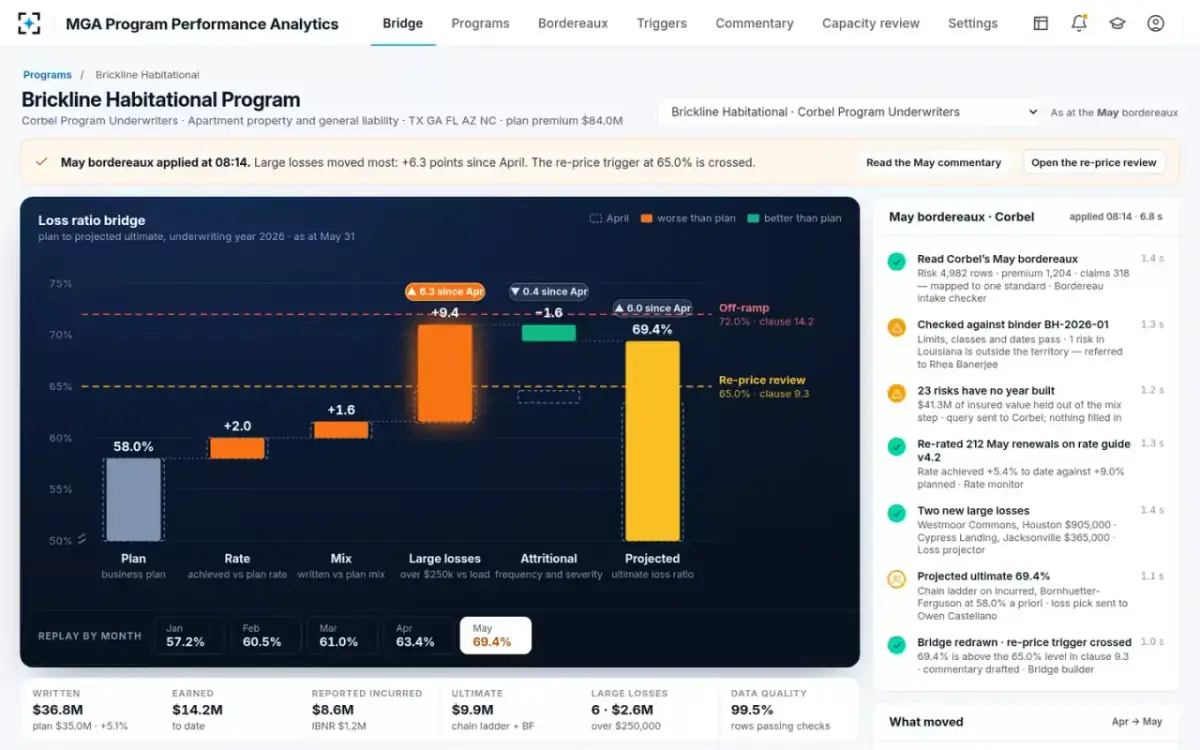
Where each input comes from in an MGA's files
Each input to a program's loss ratio is a field in a bordereau or account the MGA must send. The model act requires the MGA to account to the insurer for every transaction at least monthly (§4B), and Texas spells out what its quarterly account report must state: written, earned and unearned premium, paid and outstanding losses and loss expenses, IBNR and management fees (Tex. Ins. Code §4053.103).
Each loss ratio input, the file it comes from, and what can go wrong
| Input | Usually comes from | What to check before dividing |
|---|---|---|
| Written premium | Premium bordereau: new, renewal, endorsement and cancellation rows | Ties to the monthly account statement and the cash remitted |
| Earned premium | Calculated from each policy's premium and dates; some MGAs report it | Same earning method across programs; cancellations reversed |
| Paid losses | Claims bordereau, payment movements | Ties to the claims account; recoveries shown separately |
| Case reserves | Claims bordereau, outstanding at month end | Movements on open claims, not just new claims; large claims reported in time |
| IBNR | The carrier's actuary, or the MGA's estimate where it sets reserves | Whose estimate it is; an actuarial opinion is required where the MGA sets reserves (Model #225 §5B) |
| Loss adjustment expense | Claims bordereau or TPA fee schedule | Whether it sits in losses or in expenses, and in which ratio |
The earned premium row is where programs most often disagree with each other. One MGA reports earned premium itself; another sends only written premium and dates; a third earns monthly policies differently from annual ones. A carrier comparing nine programs' loss ratios is comparing nine definitions unless someone recalculates earned premium the same way for all of them, which is what the solution does after mapping each MGA's files to one standard.
Reading a program's loss ratio: large losses and the attritional rest
A program's loss ratio is easier to act on when large losses are separated from the attritional rest, because the two have different causes and different fixes. Attritional losses track frequency and the rate; large losses are volatile, and a plan usually allows for them with a load. The question for a carrier is not whether a program had large losses, but whether they ran above the load and whether they share a cause the underwriting can address.
The six claims behind the large-loss step, each traced to its bordereau row
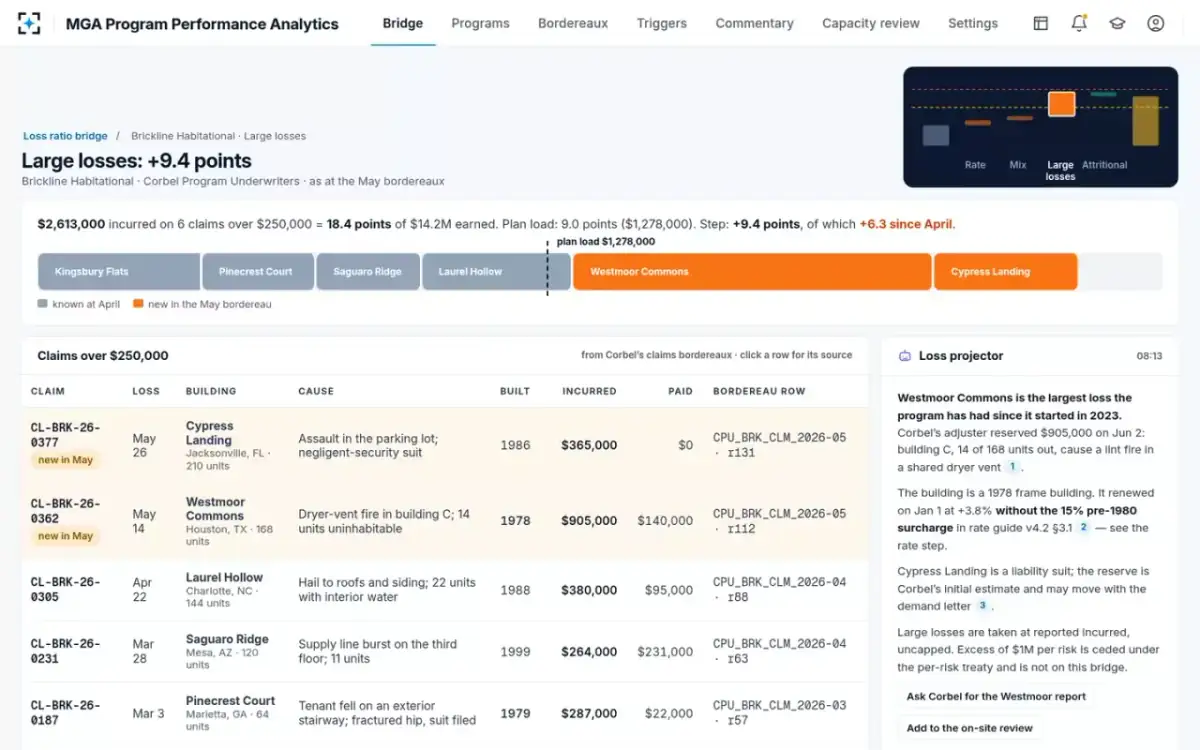
In the sample, the biggest May claim was also a rate problem: the burned building had renewed without the 15% surcharge the rate guide requires for pre-1980 frame construction. That link between a loss and a pricing rule is what turns a loss ratio from a score into a decision, and it is the subject of the guide to a rate adequacy index for programs. How to judge the result once it is calculated is the subject of what is a good loss ratio; a carrier-wide view of large claims is covered by the large loss report guide. The bridge itself is in MGA Program Performance Analytics.
Questions people ask
How do you calculate a loss ratio in Excel?
Put incurred losses in one cell and earned premium in another and divide: =B2/C2, formatted as a percentage. The spreadsheet is the easy part; the inputs must be built consistently, with earned premium calculated from each policy's dates and losses taken at the same evaluation date. For several programs, the same earning rule and loss definition must be used for all of them.
What is a pure loss ratio?
A pure loss ratio leaves loss adjustment expenses out: losses divided by earned premium. NAIC reports pure net loss ratios by line, for example 53.5% for homeowners and 48% for workers' compensation in 2025, alongside the industry's 66.5% net loss ratio, which includes loss expenses.
What is a paid loss ratio?
A paid loss ratio uses only claim payments made to date. It ignores case reserves and IBNR, so for any business with claims still open it is lower than the reported or ultimate ratio. It is useful for cash planning and for checking reserves, not for judging a young underwriting year.
Is a higher loss ratio better or worse?
For the carrier's underwriting result, higher is worse: more of each premium dollar goes to claims. For the policyholder and some regulators, a very low ratio can signal poor value; US health insurers must rebate premium when their medical loss ratio falls below 80% in the small group market or 85% in the large group market (45 CFR §158.210). What counts as good depends on the line and the expenses it must also cover.
Can a loss ratio be over 100%?
Yes, when incurred losses exceed earned premium, as can happen to a property program in a catastrophe year or to a liability program whose reserves are strengthened. NAIC's industry combined ratio, which adds expenses, was above 100% in 2016, 2017, 2022 and 2023, and a single program can swing much further than the industry.