MGA KPIs and metrics are the measures a carrier uses to judge each program a managing general agent (MGA) writes for it: the loss ratio against the business plan, reported and projected; rate achieved against the rate guide; the mix of risks written against the plan; large losses against the load allowed for them; written premium against the binder's capacity; and the timeliness and quality of the bordereaux that carry all of it. The difficulty is not choosing them but seeing them in time, because each arrives in the MGA's own files and is usually read a quarter later. Botminds' MGA Program Performance Analytics calculates every one of these for every program the morning the bordereaux land, and tests them against the levels written into each binder, so a carrier can decide while the business is still being written.
The worked examples use fictional sample data in the solution: a carrier, Harlow Ridge Specialty, with nine programs and $373.0 million of plan premium, and its Brickline Habitational program written by Corbel Program Underwriters. The definitions and duties come from NAIC's model act, state law and the UK regulators, linked where they appear.
A KPI set for MGA programs, in four families, with the binder or statute behind each
| KPI | Defined as | Where it comes from | Sample trigger |
|---|---|---|---|
| Projected loss ratio vs plan | Projected ultimate losses ÷ earned premium, against the plan loss ratio | The business plan; the binder's re-price and exit clauses | Re-price review above 65.0%; off-ramp after 2 months above 72.0% |
| Large losses vs load | Claims over the threshold ÷ earned premium, against the plan's load | The business plan | $250,000 ground-up threshold; 9.0-point load |
| Rate achieved vs rate guide | Premium charged ÷ premium the rate guide gives, on renewals | The binder's basis of rates (Model #225 §4F) | Amber when rate is more than 3 points under plan |
| Mix vs plan | Share of insured value or premium by segment, against the plan | Business plan; the binder's permitted risk types (§4F) | Highlight a bridge step that moves 0.3 points or more |
| Premium vs capacity | Written premium to date against plan and the binder cap | The binder's premium cap (§4F) | Written $36.8M against a $35.0M plan to date |
| Bordereau timeliness | Days between the due date and the day the files land | Monthly accounts (§4B); the binder's due date | Remind the MGA when more than 5 days late |
| Data quality | Rows passing every binder check ÷ rows received | The insurer's right to usable records (§4D) | Remind the MGA under 97% |
| Control indicators | Claims open over six months; claims above authority; funds held against three months of claims | Claims-file triggers (§4I); funds limit (§4C) | Set per binder |
What are MGA KPIs? The measures the binder already implies
MGA KPIs are the handful of numbers that tell a carrier whether a program is being written as agreed and whether it is earning what the plan expected. A good set follows the contract. The model act requires each MGA contract to contain underwriting guidelines, including the maximum annual premium volume, the basis of the rates to be charged and the types of risks the MGA may write (Model #225 §4F). Each of those becomes a KPI the moment the carrier measures the business against it.
The rest of the set follows the plan. A program is priced on an expected loss ratio, an expected rate change and an expected mix, with a load for large losses. Measuring the business against those assumptions every month is what separates a performance view from a compliance check: a program can be inside every binder limit and still be losing money because it is writing the riskier end of what the binder allows.
What metrics do carriers use to judge an MGA? Four families, one bridge
Carriers judge an MGA on four families of metric: the underwriting result (loss ratio and large losses), pricing (rate achieved), the portfolio (mix and premium against capacity), and the data and controls that make the other three trustworthy. The first three can be joined on one chart. A loss ratio bridge starts at the plan loss ratio and adds the effect of each family in loss ratio points, so the projected figure is explained rather than merely reported.
Where one program's 13.0 adverse points came from, as at May
Brickline, points above plan by cause
- Large losses, 9.4 · 73%
- Rate, 2.0 · 15%
- Mix, 1.6 · 12%
The split changes the conversation with the MGA. Large losses dominate this month, and some of that is luck. But rate and mix together add 3.6 points that are not luck at all: they are the MGA charging less than the rate guide and writing older buildings than the plan allowed. Those are the two the MGA can fix before the next renewal, which is why the sample carrier's commentary asks for them first.
What is a good loss ratio for an MGA? Its own plan, not the market's
A good loss ratio for an MGA program is one at or below the plan loss ratio its binder was priced on, because that plan already reflects the line, the MGA's commission and the carrier's target return. Market averages are context, not targets: the US property and casualty industry's net loss ratio, including loss expenses, was 66.5% in 2025 (NAIC 2025 analysis), but programs in different lines are priced to very different levels.
The sample book shows the spread. Its nine programs carry plan loss ratios from 45.0% for self-storage property to 62.0% for small fleet auto, each with its own re-price and off-ramp levels set several points above plan. A 60% loss ratio is a good month for the auto program and a breach of the self-storage program's re-price level. The reasoning behind a target is the subject of the guide to what a good loss ratio is, and the calculation itself of the loss ratio calculation guide.
What is rate adequacy, and why is it the earliest KPI?
Rate adequacy is whether the rates charged will cover the expected losses, expenses and profit of the business written. The Casualty Actuarial Society's principles define the standard: "A rate is an estimate of the expected value of future costs", and an actuarially sound rate is "not excessive, not inadequate, and not unfairly discriminatory" (CAS Statement of Principles). For a program, the practical measure is rate achieved against the rate guide, renewal by renewal.
It is the earliest KPI because it is known the day a policy is written, while the losses it will or will not cover take months or years to emerge. In the sample, Corbel's renewals achieved +5.4% against +9.0% planned, worth 2.0 points on the loss ratio; a third of the shortfall was one rule, a 15% surcharge for pre-1980 frame buildings that was not charged on 61 of 214 eligible renewals. How to turn that into a monthly index is set out in the rate adequacy index guide.
Mix: the KPI that moves before losses do
Mix measures what the MGA is writing against what the plan assumed: by state, construction, age, size or class. It matters because a program priced on one mix and written on another will run worse than plan even if every risk is rated correctly. The CAS principles list it among the considerations every rate must reflect: "Consideration should be given to distributional changes in deductibles, coverage limitations or type of risks that may affect the frequency or severity of claims" (CAS Statement of Principles).
Mix against plan: older buildings and more Texas than the plan allowed
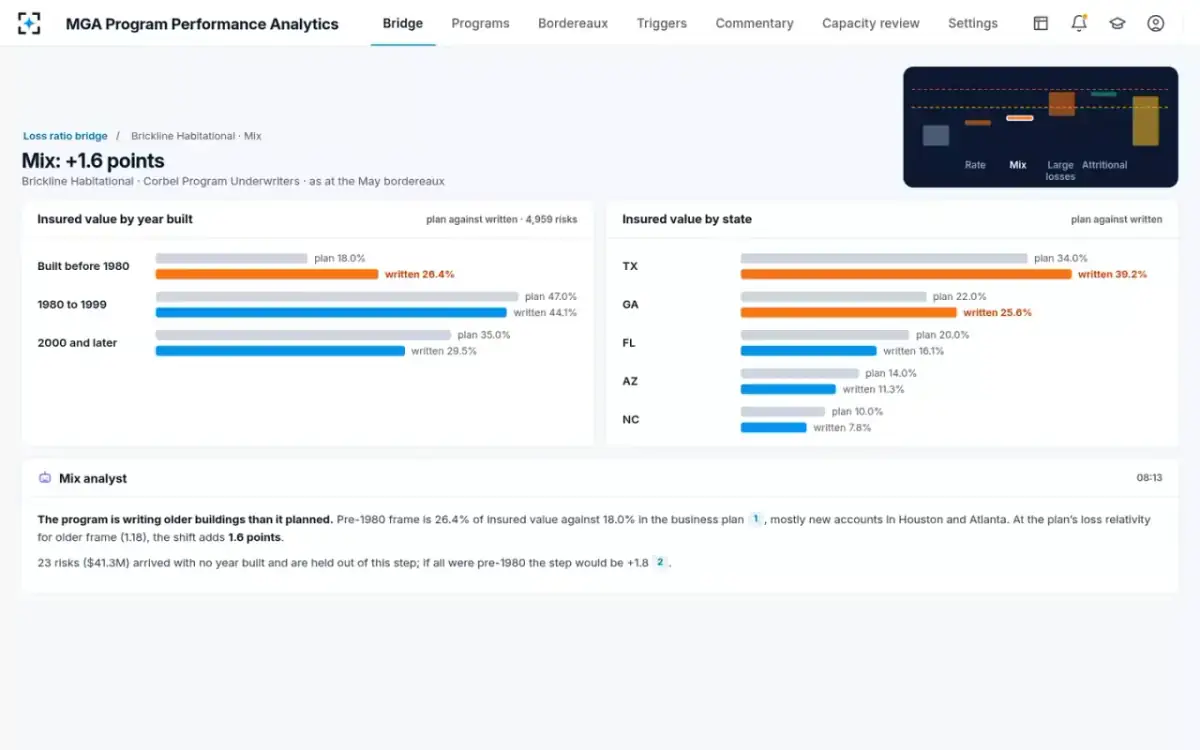
Two details make a mix KPI honest. It should use the plan's own relativities, so the MGA cannot dispute the arithmetic, only the assumption. And it should show what it could not measure: in the sample, 23 risks with $41.3 million of insured value arrived with no year built, so the step is reported as 1.6 points with a ceiling of 1.8 if all of them turn out to be pre-1980.
Data quality and timeliness are KPIs, not housekeeping
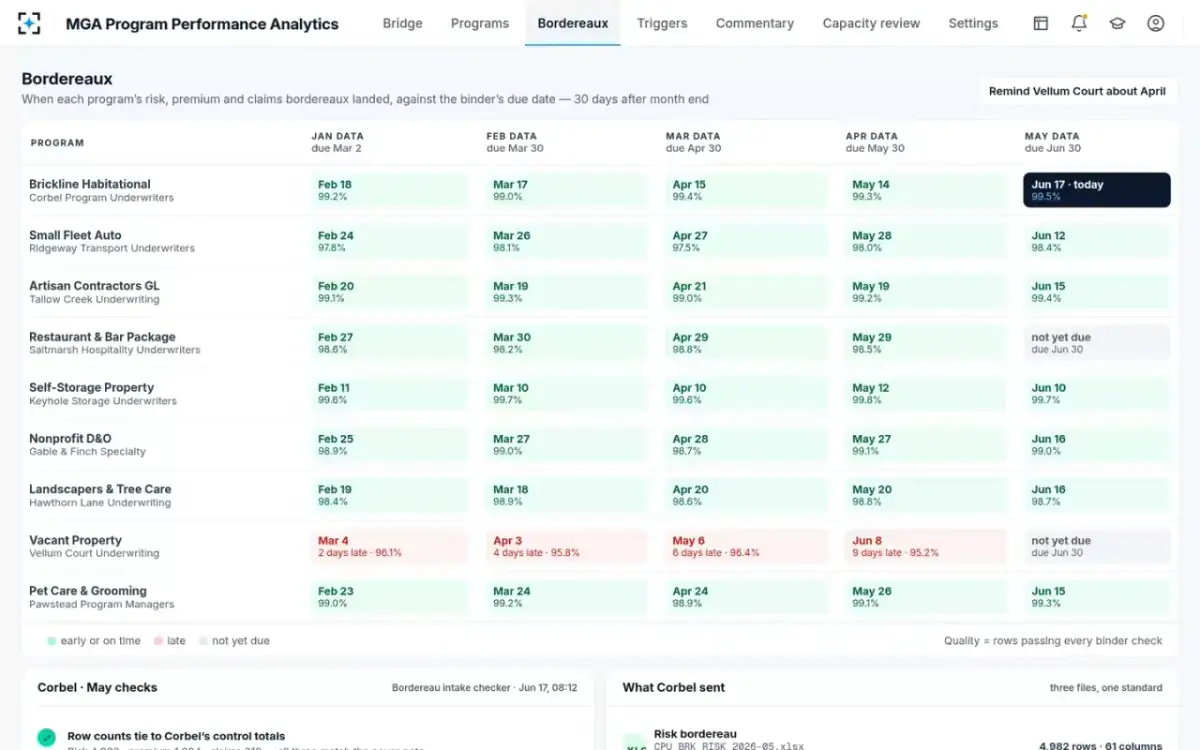
Bordereau timeliness and data quality belong in the KPI set because every other number depends on them, and because a deteriorating MGA often shows it first in its files. The model act requires accounts at least monthly and records the insurer can use (§4B, §4D); the binder sets the due date. A program whose files arrive later each month, with more rows failing checks, is telling the carrier something before its loss ratio does.
When each MGA's files landed against the due date, and how many rows passed
Control indicators the statute writes for you
Some KPIs are not about profit at all but about whether the MGA is staying inside its legal limits, and the statutes define them precisely. Claims files must go to the insurer when a claim has been open more than six months, involves a coverage dispute or may exceed the MGA's settlement authority (Model #225 §4I). The MGA may hold no more than three months of estimated claims payments (§4C). In Texas the MGA itself must notify the department within 30 days when balances due to an insurer for more than 90 days exceed $1 million or 10% of the insurer's surplus, or when money held for losses exceeds by more than $100,000 what is needed for the next 60 days (Tex. Ins. Code §4053.108).
Counting these monthly costs little once the claims bordereau is mapped: open claims by age, claims above the authority limit, and funds held against projected payments are all fields or simple sums. They also give the on-site review its agenda, because each breach found monthly is a file to pull on the visit.
How to set tolerances and triggers that mean something
A KPI becomes useful when it has a tolerance and an owner: a level at which someone must act, and a person who must decide what the action is. The FCA's 2025 review of outsourced claims found good practice in firms that "set tolerances (the minimum or maximum accepted limits used by firms to monitor their performance and the outcomes customers receive) that were subject to a review process", and assessed management information against them (FCA, home and travel claims handling arrangements, 2025). The PRA expects firms with material outsourcing to "define the key KPIs and key risk indicators which, if breached, may trigger an exit (both stressed and non-stressed)" (PRA SS2/21, paragraph 10.17).
Seven rules for setting MGA program triggers
- Take each level from the binder, not from a dashboard default
A re-price or off-ramp level the MGA has signed is enforceable; one the carrier chose afterwards is a conversation.
- Set two levels, not one
A review level that opens a conversation and a decision level that opens the exit clause. The sample uses re-price and off-ramp.
- Require persistence for the decision level
Two consecutive months above the off-ramp level in the sample; one bad month on a young year is often noise.
- Measure projected, not reported, loss ratios
Reported ratios on a young underwriting year are floors and cross triggers late.
- Give each trigger an owner and a clock
Who decides, by when, and what notice the binder requires: 60 days for a rate change in the sample binder.
- Add data triggers
Late files and low data quality degrade every other KPI; the sample reminds an MGA at 5 days late or under 97% of rows passing.
- Review the levels on a schedule
Tolerances that never change stop meaning anything; the FCA's good practice firms kept theirs under review.
What are MGA KPIs worth? Valuing earlier sight, as a method
The value of a KPI is the cost of the problem it reveals multiplied by how much sooner it reveals it. No published source gives a general figure, and none is offered here; the method below lets a carrier put its own numbers in. It works best on rate and mix, whose costs run month by month until fixed, and least on large losses, which earlier sight cannot undo.
The value of seeing a program KPI earlier, term by term
Monthly cost of the miss
Premium short, or loss ratio points × earned premium, per month the miss continues
Sample: $486,000 of surcharge missed over January to May, about $97,000 a month
From the rate or mix step
Months earlier
Month the monthly view shows it, against the month the quarterly review would
Example: 2 months
From a replay of last year
Value of earlier sight
Monthly cost × months earlier × share fixed once seen
Example: $97,000 × 2 × 100% ≈ $194,000 of premium
Head of program business
Cost of the view
Software, set-up and the hours to act on the triggers
The carrier's own figures
Finance
Two cautions keep the number honest. The months-earlier term should come from a replay of your own last year, not from a vendor's claim; how to run that replay is set out in its own guide. And the share fixed is rarely 100%: some renewals will have gone out before the MGA acts, and some shortfall is a commercial choice the carrier may accept.
Where MGA Program Performance Analytics fits the KPI set
The solution calculates the whole set above from the MGA's own risk, premium and claims bordereaux, binder and business plan: it checks every row, re-rates renewals on the rate guide, measures mix with the plan's relativities, separates large losses, projects the ultimate and tests each binder's levels, with every number opening the rows behind it. It flags any bridge step that moves 0.3 points or more since last month, and custom triggers can be added in plain words.
It does not set the KPIs for you or decide what to do when one fires. The levels come from each binder and plan, and the settings name who signs: the program actuary for the loss pick, the head of program business for re-price, line size and exit. Servicing measures such as turnaround and rework belong to a different team and a different set; policy servicing KPIs and metrics are covered in their own guide. To see the program KPIs on your own binders, start from MGA Program Performance Analytics.
Questions people ask
What KPIs matter most in program business?
Projected loss ratio against plan, rate achieved against the rate guide, mix against plan and large losses against their load, read together as a bridge. Premium against capacity and the quality and timeliness of the bordereaux sit beside them, because the binder caps premium and every other figure depends on the files.
How many KPIs should a binder contain?
Few enough that each has an owner and an action. The model act already fixes eight underwriting guideline fields; most carriers add a plan loss ratio, a re-price level and an exit level, plus data and timeliness requirements. Measures with no agreed action are better kept as context than written into the binder.
Should the MGA see the same KPIs as the carrier?
Yes, for its own program. An MGA that sees the rate and mix steps as the carrier does can correct them before renewal; in the sample, the MGA's chief executive receives the same bridge and the signed commentary for his program and no other.
How is an MGA's retention measured?
Retention is the share of policies offered renewal that do renew, by count or premium. For a carrier it is a context KPI rather than a target: rising retention after a rate increase may mean the rate is still cheap, and falling retention after a surcharge is applied may be the price of fixing rate adequacy.
Are KPIs in a binder enforceable?
They are as enforceable as the contract makes them. A re-price clause with a notice period, or an exit clause tied to months above a level, gives the carrier a right it can use; a KPI only described in a business plan gives it a conversation. Texas requires every MGA contract to deal with reporting, records and auditing (§4053.102), which makes the contract the natural home for data KPIs.