A delegated authority monitoring tool checks the business a coverholder or MGA binds on an insurer's paper against the binding authority agreement, so that a risk bound outside authority is found when the bordereau arrives, not at the next audit. A useful one does four jobs: it reads each delegate's bordereau in its own layout, turns the binder and its endorsements into checks, runs every check on every line, and looks for the insurer's written agreement behind anything outside the limits. What it must not do matters as much. A risk outside the binder is a decision for the insurer: clear it, refer it to the program underwriter, or escalate it to the delegate. Botminds' Binding Authority Compliance is built that way: six agents do the reading, checking, searching and drafting, and each has limits written into it; the head of delegated authority makes every decision and sends every notice.
This page follows one fictional bordereau through the tool: Larkspur Underwriting Managers' September risk bordereau on a small commercial property binder fronted by Corvane Specialty Insurance Company. People, companies and figures are sample data. The rules are cited where they appear.
The six agents in Binding Authority Compliance: what each does, and what none may do
| Agent | What it does | What it may never do |
|---|---|---|
| Bordereau reader | Maps each coverholder's risk and claims bordereaux to standard fields, using the coverholder's saved layout first; checks that the risk bordereau ties to the premium bordereau. | Alter a reported value. Use a column match below the confidence set (80% by default) without asking. Fill a gap without marking it as filled. |
| Binder reader | Turns the agreement, schedules and endorsements into checks, each with value, clause, page and effective dates. | Invent a limit. Apply an endorsement before its effective date. Hold a check without a clause and page. |
| Authority checker | Runs every line check on every bordereau line, ranks breaches by the severity rules and marks lines within 10% of a limit as notices. | Clear a breach. Sample. |
| Referral matcher | Searches the referral log and the underwriting mailbox for prior written agreement; matches the claims bordereau for losses at the same address before binding. | Treat a question as agreement. Count agreement from anyone not named in the binder's list of authorised underwriters. |
| Headroom tracker | Adds premium and aggregates by binder and projects when each cap will be reached at the recent pace. | Change a cap. Present a projection as anything but an estimate. |
| Notice and report drafter | Drafts breach notices and the monthly authority compliance report, citing the clause and bordereau row behind every figure. | Send anything. Name a breach that was cleared. |
What is a delegated authority monitoring tool?
A delegated authority monitoring tool is software that tests a delegate's bound business against the authority the insurer granted, continuously or each time a bordereau arrives, and records what it found. It sits between the binder, which defines the authority, and the on-site audit, which samples how it was used. The test it runs is the one the law has in mind: the NAIC Managing General Agents Act requires every MGA contract to carry underwriting guidelines on the maximum annual premium volume, the basis of rates, the types of risks, maximum limits of liability, exclusions, territory, cancellation provisions and the maximum policy period (NAIC Model #225, §4F).
The idea is old; the tooling is new. In a 2008 fraud case over surety bonds, the High Court in London described what a monthly bordereau was for in exactly these terms.
The judge found that the monthly bordereaux were meant to be the carrier manager's way of checking that the coverholder's business stayed within the binder's limits (Markel International v Surety Guarantee Consultants [2008] EWHC 1135 (Comm); the passage is quoted in what a bordereau file is worth in court).
What has changed is how much of that check a person can do by hand. A 412-line property bordereau tested against ten line checks is 4,120 individual tests; across nine binders and five coverholders, the sample insurer had 1,980 lines in from seven of its nine September bordereaux by 12 October. A monitoring tool exists so that the check the court described is actually done on every line, rather than on the 25 a person has time for.
How do you monitor binding authority compliance? Bordereau, binder, every line
Monitoring binding authority compliance takes three inputs and one rule. The inputs are the binder as amended, the delegate's risk bordereau, and the trail of referrals and approvals. The rule is that every line is tested against every check that applies to it on its own dates. Here is how the sample bordereau goes through it.
One bordereau through Binding Authority Compliance, from landing to decision
Agent
Bordereau readerLarkspur's September risk bordereau lands Sunday 11 October at 21:48: 412 lines, $1,688,400 of premium, tying to the premium bordereau. Thirteen of 14 columns map; "Wind Ded" matches at 71% and waits for a person.
Never: alters a reported value.
A person decides
Oversight analystConfirms the "Wind Ded" mapping. Rows 61 and 244 say "$25,000", so they are converted to 1.6% and 2.4% of total insured value and marked as converted.
Agent
Binder readerReads the agreement, Schedules A–G and Endorsement 2 into 11 checks, applying the raised $18.0M premium cap only from 1 July.
Never: invents a limit.
Agent
Authority checkerRuns 412 lines × 10 line checks: 4,120 tests. Six lines sit outside the binder, and four notices mark where the binder is close to a limit.
Never: clears a breach or samples.
Agent
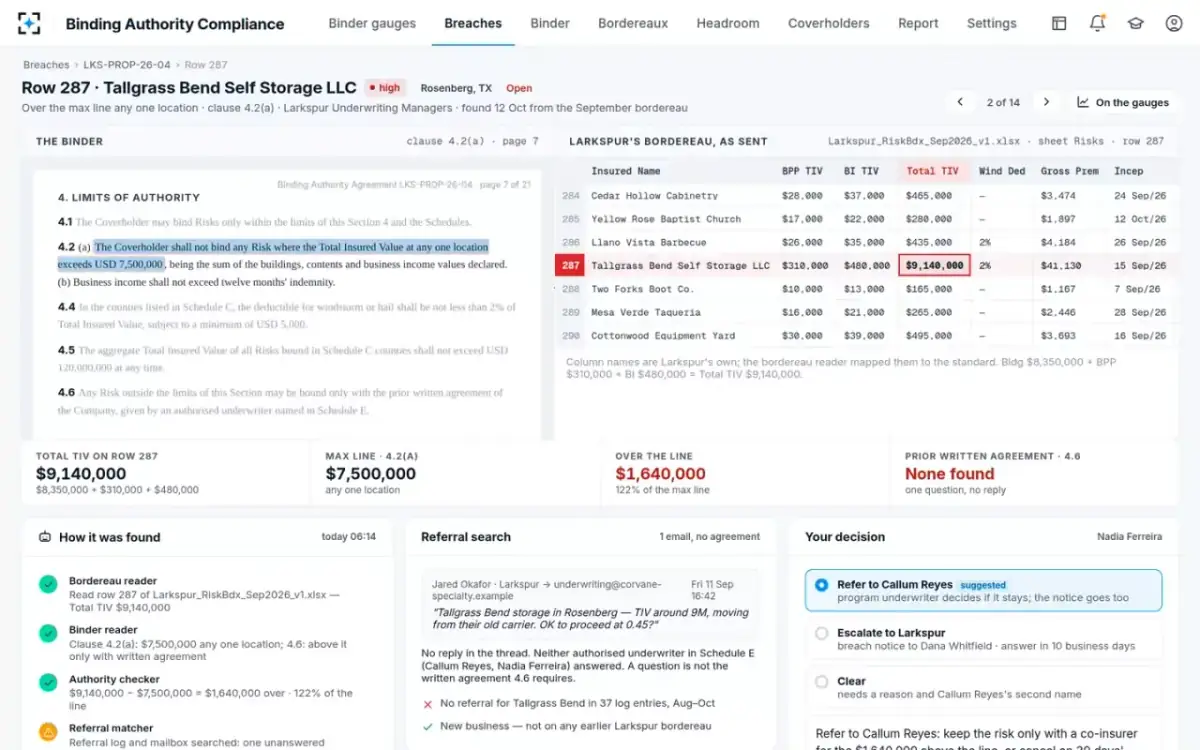
Referral matcherSearches 37 referral log entries and 212 emails. For row 287 it finds one question from the coverholder, unanswered.
Never: treats a question as agreement.
A person decides
Head of delegated authorityReads each breach with its clause beside the coverholder's row, and clears, refers or escalates it with a written reason.
Two details in that flow do most of the work. First, mapping is done once per coverholder layout and remembered, so the second month's bordereau from the same delegate needs a person only for a column that changed. Second, the binder is read with its dates. The sample binder's premium cap was $15.0M until Endorsement 2 raised it to $18.0M from 1 July; a tool that applies today's terms to every month will either miss a breach in May or invent one in August.
Can AI check bound risks against a binder?
Yes, for the parts that are reading and arithmetic, which is most of the work: mapping a spreadsheet's columns, extracting limits from a contract, comparing numbers, matching addresses and dates, and finding an email. Those are the tasks European insurers themselves report using generative AI for. In a February 2026 survey of 347 insurers in 25 countries, EIOPA found that 64% of the reported use cases were back-office productivity tools, data extraction and underwriting assistants among them (EIOPA, 2 February 2026; the finding is quoted in AI underwriting assistant tools).
The part that is judgement stays with people, and regulators say so in plain terms. EIOPA's 2025 opinion on AI governance holds the insurer ultimately responsible for the AI it uses, whoever built it (EIOPA-BoS-25-360). In the US, the NAIC's model bulletin on insurers' use of AI asks insurers to do due diligence on AI systems acquired from third parties; which states have adopted it is tracked separately. We know of no regulator that has issued a rule specific to AI in bordereau checking, so the general expectations apply: document what the system does, keep a person accountable for each decision, and be able to show how any result was reached.
That last point is the practical test for any AI in this work. A finding is useful only if a person can check it in under a minute: the clause and page, the coverholder's own row as sent, and the arithmetic between them. A score or a flag without that trail moves the work from checking bordereaux to checking the software.
A breach in Binding Authority Compliance: the clause beside the coverholder's own row
What can a monitoring tool not decide? Five decisions that stay with people
A monitoring tool cannot decide whether the insurer keeps a risk bound outside authority, and nothing in its design should let it. The binder itself usually says why: the sample agreement allows a risk above a limit only "with the prior written agreement of the Company, given by an authorised underwriter named in Schedule E". Agreement is an underwriting act by a named person; a tool can find evidence of it, but cannot give it.
Five decisions stay with people in Binding Authority Compliance, and a buyer should expect the same of any tool. Whether a breach is cleared, and on what written reason, with a second name for a high or critical one. Whether a risk outside the binder stays, which is the program underwriter's call. What goes to the coverholder, and when. Whether a cap is raised, which is an endorsement the program underwriter approves, not a setting. And whether the relationship continues, which is a matter for the chief underwriting officer. The tool's job is to put the clause, the row, the arithmetic and the email trail in front of whoever decides.
Monitoring by sample versus every line, on the same September bordereau
A 25-line sample by hand: 25 of 412, about 6%.
Every line, in Binding Authority Compliance: 412 of 412, against ten line checks: 4,120 tests.
A 25-line sample by hand: About one in three: a random 25 misses all six about 69% of the time, by our arithmetic.
Every line, in Binding Authority Compliance: All six are found, each with its clause and row, if the bordereau reports them truthfully.
A 25-line sample by hand: Rarely recorded.
Every line, in Binding Authority Compliance: Four notices: the cap at 79.0%, a zone aggregate at 87.2%, two locations at 95% and 92% of the max line.
A 25-line sample by hand: Done when a breach is noticed, from memory of the inbox.
Every line, in Binding Authority Compliance: 37 referral entries and 212 emails searched for every breach; quotes what it found.
A 25-line sample by hand: At the next audit, or when a claim arrives.
Every line, in Binding Authority Compliance: The morning after the bordereau lands.
How often should binders be monitored?
At least as often as the delegate reports, which in most binders is monthly. The NAIC model act requires an MGA to render accounts and remit funds at least monthly (premium remittance quotes the section), and binders typically set a risk bordereau deadline soon after month end; the sample binder's is 15 days. Monitoring less often than the data arrives means deliberately holding information about out-of-authority risk unread.
The cadence that matters is the gap between binding and checking. A risk bound on 2 September and reported on the September bordereau is checked, at best, about six weeks later. That is the floor a bordereau-based tool can reach, and it is why the sample insurer runs the check the night each file lands rather than at month's end. Statutory reviews sit on a slower clock: the model law's on-site review is at least semi-annual, and Florida's is annual. Those are reviews of the delegate's operations, not substitutes for reading what it bound.
Fourteen September breaches across nine binders, and where each stood
What to ask before you buy a delegated authority monitoring tool
The questions that separate monitoring tools are about evidence and control, not dashboards. Every vendor can draw a chart of breaches; fewer can show where each one came from and who decided it. These are the questions we would ask, including of our own product.
Ten questions for any delegated authority monitoring tool
- Does it check every line, or a sample?
Ask for the count of lines tested per bordereau and per check. A sampled check repeats the audit's blind spot monthly.
- Can it read our delegates' own layouts?
Ask how a new layout is mapped, what happens below the confidence threshold, and whether the mapping is remembered next month.
- Does every check cite its clause, page and dates?
A limit without a source cannot be defended to the delegate. Endorsements must apply from their effective dates, not retroactively.
- Does it ever change a reported value?
It should not. Conversions, such as a dollar deductible to a percentage, should be shown and marked, with the original kept.
- What counts as written agreement?
Only agreement in writing from someone the binder names. A question in the mailbox is not agreement, and the tool should quote what it found.
- Who can clear a breach?
A named person, with a written reason; a second name for serious breaches. Ask to see the audit trail of a cleared breach.
- Can it see a loss before binding?
Matching the claims bordereau by address and date against the bound date catches backdated risks with known losses.
- Does it project premium caps?
A cap breached in December is visible in October. Projections should be labelled as estimates.
- What does it not do?
Ask the vendor to name it. A good answer includes falsified bordereaux, unreported risks and claims quality.
- Can we test it on our own files first?
One binder and a few months of its bordereaux show more than any demonstration on the vendor's data.
Where a monitoring tool fits, and where it does not
A bordereau-based monitoring tool can only test what the delegate reports, and the most damaging breaches are the ones that are not reported truthfully. In the 2008 surety case, the court found that the coverholder's bordereaux stated the insurer's exposure as within the limits where bonds had been issued above them, and that some bonds were not reported at all. A line-by-line check of those bordereaux would have passed every line. One breach, traced back to the bind walks through how such a breach is found, and which outside data would have exposed it earlier.
So a monitoring tool is one layer, not the whole of oversight. The on-site review remains a statutory duty. Claims files need their own review; premium and cash need reconciling against the bordereau, which is the job of Premium Bordereaux Reconciliation (its reconciliation report); and a delegate's claims handling is the subject of Delegated Claims Audit (claims audit software for insurance companies). Binding Authority Compliance does add one cross-check that catches a common form of misreporting: it matches the claims bordereau against bound risks by address and date, so a risk bound after a loss at the same address is flagged as critical.
Regulators are moving in the same direction. The FCA said in February 2026 that it would review how firms oversee outsourcers and delegated authority models, and report early in 2027 (FCA, Regulatory Priorities: Insurance, 2026; see coverholder audit). Until it reports, no one can say what it will expect. What can be said is that a carrier able to show every line checked, every breach decided by a named person, and every decision on the record will have the evidence any such review is likely to ask for. To try the checks on one of your own binders and a few months of its bordereaux, start from Binding Authority Compliance; working beside the tools you have covers what it reads from your existing systems.
Questions people ask
What is delegated authority monitoring?
It is the insurer's regular check that each delegate is binding within its authority: premium cap, maximum limits, classes, territory, rates, exclusions and dates. It is usually done from the monthly risk bordereau, between the on-site reviews the MGA laws require at least once or twice a year.
Is a spreadsheet enough to monitor a binder?
For one binder and one delegate with a stable layout, it can be. It breaks down when layouts vary, endorsements change limits mid-year and the inbox holds the approvals, because each of those is a manual step. On the sample book, seven bordereaux on nine binders brought 1,980 lines by 12 October.
Can a monitoring tool notify the regulator of a breach?
It should not, and Binding Authority Compliance does not. A breach of a binder is first a matter between the insurer and the delegate; whether anything goes to a regulator is a decision for the insurer's compliance function. The tool drafts notices to the delegate only, and sends nothing until the head of delegated authority records a decision.
How long does a check take?
On the sample data, Binding Authority Compliance ran 4,120 line tests on a 412-line bordereau in 52 seconds. The time that matters more is from bordereau to decision; the solution's design target is one day.
Does monitoring replace the coverholder audit?
No. The on-site review of underwriting and claims operations is a separate statutory duty under the model act and state laws. Every-line monitoring makes the audit better aimed: the auditor arrives knowing which underwriters, classes and months produced the breaches.