The difference between agency bill and direct bill is who bills and collects the premium. Under direct bill, the insurance carrier invoices the insured, collects the premium and pays the agency its commission on a monthly commission statement. Under agency bill, the agency invoices the insured, collects the premium, holds it as a fiduciary, keeps its commission and remits the net premium to the carrier. The money moves in opposite directions, so the risk sits in different places: on direct bill the agency's risk is being paid the wrong commission without noticing; on agency bill it is holding, mixing or remitting other people's money wrongly. Botminds' Insurance Commission Reconciliation is built for the direct bill side, checking every carrier statement line against the carrier's schedule.
The page sets out both money paths, the rules that govern the money in each, the checks each needs, and what the carriers' own books show. Some agencies say "company bill" for direct bill; this guide uses direct bill throughout.
Two money paths: who collects, who pays whom, and where the agency's check sits
Direct bill
- CarrierInvoices the insured and collects the premium.
- CarrierKeeps the premium; books the commission it owes the agency.
- CarrierSends a commission statement, usually monthly, and pays it.
- AgencyChecks each statement line: policy, premium, rate, chargebacks, missing policies.
Agency bill
- AgencyInvoices the insured and collects the premium.
- AgencyHolds it as a fiduciary, in trust for the carrier and the insured.
- AgencyKeeps its commission and remits the net premium to the carrier by the agreed date.
- CarrierSends an account current; the agency reconciles collections, remittances and the trust balance.
What is the difference between direct bill and agency bill?
It comes down to four questions: who sends the bill, who receives the premium, who holds it, and how the agency's commission reaches the agency. Under direct bill the carrier does the first three and pays commission afterwards on a statement. Under agency bill the agency does the first three and takes its commission out of the premium before passing the rest on.
Direct bill and agency bill, row by row
Direct bill: The carrier, in its own name.
Agency bill: The agency, in its own name.
Direct bill: Straight to the carrier.
Agency bill: To the agency, into an account holding funds for others.
Direct bill: On the carrier's commission statement, after the carrier collects.
Agency bill: Deducted by the agency from premium it collected; the net is remitted.
Direct bill: A commission statement, line by line.
Agency bill: An account current or statement of what the agency owes.
Direct bill: Commission paid against commission owed under the schedule.
Agency bill: Premium collected, commission kept, net remitted, and the trust balance.
Direct bill: The carrier, through its billing and cancellation process.
Agency bill: The agency, which billed it and owes the carrier on the agreed terms.
Direct bill: Short payments, wrong rates, missing policies and wrong chargebacks going unnoticed.
Agency bill: Mixing, misapplying or late-remitting other people's money.
How is commission paid on direct bill policies?
On a direct bill policy the carrier collects the premium and pays the agency's commission on a statement, usually monthly, listing each policy transaction with its premium, rate and commission. The agency never touches the premium, so its whole check is on the statement: was each line paid at the rate the schedule promised, on the right premium, and were cancellations charged back only on the premium returned? It also has to look for what is not there, policies the carrier wrote and never put on a statement.
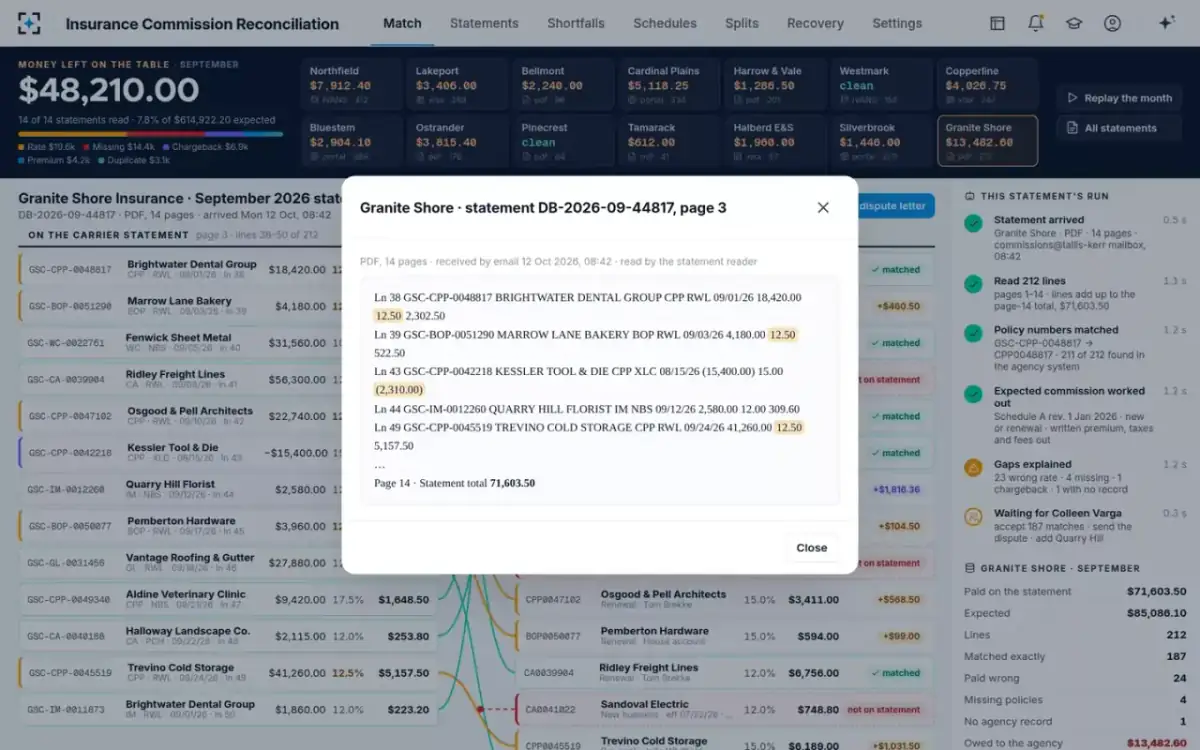
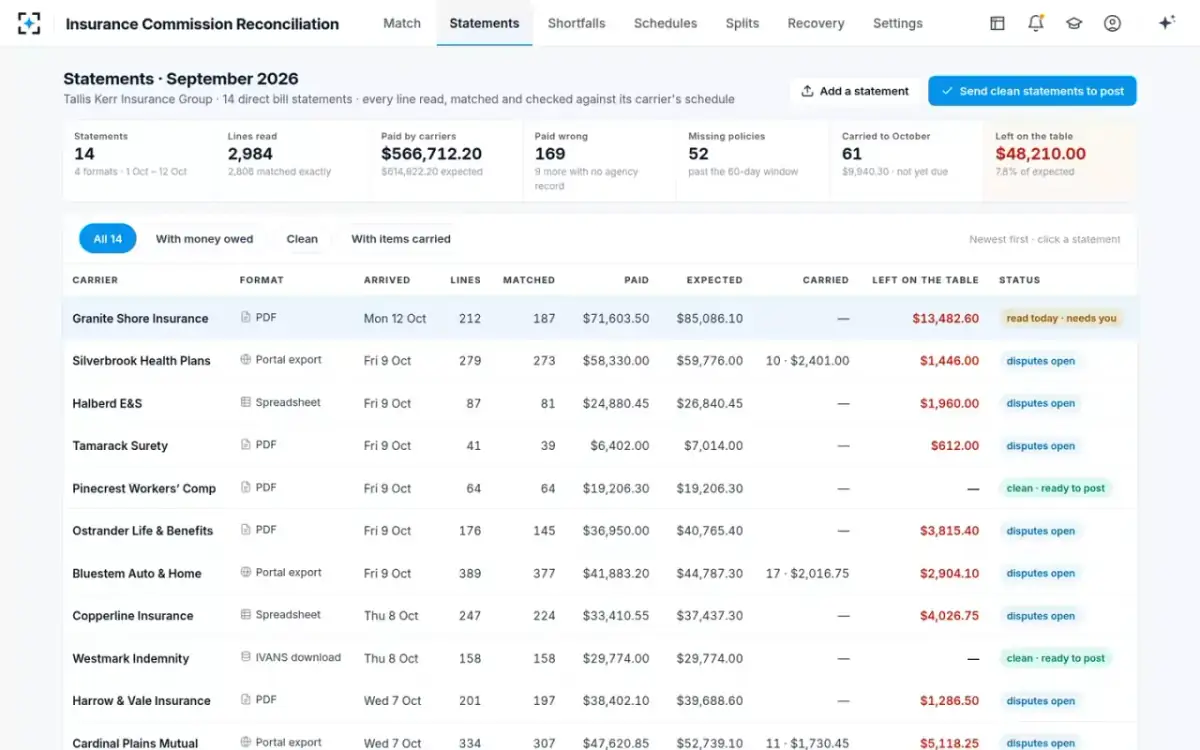
That is the work Insurance Commission Reconciliation does. On its fictional sample agency's September close, 14 carriers' direct bill statements carried 2,984 lines; checked against each carrier's schedule, they paid $566,712.20 against $614,922.20 expected. The five measures of a direct bill reconciliation set out how to judge that close.
A direct bill statement as the carrier printed it
What is net remittance in agency bill?
Net remittance is the premium an agency pays the carrier after deducting its own commission: gross premium collected, less commission, equals the amount remitted. It is due on whatever schedule the agency agreement sets, commonly against an account current the carrier sends. The commission is "paid" at the moment the agency keeps it, which is why agency bill commission errors show up as remittance disputes rather than as short commission lines.
Three things make agency bill reconciliation harder than it sounds: partial payments by insureds, installment plans, and return premiums on cancellations. Each changes what the agency owes the carrier, what it owes the insured and what commission it may keep, and each has to be traced through the account where the money sits. Whose money a return premium is works one cancellation through.
Agency bill, worked: one invoice from collection to cancellation
| Step | What happens | Insured | Carrier | Agency commission |
|---|---|---|---|---|
| 1 · Invoice | $12,000 annual premium billed by the agency; commission 15% | Owes $12,000 | Owed $10,200 net | $1,800 if all is collected |
| 2 · Partial payment | Insured pays $6,000; it goes into the account holding premium | Paid $6,000 | — | — |
| 3 · Remittance | Agency remits the net on what it collected: $6,000 less 15% | — | Received $5,100 | Kept $900 |
| 4 · Cancellation | Cancelled pro rata with 75% of the term unearned; earned premium $3,000 | Owed back $3,000 | Keeps $2,550; owes back $2,550 | Earned $450; returns $450 |
| 5 · Settlement | Carrier credits $2,550; the agency adds the $450 it returns and pays the insured | Refunded $3,000 | Net $2,550 | Net $450 |
Every cell in that table is a balance someone owes someone, and on agency bill the agency is in the middle of all of them. Commission is the smallest number in it, which is why agency bill reconciliation is mostly about premium.
Whose money sits in the agency's account?
Not the agency's. New York states the duty this way: an agent or broker is responsible in a fiduciary capacity for funds received, "and shall not, without the express consent of his, her or its principal, mingle any such funds with his, her or its own funds" (N.Y. Ins. Law § 2120). The same section allows one account for several principals, but only "if and as long as the funds so held for each such principal are reasonably ascertainable from the books of account and records of such agent, broker or reinsurance intermediary."
That second sentence is the reconciliation requirement in law. An agency bill account that holds money for 20 carriers and hundreds of insureds is lawful only while the books can say, at any moment, how much of the balance belongs to each. Florida's statute treats premiums and return premiums received by an agency as trust funds in the same way, and requires a separate account for insurers the agent is not appointed with. The account itself, and the rules on what may go in and out of it, are covered in what a premium trust account is.
Who chases unpaid premium on agency bill?
The agency does, because it sent the bill and owes the carrier the net premium on the agreed terms whether or not the insured has paid. That is the commercial trade at the heart of agency bill: the agency controls the client relationship and the timing of collections, and in exchange takes on collection work and the risk of remitting before collecting. Under direct bill the carrier chases its own premium and cancels for non-payment under its own process, and the agency's role is to help the client keep the policy.
What the carriers' books show
Carriers carry the other side of both methods on their balance sheets. The U.S. Treasury's Federal Insurance Office defines agents' balances as admitted premium still in the course of collection, direct and group billed, including amounts agents have collected but not yet sent to the insurer (FIO, Annual Report on the Insurance Industry, September 2026). The definition joins the two methods: premium the carrier billed and has not collected, and premium an agency collected and has not yet remitted.
Agents' balances as a share of earned premium, by line, 2024
The pattern is clear even if the split is not: commercial lines carry more premium in the course of collection, relative to what they earn, than personal lines. Workers' compensation, commercial auto and commercial package each show balances near 28% to 30% of earned premium, against about 17% for personal auto and homeowners. Those are the lines where an agency is most likely to be holding, remitting or chasing money as well as checking commission.
How do you reconcile agency bill?
Agency bill is reconciled from the agency's own bank account outwards: every premium received is applied to an invoice, every invoice to a carrier, every remittance to an account current, and the trust account's balance to the sum of what is owed to each carrier and each insured. Commission is checked too, but as the difference between gross and net on each item, not as a carrier's statement line.
Which checks belong to which billing method
- Direct bill: every statement line against the schedule
Rate in force on the transaction date, commissionable premium, transaction type.
- Direct bill: chargebacks against the premium returned
And duplicates across statements.
- Direct bill: the reverse check for missing policies
Policies past your timing window that appear on no statement.
- Agency bill: cash received applied to invoices
Partial payments and installments traced to the policy.
- Agency bill: net remittance against the account current
Gross less commission, item by item, by the due date.
- Agency bill: trust balance by carrier and insured
Each principal's money ascertainable from the books at any time.
- Agency bill: return premiums paid out
To the insured, on time; they are not the agency's money.
- Both: producer pay on what was actually received
Not on what the agency system expected.
A month of direct bill: fourteen carriers' statements, each checked line by line
Which is better for an agency, direct bill or agency bill?
Neither is better in general; they trade control for work. Agency bill gives the agency the client's payments, the timing of collections and a clearer view of the account, and costs it collection work, fiduciary accounting and the risk of remitting before collecting. Direct bill hands billing and collection to the carrier and leaves the agency with one job, checking that the commission statement is right, which is easy to under-staff because nothing has to be done for money to arrive.
The choice is not always the agency's alone: carriers set which billing plans they offer for which lines, and large commercial accounts may need terms only agency bill allows. What an agency can choose is to staff the check that its billing method needs. On direct bill, that check is line by line against the schedule; how far a spreadsheet tracker gets with it is a fair first test.
What is list bill?
List bill is a billing arrangement in which one bill lists several insureds or certificates, typically an employer's group or a fleet, and one payer pays it. It can sit inside either method: a carrier can list-bill an employer directly, or an agency can list-bill and remit. The FIO's definition of agents' balances names "group billed uncollected premiums" among the balances a carrier carries. For reconciliation, the point is that one payment covers many lines, so a short payment has to be traced to the person or vehicle it belongs to before commission can be checked.
To see a month of direct bill statements checked line by line, start from Insurance Commission Reconciliation.
Questions people ask
Is agency bill the same as company bill?
No; they are opposites. Company bill is another name for direct bill, where the insurance company bills the insured. Agency bill is where the agency bills and collects.
Do agencies earn more commission on agency bill?
The commission rate comes from the carrier's schedule, which may or may not differ by billing method. What differs is timing: on agency bill the agency keeps its commission when it collects, rather than waiting for the carrier's statement.
Can an agency keep interest on premium it holds?
That depends on state law and the agency agreement, and it should be settled in writing before an account is opened. Whatever the answer, each principal's funds must still be identifiable in the books.
How often should agency bill premium be remitted?
On the schedule in the agency agreement, often monthly against the carrier's account current. Until it is remitted, the premium sits on the carrier's books among its agents' balances.
Does direct bill mean the agency has nothing to reconcile?
No. On direct bill the agency has nothing to collect, but it still has to check every commission statement line against the schedule, every chargeback against the premium returned, and every policy it wrote against the statements.