Insurance agents are paid mainly by commission: independent agents may be paid by commission alone, and agents employed by an agency or a carrier by salary, salary plus commission, or salary plus bonus. For a producer in an independent agency, the commission is a share of what the carrier pays the agency, set by a split agreement (often one percentage for new business and a lower one for renewals). That makes producer pay a second reconciliation behind the first: carrier to agency, then agency to producer. When an agency pays producers on what its system expected before the carrier's statement is checked, every short payment, missing policy and wrong chargeback becomes a clawback months later. Botminds' Insurance Commission Reconciliation pays producer splits on commission actually received and holds the producer's share of anything in dispute until the carrier pays.
The two accounts below follow one fictional producer, Tomas Reyes-Hale of Thackery Insurance Group, through a renewal and a new policy; screens show the solution's own fictional sample agency. Public figures come from the Bureau of Labor Statistics and New York statute.
Two accounts, one month apart: carrier to agency, then agency to producer
Carrier → agency
Agency → producer
Do insurance producers get a salary or commission?
Mostly commission, in one form or another. The Bureau of Labor Statistics says: "Independent agents may be paid by commission only. Sales workers who are employees of an agency or an insurance carrier may be paid in one of three ways: salary only, salary plus commission, or salary plus bonus." It adds that "In general, commissions are the most common form of compensation, especially for experienced agents" (BLS Occupational Outlook Handbook).
The same source puts the median annual wage for insurance sales agents at $62,280 in May 2025, and $61,550 for those working in insurance agencies and brokerages, which employ 63% of the occupation's 572,600 jobs. Those wage figures include commissions and production bonuses paid to employees; they exclude self-employed agents, the group most likely to be paid on commission alone.
How are producer splits calculated?
A producer's split is a percentage of the commission the agency earns on each policy the producer handles, set by a written producer agreement. An agreement may pay a higher percentage on new business than on renewals, exclude house accounts the agency services directly, and say whether the percentage applies to commission expected by the agency system or commission received from the carrier. That last choice decides how often a producer is clawed back.
In the solution's sample agency, commercial producers' agreements pay 40% or 35% of new business and 25% to 30% of renewals; personal lines producers are on 20% and 15%. Who may be paid a split at all is a licensing question; commission split rules set it out.
When do producers get paid on new business?
When the agreement says, and the choice is between speed and accuracy. An agency that pays on expected commission can pay in the month the policy binds, before the carrier has put it on a statement. An agency that pays on received commission pays when the carrier's statement arrives and has been reconciled, which on new business may be a month or more later.
For employed producers in New York, the law sets an outer limit. A commission salesperson "shall be paid the wages, salary, drawing account, commissions and all other monies earned or payable in accordance with the agreed terms of employment, but not less frequently than once in each month and not later than the last day of the month following the month in which they are earned" (N.Y. Labor Law § 191(1)(c)). The definition of commission salesperson expressly includes employees whose principal activity is selling "insurance" (§ 190(6)). When commission counts as earned is for the written terms to say, which is one more reason to write them precisely.
One renewal, two ways to pay the producer
- Paid early, 30 Sep1–30 Sep
- Short, 14 Oct1–14 Oct
- Clawed back15–31 Oct
- Repaid, 30 NovNov
- Waiting for the statement1 Sep–14 Oct
- Paid, share held15–31 Oct
- Released, 30 NovNov
What is a producer clawback?
A producer clawback is a deduction from a producer's later pay to reverse commission already paid. It happens for two very different reasons. Some clawbacks reflect real changes: a policy cancelled mid-term, a premium reduced by endorsement or audit. Others reflect the agency paying before checking: a carrier's short payment, a missing policy or an oversized chargeback that the producer's statement passed straight through.
The second kind is avoidable, and it is the kind producers resent most, because they are paying back the carrier's error before anyone has argued with the carrier. New York's rule on commission agreements reaches it directly: "Where the writing provides for a recoverable draw, the frequency of reconciliation shall be included" (N.Y. Labor Law § 191(1)(c)). Clawbacks on cancellations follow the chargeback arithmetic in whose money a return premium is.
Do producers get paid on renewals?
Where the agreement provides for it, at the renewal split, for as long as they remain the producer of record. What happens after a producer leaves is a matter for the agreement, within a limit set by licensing law: the NAIC's model allows renewal and deferred commissions to be paid to someone who was licensed when the policy was sold, even if they are not licensed now (NAIC Model #218, §13C). An agency paying a departed producer's renewals needs both the agreement clause and the licence record from the original sale.
What is a producer statement?
A producer statement is the agency's monthly account to a producer of what they earned: one line per policy transaction, with the commission the agency received or expected, the producer's split, the amount paid, and any adjustments. New York gives employed commission salespeople a right to one: "The employer shall furnish a commission salesperson, upon written request, a statement of earnings paid or due and unpaid" (§ 191(1)(c)).
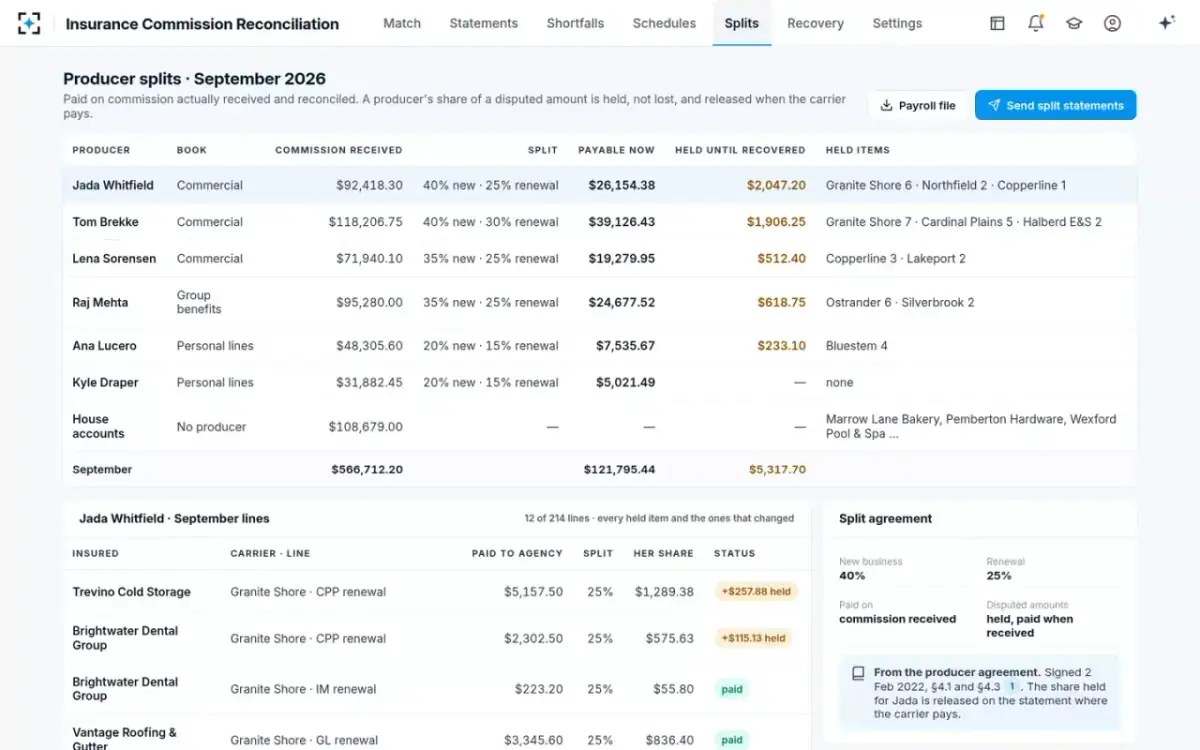
A useful producer statement can be traced line by line to a carrier statement. If it is built from the agency system's expectations instead, the producer is reading a forecast and will see reversals later without the carrier's reason beside them. In the solution, each producer's lines come from reconciled carrier statements, and each held item names the carrier, the reason and the statement where it is expected to be paid.
Each producer paid on commission received, with held items named
How do agencies pay producers on direct bill commission?
On direct bill, the agency only knows what it was paid when the carrier's statement arrives, so it chooses between three models. Each has a cost, and the table sets them side by side.
Three ways to pay producers on direct bill commission
| Model | When the producer is paid | What happens when a carrier pays short | Who carries the risk |
|---|---|---|---|
| Paid on expected | In the month the agency books the commission | The share is clawed back later, and repaid if the agency wins its dispute | The producer, until the dispute is won |
| Draw against commission | A fixed draw, reconciled to commission earned at set intervals | The draw balance absorbs it until the next reconciliation | The agency, then the producer at reconciliation |
| Paid on received | When the carrier's statement is reconciled | The disputed share is held and paid when the carrier pays | The agency's dispute process; the producer only waits |
Paying on received ends the clawbacks that come from carrier errors, because nothing a carrier has not paid is ever paid out. It does not end clawbacks from real cancellations, which follow the policy. What it costs is waiting, which is why the speed of the agency's close matters to producers as much as to the controller: the specialist's month-end is where that time is spent.
Moving producers to pay on received commission without a pay gap
Switching from paying on expected to paying on received commission delays some pay by about a statement cycle, once. Plan for that month rather than let producers discover it on payroll. Four steps keep it orderly.
First, change the agreement before the pay: the base of the percentage and the treatment of disputed amounts are contract terms, and in New York the written terms must say how commission is calculated. Second, bridge the first month: pay the last month on expected and the next on received, and show producers the held list on day one so a gap is visibly a hold, not a cut. Third, publish the release rule: a held share is paid on the statement where the carrier pays, and the agency's dispute letters and replies are visible to the producer by item. Fourth, measure it: count clawbacks a month before and after, and the days a held share waits, by carrier.
The trade the producer gets is predictability. In the solution's sample agency, held shares were $5,317.70 across all producers in September against $121,795.44 paid out, and each held item named its carrier and reason. A producer who can see that list stops asking whether a renewal was paid and starts asking when.
Four seats around the producer's statement
The producer is not the only one who feels the second reconciliation. Sales managers spend time on disputes that began as carrier errors, accountants reverse lines they posted on expectation, and controllers carry clawbacks as receivables from their own staff.
Who handles producer pay, before and after paying on received commission
Today
Paid on what the agency system expected, then clawed back when a statement comes in short; cannot tell from the statement why.
With agents
Paid on commission received, with each held item named and the carrier's reason beside it.
Still theirs: the client conversation about a renewal missing from a statement
Today
Mediates clawback disputes between producers and accounting, months after the sale.
With agents
Sees held amounts by producer and carrier before payroll, not after.
Still theirs: split agreements and producer targets
Today
Builds producer statements from the agency system, then reverses lines as carrier statements disagree.
With agents
Builds them from reconciled statement lines, so the producer statement and the carrier statement agree.
Still theirs: any manual adjustment, with its reason
Today
Approves payroll on expected figures and carries the clawbacks as receivables from producers.
With agents
Approves payroll on received figures; held amounts are a liability with a named release event.
Still theirs: releasing anything held outside the producer agreement
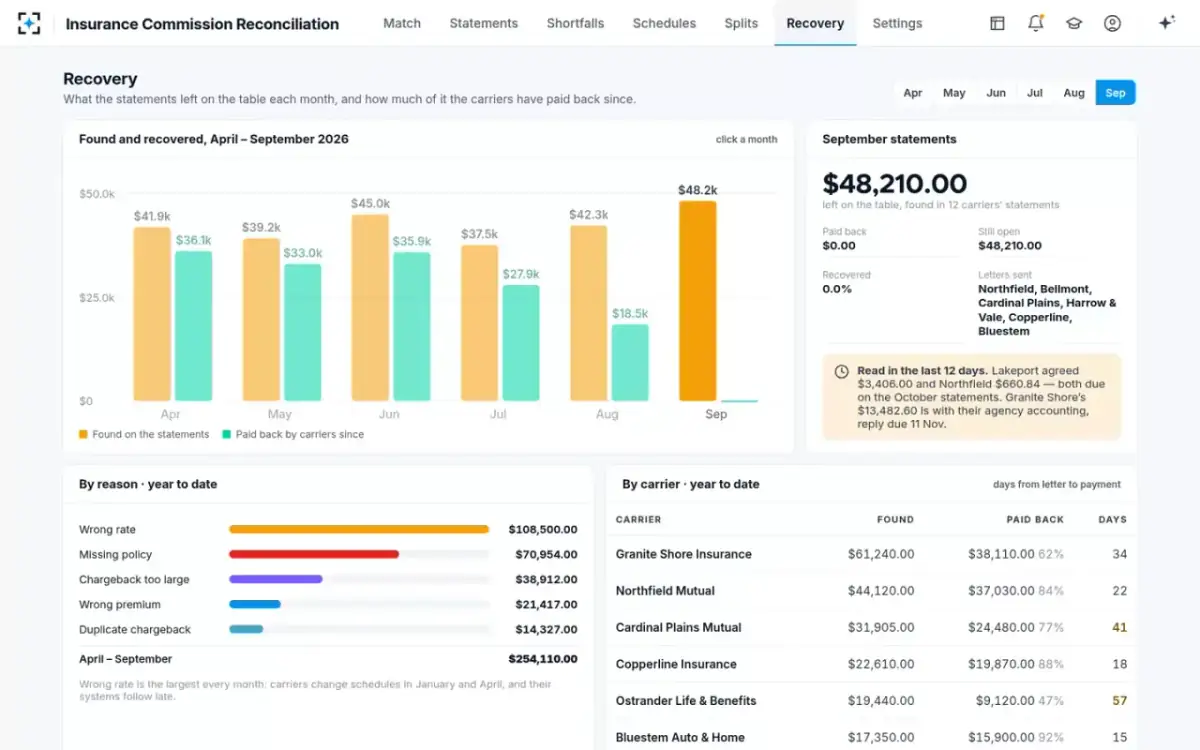
What carriers paid back, and how fast: the release events for held shares
To see producer splits paid on reconciled statements, start from Insurance Commission Reconciliation.
Questions people ask
How are independent insurance agents paid?
An independent agency is paid commission by each carrier it represents, under each carrier's schedule, and the agency's producers are paid a split of it under their own agreements. The BLS notes that independent agents may be paid by commission only.
How are insurance producers paid on renewals?
At the renewal percentage in their agreement, which is often lower than the new business percentage. In the solution's fictional sample, commercial producers earn 40% or 35% of new business commission and 25% to 30% of renewal commission.
Can an agency deduct a chargeback from a producer's pay?
If the producer agreement provides for it and, for employees, state wage law allows the deduction. New York requires commission terms in writing, including what happens on termination; check your own state's rules before deducting.
What is a draw against commission for insurance agents?
A regular advance paid against commission the producer is expected to earn, reconciled to actual commission at set intervals. In New York, a written commission agreement with a recoverable draw must state how often it is reconciled.
Why does my producer statement not match the carrier statement?
Usually because the producer statement was built from what the agency system expected, not from what the carrier paid. Short payments, missing policies and chargebacks on the carrier statement then appear on later producer statements as reversals.