Insurance agency commission software is any system an agency uses to record, check and pay out the commission carriers owe it: the commission module in an agency management system, a producer compensation tool, or a reconciliation tool that checks each carrier statement against the carrier's schedule. Which one pays for itself depends on a handful of key performance indicators, and the largest of them is not hours saved but commission recovered: underpayments found and paid back, missing policies found, oversized chargebacks corrected. Botminds' Insurance Commission Reconciliation is built to move those indicators by reading every statement line against the schedule and drafting the dispute; this guide shows how to price that on an agency's own book before buying anything.
Industry figures come from the Texas Department of Insurance's compilation of the national Insurance Expense Exhibits; examples come from the solution's fictional sample agency; payback figures are arithmetic on inputs you replace with your own.
The KPI tree for agency commission software, from leading measures to commission protected
Outcome
Recovered + found missing + chargebacks corrected + hours freed × costThe number the principal signs off onDrivers
Disputed $ × share paid backBy carrier and reasonPolicies past the window × expected commissionThe reverse checkCharged back − owed back, on cancellationsPro rata against the premium returned(Days by hand − days now) × 8 × 12Priced at your loaded costLeading measures
Checked ÷ statement linesBelow 100% caps every driverReasoned $ ÷ (expected − paid)Unexplained gaps are not chasedMedian by carrierWhere recovery stallsReversals and $ a monthPaid early, taken back laterHow much commission is at stake in an agency's book?
Enough that a fraction of a point matters. Insurers' commission and brokerage expense across all property and casualty lines was 11.11% of earned premium in 2024, $80.7 billion on $726.4 billion of premium earned, in the national exhibits compiled by the Texas Department of Insurance (TDI, 2024 Insurance Expense Exhibit). On commercial lines the share runs higher: 16.32% for commercial multiple peril, 17.22% for inland marine, 12.57% for commercial auto liability. These are insurers' expense ratios, including brokerage, not the rate any one agency is paid; the full table by line explains what they do and do not show.
The arithmetic that follows is simple and worth doing before any demonstration. Commission on a book is premium times the blended rate; every 1% of that commission not collected is premium × rate × 0.01. On a $25 million book at the all-lines ratio, that is about $27,800 a year for each percent missed.
What each 1% of commission missed is worth a year, by book size
What KPIs should an agency track for commissions?
Track four drivers and four leading measures. The drivers are dollars: underpayments recovered, missing commission found, chargebacks corrected, hours freed. The leading measures explain the drivers: the share of lines whose rate was checked, the share of variance with a reason, days from dispute letter to payment by carrier, and producer clawbacks a month. A driver that falls is diagnosed by the measure beneath it.
The ordering matters. An agency that tracks only days to close will buy speed and may still check rates only on lines that look wrong. An agency that tracks lines rate-checked and variance explained will find the money first and the speed follows, because the mechanical work is what software removes. The five accuracy measures define the leading measures in detail.
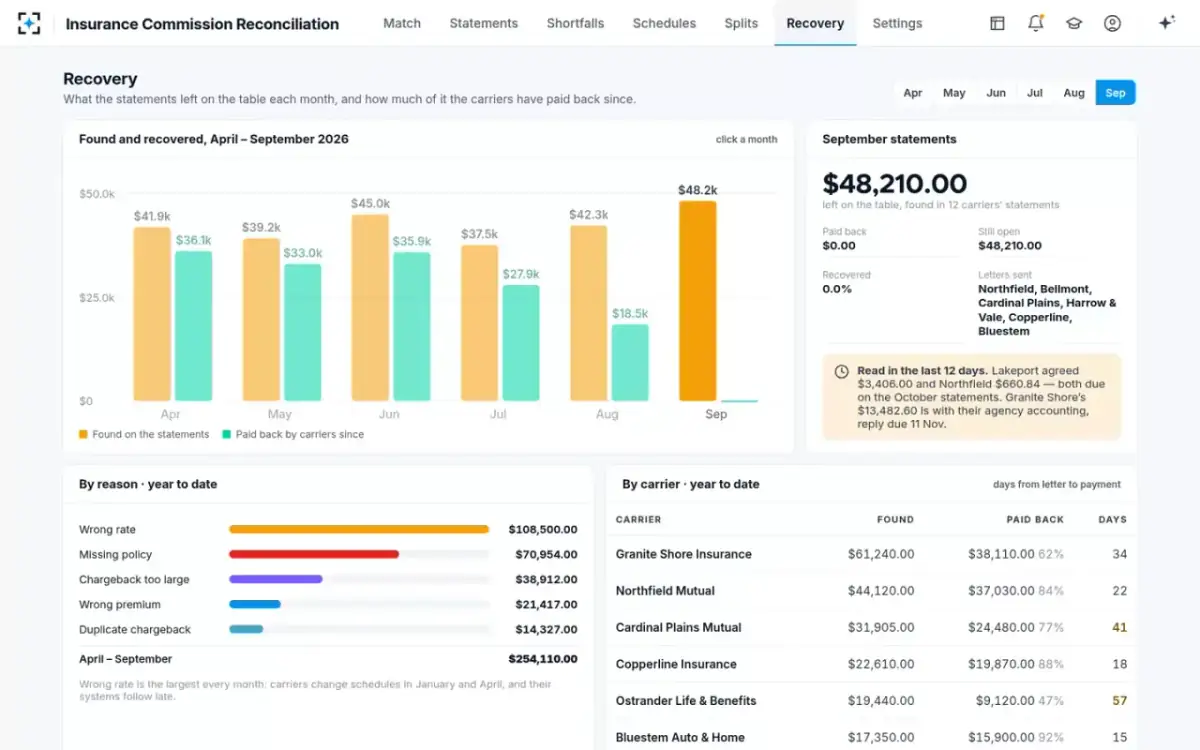
Found on the statements, and paid back since, month by month
How much commission do agencies miss?
We found no government, academic or non-profit study that measures it, and figures quoted by vendors are not evidence. The only number worth using is your own, and it can be produced in a week: replay one closed month through line-by-line checking and count what the first close did not find. Split the result by reason, because a missing-policy total and a wrong-rate total lead to different fixes.
The sample agency illustrates the shape, not the size. Its September statements left $48,210.00 against $614,922.20 expected, 7.8%; over six months the solution found $254,110.00, with wrong rates the largest reason every month. Those are fictional figures from a designed sample; they are useful for seeing which KPI moves which driver, not as a forecast.
What is the ROI of commission reconciliation software?
Return on a reconciliation tool is commission protected a year, net of what the agency would have recovered anyway, divided by the tool's annual cost. The "anyway" term is the one most cases leave out: an agency that already disputes some wrong rates by hand should count only the increase.
A year's return on commission reconciliation, term by term
Recovered
(Disputed $ now − disputed $ before) × share carriers pay back
Use your replay for the first term and carriers' history for the second.
Controller
Found missing
Missing policies a year × average expected commission
Only those past your timing window; younger items are carried.
Accountant
Hours freed
(Close days by hand − close days after) × 8 h × 12 × loaded hourly cost
Count hours redeployed, not hours eliminated, unless a role changes.
Agency principal
Cost
Subscription + set-up + controller and accountant review time
Review time does not disappear; it moves to the gaps.
Finance
Hours are the smaller term, which is why a case built on them alone looks weak. Our estimate for the sample agency's 14 statements is 9 working days a month by hand against the solution's 2-day target: 7 days, or 672 hours a year. At the BLS median for bookkeeping, accounting and auditing clerks, $50,670 a year in May 2025 (BLS), or about $24.36 an hour before benefits, that is roughly $16,400. One percent of commission on a $25 million book is larger.
How long does it take to close commissions each month?
There is no published benchmark; it scales with statement lines and formats, not with premium. Our estimate for 14 carriers and about 3,000 lines is nine working days by hand, of which collecting, keying and matching take five and chasing totals another one and a half. The solution's design target for the same month is two days, a target rather than a measured result.
Days to close is worth tracking for a reason beyond hours: producer pay and the dispute window both run from it. A close that finishes on day nine leaves less of a carrier's dispute window for the letter, and pays producers on expected figures in the meantime.
Does commission software calculate producer splits?
Many tools do, but the question that matters is splits on what. Software that pays producers on the agency system's expected commission pays early and claws back later, when a statement arrives short or a chargeback lands. Software that pays on reconciled commission pays what came in and holds the producer's share of anything in dispute.
In the sample agency's September run, producers were paid $121,795.44 on commission actually received, and $5,317.70 of their shares was held against disputed items, to be released on the statement where each carrier pays. One producer's held share on a single under-paid renewal was $115.13: 25% of a $460.50 rate shortfall. That is the KPI an agency feels in its producer conversations: clawbacks that never had to happen. How producers are paid covers the agreements behind it.
Can commission software handle agency bill and direct bill?
Ask, because the checks differ. On direct bill the carrier pays commission on a statement and the check is the commission line; on agency bill the agency collects premium, keeps its commission and remits the net, and the check is the remittance and the premium trust account. Insurance Commission Reconciliation is built around direct bill commission statements; an agency that is mostly agency billed needs premium reconciliation as well. Where the risk sits under each sets out which checks belong to which.
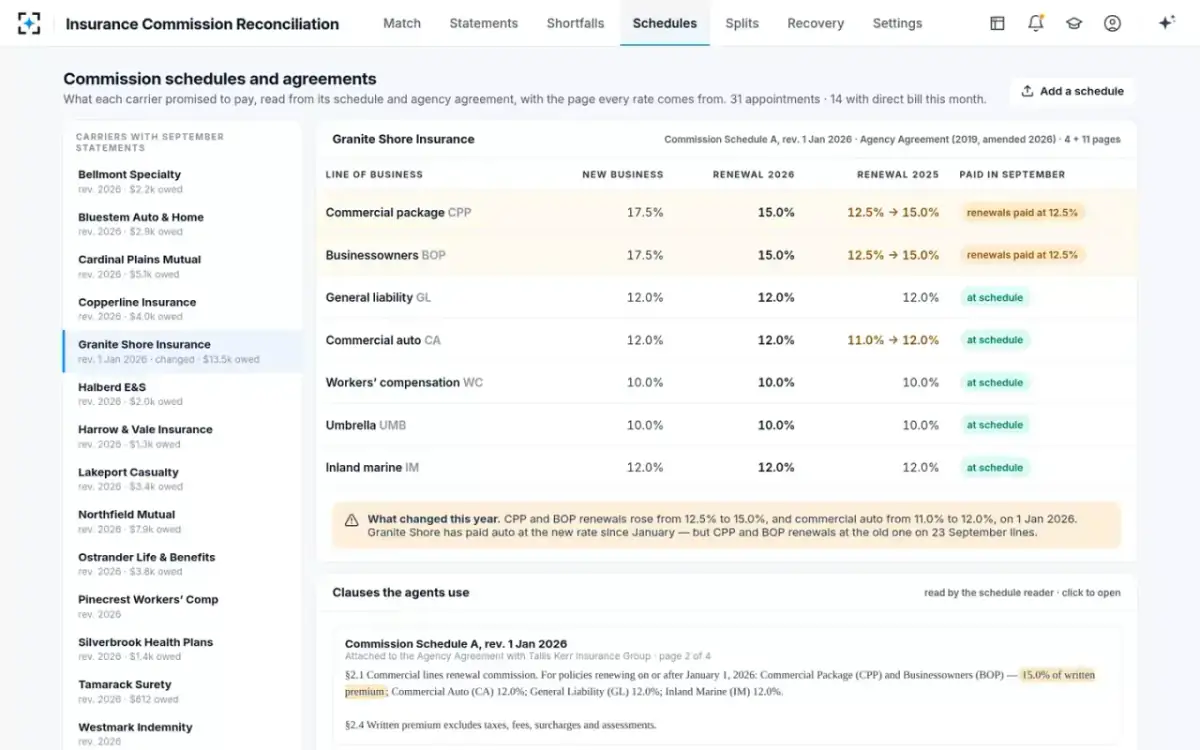
What each carrier promised: the schedule, with this year beside last year
What is the best commission software for insurance agencies?
The best one for an agency is the one that moves its largest driver on its own statements, and that can only be shown on a replay. For an agency with many carriers and frequent schedule changes, that is usually rate checking and missing-policy detection; for one with clean electronic downloads and few carriers, it may be the agency system's own module. A demonstration on a vendor's data shows the interface, not the return.
Before you buy: eight checks on any agency commission software
- Replay a closed month
Your statements, schedules and agency records; count what it finds that you did not.
- Ask where rates come from
Your schedules and agreements with effective dates, or a rate table someone maintains.
- Check the reverse search
Does it list policies that never appeared on a statement, with a timing rule you set?
- Test a mid-term cancellation
The chargeback should follow the premium returned unless your agreement says otherwise.
- See the dispute output
A letter that quotes the clause and lists every line, drafted for a person to send.
- Find out what producers are paid on
Received and reconciled commission, with disputed shares held.
- Confirm nothing posts without approval
Write-offs and postings stay with the controller.
- Price the review time
People still read the gaps; budget for it in the ROI.
A worked payback, on an illustrative book
The formula is only useful filled in, so here it is with round, invented inputs; every one of them should be replaced by an agency's own. Take an agency with $25 million of premium and a blended commission rate of 12%, $3.0 million of commission a year. Suppose its replay of one closed month finds shortfalls equal to 1.5% of commission that its own close did not dispute.
Payback, term by term, with invented inputs
| Term | Input (replace with yours) | A year |
|---|---|---|
| Shortfalls not disputed today | 1.5% of $3.0M of commission, from a one-month replay | $45,000 |
| Recovered | 75% of that paid back by carriers | $33,750 |
| Missing commission found | 20 policies a year × $600 expected commission | $12,000 |
| Hours freed | 672 hours × $30 loaded cost | $20,160 |
| Annual benefit | Recovered + missing found + hours freed | $65,910 |
| Payback | If the tool cost $30,000 a year all-in | About 5.5 months |
Two things in the table carry the case. The recovered term depends on two inputs only the agency can measure: what its replay finds, and what its carriers actually pay back, which is why the recovery KPI is tracked by carrier. And the hours term is under a third of the benefit even at a loaded rate above the clerical median; an agency that cannot redeploy the hours should count them at zero and see whether the case still holds.
How much does commission tracking software cost?
We found no independent survey of prices, and list prices are not comparable because tools are priced per user, per carrier, per policy or per statement. Compare total cost of ownership instead: subscription, set-up (loading schedules and agreements is the real work), the agency system connection, and the people time that remains. Then put it beside the return from your replay. A tool that costs more and checks every line can pay back faster than one that costs less and checks totals.
To see the KPI tree filled in on a sample agency's statements, start from Insurance Commission Reconciliation, or follow one statement line through the software.
Questions people ask
What is a good commission recovery rate?
We found no published benchmark. Track the share of disputed dollars carriers pay back by carrier, and the days it takes; in the solution's fictional sample, the carriers on the recovery screen had paid back between 47% and 92% of what was found year to date, taking 15 to 57 days from letter to payment.
Should an agency measure commission software by hours saved?
Measure hours, but do not build the case on them. In our estimate for a 14-carrier close, freed hours are worth about $16,400 a year at a median clerical wage, while each percent of commission on a $25 million book is worth about $27,800.
Is commission income the same as the commission rate in the expense exhibits?
No. The 11.11% figure is insurers' incurred commission and brokerage expense as a share of earned premium across all P&C lines in 2024. An agency's own rates are set by each carrier's schedule and differ by line, transaction and carrier.
What data does commission software need to start?
Carrier statements for a month, each carrier's commission schedule and agency agreement, the agency system's policy and premium records for the period, and producer split agreements. Loading the schedules is most of the set-up work.
Can commission software dispute shortfalls with carriers?
It can prepare the dispute; people should send it. In the solution, the dispute letter writer drafts the letter with the clause quoted and every line listed, the accountant sends letters up to $2,500 and the controller approves larger ones.