Direct bill commission reconciliation is the monthly check that each carrier paid the agency the commission it owed on policies the carrier billed directly: every line of the carrier's commission statement matched to the agency system's record of the transaction, the commission recomputed from the carrier's schedule, and every difference explained, disputed or carried. A reconciliation that only shows statement totals agreeing with the agency system's receivable proves the cash arrived, not that it was right. Five measures show whether a close can be trusted, and Botminds' Insurance Commission Reconciliation reports all five for every statement.
The figures on this page come from the solution's fictional sample agency, Tallis Kerr Insurance Group, and its 14 carriers' September 2026 statements. The targets are ours, offered as a starting point for an agency's own policy.
Five measures of a direct bill commission reconciliation
1Line coverage
What it showsShare of statement lines whose commission was checked against a schedule rate, not just matched to a policy.
FormulaLines rate-checked ÷ lines on the month's statements
TargetEvery line, every month
2Match precision
What it showsShare of matched lines joined to the right policy and transaction, found by re-checking a sample by hand.
FormulaCorrect matches in sample ÷ matches sampled
TargetNo wrong match in the sample before posting; widen the sample if one appears
3Variance explained
What it showsShare of the gap between expected and paid commission that carries a reason and its evidence.
FormulaVariance with a reason ÷ (expected − paid)
TargetAll of it; an unexplained gap is a finding in itself
4Missing-policy detection
What it showsPolicies past the agency's timing window that should have paid commission and appear on no statement.
FormulaPolicies listed missing ÷ policies past the window with no commission line
TargetEvery one, each with its carrier evidence
5Recovery
What it showsWhat carriers paid back on disputed items, and how fast.
FormulaPaid back ÷ disputed; days from letter to payment, by carrier
TargetSet by carrier; watch the slowest
How do you reconcile direct bill commissions?
You reconcile direct bill commissions in five steps: prove the statement, match each line, recompute the expected commission, classify every difference, and close with the controller. Each step has one test, and skipping any of them is how short payments survive.
Proving the statement means adding its lines to the carrier's printed total before anything else; a dropped or doubled line makes every later comparison wrong. Matching means joining each line to the agency system's policy on policy number, insured, effective date and transaction type. Recomputing means taking the commissionable premium and the rate from the schedule in force on that transaction. Classifying means giving every difference a reason: wrong rate, wrong premium, chargeback, duplicate, missing policy, or timing to be carried. Closing means the controller reviews the gaps and the letters before the statement is posted. The specialist's month-end, hour by hour follows the same steps from the desk.
What is a commission variance?
A commission variance is the difference between the commission the agency expected on a statement line and the commission the carrier paid. It is a number, not a finding: a variance becomes a shortfall only when it has a reason the agency can evidence and it falls outside the timing window. Two variances can also cancel each other, which is why tying totals proves little.
On the sample agency's September close, expected commission across 14 statements was $614,922.20 and carriers paid $566,712.20. The $48,210.00 between them, 7.8% of expected, broke down into five reasons, each with the lines behind it. Another 61 items worth $9,940.30 were inside the 60-day window and carried to October, not disputed.
Where one month's variance came from, by reason
How do you check commission rates against the schedule?
You check a rate by recomputing the line, not by eyeballing the percentage. The expected commission is the commissionable premium times the rate the schedule sets for that line of business and transaction type on that date; a rate that looks normal can still be last year's. The test needs three facts the statement does not carry: which schedule revision was in force, whether the transaction is new or renewal, and what premium the schedule pays on.
The expected-commission test, term by term
Commissionable premium
Written premium on the transaction − items the schedule excludes
A schedule may pay on written premium excluding taxes, fees, surcharges and assessments; the sample carrier's §2.4 says so.
Schedule and agency system
Schedule rate
Rate for line × transaction type, from the revision in force on the transaction date
Never apply a revision before its effective date; keep the page the rate came from.
Carrier schedule
Expected commission
Commissionable premium × schedule rate
On a cancellation, the premium is the return premium, not the full term.
The reconciliation
Variance
Expected − paid, outside the rate and penny tolerances
The sample agency uses 0.05 points and $1.00 a line; below them a difference counts as rounding.
Accountant reviews
The rate test is where the money usually sits. In the sample, Granite Shore Insurance raised commercial package and businessowners renewals from 12.5% to 15.0% on 1 January 2026 and commercial auto from 11.0% to 12.0%. Its system paid the new auto rate from January and the old package rate through September, on 23 lines in one statement. Nothing about a 12.5% line looks wrong to a person who does not have the 2026 schedule open.
How do you find missing commissions?
You find missing commissions by reconciling in reverse: start from the agency system's policies that should have produced a commission line, and look for each one on the carriers' statements. A statement can only show what the carrier paid; a policy it never booked, or booked under another agency code, simply is not there. The reverse check needs a timing rule, because a carrier may report new business on a later statement than the month it binds, and a missing policy is only missing once it is late.
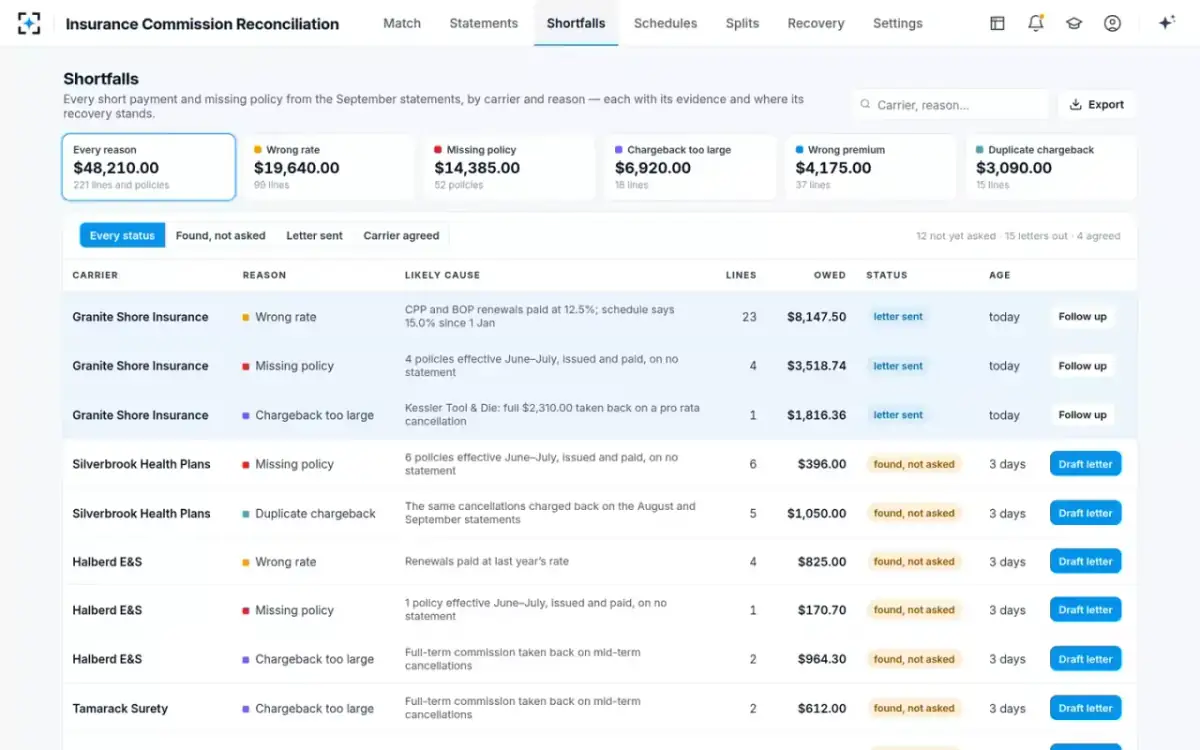
In the sample, the rule is 60 days past the effective date. At that line, 52 policies across the 14 statements were called missing, worth $14,385.00 of commission; on Granite Shore's statement alone there were four, effective on 8, 15, 22 and 29 July, issued and billed by the carrier and absent from three months of statements. Policies bound in the last 60 days were listed as carried, not chased.
Every short payment and missing policy, with where its recovery stands
What match rate is good for commission reconciliation?
A match rate is only useful split in two: how many lines were matched, and how many of those matches are right. A tool or a person can push the first towards 100% by matching loosely, and a loose match hides the very errors reconciliation exists to find. We found no published benchmark for either number, so set your own by sampling.
In the sample month, 2,808 of 2,984 lines matched exactly; on Granite Shore's statement 211 of 212 lines were found in the agency system and the remaining one was a policy the agency had never recorded. A useful monthly routine is to re-check a random sample of matched lines by hand before posting: if the sample is clean, the matches stand; if it finds a wrong match, enlarge the sample and look for the pattern (usually one carrier's numbering or one transaction code).
What is a commission receivable, and what do examiners compare it with?
A direct bill commission receivable is the commission an agency has booked as earned on policies the carrier bills, and not yet received on a statement. Where an agency accrues it, reconciliation is what clears it: each statement line clears a receivable, and what is left is either timing or a shortfall. A receivable that never clears is the accounting trace of a missing policy.
The carrier keeps the mirror image. In the national Insurance Expense Exhibit for 2024, the insurers that write in Texas reported $148.2 billion of agents' balances on their national direct business, 20.4% of earned premium across all property and casualty lines (TDI, 2024 Insurance Expense Exhibit). Market conduct examiners test the producer side of those balances with a standard that reads: "Producer account balances are in accordance with the producer's contract with the insurer" (NAIC, 2024 Market Regulation Handbook Examination Standards Summary). An agency's reconciliation, line by line against the contract, is the same test run from the other end. How agency bill and direct bill move those balances explains why the two sides hold different balances.
How often should commissions be reconciled?
Every statement, every month, as it arrives, because the evidence and the leverage both decay. An agency agreement may set a window for disputing a statement (the sample carrier's allows 180 days from the statement date), and a schedule error left for a quarter repeats on every statement in it. A monthly close also keeps producer pay current, since splits are computed from what came in.
Keep the result long after the close. Florida, for example, requires agents to keep records of the policies they transact for at least five years after the policy expires (Fla. Stat. § 626.748); the statement, the reconciliation and the dispute file belong with them.
The five measures on one sample month
Filled in for a real close, the five measures read as a scorecard the controller can sign. The figures below are the solution's fictional sample agency's September statements; the point is the shape of the evidence, not the values.
The five measures for one month's direct bill close
| Measure | Sample result | What the controller asks next |
|---|---|---|
| 1 · Line coverage | 2,984 lines read from 14 statements, each checked against its carrier's schedule | Were any statements missing from the month? |
| 2 · Match precision | 2,808 lines matched exactly; lines below the 0.90 confidence threshold left for the accountant | Did this month's hand re-check of matched lines find any wrong join? |
| 3 · Variance explained | $48,210.00 between expected and paid, all of it under one of five reasons | Which reason grew against last month? |
| 4 · Missing-policy detection | 52 policies past the 60-day window with no commission line; 61 younger items ($9,940.30) carried | Are the carried items on next month's statements? |
| 5 · Recovery | Six months: $254,110.00 found; carriers on the recovery screen paid back 47% to 92% of theirs | Which carrier is slowest from letter to payment, and why? |
Read top to bottom, the scorecard also shows where a close can fail without anyone noticing. A month with full coverage but a falling recovery rate means letters are going out and not being followed up. A month where one reason doubles often points to one carrier changing something, a schedule, a code or a system, and the measure points to which.
What reports show commission reconciliation results?
Four reports cover the five measures: a statement status report (lines, matched, rate-checked, paid, expected, carried, left on the table, by carrier), a shortfall queue by reason and status, a recovery report by month and carrier with days from letter to payment, and a producer split report showing what was paid and what is held. The controller should be able to open any figure in them and reach the statement line behind it.
A monthly close you can defend, in ten checks
- Every statement proved to its printed total
Before any matching; a dropped line hides a shortfall.
- Every line matched on four keys
Policy number, insured, effective date, transaction type.
- Every line rate-checked against the schedule in force
With the revision and page recorded.
- Cancellations checked against the premium returned
Not the full term; see the chargeback test.
- Reverse check for missing policies
Policies past your window with no commission line.
- Every variance dollar given a reason
Unexplained variance is itself a finding.
- Timing items carried, not disputed
Listed on the next month's match.
- A sample of matches re-checked by hand
Widen it if one is wrong.
- Letters sent with clause and lines
Track replies against the agreement's response period.
- Controller sign-off before posting
And on every write-off.
Most of the dollars on a typical variance report come from two checks a spreadsheet makes hard: the rate test and the reverse check. Where a spreadsheet tracker stops shows why. Chargebacks need a test of their own, set out in whose money a return premium is. To see the five measures on a live statement, start from Insurance Commission Reconciliation.
Questions people ask
What is the difference between matching and reconciling commission?
Matching joins a statement line to a policy; reconciling also proves the amount. A line can match perfectly and still be paid at last year's rate, on the wrong premium, or charged back for the full term on a mid-term cancellation.
What is a direct bill commission statement?
It is the carrier's monthly list of commission owed to the agency on policies the carrier billed: one line per transaction with policy, insured, line, transaction, premium, rate and commission. It arrives as a PDF, a spreadsheet, a portal export or an electronic commission download.
Should a commission variance under a dollar be chased?
Usually not line by line. Set a penny tolerance (the sample agency uses $1.00 a line) and a rate tolerance (0.05 points), and treat differences below them as rounding. Watch the total of rounding by carrier, though: a systematic small error can add up.
What causes most direct bill commission shortfalls?
We found no published study of causes. In the solution's fictional sample, wrong rates were the largest reason every month, ahead of missing policies, oversized chargebacks, wrong premium bases and duplicate chargebacks. Your own reasons will show after one month of line-by-line checking.
How long do carriers take to pay back a commission dispute?
It varies by carrier, which is why the recovery measure is tracked per carrier. In the sample, days from letter to payment ranged from 12 to 57 across carriers, and one carrier's agreement allowed it 30 days to respond.