A wholesale insurance broker and an MGA do different jobs on the same risk. The wholesale broker works for the retail agent: it takes a risk the agent's own markets will not write and shops it to insurers, often surplus lines insurers, that the agent cannot reach. An MGA (managing general agent) works for an insurer: it underwrites, and often binds, business on that insurer's paper within limits the insurer sets. The difference matters because a hard commercial risk often passes through both, retail agent to wholesaler to MGA to insurer, and each hand-off adds days while the renewal date gets closer. Botminds' Carrier Appetite Search is built for the first link in that chain: it shows a retail account manager which markets, direct or through a wholesaler, will actually write a risk before anything is sent, each with the appetite-guide passage that says so.
Neither role is defined by its title. The NAIC's model law on MGAs warns that people "calling themselves 'managing general agents' may not necessarily fall under" it, and the NAIC's producer licensing model mentions a wholesale broker only as an example of "a person licensed as an insurance producer who acts only as an intermediary between an insurer and the customer's producer" (Model #218, §18): a producer like any other, set apart by its role. What separates them is whom they act for and what they may decide, and both of those are written down.
One hard risk, four hands: who acts for whom, and where the days go
What is the difference between a wholesale broker and an MGA?
The short answer: a wholesale broker sells access to markets, and an MGA is a market. The wholesale broker's client is the retail agency (and, behind it, the insured); its product is placement. The MGA's principal is the insurer; its product is underwriting capacity. A wholesaler that also holds binding authority from an insurer is acting as both, which is common and is the source of most of the confusion between the two terms.
The NAIC's Managing General Agents Act (Model #225) draws the line by activity, not by name. A person is an MGA if it manages all or part of an insurer's business and acts as its agent while producing and underwriting premium of at least 5% of the insurer's policyholder surplus in a quarter or year, together with adjusting or paying claims over $10,000 or negotiating reinsurance for it. The same model defines underwriting as the authority to accept or reject risk on the insurer's behalf (NAIC Model #225, §2). Below those thresholds an agent with binding authority is still an agent with binding authority; it simply does not trigger the model's contract, audit and reporting rules.
The UK regulator describes the wholesale side from the London end. Its study of wholesale broking found "2 different types of wholesale broker: those who place business coming from a third-party intermediary and those where a global broker handles a major corporate from initial client contact to placement", and added that the intermediary in the first case "is typically a third-party retail broker" (FCA, Wholesale Insurance Broker Market Study, MS17/2.2, February 2019). The first type is what a US retail agent means by "my wholesaler".
Wholesale broker vs MGA, row by row
Wholesale broker: The retail agency and its client, in placing the risk.
MGA: The insurer, under a written contract that sets what it may write.
Wholesale broker: Which markets to show, and how to present the risk to them.
MGA: Whether to accept the risk, on what terms, inside the insurer’s limits.
Wholesale broker: Only if an insurer has separately granted it authority.
MGA: Yes, within its binding authority; above it, the risk is referred.
Wholesale broker: Producer licence, and a surplus lines licence where it places with nonadmitted insurers.
MGA: Producer licence; under Model #225, a written contract with the insurer that sets its authority, which the insurer reports to its regulator.
Wholesale broker: Usually a share of the commission, sometimes a fee to the client or retail agency.
MGA: Commission from the insurer, sometimes with a profit share the model law holds back until profits are verified.
Wholesale broker: The broker, to its client, for how the risk was presented and placed.
MGA: The insurer: the model law treats the MGA’s acts as the insurer’s own.
Is an MGA an insurer, or a broker?
Neither, in law: an MGA is an agent of the insurer. It writes on the insurer's paper, so the policy names the insurer, the insurer's financial strength backs it and the insurer's regulator can hold the insurer to account for it. The model law is blunt about it: the acts of the MGA are considered the acts of the insurer, and the MGA may be examined as if it were the insurer. That is why insurers audit their MGAs and why a binding authority runs to pages of limits.
Nor is an MGA a broker in the sense that matters to a retail agent. A broker represents the buyer; an MGA represents the seller. A retail agency that sends a submission to an MGA is asking an underwriter for a decision, not hiring an intermediary to look for one. The written limits an MGA works inside (classes, territories, maximum limits and premium, exclusions) are its own appetite guide, and they are narrower than the insurer's. The MGA underwriter's side of that question is in binder underwriting guidelines; this page stays with the retail agent's.
Why do retail agents use wholesale brokers?
Because appetite and appointment rarely line up. Under the NAIC's producer licensing model, a producer may act as an insurer's agent only once that insurer has appointed it (Model #218, §14A). A retail agency is appointed with a set number of insurers, and each of those appointments comes with premium expectations and a contract. When a risk falls outside every appointed market's appetite, the agency needs a route to markets it has no contract with.
The wholesaler is that route. It holds the contracts, and in many states it holds the surplus lines licence that nonadmitted insurers require: federal law defines a surplus lines broker as one "licensed in a State to sell, solicit, or negotiate insurance on properties, risks, or exposures located or to be performed in a State with nonadmitted insurers" (15 U.S.C. § 8206). The FCA heard the same reasons in London: retail brokers usually need a terms of business agreement with each insurer, with "fixed costs and potentially prohibitive conditions (such as a minimum amount of business) that could deter retail brokers without substantial volume" (FCA MS17/2.2). A wholesaler pools that volume across hundreds of retail agencies.
Four seats on one hard risk, and what each is waiting for
Today
Waits on the client for the description, then on each market for an answer, often a decline.
With agents
Knows which appointed markets and which wholesaler markets fit before the first email.
Still theirs: The client relationship and the decision to go through a wholesaler
Today
Receives a risk two or three of the agency’s markets have already declined, with the reasons often missing.
With agents
Receives the description, what each declining market said and why, and where the retail agency stands.
Still theirs: Market choice and presentation to the surplus lines and specialty markets
Today
Reads submissions that never fit the binder to find the few that do.
With agents
Sees fewer submissions outside the binder’s classes and territories.
Still theirs: Every underwriting decision and every referral to the insurer
Today
Gets referrals from the MGA on risks above its authority.
With agents
Unchanged: referrals are the insurer’s control on the MGA, not a wait to remove.
Still theirs: Authority above the MGA’s limits, and the audit of what it bound
Who pays the wholesale broker, and does the client pay more?
Usually the insurer pays, through commission deducted from the premium, and the wholesaler shares it with the retail agency. The FCA describes the general pattern for brokers: most are paid by commission that the insurer deducts from the gross written premium, and some charge the client a fee instead of, or as well as, commission (FCA MS17/2.2). In US surplus lines placements a wholesaler may also charge a policy or inspection fee, where the state allows it, which the insured pays on top of premium and tax.
How large is the pot being shared? Across all property and casualty lines, insurers' commission and brokerage expense was 11.11% of earned premium in 2024, and 16.32% on commercial multiple peril, the line most commercial packages sit in (Texas Department of Insurance, Insurance Expense Exhibit 2024, national direct business, compiled from the NAIC database). Those are insurer expense ratios, not what any one agent earns, but they bound the money a two-broker chain can divide. A three-way split does not have to raise the premium; it does lower the retail agency's share, which is one reason an agency prefers a direct market that fits over a wholesale market that also fits.
How long does a wholesale submission take?
There is no published benchmark from any regulator or academic source, so measure your own. Each hand-off in the chain has a working part and a waiting part, and on a hard risk the waiting part dominates. The estimate below shows one mid-size commercial account, sent first to two appointed markets that decline it, then to a wholesaler that shows it to an MGA.
Most of the calendar on a hard risk is spent asking markets that will say no
- Prepare and send to two appointed markets4 d
- Wait for two declines10 d
- Re-present to a wholesaler3 d
- MGA underwriter’s queue8 d
- Referral to the insurer7 d
- Prepare once, send to the wholesaler5 d
- MGA underwriter’s queue8 d
- Referral to the insurer7 d
The two lanes differ by the declines, not by the underwriting. That is the useful way to read any wholesale delay: the MGA's queue and the insurer's referral are controls the insurer chose; the ten days spent waiting for two predictable declines were the agency's choice. Replaying last year's declines shows how many of yours were predictable from the guides you already held, and what a wasted week costs prices them.
Can a retail agent go direct to an MGA?
Yes, if the MGA will contract with the agency. Some MGAs appoint retail agencies directly for programs (a class, a state or a size band they write on one insurer's paper), and the agency then treats the MGA like any appointed market. Others write only through wholesalers, because a wholesaler sends them pre-screened risks in volume and takes on the surplus lines filing. The contract decides; the title does not.
The practical test is the agency's own appointment list. A market the agency holds a contract with, whether an insurer, an MGA program or a wholesaler, is reachable today. A market it does not is reachable only through someone who does. How to get appointed with insurance carriers covers how that list is built and widened.
When should a risk go to the E&S market?
When the admitted market cannot write it, and the state's diligent-search rule has been met. Most states allow a surplus lines placement only after admitted insurers have been tried. North Carolina's statute is typical: surplus lines may be used only for cover that admitted insurers will not provide, and only after a diligent search among the admitted insurers that write that kind and class of insurance in the state (N.C. Gen. Stat. § 58-21-15). Some states relax the search when a retail producer refers the risk to an unaffiliated surplus lines producer; Illinois does this for commercial risks (215 ILCS 5/445).
One phrase in the North Carolina text matters most for an appetite search: the insurers must be actually writing the class in the state. A refusal counts toward the search only from an admitted insurer that writes that kind and class of insurance in the state. A market that does not write in the state at all, or excludes the class outright, was never a candidate, so its "no" is not evidence of a search. Filing, affidavits and stamping belong to the surplus lines licensee, usually the wholesaler; Botminds' Surplus Lines Filing Compliance covers that side.
The admitted markets first, the surplus-lines market held back
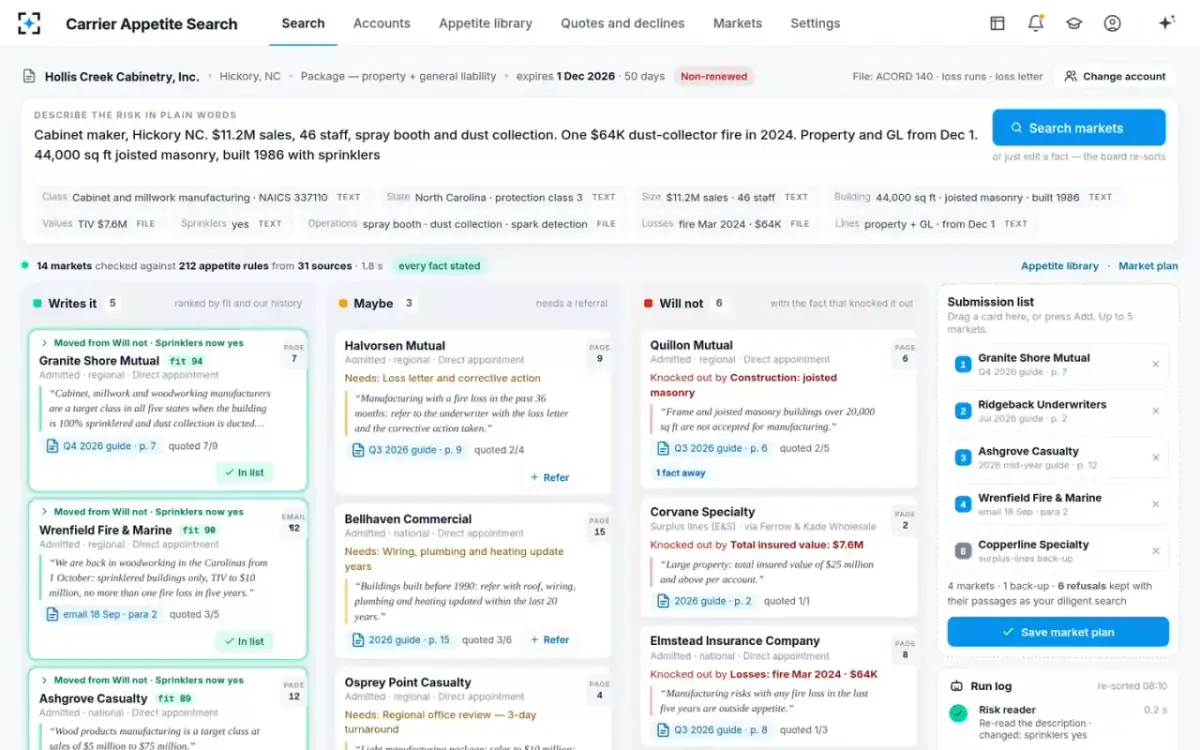
The back-up line names the route as well as the market: Copperline is reached through the wholesaler, not directly. A board that shows reach next to appetite tells the account manager whether a fit is a phone call or a referral.
Which waits does an appetite search remove, and which does it leave?
It removes the waits caused by asking the wrong market. Those are the declines that were predictable from what the market had already written down: a class it excludes, a state it does not write, a building it will not take, a loss history outside its limits. In Botminds' Carrier Appetite Search, the guides, bulletins, portal pages and underwriter emails of every market the agency can reach are read into rules with their page and date. A risk described in plain words is tested against all of them, and each market lands in Writes it, Maybe or Will not, with the passage that put it there.
It leaves the underwriting waits, and it should. An MGA's queue, an insurer's referral above the MGA's authority and a loss-control inspection are the market making its decision. An appetite match says a market is willing to look; it does not say the market will quote, at what price or on what form. The checklist below separates the two for an agency deciding whether to send a risk direct or through a wholesaler.
Before a hard risk leaves the retail agency: direct, or through a wholesaler?
- Is any appointed market a written fit?
A class, state and size the market’s current guide names, not a market that “sometimes” takes it.
- Is the fit current?
A guide past its edition date, or contradicted by a newer bulletin or underwriter email, is not a fit.
- Which unstated details could knock it out?
Sprinklers, alarms, loss history and building age left blank should count against the risk until confirmed.
- Which wholesaler markets fit, and through whom?
Name the route as well as the market: the wholesaler that holds the contract.
- Does the state require an admitted search first?
If so, which admitted insurers actually write this class here, and which of them have declined?
- What will the client pay in fees as well as premium?
Surplus lines tax and any broker or policy fee change the comparison with an admitted quote.
Sample figures on this page come from a fictional agency running Botminds' Carrier Appetite Search; every name in them is invented. How the six agents behind the board divide the reading and matching, and what none of them may decide, is set out in carrier appetite, matched by six agents.
Questions people ask
Is an MGA the same as a wholesaler?
No. An MGA acts for an insurer and underwrites inside limits the insurer sets; a wholesaler acts for the retail agency in finding a market. One firm can be both, holding binding authority for some programs and brokering everything else. The NAIC's model law decides MGA status by activity: managing an insurer's business and underwriting premium of at least 5% of its surplus, with claims or reinsurance authority.
What is a wholesale broker in insurance?
A licensed producer that places risks for other producers rather than for the public. Retail agencies use one to reach markets they are not appointed with, most often surplus lines insurers, which only a surplus lines licensee may place with. The FCA describes the same structure in London, where retail brokers usually need a terms of business agreement, often with minimum volumes, before they can deal with an insurer directly.
Does going through a wholesaler cost the client more?
Not necessarily in premium, because the wholesaler is usually paid from the commission the insurer already allows. The client may pay surplus lines tax, which applies to the placement rather than to the broker, and a policy or inspection fee where the state permits one. Ask for every fee in writing before comparing a wholesale quote with an admitted one.
Can an MGA decline a risk the insurer would write?
Yes. The MGA's binding authority is usually narrower than the insurer's own appetite, and anything outside it is either declined or referred to the insurer. A decline from an MGA program is a decline from that program, not necessarily from the insurer behind it, which may write the same class through its own underwriters or another program.
Do retail agents need to be appointed by the wholesaler's insurers?
Generally not, because the retail agent is not acting as those insurers' agent. The NAIC's State Licensing Handbook reads the model the same way: appointments are needed only for producers acting as an insurer's agent, not for brokers (NAIC State Licensing Handbook). The retail agent still needs a licence for the line, and in some states a broker's licence or an agreement with the surplus lines licensee.