An FCA target market assessment is the insurer's identification, for each insurance product, of the group of customers the product is designed for, and of any customers for whom it would not provide the intended value. The insurer (the "manufacturer") makes it under the FCA's product governance rules in PROD 4.2. A broker or other distributor of that product does not repeat it, but must have arrangements to obtain it from the insurer, understand it and distribute in line with it, under PROD 4.3. That makes the insurer's written appetite a regulated document in the United Kingdom: the closest any rulebook comes to the appetite guide a US agent reads. Botminds' Carrier Appetite Search keeps each market's written appetite as passages with their page and date, which is the kind of file the rule assumes a distributor holds.
One boundary matters before anything else. From 9 December 2025, PROD 4 does not apply to specialist risks contracts, or to general insurance contracts distributed to larger commercial customers where no policyholder or policy stakeholder is a consumer (FCA Handbook, PROD 1.4.3R and 1.4.3-AR). The target market duty now lives mainly in personal lines and in commercial insurance for small businesses, charities and trusts below the size thresholds.
PROD 4.3 duty by duty, and the file that proves each one
| Rule | What the distributor must do | The file that shows it |
|---|---|---|
| 4.3.1R | Have adequate arrangements to obtain the manufacturer’s product information, product approval information and identified target market | A library of each insurer’s product and target market information, with the date received |
| 4.3.2R | Have adequate arrangements to understand each product’s characteristics and identified target market | The same library, read: who in the firm owns each product’s information, and how staff use it |
| 4.3.2AR | For non-investment products, understand the value assessment and any group for whom the product is not expected to give fair value | The insurer’s fair value outcome and its stated excluded groups, filed with the product |
| 4.3.5R, 4.3.6R | Product distribution arrangements that prevent customer detriment, manage conflicts and take customers’ characteristics into account | A written distribution policy covering how products are matched to customers |
| 4.3.8R | Keep any distribution strategy in line with the manufacturer’s strategy and target market | Evidence that sales stay inside each product’s target market |
| 4.3.10R | Review the arrangements at intervals the firm sets by potential for harm, and keep a record of the intervals and why | A review log with the interval decided for each product and the reasons |
| 4.3.11R | Tell the manufacturer promptly when a product is out of line with its target market | Notes of what was reported to which insurer, and when |
| 4.3.13R, 4.3.14R | Document relevant actions for audit, and set out the arrangements in writing for staff | The written arrangements, and the audit trail behind them |
What is a target market assessment under the FCA rules?
It is the manufacturer's statement of who a product is for. For each product, the insurer's product approval process must "specify an identified target market", assess the risks to it, keep the distribution strategy consistent with it and take reasonable steps to see that the product reaches it (PROD 4.2.15R). The target market "must be identified at a sufficiently granular level, taking into account the characteristics, risk profile, complexity and nature of the insurance product" (PROD 4.2.16R).
The assessment is not the point-of-sale check. The FCA distinguishes identifying a target market from the individual assessment of whether a product meets a particular customer's demands and needs (PROD 4.2.20G). A broker does both: it relies on the insurer's target market to decide which products it may offer to which customers, and it makes its own demands-and-needs assessment for each customer.
What does PROD 4.3 require of distributors?
It requires a distributor of products it does not make to obtain the manufacturer's information and understand it. The core rule is short: where a firm distributes insurance products it does not manufacture, it must have adequate arrangements to understand "the characteristics of each insurance product" and "the identified target market of each insurance product" (PROD 4.3.2R). The FCA's guidance adds the standard: distributors "should put in place effective arrangements to ensure that they obtain sufficient, adequate and reliable information from the manufacturer" (PROD 4.3.4G).
Two further rules turn the information into conduct. A specific distribution strategy must be "in accordance with the distribution strategy set up and the target market identified by the manufacturer" (PROD 4.3.8R). And the arrangements must be reviewed regularly; when reviewing them, "a firm must verify that the insurance products are distributed to the identified target market" (PROD 4.3.10R(2)). A firm that cannot say which product information it relied on, on which date, will struggle to show either.
Who is responsible for the target market, insurer or broker?
Insurer (manufacturer): Identifies it for each product, at a granular enough level, with any groups the product does not suit.
Broker (distributor): Obtains it, understands it and keeps its own distribution inside it.
Insurer (manufacturer): Must make available the product information, its approval process and the target market.
Broker (distributor): Must have arrangements to obtain that information, and take reasonable steps where the manufacturer is outside PROD 4.2.
Insurer (manufacturer): Assesses whether the product gives fair value to the target market.
Broker (distributor): Understands the outcome, and the effect of its own remuneration on the value.
Insurer (manufacturer): Reviews products at intervals it sets by potential for harm.
Broker (distributor): Reviews its distribution arrangements at intervals it sets, and records why.
Insurer (manufacturer): Acts to avert detriment when the product no longer fits its target market.
Broker (distributor): Tells the manufacturer promptly, and amends its own distribution strategy.
Does the target market apply to commercial insurance?
For smaller commercial customers, yes; for larger ones, no longer. Since 9 December 2025, PROD 4 does not apply to "a specialist risks contract", or to "a general insurance contract (other than a specialist risks contract) distributed to larger commercial customers who make the arrangements preparatory to them concluding the contract", as long as no policyholder or policy stakeholder is a natural person acting outside their trade (PROD 1.4.3R and 1.4.3-AR). The FCA's guidance spells out the consequence: "PROD 4 will apply if at least one of the policyholders or any policy stakeholders is a consumer" (PROD 1.4.3-BG).
A larger commercial customer, in the new definition, includes a charity with annual income of £6.5 million or more, a trust with net assets of £5 million or more, and an enterprise that is neither a micro-enterprise nor a small business, using the size tests the Financial Ombudsman Service applies (FCA PS25/21, November 2025). Specialist risks contracts are the old large-risk classes: railway rolling stock, aircraft, ships, goods in transit, aircraft and ships' liability, and some credit and suretyship. Reinsurance and genuinely bespoke contracts are also outside PROD 4.
Is the product in scope of the target market rules? A first sort
| Customer or contract | PROD 4 target market rules | What still applies |
|---|---|---|
| Consumer (personal lines) | Apply | All of PROD 4, plus the Consumer Duty |
| Micro-enterprise or small business | Apply | PROD 4, and the FCA Principles |
| Larger commercial customer, no consumer policyholders or stakeholders | Do not apply, from 9 December 2025 | The Principles: treating customers fairly, clear communication, conflicts |
| Commercial policy with consumer policyholders, such as residential leaseholders | Apply | PROD 4 looks through to those policyholders |
| Specialist risks contract (marine, aviation, transit, some credit) | Do not apply | The Principles |
| Reinsurance, or a bespoke contract not marketed to others | Do not apply | The Principles |
What information must an insurer give a broker?
Enough for the broker to understand the product and its target market. The manufacturer "must make available to a distributor" all appropriate information on the product, on the product approval process and "the identified target market of the insurance product" (PROD 4.2.29R). For non-investment products the FCA expects that to include the intended value of the product, any effect the distributor may have on that value which the insurer has not allowed for, and "any type of customer for whom the insurance product is unlikely to provide fair value" (PROD 4.2.29AG). The information must let the distributor "identify any customers for whom the insurance product is not compatible with their needs, characteristics and objectives" (PROD 4.2.31R).
There is one limit. A manufacturer need not disclose information "objectively considered to be commercially sensitive" if what it does disclose still lets distributors understand the target market and spot customers outside it (PROD 4.2.32R(3)). In practice that is where an insurer's internal underwriting rules stop and its published appetite begins: the broker gets who the product is for, not how the insurer prices it.
What is a negative target market?
It is the group of customers a product is not for. The FCA's rules allow a manufacturer to identify "groups of customers for whose needs, characteristics and objectives the insurance product is generally not compatible" (PROD 4.2.17R), and for non-investment products they go further: the insurer must identify any groups for whom the product would not give the intended value, take reasonable steps to keep it from them and give distributors "a clear description of these customers" (PROD 4.2.17AR).
In appetite terms, a negative target market is the exclusion list. "Prohibited classes: woodworking, sawmills, pallet and cabinet manufacturing", in a fictional guide from the sample library behind the screen below, is the same kind of statement written for an agent rather than a regulator. A distributor that sells to an excluded group is outside the insurer's target market, and under PROD 4.3.11R it has a duty to tell the insurer when it finds a product reaching the wrong customers.
Written appetite, kept as a passage with its page and date
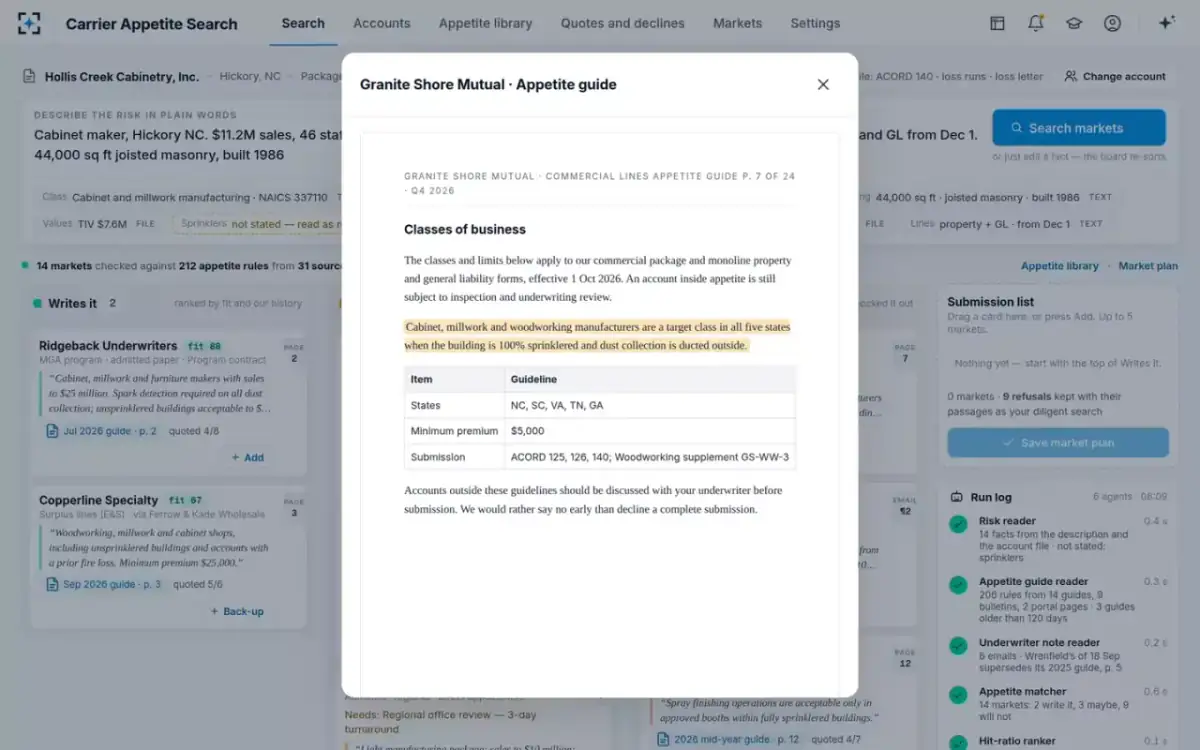
The guide's opening line says the classes apply from 1 October 2026. Keeping that date beside the passage is what lets a firm show, later, which version of the insurer's information it relied on.
How often should a target market be reviewed?
As often as the risk of harm requires: the FCA removed the fixed annual review for non-investment products in 2025. A distributor "must determine on an ongoing basis the appropriate intervals for the regular review of its product distribution arrangements based on the potential for customer harm" and keep a record of the intervals and the reasons (PROD 4.3.10R(3A) and (5)). The guidance says plainly that this "may result in reviews being carried out more frequently than once every 12 months", or less frequently where harm is less likely (PROD 4.3.10AAG).
The FCA's own summary of the change, in its November 2025 policy statement, was that it was "removing the governance requirement to review products every 12 months – instead requiring firms to decide how frequently reviews should be carried out based on risk" (FCA PS25/21). For a broker, the practical trigger for an unscheduled review is new information from the insurer: a revised target market, a new exclusion, a product withdrawn. An appetite library that flags a changed passage is one way to see those triggers arrive.
The insurer writes the target market; the broker must be able to show it obtained it, understood it and sold inside it. That is an appetite file with a date on every page.
What is product oversight and governance in insurance?
Product oversight and governance, often shortened to POG, is the European name for the rules the FCA carries in PROD 4: the insurer's product approval process, target market, testing and review, and the distributor's arrangements to obtain and use that information. The FCA's rules began as the UK's implementation of the Insurance Distribution Directive, and the Handbook still notes the source article beside many PROD 4 rules. Firms that sell in both the UK and the European Union work to two versions that have started to diverge, as the 2025 changes show.
POG is product-level, not technology-level. The FCA's 2024 AI Update says its rules rarely require or forbid any particular technology; the regulator looks at risks and outcomes instead (FCA, AI Update, April 2024). A firm can hold its target market information in folders, a spreadsheet or software that reads it; what the supervisor tests is whether the arrangements are adequate, reviewed and documented.
Is target market information the same as advice on a fair analysis?
No, but they meet. A broker that tells customers it advises on the basis of a fair analysis must base that advice on enough of the market's contracts to support a recommendation (FCA Handbook, ICOBS 5.3). Knowing each insurer's target market tells the broker which of those contracts are candidates for a given customer at all; the fair analysis compares the candidates. How a broker evidences that comparison is set out in the demands and needs statement.
The distributor's target market file: what a supervisor would expect to find
- Every product distributed, with its manufacturer
Including products from manufacturers outside PROD 4.2, where the firm must take reasonable steps to get the information.
- Each product’s target market and excluded groups, as received
The insurer’s words, the document they came from and the date received.
- The fair value outcome for non-investment products
And any group for whom the product is not expected to give fair value.
- The written distribution arrangements
Endorsed by the governing body and available to staff.
- The review intervals and the reasons
Per product, set by potential for harm, with the record PROD 4.3.10R(5) requires.
- Reports made to manufacturers
What was found, which insurer was told, when, and what the firm changed.
- Scope decisions
Which products and customers the firm treats as outside PROD 4 after December 2025, and why.
Sample figures and screens on this page are fictional. US readers will find the same discipline described in the appetite guide files an agency gathers, where no rule requires it, and the wider vocabulary in underwriting appetite and eleven other terms.
Questions people ask
What is a target market statement?
It is the document in which an insurer sets out a product's target market for distributors: who the product is designed for, who it is not for, and how it should be distributed. The FCA does not prescribe a template; it prescribes what the information must enable a distributor to do, including identify customers for whom the product is not compatible.
Do MGAs have to do a target market assessment?
An MGA that designs a product with an insurer is a co-manufacturer and must agree its role with the insurer in writing. Under the 2025 rules the firms may choose a single lead firm to carry the manufacturer duties, but the lead must be an insurer or a Lloyd's managing agent: the FCA's guidance says an insurance intermediary "cannot be a lead firm" for that purpose.
Does the Consumer Duty replace the target market rules?
No. The Consumer Duty applies alongside PROD for retail customers. The FCA's 2025 changes relied on the Duty to justify removing some prescriptive rules, but PROD 4's target market requirements remain for products in scope.
What happens if a broker sells outside the target market?
A sale outside the target market is not automatically a breach, because the point-of-sale assessment is about the individual customer. But a pattern of sales outside it suggests the distribution arrangements are not working, and PROD 4.3.11R requires the broker to tell the insurer promptly and, where appropriate, change its distribution strategy.
Does a US agency have an equivalent duty?
Not in this form. US law regulates the producer's licence, appointment and conduct, not a target market file. But the practical risk is the same: a submission to a market whose written appetite excludes the client wastes time, and a placement outside a program's rules can unravel. Keeping the insurer's written appetite, dated and cited, serves both systems.