An insurance appetite checker is a tool that takes a description of a risk (class, state, size, building, losses) and tells an agent which insurers or MGAs want to write it, before a submission is sent. Some are run by a single carrier for its own appointed agents; others work across many markets for the agency. The second kind is the harder one to build and the harder one to judge, because its answers are only as good as the appetite documents behind them and nobody outside the agency can see whether those documents are current. Botminds' Carrier Appetite Search is a multi-market checker built on the agency's own guides, bulletins, portal pages and underwriter emails, with each market's answer tied to its passage and page. The ten questions below are the ones to ask of any appetite checker, including ours.
The questions follow one principle: a checker should leave behind the evidence a careful person would want if a placement were later questioned, by a client, an underwriter, an errors and omissions insurer or an examiner. A checker that is fast but cannot show why is a faster way to send the wrong submission.
Ten questions for an insurance appetite checker
| Question | What a good answer shows | Red flag |
|---|---|---|
| 1. Can it show the passage behind every answer? | The market’s own words, the document, the page and the date, one click from the verdict | A score or a colour with no source |
| 2. Does it know which markets you can reach, and how? | Your appointments, program contracts and wholesaler routes beside each market | A national market list that ignores your appointments |
| 3. Whose appetite data is it? | Your markets’ current guides, bulletins and emails, loaded by you or from your inbox | A vendor-maintained summary with no edition dates |
| 4. Does every rule have a date, and which wins? | Edition dates, stale guides flagged, newer bulletins and emails winning with the old passage still visible | Rules with no date, or silent overwriting |
| 5. What does it do with a detail you did not give? | Marks it as not stated and reads it the cautious way, so the board errs toward no | Assumes the best, and sends you to a decline |
| 6. Does each refusal name the deciding detail? | “Will not: construction”, with the rule, so you can fix it or explain it | A bare “not a fit” |
| 7. Who may override a refusal, and is the reason kept? | A named role, a required reason, kept on the account file | Anyone can hide a refusal, and nothing records it |
| 8. Does it send anything on its own? | Drafts only; a person chooses the markets and sends | Automatic submissions to “matched” markets |
| 9. Will it run a replay on your closed files? | Your last year’s submissions, run as sent, scored against what markets did | Only the vendor’s own accuracy figure |
| 10. What does it leave behind? | Every search, re-sort, plan, override and sign-off on an activity trail | Results that vanish when the screen closes |
What is an insurance appetite checker, and how do appetite checkers work?
Every checker does three things: it reads a description of the risk, it holds a set of appetite rules for each market, and it compares the two. The differences are in where the rules come from and what the comparison returns. A carrier's own checker draws on its underwriting rules and returns a yes, a no or a referral for that carrier only. A multi-market checker needs rules for every market the agency uses, which means reading many carriers' guides, each written differently, and keeping them current.
In Carrier Appetite Search the reading is done by agents with narrow jobs. One reads the description and the account file into details, each with its source. One reads guides, bulletins and portal pages into rules, each with its page and date; another reads underwriter emails and marks which older passage each one replaces. A matcher tests every rule against the risk and sorts each market into Writes it, Maybe or Will not, naming the deciding detail.Carrier appetite, matched by six agents sets out each agent and its limits.
Two kinds of appetite checker, and what each can answer
A single carrier's checker: Will this carrier consider the risk?
A multi-market appetite search: Which of all your markets will, and through which route?
A single carrier's checker: The carrier’s own underwriting rules, kept current by the carrier
A multi-market appetite search: Each market’s guides, bulletins, portal pages and emails, kept current by the agency
A single carrier's checker: Rarely; the carrier’s rules are its own
A multi-market appetite search: Must, or it cannot be checked
A single carrier's checker: Only for itself
A multi-market appetite search: Must, or it recommends markets you cannot reach directly
A single carrier's checker: Usually free to appointed agents
A multi-market appetite search: A licence, plus the work of keeping the library current
Are carrier appetite tools accurate?
They are as accurate as their newest source, and you can measure it on your own files. The common failure is not misreading a guide; it is reading an old one. A guide raised a size limit in a bulletin, an underwriter reopened a class by email, and the checker still holds last quarter's edition. That is why questions 3 and 4 matter more than any vendor's accuracy figure: who loads the sources, and does every rule carry a date?
The fair test is a replay: take last year's submissions, run each through the checker as it was described on the day it was sent, against the guides in force that day, and count how many out-of-appetite declines it would have prevented and how many quotes it would have blocked. The replay method sets out the steps. No regulator, academic study or non-profit research body publishes accuracy benchmarks for appetite tools, so your replay is the benchmark.
The plan cites the passage that makes each market a fit
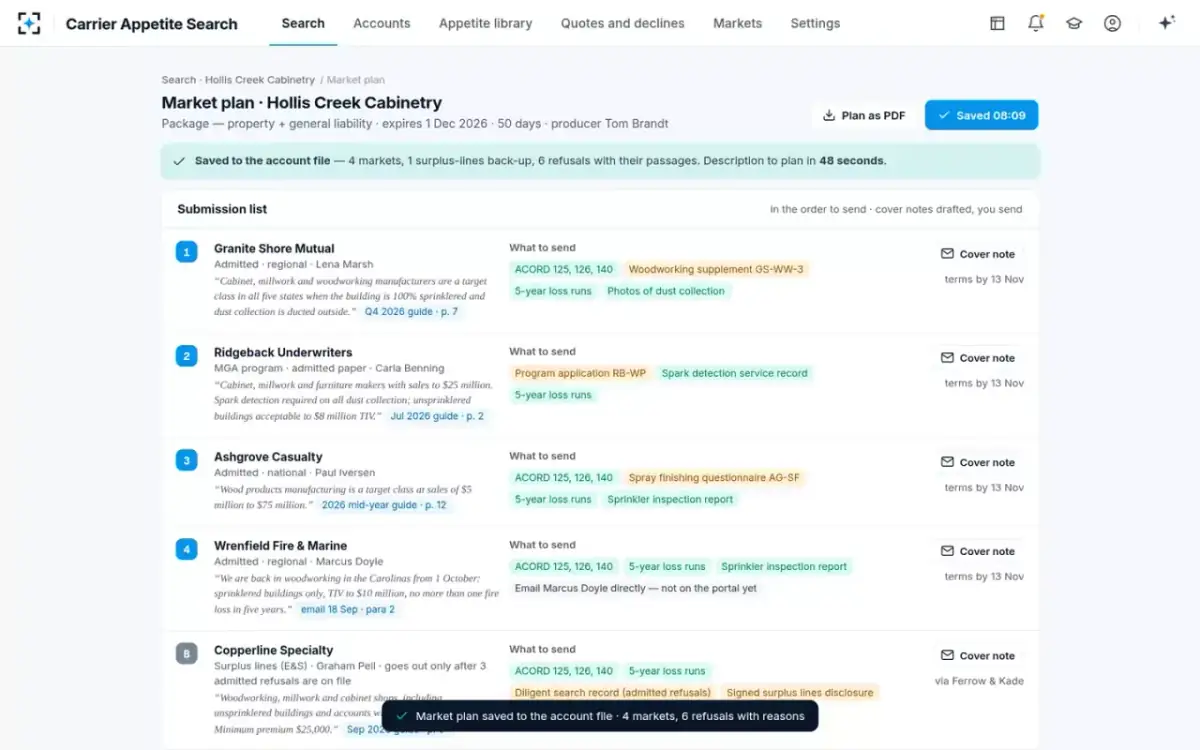
The plan is saved to the account file, so the reason each market was chosen survives the renewal. That is question 10 answered on one screen.
Questions 1 and 2: can you see why, and can you reach the market?
Show the passage. A checker that says "fit 88" without the sentence behind it asks for trust instead of giving evidence. The market's own words, with document, page and date, let an account manager check the answer in seconds and quote it to the underwriter.
Know the routes. Under the NAIC model a producer acts as an insurer's agent only once appointed by it (Model #218, §14), and insurers' examiners check that "regulated entity records of licensed and appointed (if applicable) producers ... agree with insurance department records" (NAIC exam standards, 2024). A checker that ignores your appointment list recommends markets you can only reach through someone else, without saying so.
Questions 3 and 4: whose appetite data is it, and is it current?
Own the data. A vendor-maintained appetite database may be convenient, but ask how it learns that a carrier changed its mind last week, and whether it holds your markets' program guides or only the national ones. A checker that reads your own sources is current when you are.
Date everything. Every rule needs an edition date, a stale flag after a set age, and a rule for conflicts. In Carrier Appetite Search the newest dated source wins and the passage it replaced stays visible; guides older than 120 days, by default, are flagged for the marketing coordinator to chase.
Questions 5 to 8: what does it assume, and what may it do?
Missing details. A checker that assumes a building is sprinklered because nobody said otherwise will send you to markets that require sprinklers, and the decline will come back a week later. The safer design marks the detail as not stated and reads it as absent, and names it, so the account manager knows the one question to ask the client.
The deciding detail. A refusal that names the detail ("Will not: construction, frame and joisted masonry over 20,000 sq ft") is useful three ways: it can be checked, it can be fixed, and it can be explained to the client. It is also the start of a diligent search if the risk goes to surplus lines, provided the refusal comes from an admitted insurer that writes the class in the state, which is how North Carolina frames the search (N.C. Gen. Stat. § 58-21-15). A checker that counts refusals from markets that never wrote the class is padding the file.
Overrides. Appetite rules are blunt, and good underwriters make exceptions, so a checker must allow overrides. The question is who, and whether the reason survives. In Carrier Appetite Search the default is the placement specialist, with a reason kept on the account file.
Sending. Sending a submission commits the client's information and the agency's name to a market. The licence gives no authority to commit an insurer, and nothing in an appetite match changes that. A checker should draft, not send.
Drafted with the passage, sent by a person
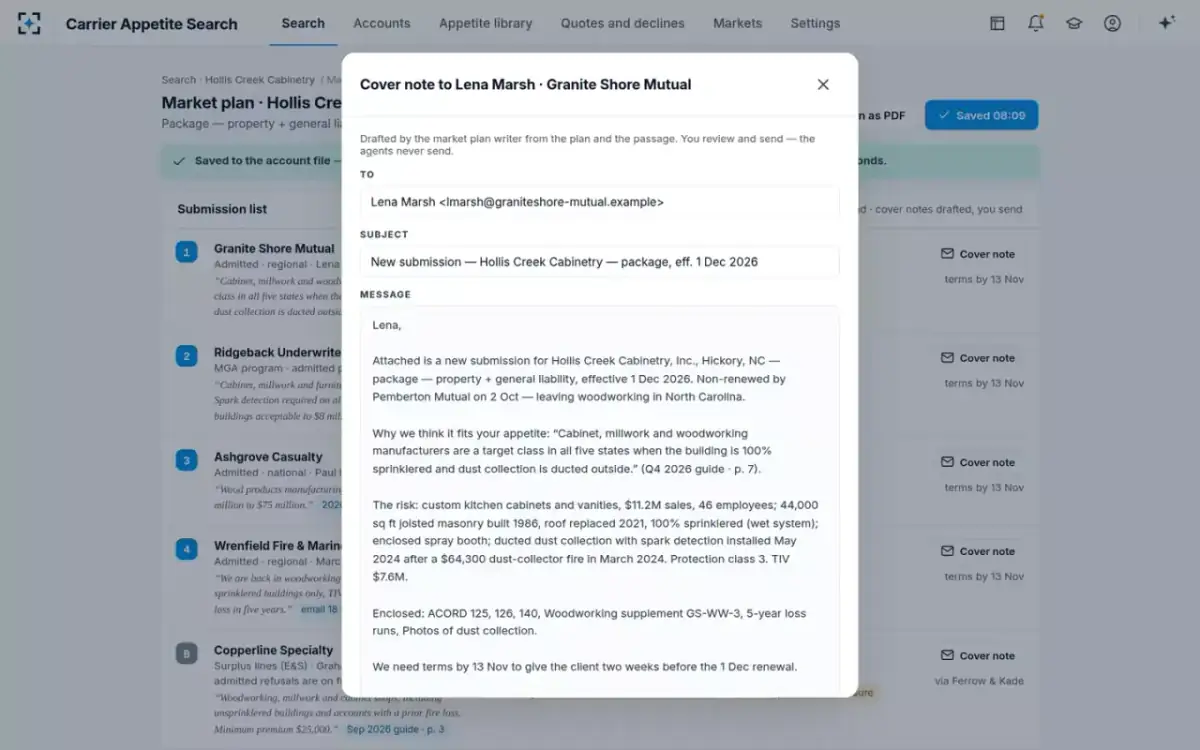
Quoting the passage back to the underwriter is the cheapest way to get a submission read first: it shows the agency checked the guide before sending.
Questions 9 and 10: can you test it, and what does it leave?
The replay. A vendor confident in its checker will run it on your closed files, with your outcomes held back, and let you score it. A vendor that offers only its own accuracy figure is asking you to trust a number measured on someone else's book.
The trail. Every search, re-sort, plan, override and sign-off should be kept with who did it and when. US law sets no specific rule for appetite records, but the UK's product governance rules show what a regulator expects of distribution decisions: relevant actions "must be duly documented, kept for audit purposes and made available to the FCA upon request" (FCA Handbook, PROD 4.3.13R). An agency defending a placement years later needs the same.
A checker that is fast but cannot show why is a faster way to send the wrong submission.
What should an appetite tool integrate with?
With the places the agency's appetite and accounts already live. The minimum is the agency's document store or shared folders for guides, a shared appetite inbox for underwriter emails, the account file for applications and loss runs, and the agency management system for the appointment list and the history of quotes and declines. Carrier portals matter too, though most are reached by a person saving a dated copy of the class lookup rather than by a connection.
Ask what happens when an integration fails. If the inbox connection breaks, does the checker say that its email rules stopped updating on a given date, or does it keep answering as if nothing changed? The second is worse than having no integration at all. The appetite inventory lists every source an appetite search needs and who in the agency owns each one.
Who Carrier Appetite Search is for, and what it will not do
It fits retail agencies and brokers that place commercial risks across several carriers, MGAs and wholesalers, keep appetite in guides, bulletins, portals and inboxes, and lose time to predictable declines. Run on a fictional agency's sample data, it checked 14 markets against 212 appetite rules from 31 sources in 1.8 seconds and produced a saved market plan 48 seconds after the risk was described. The design target is to cut out-of-appetite declines to 13% of commercial submissions from the sample agency's 38%. Those are sample results and a target, not a customer's measured result; your replay is the number that counts.
It does not quote, rate or bind; it does not replace a carrier's own checker for that carrier's answer; and it does not replace a wholesaler's knowledge of the surplus lines market. It reads appetite, not policy wording, so it says nothing about whether a quoted form covers what the client needs. Regulators will not ask for it by name: the FCA says it regulates outcomes and stays neutral about technology (FCA, AI Update, April 2024). What they ask for is properly appointed producers, fair treatment and a record of why. The ten questions are a way to buy that.
A two-week trial of any appetite checker, on your own files
- Day 1–2: load your sources
The appointment list, current guides and bulletins for every reachable market, and the appetite inbox.
- Day 3: check twenty rules by hand
Open the cited page for each. Any rule without a page, or with the wrong words, fails question 1.
- Day 4–7: replay a closed quarter
Submissions as sent, guides as they were, outcomes held back. Score the four boxes.
- Day 8–10: run live accounts
Five accounts being marketed now; compare the board with what the markets answer.
- Day 11: test the edges
A description with details missing; an email that contradicts a guide; an override with a reason.
- Day 12–14: decide on evidence
Avoidable declines caught, quotes it would have blocked, time per market check, and what it left behind.
Questions people ask
How much does an appetite search tool cost?
Vendors rarely publish prices, so compare the tool with the work it replaces. Botminds estimates that a by-hand market check on one commercial account takes about three hours, and about half an hour with agents reading and matching; multiply the difference by your marketings per year and your staff cost. Add the coordinator's time to keep the library current, which no tool removes.
Can an appetite tool read PDF appetite guides?
A good one can, but test it on your hardest guide: one with class tables, footnotes and a construction matrix. Ask to see a rule it extracted with the page open beside it. Paraphrase is where a "refer" turns into an "acceptable", so the rule should keep the guide's own words.
Does an appetite checker replace the wholesaler?
No. It tells the agency which wholesaler markets fit and that the route is a referral; the wholesaler still holds the contracts, the surplus lines licence and the relationships. What the checker changes is what reaches the wholesaler: a risk already described, with the admitted markets' refusals and their reasons attached.
What data does an appetite tool need from my agency?
The appointment list with routes, every reachable market's guides and bulletins, the underwriter emails about appetite, the account file for each risk searched and, for ranking, the history of quotes and declines by market. It does not need policy or claims data beyond loss runs, and it should not need access to send email on the agency's behalf.
Is a free carrier appetite checker enough?
For that carrier, often yes; its own checker is the best word on its own appetite. It cannot tell you which of your other markets want the risk, which you can reach directly, or how the answers compare. Agencies that use many markets tend to need both: a multi-market search to pick the carriers, and each carrier's checker to confirm.