Hard to place insurance is commercial or personal cover that the standard admitted market will not readily write: a class most insurers exclude, a loss history, a building, a location or a size that falls outside most appetite guides. Such risks can usually be placed, through specialty markets, MGA programs, the surplus lines market or, for some lines, a state residual plan, but only after more markets have been asked and more have said no. That makes time the scarce resource. Botminds' Carrier Appetite Search shows the account manager, on day one, which markets' written appetite fits the risk and which will not, so the weeks before expiry go to markets that might quote. This page prices a wasted week, using public wage and commission data and your own account's figures.
The clock is set by law and by contract, not by the broker. In New York, an insurer that will not renew a covered commercial policy must mail notice between 120 and 60 days before it expires, and send a copy to the insured's agent or broker as well (N.Y. Ins. Law § 3426(e); the carrier's side is laid out in thecommercial insurance renewal timeline). Other states set their own windows. Whatever the state, the broker's runway begins the day the notice lands.
Sixty days from non-renewal to expiry: where a hard risk's runway goes
- Gather the file7 d
- Two usual markets decline10 d
- Two more decline10 d
- Wholesaler and quotes25 d
- Decide and bind8 d
- Gather the file7 d
- Four fitting markets quote together25 d
- Decide and bind8 d
- Spare: room for a second round20 d
What makes a risk hard to place?
A risk becomes hard to place when the number of markets whose written appetite includes it falls to a handful. Four things usually do it. The class itself: a hazard most guides exclude, such as spray finishing, roofing or late-night liquor. The risk's own record: losses in the last three to five years, or an open claim. The property: frame construction, old wiring or roofs, no sprinklers, a catastrophe-exposed location. And size: values or revenue above the limits a regional market will write, or below the minimum premium a specialty market will accept.
The market moves the boundary too. The NAIC's review of 2025 found property lines, commercial property above all, softening, while casualty lines stayed firm as social inflation and very large verdicts kept pushing loss costs up (NAIC, 2025 Annual Property and Casualty Industries Analysis Report; what that means for a renewal is in hard market vs soft market insurance). A risk with heavy liability exposure can therefore be harder to place this year than last, even with the same record, and an agency's memory of who wrote it two years ago is a poor guide.
The market a hard risk is placed into, in four figures
4.7%
rise in US commercial lines direct premiums written in 2025
93%
P&C combined ratio in 2025 (93.03%), from 96.65% in 2024
$20M
per building, $100M per location: California FAIR Plan commercial property limits approved in March 2025
90days
the longest an Arizona binder may run without the director’s written approval
How long does it take to place a hard risk?
Longer than a standard renewal, because each round of markets takes one to three weeks and a hard risk often needs two or three rounds. No regulator or academic source publishes placement times for hard-to-place commercial risks, so the honest answer comes from your own files: for the last ten difficult renewals, count the days from the notice to the first market sent, from each send to each answer, and from the last answer to binding.
What the files usually show is that the waiting is concentrated in the early rounds. Markets that will not write the class tend to answer late, because a decline is nobody's priority, and the agency often waits for them before widening the search. The fix is not to chase the underwriters; it is not to send to markets whose own guide already excludes the risk. Replaying last year's declines shows how many of your early rounds were predictable.
What a wasted week costs, term by term
A wasted week has three costs: the hours spent preparing for and chasing a market that was never going to write the risk, a share of the runway that the account cannot get back, and the goodwill a predictable decline spends with that underwriter. The first is small and easy to price. The second is the one that loses accounts.
The price of one wasted week on a hard-to-place account
Staff time
hours on the wrong market × loaded hourly cost
Preparing, sending, chasing and recording the decline. At the BLS median wage for insurance sales agents, $62,280 a year, an hour is about $30 before benefits.
Your payroll
Runway lost
7 days ÷ days from notice to expiry
On a 60-day notice, one week is 12% of the time the account has. Two wasted weeks leave too little for a second round of quotes.
Your notice dates
Revenue at risk
chance the account lapses or is lost × the agency’s commission on it
Insurers’ commission and brokerage expense on commercial multiple peril was 16.32% of earned premium in 2024, an average across insurers, not the rate on any one account.
Your agency’s split
Goodwill spent
predictable declines sent to one underwriter this year
Not priced in money, but counted: it is why the next submission to that market is read later.
Your placement specialist
Take the sample account behind the screens on this page: a fictional cabinet maker with a $48,600 package premium, non-renewed on 2 October for 1 December, 60 days' notice. If the agency's commission on it were 11%, a hypothetical rate, the account would be worth about $5,300 a year to the agency, renewal after renewal. Two hours wasted on a market that excludes joisted masonry cost about $60. A week of runway lost, on an account with three rounds to run, can cost the account. The first number is the one agencies measure; the second is the one that matters.
Where do you place hard to place commercial insurance?
In widening circles: first the admitted markets whose written appetite fits, then specialty admitted markets and MGA programs for the class, then the surplus lines market through a wholesaler, and for some lines a state residual plan. Each circle is reached differently. The agency's own appointments are a phone call. An MGA program may need a separate contract. Surplus lines usually need a wholesaler holding the surplus lines licence, and the state's diligent-search rule must be met first.
Residual plans are the last circle, and they are narrower than people think. California's FAIR Plan, which the state calls its "insurer of last resort", had its commercial property limits raised in March 2025 to "$20 million per building, with a total $100 million maximum limit per location" (California Department of Insurance, 28 March 2025), a sign of how far the admitted market had retreated. Illinois' surplus lines law, for its part, does not require a producer to submit a risk to a residual market mechanism that it is not eligible for or whose limits it exceeds, as part of a diligent effort (215 ILCS 5/445).
When should a hard to place risk go to surplus lines?
When the admitted market has been tried and the state's rule allows it, and not before. North Carolina's statute, like most, permits a surplus lines placement only where the cover "cannot be obtained from insurers who are admitted to do business in this State", after "a diligent search is made among the insurers who are admitted to transact and are actually writing the particular kind and class of insurance in this State" (N.C. Gen. Stat. § 58-21-15). Rules differ by state in the number of declinations, the form and who signs it; Botminds' Surplus Lines Filing Compliance covers the filing side.
"Actually writing" is the phrase that turns an appetite search into evidence. An admitted insurer that does not write in the state, or excludes the class outright, was never in the search, so its refusal does not count toward it. An appetite library that records which admitted markets write the class in the state, and which of those declined and why, gives the surplus lines broker a search it can defend instead of a list of names.
Accounts to market, non-renewals first, with the days left
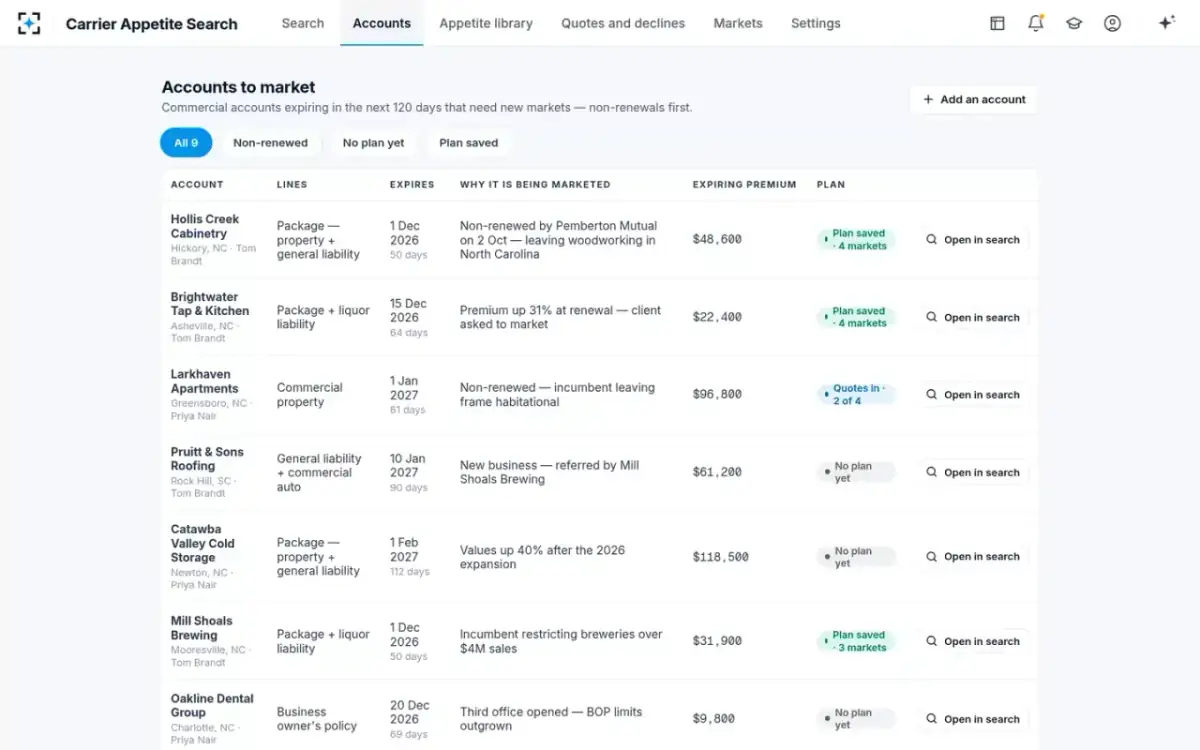
The 120-day horizon matches the longest notice New York's statute allows, so a non-renewal appears on this list the day its notice arrives.
How many markets should a hard risk be shown to?
As many as fit, and no more. Showing a hard risk to every market in reach feels thorough but costs goodwill with each predictable decline, and it can confuse an account if two wholesalers approach the same surplus lines insurer. Showing it to too few leaves the client without a comparison. The useful number is the count of markets whose written appetite includes the risk, plus a back-up route, and Carrier Appetite Search caps a submission list at a number the agency sets (five by default) so that the decision to go wider is a person's.
The order matters as much as the count. Admitted markets that fit go first, both because the client usually pays less in tax and fees and because a surplus lines placement needs the admitted refusals on file. Within the admitted group, the agency's own history with each market (how often it quoted similar risks) is a better tie-breaker than habit. Wholesale broker or MGA explains the routes beyond the agency's own appointments.
How early should a hard to place renewal start?
As early as the facts are known, which for a non-renewal is the day the notice arrives and for a known-difficult renewal is earlier still. For a binder to bridge a late placement, check the state's limit first. In Arizona a binder ends when the policy issues or 90 days after it takes effect, whichever comes first, unless the director approves an extension in writing (Ariz. Rev. Stat. § 20-1120; other states in how long a binder is good for). A binder is a bridge, not a second runway.
The agency can start earlier than the notice on risks it knows are fragile. A renewal review 120 days out, with the risk described and checked against current appetite, shows whether the incumbent's latest bulletin has moved the class, and whether any other market still writes it. When the notice comes, the plan already exists.
An insurance placement strategy for a hard risk, in the first week
- Describe the risk once, completely
Class, state, size, building, protection, operations, losses and lines, with the source of each detail.
- Mark what is not stated
An unconfirmed sprinkler or alarm is treated as absent until the client confirms it in writing.
- Check every reachable market’s current appetite
Guides, bulletins and underwriter notes, newest first, with the edition date in view.
- Separate fits from routes
Appointed markets, MGA programs, wholesaler markets: each fit with the way to reach it.
- Send to the fits together
Parallel, not serial; each with a cover note quoting the passage that makes it a fit.
- Keep the refusals with their passages
If surplus lines may be needed, the admitted refusals and their reasons are the start of the diligent search.
- Set the decision date
Terms asked for by a date that leaves time for a second round and for binding before expiry.
What happens if no carrier will insure my business?
It is rarely literally none. A business declined by the admitted market can usually find cover in the surplus lines market, through a broker licensed for it, usually at a higher price and on different terms. For property, some states run a FAIR plan as the insurer of last resort, as California does. What the owner should ask the broker is which markets were tried, why each said no and what would change the answer.
That last question is where a cited appetite search earns its keep for the client as well as the agency. "Will not: construction, frame and joisted masonry over 20,000 sq ft" tells a business owner something they can act on, now or before the next renewal: sprinkler the building, upgrade the dust collection, separate the spray booth. A bare "declined" tells them nothing.
Figures on this page that come from the solution are fictional sample data. Carrier appetite, matched by six agents shows how the board is produced and which decisions stay with people.
Questions people ask
What does hard to place mean in insurance?
It describes a risk that few admitted insurers will write on standard terms because of its class, loss history, property, location or size. It is a description of the market's appetite, not a legal category. A risk that is hard to place this year may be easier next year if the class's results improve or the business fixes what knocked it out.
Is hard to place the same as high risk?
Not quite. A high-risk business with a clean record in a well-served class may be easy to place at a high price; a modest risk in a class most insurers have left may be hard to place at any price. Placement difficulty depends on how many markets' written appetite includes the risk, not only on how risky it is.
Can a broker bind cover while still marketing a hard risk?
Only with an insurer that has agreed to cover it, and binders have limits. In Arizona a binder lapses when the policy issues or after 90 days, whichever is sooner, unless the director approves an extension in writing. A binder from the expiring insurer is not available on a non-renewal, so the runway is the notice period.
Does the surplus lines market cost more?
Usually the premium is higher and the insured pays surplus lines tax, and sometimes a broker or policy fee, on top. Ask how the state's guaranty arrangements treat the policy before comparing it with an admitted quote. In exchange, surplus lines insurers can write classes and terms the admitted market will not, which for a hard risk may be the only cover available.
How do I make my business easier to insure?
Find out which detail knocked each market out, and fix the ones that can be fixed: sprinklers, alarms, roof or wiring updates, loss-control changes after a claim, separated hazardous operations. Then make sure the next submission states them, with evidence, because an unstated improvement is usually read as no improvement.