Carrier appetite is the set of risks an insurer, MGA or wholesale market wants to write: the classes, states, sizes, buildings, operations and loss histories it says yes to, and the ones it will not touch. It is written in many places at once (an appetite guide, a quarterly bulletin, a portal page, an underwriter's email), it changes without notice, and every market words it differently, which is why matching a risk to it is slow. Botminds' Carrier Appetite Search splits that matching into six jobs for agents, each of which must show the passage and page it relied on, and leaves three decisions to people: which markets the client sees, whether to go beyond the agency's appointments, and anything said to the client about cover.
The split is not a product choice so much as a reading of the law. A producer licence, in the NAIC's model, gives its holder no authority of any kind to represent or commit an insurer (NAIC Producer Licensing Model Act #218; the difference is drawn in insurance license vs appointment). Authority comes from appointments, contracts and the insurer's own underwriters. Software that matches appetite inherits that limit: it can tell an account manager where a risk fits, but never commit a market, and never speak for one.
Six agents and the people who decide: one risk, from plain words to a plan
Agent
Risk readerTurns the account manager’s description, the applications on file and the loss runs into details: class, state, size, building, protection, operations, losses, lines. Each detail names its source.
Never: fills in a detail nobody stated; an unstated sprinkler is read as none
Agent
Appetite guide readerReads each market’s guide, bulletins and portal pages into rules (class stance, limits, protection requirements), each with its page and date.
Never: keeps a rule without its page, or rewrites the passage
Agent
Underwriter note readerReads the shared appetite inbox into rules and marks which older passage each one supersedes.
Never: treats a note as appetite without its sender and date
Agent
Appetite matcherTests every rule against the risk and sorts each market into Writes it, Maybe or Will not, naming the deciding detail. Re-runs whenever a detail changes.
Never: puts a market in Writes it without a passage that names the class
Agent
Hit-ratio rankerOrders the markets by fit and by the agency’s own quotes and declines over a window the agency sets.
Never: hides a market because of its rank
A person decides
Account managerChooses the markets, the order and the route; corrects any detail the reader got wrong.
Agent
Market plan writerDrafts the plan, what each market needs and a cover note to each underwriter, quoting the passage.
Never: sends a submission or contacts an underwriter
A person decides
Placement specialist and principalOverrides a Will not, with a reason on the file; signs before any surplus lines market is approached.
Never: delegates the override or the sign-off to an agent
What is carrier appetite, and where is it written?
Carrier appetite is a market's written statement of what it wants to write, and it lives in at least four kinds of document. The appetite guide is the anchor: a PDF of classes, limits and conditions, usually re-issued on a cycle. Bulletins change it between editions. Portal pages carry class lookups that may be newer than either. And the underwriter's email ("we are back in woodworking in the Carolinas from 1 October") is often the newest word of all, and the one most likely to be lost in a single person's inbox.
Appetite is not eligibility, and it is not a quote. Eligibility is the market's underwriting rule for accepting a risk; appetite is how much it wants risks like it. A target class, an acceptable class and a referral class can all be eligible. Underwriting appetite, and eleven other market terms defines each word against the rule or document that gives it meaning.
How do agencies track carrier appetite today?
Mostly by memory, a spreadsheet and the portals. An account manager knows the eight or so markets she places most often and checks the rest when a risk is unusual: a guide here, a portal lookup there, an email to the marketing coordinator who keeps the folder current. The method works for familiar risks and fails on the ones that matter most: a non-renewal in an awkward class, a market that changed its mind last quarter, an appointment the agency rarely uses.
Botminds estimates that a by-hand market check on one commercial account takes about three hours: half an hour reading the account file into details, an hour and a quarter in portals and guides, half an hour in underwriter emails, a quarter of an hour choosing the order and half an hour listing what to send. With agents doing the reading and matching, the same estimate falls to about half an hour, nearly all of it the account manager's own choices and cover notes. These are estimates for planning, not measured results; the way to get your own figure is to time the next ten marketings.
One sample run: every market checked, every passage cited
14
markets checked against 212 appetite rules from 31 sources
1.8s
from description to a sorted board
48s
from description to a saved market plan
3
markets moved from Will not to Writes it when one detail, sprinklers, was added
Can AI read carrier appetite guides?
Yes, if reading means turning each passage into a rule that keeps its page, its date and its exact words. The guide reader in Carrier Appetite Search does not summarise a guide; it extracts rules such as "frame and joisted masonry buildings over 20,000 sq ft are not accepted for manufacturing", ties each one to page 6 of a dated edition, and flags any guide older than a set age (120 days by default) so someone asks the market for the current one. The underwriter-note reader does the same for the appetite inbox, and records which guide passage each newer note replaces, while keeping the replaced passage visible.
The hard part is not the PDF; it is the conflicts. A Q3 guide, a 1 October bulletin and an underwriter's email of 18 September can each say something different about the same class. The rule the solution follows is simple: the newest source wins, and the older one stays on screen with the reason it lost. A reader can then disagree with the machine on evidence, not on trust.
A Will not names the detail that knocked it out, and the passage that says so
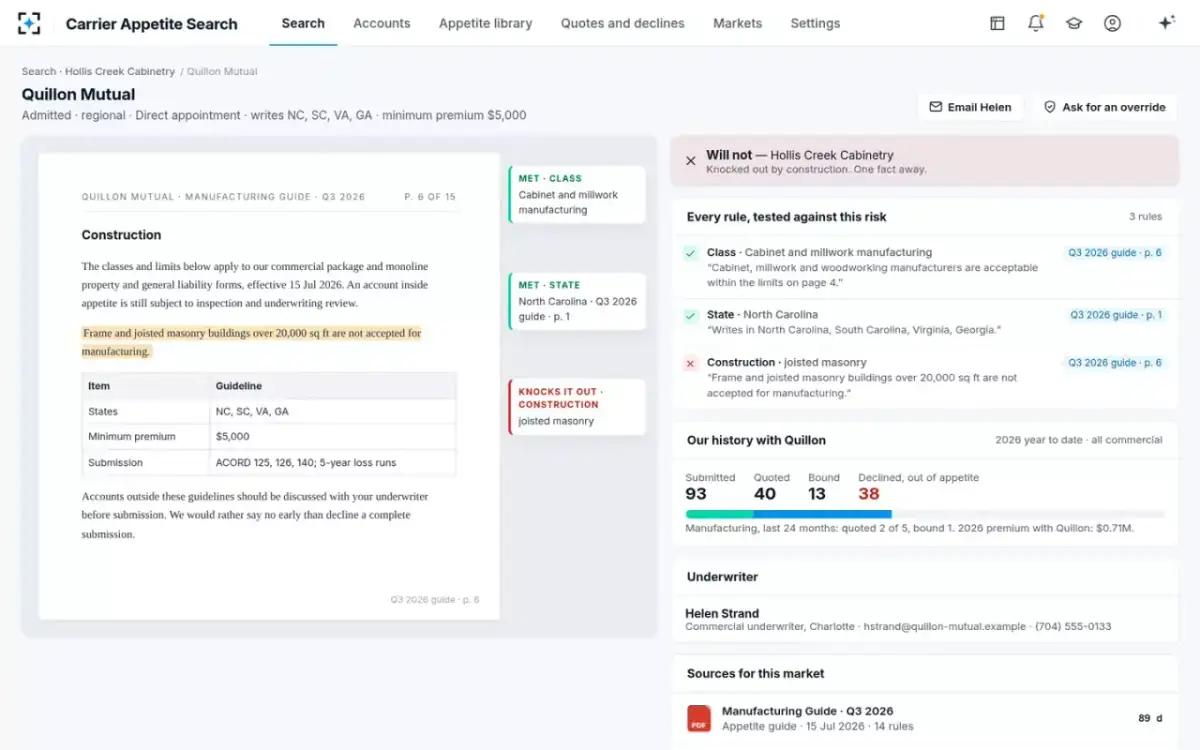
The override button is there, but it belongs to the placement specialist and asks for a reason that stays on the account file.
What should an appetite tool never decide? Three calls that stay with people
Three decisions stay with people, because each is either a judgement about the client or an act that commits the agency. The table sets out what each agent may and may not do; the paragraphs below explain the three human calls.
What each agent may do, and what it may never do
| Agent | May | May never |
|---|---|---|
| Risk reader | Read details from the description and the account file, and mark each with its source | Guess a detail, or infer a protection feature nobody stated |
| Appetite guide reader | Turn guides, bulletins and portal pages into rules with page and date | Keep a rule without its page, or paraphrase the passage |
| Underwriter note reader | Turn underwriter emails into rules, and mark what they supersede | Treat pricing chatter, or a note without sender and date, as appetite |
| Appetite matcher | Sort every market into Writes it, Maybe or Will not, naming the deciding detail | Place a market in Writes it without a passage that names the class |
| Hit-ratio ranker | Order markets by fit and by the agency’s own quotes and declines | Hide a market because of its rank; rank surplus lines above admitted |
| Market plan writer | Draft the plan, the document list and the cover notes | Send anything, or contact an underwriter |
Which markets the client sees. A board of five markets that write the risk is advice to the account manager, not to the client. Which of them to approach, in what order and with what story is a placement judgement that weighs things no guide states: how the underwriter treated the last three accounts, whether the client needs a market that pays claims locally, and how much of the agency's goodwill one more submission spends.
Whether to go beyond the agency's appointments. Under the NAIC model, a producer acts as an insurer's agent only once appointed by it. Examiners test it: the NAIC's producer licensing standards check that producers were licensed and appointed in the state where the application was taken (NAIC Market Regulation Handbook, examination standards, 2024). An appetite match on a market the agency cannot reach is a reason to call a wholesaler, and that call, with its fee and its loss of control, is a person's.
Anything said to the client about cover. The matcher reads appetite, not policy wording. A market in Writes it may quote on a form that excludes the very exposure the client worries about. Explaining cover, and recommending one quote over another, stays with the licensed producer.
An appetite match says a market is willing to look. It does not say the market will quote, at what price or on what form, and nothing the agents write may say otherwise.
How often do carriers change appetite?
Often enough that a guide's edition date is a material fact. Guides are commonly re-issued by quarter or half-year, bulletins arrive between editions and underwriters announce changes by email before the guide catches up. No public source counts appetite changes across the market, so measure the change rate in your own library: how many rules changed in the last two quarters for the twenty classes you write most.
The underwriting side of the change is regulated even where appetite itself is not. The NAIC's exam standard for property and casualty files expects underwriting, rating and classification to rest on adequate information gathered at the start of cover, not near expiry or after a claim (NAIC Market Regulation Handbook, chapter 21). A market that learns of a disqualifying detail after binding has a problem; a retail agency that knew it and did not say so has a bigger one. Reading unstated details the cautious way, as the risk reader does, keeps both from happening.
Add one detail and the board re-sorts, with the reason for every move
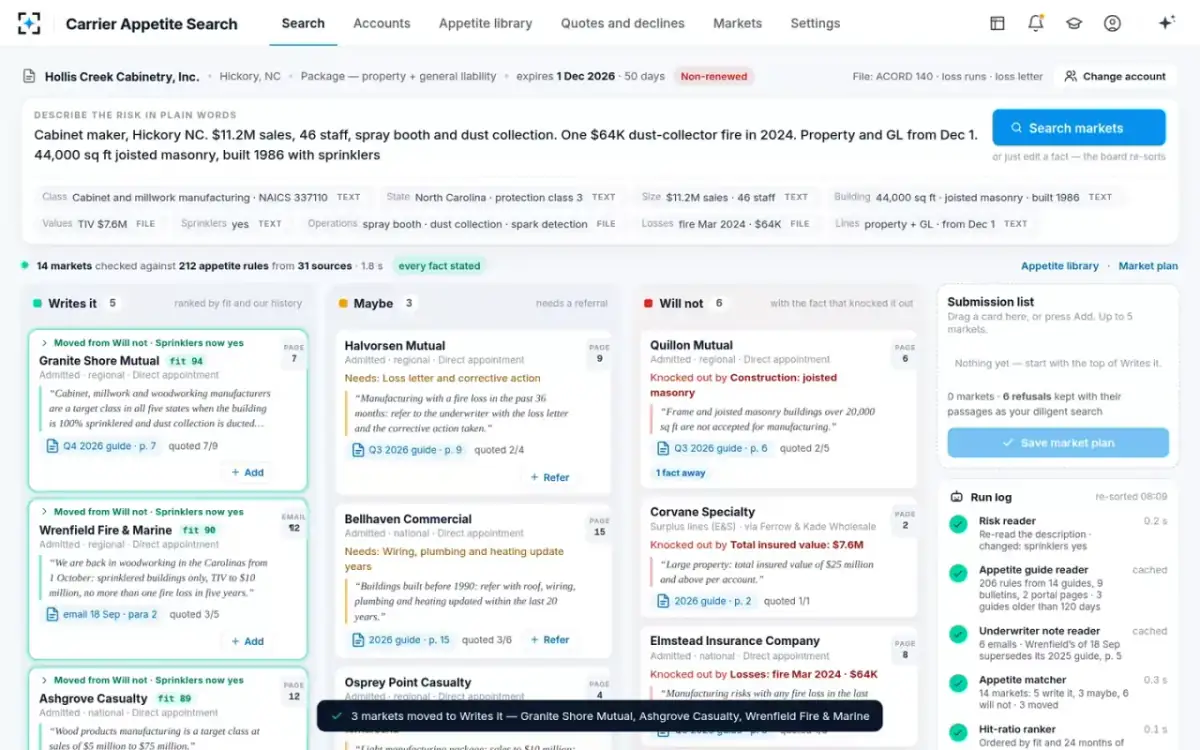
Wrenfield is in on an underwriter’s email of 18 September, which supersedes its 2025 guide. The passage card says so, and the old guide passage is still one click away.
How accurate is an AI appetite match, and how would you know?
Accuracy here has two halves, and both can be measured on your own files. The first is reading: does each rule match its passage, word for word, with the right page and date? Check a sample by opening the cited page. The second is routing: on submissions you already sent, would the match have put the declining markets in Will not and the quoting markets in Writes it or Maybe? That second test is a replay of last year's book, and it gives you your own number instead of a vendor's.
Replaying last year's declines sets out the method step by step. Two cautions apply to any figure it produces. A replay measures declines that were predictable from what the market had written down; it cannot measure an underwriter's mood. And general studies of AI at work do not transfer: the best known, an NBER study of 5,179 customer-support agents, found productivity up 14% on average and 34% for novices (Brynjolfsson, Li and Raymond, NBER Working Paper 31161), but that was support work, not broking.
Does an appetite match mean the carrier will quote?
No. A match means the market's own written words say it wants this kind of risk. Whether it quotes depends on things no guide holds: the underwriter's book that month, the quality of the submission, the loss runs once read in full, an inspection. What a good match changes is the denominator: fewer submissions to markets that were never going to look, so more of the agency's submissions reach underwriters who might say yes.
That is why the hit-ratio ranker uses the agency's own history, not just fit. Two markets with the same written appetite can behave very differently with one agency: in the sample agency's history, one quoted 7 of 9 manufacturing risks in two years, the other 2 of 5. Showing both, with the history beside the passage, lets the account manager weigh what the market says against what it does.
Where Carrier Appetite Search fits, and where it does not
It fits a retail agency or broker that places commercial risks across several markets and keeps their appetite in guides, bulletins, portals and inboxes. It earns its keep on the accounts that leave the usual markets: non-renewals, growth into a new class, a market that tightened. In the United Kingdom, where distributors of products in scope of the product governance rules must have arrangements to understand each product's identified target market (FCA Handbook, PROD 4.3.2R), the same library doubles as the evidence of those arrangements.
It does not underwrite, rate, quote or bind, and it is not a submission portal. It does not replace the wholesaler's knowledge of the surplus lines market or the underwriter's judgement. Regulators are not asking for a particular tool: the FCA's AI Update of April 2024 says its rules seldom require or forbid any particular technology (FCA, AI Update). What they test is the outcome: properly appointed producers, fair treatment and clear communication. A cited passage per market, a person per decision and a reason per override are how an agency shows that outcome. Ten questions to ask before you buy an appetite checker turns those tests into a scorecard.
Questions people ask
What is carrier appetite in insurance?
The classes, states, sizes and risk features an insurer or MGA wants to write, as stated in its appetite guide, bulletins, portal and underwriters' notes. It is narrower than what the insurer is licensed to write and changes more often. A risk inside appetite gets a look from an underwriter; one outside it usually comes back declined without one.
Is carrier appetite the same as underwriting guidelines?
They overlap. Underwriting guidelines are the insurer's internal rules for accepting and pricing a risk; an appetite guide is the part it publishes to agents so they send the right risks. Some insurers' underwriting guidelines are filed with regulators, and two states treat them as public, as are underwriting guidelines public record explains.
Can an appetite tool send submissions for me?
It can, technically, but a well-designed one should not. Sending commits the agency's name and the client's information to a market, and a licence alone gives no authority to commit an insurer. In Carrier Appetite Search the plan writer drafts the cover notes; the account manager reviews and sends them herself.
What happens when the description leaves something out?
The missing detail is shown as not stated and read the cautious way, so a market that requires sprinklers lands in Will not until someone confirms the building has them. The board names the missing detail, so the account manager knows the one question to ask the client.
What decides the order of the markets?
In Carrier Appetite Search the ranker orders them by fit and by the agency's own quotes and declines with each market over a window the agency sets, 24 months by default. Those are its inputs, and no market is hidden because of where it ranks.