A commercial insurance appetite guide is a carrier's or MGA's own statement of the commercial risks it wants to write: target and acceptable classes, excluded classes, states, size limits, minimum premiums, building and protection requirements, loss-history rules and what a submission must include. Most arrive as PDFs re-issued on a cycle, and none of them is complete on its own: bulletins amend them between editions, portal pages carry newer class lookups and underwriters announce changes by email. Botminds' Carrier Appetite Search reads all of these into rules with their page and date, but it can only be as current as what it is given. Before go-live, an agency needs an inventory: every market it can reach, every source of that market's appetite, who owns each source and how often it changes.
The inventory below is what a pilot needs. It is in the order that saves the most time, and it starts with a file that is not an appetite guide at all.
The appetite inventory: what to gather, who owns it and how often it changes
| Source | What it holds | Usual owner in the agency | How often it changes | Where it lives today |
|---|---|---|---|---|
| Appointment list | Every market the agency can place with, by state and line, and the route: direct, MGA program or wholesaler | Agency principal or licensing coordinator | When a contract is signed or ended | Carrier contracts; the agency system; state licence records |
| Appetite guides | Classes, states, limits, protection, losses, submission requirements | Marketing coordinator | Each edition: commonly quarterly or half-yearly | Carrier portals, email attachments, shared folders |
| Bulletins | Changes between editions: a class opened or closed, a limit raised | Marketing coordinator | Irregular, several a year per market | Email; portal news pages |
| Portal class lookups | The carrier’s class-by-class answer, often newer than the guide | Account managers | Without notice | Behind each carrier’s login |
| Underwriter emails and notes | Re-entries, exits, exceptions, “we would rather see it early” | Whoever received them | Weekly in a busy market | Personal inboxes |
| Program applications and supplements | What each market requires with a submission | Account managers | With the program | Portals; shared folders |
| Wholesaler and MGA market lists | Which specialty and surplus lines markets each wholesaler reaches, where it publishes this | Placement specialist | Irregular | Wholesaler portals and emails |
| Quotes and declines history | What each market did with the agency’s submissions, with reasons | Agency system | Every submission | Agency management system notes |
What is in a commercial insurance appetite guide?
A good one answers five questions for each class: will the market write it (target, acceptable, refer or excluded), where (states or territories), how big (sales, payroll, values, minimum and maximum premium), on what conditions (construction, protection, operations, loss history) and with what submission (applications, supplements, loss runs, photos). The detail varies enormously. Some guides run to two pages of class codes; others run to thirty, with construction tables and a page per program.
What most guides leave out is as important. They rarely say when they stop being valid, rarely list what changed since the last edition and almost never say how an exception is decided. Those gaps are why the other sources in the inventory exist, and why an appetite search has to keep each rule with its page and date: a rule without a date cannot be compared with the bulletin that replaced it.
In the United Kingdom the content is partly a legal matter. For products in scope of the product governance rules, the insurer must give distributors information on the product, its identified target market and the suggested distribution strategy, and "the information in (1) must be clear, complete and up to date" (FCA Handbook, PROD 4.2.30R). US law sets no such standard for appetite guides, but the UK wording is a fair test of any guide a US agency relies on. The FCA's target market rules are set out in full on their own page.
Why is the appointment list the first file, not the last?
Because appetite without appointment is a market the agency cannot use directly. Under the NAIC's producer licensing model, a producer may act as an insurer's agent only after that insurer has appointed it (NAIC Model #218, §14). An appetite search that puts an unappointed carrier in Writes it, without saying the route goes through a wholesaler, invites exactly the mistake regulators examine for.
The list also defines the search's scope. A typical agency is appointed with a set number of carriers and holds program contracts with some MGAs and agreements with one or two wholesalers; every market outside that list is reachable only through someone else. Check the agency's own list against state records before loading it: the Producer Database run by the National Insurance Producer Registry, which the NAIC describes as "the national repository for producer license information" (NAIC Insurance Department Resources Report, 2023), holds the states' licensing data, and the registry's Gateway carries appointments and terminations between insurers and regulators. The registry handled 185.9 million transactions in 2025 (NIPR, 2025 annual report).
One library: every guide, bulletin, email and portal page, with what changed
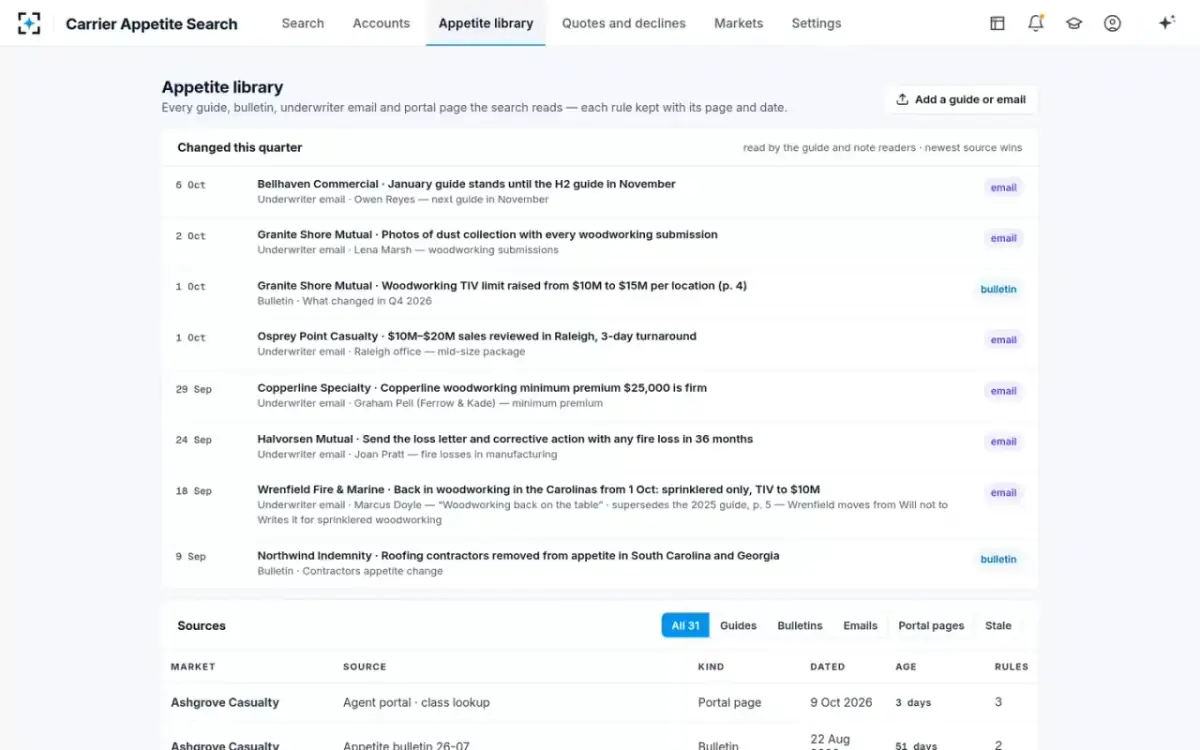
Three of the guides are flagged as older than 120 days, the agency's stale setting. The flag is a prompt to the marketing coordinator, not a verdict: an old guide may still be current, and the coordinator asks the market.
Where do I find carrier appetite guides?
In four places, and an agency should check all four for each market. The carrier's agent portal, usually under underwriting or appetite. The marketing representative or territory manager, who can send the current edition and confirm whether a newer one is coming. The underwriters' emails, which often attach a guide or announce a change. And the agency's own shared folders, where old editions tend to collect; keep them, dated, because a replay of past submissions needs the edition that was in force at the time.
Carriers publish appetite to their appointed agents, not to the public, so a search engine is the wrong tool for the current edition. Guides found online may be old, regional or for a different program. The safest rule is to accept a guide into the library only from the market itself, with its edition date, and to record where it came from.
Do wholesalers publish appetite guides?
Some do, many do not, and those that do usually publish market lists rather than rules: which specialty and surplus lines markets they reach for which classes, sometimes with minimum premiums. The specialty markets behind them publish guides of their own, which the wholesaler may share. For an appetite search, a wholesaler's market list is a route, and each market on it still needs its own appetite rules before it can be placed on a board.
Treat underwriter emails from wholesale brokers the same way as those from carriers: a dated statement from a named person about a named market. "Copperline's woodworking minimum premium of $25,000 is firm", in a fictional example from the sample library, is a rule with a sender, a date and a market, and it belongs in the library as much as a guide does.
A rule without a date cannot be compared with the bulletin that replaced it. Keep the page, the date and the exact words, or the library becomes a rumour mill.
How often are appetite guides updated, and how do you keep them current?
There is no rule; markets set their own cycles, and many re-issue quarterly or half-yearly with bulletins in between. No public source counts how often carriers change appetite, so measure your own markets: for each, the dates of the last three editions and the number of bulletins and appetite emails since. That gives each market a refresh rhythm, and a market that has not sent anything in two cycles is the one to call.
Carrier Appetite Search flags any guide older than a set age (120 days by default, adjustable from 30 to 365) so the marketing coordinator can ask for the current edition, and it applies one ordering rule across sources: the newest dated source wins, and the passage it replaced stays visible with the reason. Keeping guides current is still a person's job; the software makes the overdue ones obvious.
Four weeks to a library a pilot can trust
- Appointment list, checked against state recordsWeek 1
- Guides and bulletins for every reachable marketWeeks 1–2
- Appetite inbox and portal pagesWeek 3
- Replay on closed submissions; fix the gapsWeek 4
What format are appetite guides in?
Mostly PDF, laid out for people: tables of class codes, columns of states, footnotes that change a rule, a construction matrix on one page and its exceptions on another. Bulletins are shorter PDFs or emails. Portal lookups are web pages that change without notice, so the library should keep a dated copy of what the page said when it was read. Underwriter notes are emails with the rule buried in a sentence.
The format determines what a reading tool must do. It has to keep the passage word for word, because paraphrase is where a "refer" becomes an "acceptable". It has to keep the page, because an underwriter will ask where the agency read it. And it has to understand that a footnote or a later table can override a sentence on the same page. Ask any vendor to show a rule extracted from one of your own guides, with the page open beside it.
Who in the agency owns carrier appetite?
Usually nobody, formally, which is the problem the inventory is meant to fix. Account managers hold it in their heads, the marketing coordinator holds the folder, the placement specialist holds the relationships with underwriters and the principal holds the contracts. A library needs one owner for its completeness, typically the marketing coordinator, and one owner for its exceptions, typically the placement specialist, who alone may override a Will not and must leave a reason on the account file.
That split mirrors what examiners expect of insurers' own files, where underwriting must rest on information gathered at or near the start of cover, not after a claim (NAIC Market Regulation Handbook, chapter 21). An agency that can show which guide edition it relied on, on the day it sent a submission, has the equivalent on its side of the transaction.
Your agency's rules: stale guides, cautious reading, who may override
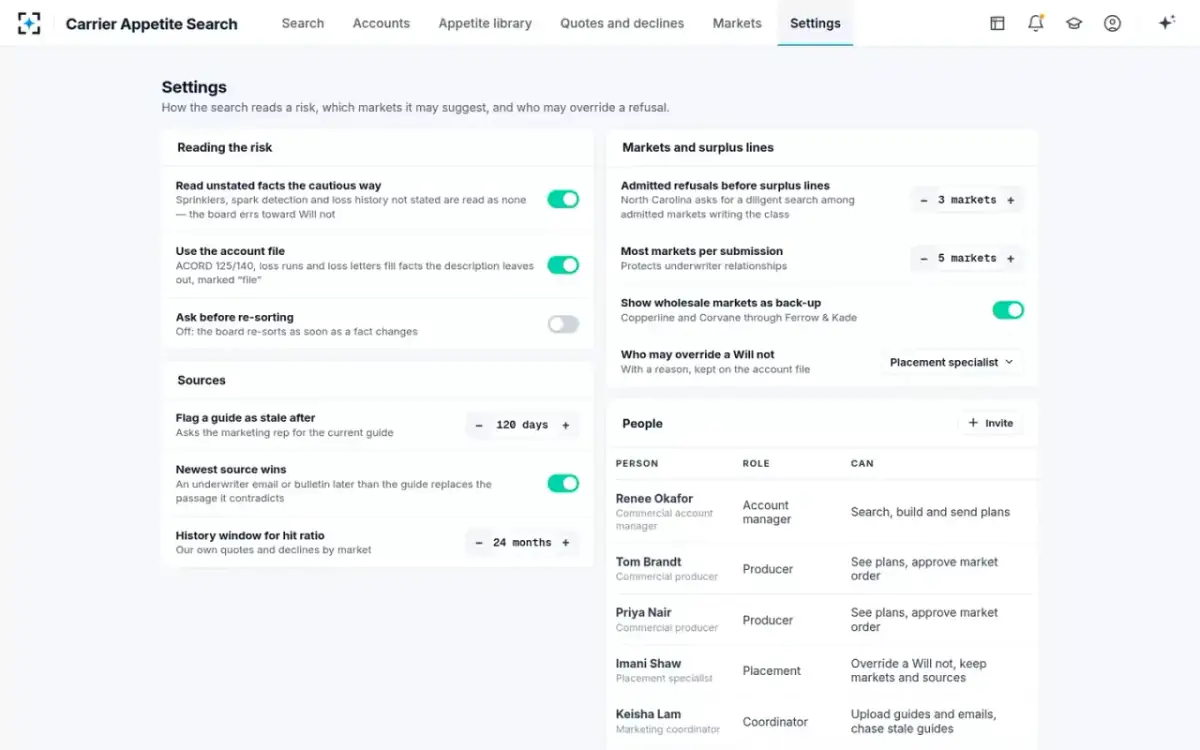
The people panel assigns the library to a coordinator and overrides to a placement specialist; account managers search and build plans, producers approve the market order.
What do you need to set up an appetite search tool?
The inventory above, a few weeks of a coordinator's time and a set of closed submissions to test on. The checklist is the short version; it matches the sources Botminds' Carrier Appetite Search reads: appetite guides and bulletins, the shared appetite inbox, carrier portal pages, the account file, past quotes and declines by carrier and the appointment list.
Before go-live: the files and decisions an appetite search needs
- The appointment list, by market, state, line and route
Direct, MGA program or wholesaler. Checked against state licence and appointment records.
- The current guide for every reachable market, with its edition date
From the market itself. Keep old editions too, dated, for replays.
- Every bulletin since the current edition
A missing bulletin is the commonest reason a match disagrees with a market.
- A shared appetite inbox
Underwriter emails forwarded to one address, so a note is not lost in one person’s mail.
- Portal pages saved with their date
What the class lookup said when it was read, not what it says today.
- Twelve months of quotes and declines
With the market’s reason for each decline, for the ranking and for a replay.
- Three settings decided
When a guide counts as stale, whether unstated details are read the cautious way, and who may override a Will not.
- A handful of live accounts
Ones being marketed now, so the first results are checked against real answers within weeks.
Figures and screens on this page that come from the solution are fictional sample data. Once the library is loaded, the test of whether it is complete is a replay of last year's declines; the test of the tool itself is in ten questions for an appetite checker.
Questions people ask
Is an appetite guide the same as an underwriting manual?
No. The underwriting manual is the insurer's internal rulebook for accepting, rating and pricing risks; the appetite guide is the part it publishes to agents so they send the right ones. A guide may say a class is acceptable; the manual says how the underwriter prices it and what would make them decline it anyway.
Can I share a carrier's appetite guide with another agency?
Check the agency agreement first. Guides are usually published to appointed agents for their own use, and some carry confidentiality wording. An appetite library should be for the agency's own staff, with access controlled like any other carrier material.
What if two sources from the same market disagree?
Use the newer one, keep the older one visible and, if the difference matters to a live account, ask the underwriter. An email of 18 September that reopens a class closed in the 2025 guide outranks the guide; a guide of 1 October that contradicts the email outranks the email.
Do personal lines appetite guides work the same way?
The sources are similar, but personal lines appetite is often expressed through the carrier's rating and quoting systems rather than PDFs, and is often tied to territories and property characteristics. Carrier Appetite Search is built for commercial placements, where guides, bulletins and underwriter notes carry most of the appetite.
How many markets should the library hold at go-live?
Every market the agency can place with, directly or through a wholesaler, for the lines in scope. A library that holds only the favourite eight markets will recommend only those eight, which is the habit the search is meant to break.