Which insurance carriers write restaurants? On paper, a great many: in California alone, 199 licensed insurers wrote commercial multiple peril property premium in 2025 and 187 wrote its liability side, the lines that carry most restaurant package policies. In practice, far fewer will want a particular restaurant, because each carrier's appetite guide sorts restaurants by what they cook, how much of their sales is alcohol, when they close, what the building is and what has burned before. A family restaurant that closes at nine and a bar-and-grill open until two are different risks to almost every underwriter. Botminds' Carrier Appetite Search reads each market's guide, bulletins and underwriters' notes and shows an agency which of those markets will actually quote it, with the passage that says so. The public count of licensed carriers is where the search starts, not where it ends.
The count matters anyway, because it shows how large the gap is. California's Department of Insurance publishes, for every line, how many licensed insurers reported premium the year before. Those are the carriers that could, in law, write a California restaurant. The rest of this guide is about the filters between that number and a short list.
Licensed insurers with premium in California, 2025, by line a restaurant may need
How many carriers write restaurant insurance?
Nobody publishes a count of carriers with an appetite for restaurants, because appetite is not filed with regulators the way licences and premiums are. What the public data do show is the ceiling and its direction. In California the number of insurers reporting commercial multiple peril liability premium fell from 205 in 2015 to 187 in 2025, and on the property side from 213 to 199, while the premium written in those lines rose (CDI, 2025 summary, with earlier years). Fewer licensed writers are sharing a larger book.
The loss figures explain part of the appetite. In 2025 California's commercial multiple peril liability line ran a loss ratio of 104.11%, losses incurred above premium earned before any expenses, while the property side ran 65.30%. A carrier looking at those two numbers will be keener on a restaurant's building than on its liquor and its slip-and-fall exposure, and its guide will say so in the conditions it puts on the liability side.
The restaurant market in four public numbers
264K
full-service restaurant establishments in the US in 2024 (264,208), with 5.35 million jobs
43K
drinking places (alcoholic beverages) in the US in 2024 (42,624)
104%
loss ratio (104.11%) on California commercial package liability, 2025
5,600
restaurant fires reported each year, 2011–2013, about $23,000 of loss per fire
What makes a restaurant hard to insure?
Cooking, alcohol, hours and the building, roughly in that order. Cooking is the fire risk underwriters price first. The U.S. Fire Administration found cooking "by far the leading cause of restaurant fires, accounting for 64% of restaurant fires", with heating and electrical malfunction at 7% each (USFA, Restaurant fires 2011–2013). That is why guides ask about fryers, open flame, solid-fuel cooking, hood and duct suppression and how often the hoods are cleaned.
Alcohol moves the liability side. Guides commonly sort restaurants by the share of sales from alcohol, and treat a restaurant with a bar differently from a bar with food. The fire data point the same way: the agency found that fires in other eating and drinking places, "including bars, nightclubs, pubs and the like", had "higher fatalities and dollar loss per 1,000 fires than restaurants". Late hours, entertainment, dancing and security staff move a risk further from most guides' acceptable classes.
Why cooking controls is the first question: restaurant fires by cause and by spread
By cause
- Cooking · 63.5%
- Heating or electrical · 13.9%
- Other · 22.6%
By spread
- Object of origin · 67.9%
- Room of origin · 18%
- Beyond the room · 14%
The building and the record finish the picture. Older wiring and roofs, frame construction, shared walls with other tenants, a location without a nearby fire station and any fire or liability claim in the last three to five years each narrow the field. None of these is unusual for a restaurant, which is why so many restaurant renewals become marketing exercises.
Why was my restaurant declined for insurance?
Usually because one detail took it outside the carrier's written appetite, and the decline letter did not say which. The commonest are the ones above: cooking without the suppression or cleaning the guide requires, alcohol sales above the guide's share, closing hours later than it accepts, a building it will not take, or a loss in the period it looks back over. Sometimes the decline is about capacity rather than the restaurant: the carrier has written as much restaurant business in that area as it wants this year.
The useful response is to find the deciding detail. A broker who can say "this market excludes restaurants with more than a set share of sales from alcohol; yours is above it" can either find a market that accepts it or explain what would change the answer. A bare "declined" leaves the owner nowhere. That is the reason Carrier Appetite Search names the detail that knocked each market out, and reads any detail the agency has not confirmed (sprinklers, suppression, cleaning) as absent until it is.
How do agents find markets for restaurants?
By narrowing in four steps, whether they do it from memory or with software. The table sets out each filter, what it removes and where the answer is written. The first filter is public; the others are in documents the agency holds or can get, and the count at each step is the agency's own.
From licensed carriers to a short list: four filters
| Filter | What it removes | Where the answer is written | Who can answer it |
|---|---|---|---|
| 1. Licensed in the state, writing the line | Insurers not admitted for commercial package or liability there | State market share data; the insurer’s licence | Public record |
| 2. Restaurants inside the written appetite | Carriers whose guides exclude the restaurant’s type, alcohol share, hours or size | Each carrier’s appetite guide, bulletins and underwriters’ notes | The agency’s appetite library |
| 3. Conditions the restaurant meets | Carriers whose conditions it fails: suppression, cleaning, building, loss history | Guide conditions; the application and loss runs | The account file, confirmed by the owner |
| 4. Reachable by the agency | Carriers the agency is not appointed with, unless a wholesaler or program can reach them | The agency’s appointment list; wholesalers’ market lists | The agency principal |
The fourth filter is the one agencies forget to show. Under the NAIC's producer licensing model, a producer may act as an insurer's agent only once appointed by it (NAIC Model #218, §14), so a carrier with a perfect restaurant appetite is a direct option only for agencies it has appointed. For everyone else it is a wholesale or program route, with a longer wait and a commission split. How to get appointed with insurance carriers explains how agencies widen that list before they need it.
Restaurants on the marketing list, beside the manufacturers and the apartments
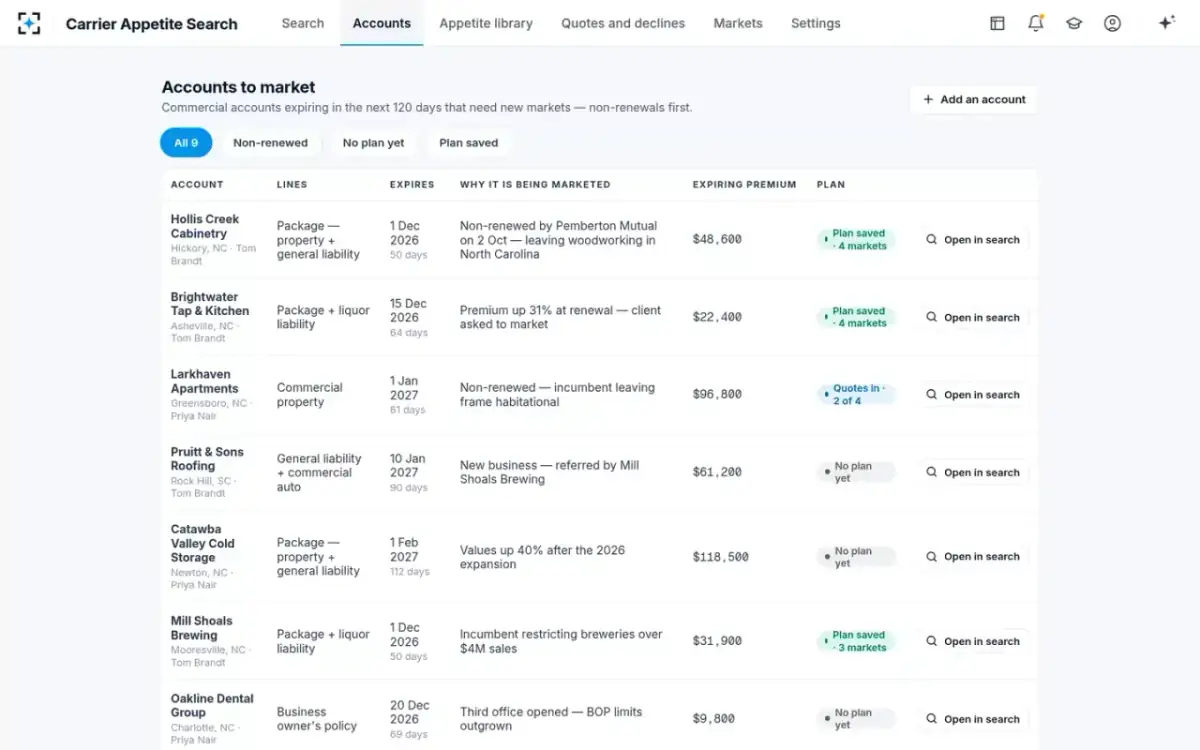
The reason for marketing is in the row: the restaurant's premium rose 31% at renewal and the owner asked for alternatives. A market search on that account starts with the liability side, where the conditions are tightest.
Do restaurants need a BOP or a package policy?
It depends on size and on alcohol. A businessowners policy bundles property and general liability on standard terms for small businesses, and many carriers' BOP programs accept small restaurants that meet their conditions, often with limits on sales, alcohol share and cooking type. A commercial package policy is assembled from separate property and liability parts and suits larger restaurants, multiple locations and risks a BOP program will not take. Liquor liability, workers' compensation and commercial auto for delivery vehicles are usually separate policies either way.
For market selection the distinction matters because BOP and package appetite are often in different guides, even at the same carrier. A restaurant that has outgrown one carrier's BOP may still be inside its package appetite, and an appetite search should read both.
Which carriers write liquor liability?
Fewer than write the rest of the package, and the list changes by state. General liability forms commonly exclude liability for businesses that sell or serve alcohol, so a restaurant with a bar needs liquor liability cover written separately or by endorsement. Carriers that write it set their appetite by the share of sales from alcohol, closing hours, entertainment and the state's law on a seller's liability for serving alcohol, which differs from state to state. That is why the liquor line is often where a restaurant account moves from the admitted market to a specialty or surplus lines market through a wholesaler.
This page does not name carriers, for a reason that goes beyond policy: any list would be out of date within a quarter, and it would describe the carriers' appetite in general rather than for the restaurant in front of you. The durable answer is the agency's own library, read against the specific restaurant.
What do carriers ask restaurants on the application?
The questions follow the hazards. Expect the carrier's application or supplement to cover the points below, and expect a missing answer to count against the risk. Insurers' examination standards ask that underwriting rest on adequate information gathered at or near the start of cover (NAIC Market Regulation Handbook, chapter 21), so the questions a carrier does not ask before binding it may ask after a claim.
What restaurant appetite guides and applications usually turn on
- Type of cooking
Fryers, open flame, grills, solid-fuel ovens; how much of the menu is cooked on site.
- Hood and duct suppression and cleaning
What system is fitted, when it was last serviced, how often hoods and ducts are cleaned.
- Alcohol share of sales
Food versus alcohol receipts; whether the bar is incidental or the main business.
- Hours and entertainment
Closing time, live music, dancing, cover charges, security staff.
- Building and occupancy
Construction, age of wiring and roof, sprinklers, shared walls, other tenants.
- Delivery and catering
Owned or employee vehicles, off-site events, third-party delivery arrangements.
- Loss history
Fires, slips and falls, liquor claims and employee injuries over the look-back period.
- Sales and locations
Annual sales per location and in total; the guide’s size limits are often per location.
Which insurance companies insure restaurants, then?
The honest answer is a method, not a list. Start from the licensed writers for the lines the restaurant needs; read each reachable market's current appetite for that type of restaurant; test the restaurant's own details against each market's conditions; and keep the route (direct, program or wholesaler) beside each fit. For one Asheville restaurant with a bar in the sample agency, that method ends with four markets on a submission list, not 187.
Done by hand, the method is an afternoon of portals and PDFs per account, which is why agencies fall back on the three or four markets they always use. Done by Carrier Appetite Search, each market lands in Writes it, Maybe or Will not with its passage, and the account manager decides which to approach. Replaying last year's restaurant declines is the quickest way to see how many of yours were predictable.
Questions people ask
What insurance does a restaurant need?
Typically property and general liability (as a BOP or package), liquor liability if it serves alcohol, workers' compensation where it has employees (required by law in most states) and commercial auto if it owns delivery vehicles. Many also buy employment practices, cyber and equipment breakdown cover. Each line can come from a different market.
Why did my restaurant insurance premium go up?
Liability results are one reason: California's commercial package liability line paid more in losses than it earned in premium in 2025, with a loss ratio of 104.11%. Others are the restaurant's own claims, higher property values, changes in the carrier's appetite and fewer carriers competing for the class.
Can a restaurant get insurance after a kitchen fire?
Usually, but from fewer markets and with conditions. Many guides look back three to five years for fire losses and ask what was done afterwards. A submission that shows the cause, the repair and the new controls, such as an upgraded suppression system and a cleaning contract, gives an underwriter a reason to say yes.
Is a food truck insured like a restaurant?
No. A food truck needs commercial auto as well as liability and equipment cover, and many restaurant programs exclude mobile operations. It is usually written by markets with a separate food truck or mobile vendor appetite.
Does every carrier in the state data write restaurants?
No. The California figures count insurers that reported any premium in a line, including carriers that write only offices, only contractors or only large accounts. They are a ceiling for the search, not a list of restaurant markets.