In insurance, "out of appetite" means a carrier, MGA or wholesale market has declined a submission because the risk falls outside what it has said it wants to write: a class it excludes, a state it does not write, a building, size or loss history beyond its limits. It is usually a decline without underwriting, often in a one-line email, and for the retail agency it is the most wasteful kind: the market could have been ruled out before anything was sent. Botminds' Carrier Appetite Search exists to catch those risks before they leave the agency, by testing each one against every market's written appetite. The way to find out whether it, or any appetite match, would have caught yours is to replay last year's closed submissions through it and count.
A replay needs no vendor statistic and no leap of faith. You already hold the submissions, the markets they went to and what came back. Run each through the match as the risk was described on the day it was sent, and compare the board with the answer the market actually gave.
Every submission lands in one of four boxes
Market declined: Avoidable decline. The guide already said no; the submission cost a week and some goodwill.
Market quoted: False Will not. The market quoted a risk the match would have kept from it: find the rule that misfired.
Market declined: Underwriter’s decline. The risk fit on paper; the reason lies outside the guide.
Market quoted: Confirmed fit. The match and the market agreed.
What does out of appetite mean in insurance?
It means the market will not consider the risk at all, as opposed to considering it and saying no. An out-of-appetite decline points to the market's own written words: the appetite guide, a bulletin, a portal class lookup or an underwriter's note. An underwriting decline, by contrast, follows a look at the risk itself: the loss runs, the inspection, the price the market would need. The distinction matters to an agency because only the first kind is predictable from documents it already holds.
Markets use the phrase loosely, so the agency has to sort the declines itself. "Not a fit for us at this time" can mean the class is excluded, the underwriter's book is full this quarter, or the submission arrived incomplete. A replay only works if each decline is first coded by its real reason, using the decline note and, where it is thin, a call to the underwriter.
Why do carriers decline submissions as out of appetite?
Because the risk fails a rule the market published and the agency did not check, or checked against an old edition. In the sample agency behind the screens on this page, a fictional independent agency, the reasons markets gave for 295 out-of-appetite declines in 2026 fell into six groups, and the largest was the most avoidable: the class was not written at all.
Why markets said no: 295 out-of-appetite declines in one sample agency
Class, size and state are written in every guide, so a decline on any of them is a document the agency failed to read. Protection, losses and construction are written in the guide too, but they also need a detail from the client that a description often leaves out. That is why an appetite match that treats an unstated sprinkler as "none" catches more of those declines than one that assumes the best: it forces the question before the submission, not after.
How do you test an appetite tool? Replay last year, step by step
Take a closed period, run every submission through the match as it was described on the day it was sent, and score each market's verdict against what that market did. The steps below make it a test the agency controls. The one rule that keeps it honest: the tool sees only what the account manager knew when she sent the risk, and the guides that were in force on that date.
A replay of closed submissions, in eight steps
- Pick a closed window
Six to twelve months of commercial submissions with every answer back: quotes, declines and no-responses.
- Code each decline by its real reason
Class, state, size, protection, losses, construction, capacity, incomplete submission or price. Call the underwriter where the note is vague.
- Restore the guides as they were
The guide edition, bulletins and underwriter notes in force on each send date, not today’s.
- Describe each risk as it was sent
Use the submission as sent; do not add details the agency learned later.
- Run the match and freeze the board
Record Writes it, Maybe or Will not for each market the submission actually went to.
- Score the four boxes
Avoidable declines, false Will nots, underwriter’s declines and confirmed fits, per market and per reason.
- Open every false Will not
Each one is a rule read wrongly, a stale guide or an underwriter who stretched. Fix the first two; note the third.
- Have a second person check twenty
A placement specialist re-scores a random twenty submissions blind. Disagreements show where the coding is soft.
Two numbers come out, and both belong to the agency. The first is the share of out-of-appetite declines the match would have prevented: avoidable declines divided by all out-of-appetite declines. The second is the cost of caution: false Will nots divided by all quotes. A tool can push the first number up by marking everything Will not; the second number is what catches it.
The replay's two numbers, and what moves them
| Measure | How to compute it | Rises when | Falls when |
|---|---|---|---|
| Avoidable declines caught | Out-of-appetite declines the match marked Will not ÷ all out-of-appetite declines | Guides are current, and unstated details are read the cautious way | Guides are stale, or emails and bulletins are missing from the library |
| Quotes the match would have blocked | Quotes from markets the match marked Will not ÷ all quotes | Rules are read too strictly, or underwriters stretch for good accounts | Every Will not cites a passage that names the class or limit |
| Underwriter’s declines | Declines from markets marked Writes it or Maybe ÷ all declines | The market tightened without telling anyone, or the submission was weak | Not an appetite problem: improve the submission, or ask the underwriter |
What is a good decline rate for submissions?
There is no published standard, and any figure quoted without its denominator should be treated with suspicion. No regulator, academic study or non-profit research body publishes decline rates or hit ratios for retail agencies' commercial submissions. The useful comparison is internal: the same agency, same classes, before and after a change.
For what it shows of the arithmetic, the sample agency's out-of-appetite share ran at 38% of commercial submissions from January to April; the design target for Botminds' Carrier Appetite Search is 13%. Both are figures from a fictional agency and a design goal, not anyone's measured result. Your replay will produce your own starting point, and the same replay run six months after go-live is the only fair way to measure the change.
Quotes and declines by market, from the agency's own history
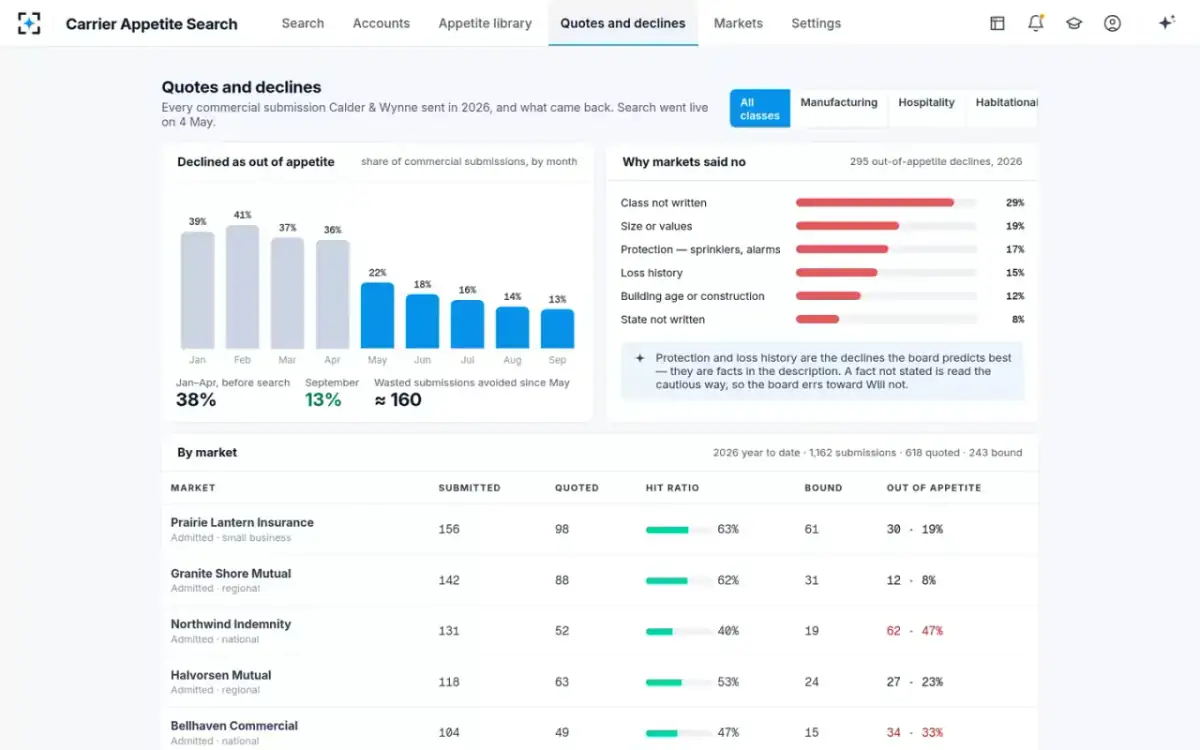
The 'Why markets said no' panel is coded from the decline notes. A replay needs that coding first; the categories are the six used in the chart above.
How do you track declinations by carrier?
Keep each decline as a line with five fields: the market, the date, the risk as described, the reason in the market's own words and the reason as the agency coded it. Without the market's words, the code is a guess; without the code, the words cannot be counted. Most agency systems hold a status ("declined") and a free-text note, which is enough to start a replay but not to run one every month.
Declines are also evidence, and the law treats some of them that way. Where a risk moves to surplus lines, the declining admitted insurers are the diligent search. California's statute lets the commissioner review the filed form, "including, but not limited to, whether the listed insurers actually write that type of insurance, and whether the three insurers declined the risk", and take disciplinary action for misrepresentation (Cal. Ins. Code § 1763(b), as captured April 2025). Florida's quarterly surplus lines affidavit "shall include efforts made to place coverages with authorized insurers and the results thereof" (Fla. Stat. § 626.931(2), 2026). A decline note filed with its reason is worth more than one filed as "declined".
How long should you keep declination records?
At least as long as the longest record rule that touches them, which for most agencies means the policy file. Florida, for example, requires every agent to keep records of policies transacted, including applications and documents signed by the insured, for at least five years after the policy expires (Fla. Stat. § 626.748; other states are compared in insurance agency record retention guidelines). Declines on a risk that was later placed belong in that file. Check your own states' rules and your errors and omissions insurer's guidance; keep the longer period.
For a replay, keep more than the decline itself: the description as sent and the guide edition in force. A decline without the description that triggered it cannot be replayed, and a guide that has been overwritten by its next edition cannot be restored. An appetite library that keeps every edition with its date solves the second problem as a side effect.
Can an out of appetite decline be appealed?
Sometimes, and only with a new fact or a reason the rule does not fit. Appetite rules are blunt instruments. A guide that excludes "frame and joisted masonry buildings over 20,000 sq ft" for manufacturing cannot distinguish a sprinklered cabinet plant with modern dust collection from a bare one. An underwriter may make an exception for an account that is clearly better than its class, but an appeal that brings nothing new spends goodwill the agency needs for the next submission.
In Carrier Appetite Search, overriding a Will not is a deliberate act: by default only the placement specialist may do it, and the reason stays on the account file. That keeps exceptions visible, and it gives the next replay a third category to count: overrides that the market accepted, and overrides that came back declined anyway.
A replay measures declines the market had already written down. It cannot measure an underwriter's mood, and a tool that claims to should be asked how.
Do declines hurt the agency's relationship with the underwriter?
They cost something, though nobody publishes how much. An underwriter who reads ten submissions from an agency and declines six on the first page learns that the agency does not read the guide, and reads its next submission later. The cost shows up as slower answers and fewer stretches for borderline accounts, which is why the replay's third box, underwriter's declines, deserves a conversation with the market rather than a statistic.
The relationship runs both ways. In the United Kingdom, a distributor that becomes aware a product "is not in line with the interests, objectives and characteristics of its identified target market" must "promptly inform the manufacturer" (FCA Handbook, PROD 4.3.11R). There is no such duty on a US agency, but the habit is worth copying: a market whose guide says one thing while its underwriters do another should hear it from the agencies whose submissions it declines.
The market's history sits next to its rules
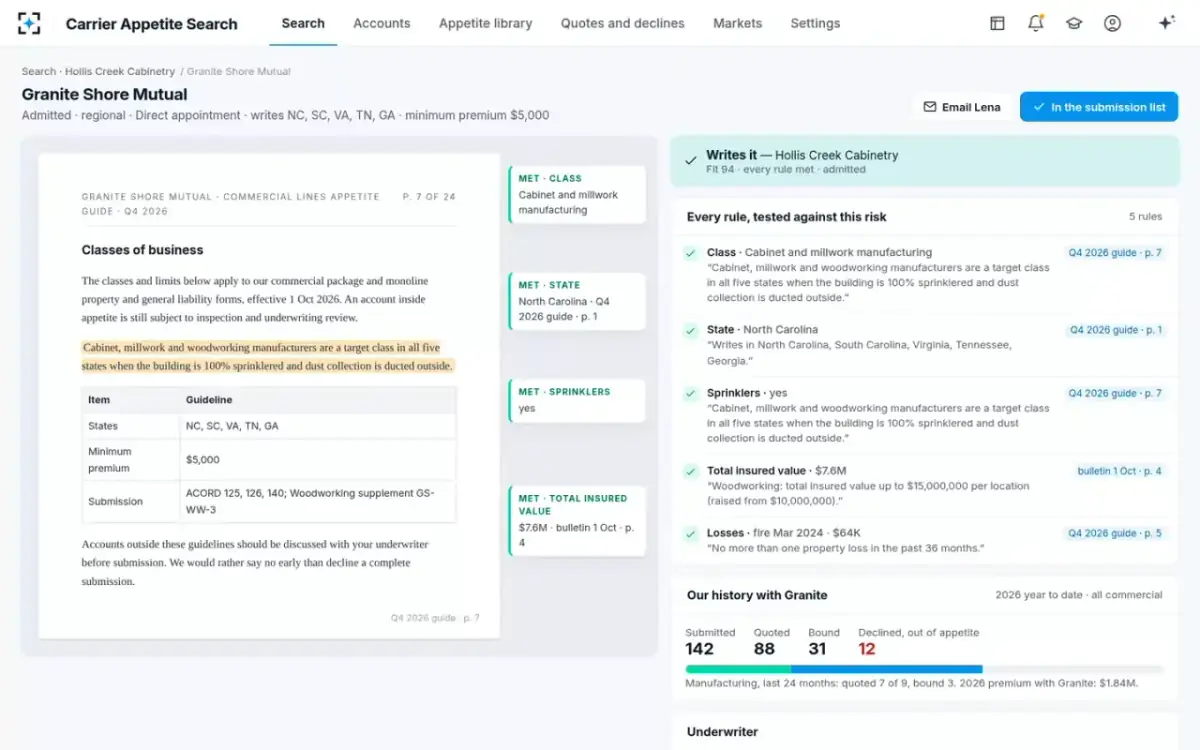
The total insured value rule is met on a bulletin of 1 October, which raised the limit from $10 million to $15 million per location. A replay run on the guide alone would have marked this market Will not.
The note under that screen is the replay's most important lesson. A match is only as good as the newest source in its library, and the commonest reason a tool scores badly on a replay is a library that holds the guide but not the bulletin. What to gather before go-live lists the sources a replay needs, and ten questions for an appetite checker turns the replay into a buying test.
Questions people ask
What is the difference between declined and out of appetite?
Every out-of-appetite answer is a decline, but not every decline is out of appetite. Out of appetite means the risk fails the market's written rules, so it is usually not underwritten; other declines follow underwriting, such as a poor loss history read in full, an inspection or a price the client would not pay. Only the first kind can be predicted from the guides.
Should I resubmit if the market's appetite changes?
Yes, if the change answers the reason for the decline and the client's renewal allows the time. A bulletin that raises a size limit or an underwriter who re-enters a class is a new fact; say so in the cover note and quote the new passage. A resubmission that changes nothing but the date is likely to get the same answer.
How many submissions do I need for a replay?
Enough to have at least a few dozen out-of-appetite declines, so that each reason group holds more than a handful. For a small agency that may mean a full year; for a large one, a quarter. Fewer than that, and a single unusual account can swing the result.
Do no-responses count as declines?
Count them separately. A market that never answers may have declined silently, lost the email or still be working on it. Treating silence as a decline flatters a tool that marked the market Will not; leaving it out hides a real cost. Report both ways.
Can a replay be run before buying a tool?
Yes, and it should be. Give the vendor a sample of closed submissions and the guides in force at the time, hold back what the markets answered, and score the result yourself. A vendor that will not run a replay on your files is asking you to trust its numbers instead of your own.