Insurance agency record retention guidelines start from one rule: an agency must keep the records of the policies it transacted for as long as its state requires, and that clock runs from the policy, not from the agency's ownership. When a buyer converts an acquired agency's system and switches the old one off, the seller's applications, endorsements, signed documents, premium records and disclosures still have to be producible on request for years. Florida sets the clearest benchmark, five years after each policy expires for an agent's policy records and three years after payment for premium records; New York keeps compensation disclosures and fee memoranda for three years. The practical question after an acquisition is which records move into the buyer's live system, which go into a readable archive, and which can be destroyed, securely, when their clocks run out. Botminds' Agency Acquisition Data Migration is read-only on the seller's system, loads the book to a staging copy first, and keeps every original value in an archive when a record is changed or merged, so the answer to "what did the seller's system say?" survives the cutover.
Keep, archive or destroy: a retention map for an acquired agency's system
| Record | Treatment | The rule behind it |
|---|---|---|
| Applications, change endorsements and documents the insured signed or initialled | Carry live for active clients; archive the rest, readable | Florida: at least 5 years after policy expiration (§626.748) |
| Records of premium payments, return premiums and trust funds | Archive with the accounting history | Florida: at least 3 years after payment (§626.561) |
| Compensation disclosures to purchasers | Archive, linked to the client | New York Regulation 194: at least 3 years after the disclosure |
| Signed fee memoranda for advice or review | Carry with the client; they define what was agreed | New York §2119: at least 3 years after the services |
| Activity notes, emails, quotes and declinations | Carry for active clients; they hold the E&O evidence | The policy-record rules above, and the E&O tail period |
| The seller's system itself | Read-only, then a verified archive export | Whatever the longest record clock above requires |
| Diligence extracts and test-load copies | Destroy securely after sign-off | NAIC Model #668: secure disposal of nonpublic information |
How long should an insurance agency keep records?
As long as the longest rule that applies to each record, measured from the event that rule names. For an agent's policy records in Florida, that is at least five years after the policy expires; for premium payment records there, at least three years after payment; for New York compensation disclosures and fee memoranda, at least three years. Those are floors, not targets: an agency that may need a record to defend an errors-and-omissions claim, or that holds records an insurer or regulator may ask for, may need to keep them longer.
Two features of these rules matter in an acquisition. The clocks run from each policy's expiry or each payment, so a book always holds records at every stage of their life, some brand new and some about to run out. And the clocks do not stop when the agency is sold: the records of policies the seller transacted are still records of policies transacted, whoever now holds them.
Retention clocks for an agency's records, in years from the event that starts each one
- Policy termTerm
- After expiration5 years after expiry
- After payment3 years after payment
- After disclosure or services3 years
- After the appointment ends6 years after termination
What records must insurance agents retain?
The records that let the policyholder and the regulator find out what was transacted. Florida's statute is the most specific: "Every agent transacting any insurance policy must maintain in his or her office, or have readily accessible by electronic or photographic means, for a period of at least 5 years after policy expiration, such records of policies transacted by him or her as to enable the policyholders and department to obtain all necessary information, including daily reports, applications, change endorsements, or documents signed or initialed by the insured concerning such policies" (Fla. Stat. §626.748).
Read that list against an agency system and it covers more than the policy table. Applications are usually attachments. Change endorsements are partly fields and partly scanned pages. "Documents signed or initialed by the insured" include the declination forms and applications that defend the agency in an E&O claim. Money adds its own records: Florida treats premiums and return premiums an agency receives as trust funds and requires books, accounts and records of each premium payment to be kept for at least three years after payment (Fla. Stat. §626.561). New York adds disclosure records, discussed below.
What are the record retention rules in Florida for insurance agents?
Two statutes set them: §626.748 for an agent's policy records, at least five years after policy expiration, kept in the office or readily accessible electronically or photographically; and §626.561 for premium payment records, at least three years after payment. Both apply to the licensee that transacted the business, and both are minimums.
For an acquirer the five-year rule is the long pole. A policy that expired the week before closing has records that must stay accessible for five more years; a policy the buyer renews keeps adding records. The seller's records of a client who moves to another agency at the sale still have their own clock. That is why switching off the seller's system is a records decision as much as an IT one, and why the archive has to be tested for readability, not just created.
How long do you keep insurance applications?
In Florida, at least five years after the policy the application led to has expired, because an application is one of the policy records §626.748 names. For an application that never became a policy, the agency's own retention schedule and its E&O counsel decide, since a declined or abandoned application can still be evidence of what a client asked for.
In a migration, applications are the records most likely to be lost by accident. They often live as attachments rather than fields, and a load that moves fields but not attachments, or moves attachments without linking them to their policies, keeps the data and loses the record. In the sample acquisition, 58,204 of the seller's 58,214 attachments loaded and were linked to their clients and policies; the ten that would not open were named on the sign-off and requested again from the seller.
Do digital copies satisfy record retention?
Generally yes, if the copy is accurate and stays accessible for the whole period. Florida's statute allows records "readily accessible by electronic or photographic means". The federal E-SIGN Act goes further for any rule that requires a record to be retained: the requirement is met by an electronic record that accurately reflects the original and stays accessible, for the whole required period, to everyone the law entitles to see it, in a form that can be accurately reproduced later (15 U.S.C. §7001(d)(1)).
What makes an electronic archive count as the record
An archive that satisfies retention: Every field and attachment as it was, including signatures and handwritten notes.
An archive that only looks like one: A cleaned copy, or fields without the scans behind them.
An archive that satisfies retention: Readable by the people entitled to it, for the whole period, without the old system.
An archive that only looks like one: Readable only in the old system, which is due to be switched off.
An archive that satisfies retention: Can be printed or sent accurately on request.
An archive that only looks like one: A database dump nobody can query.
An archive that satisfies retention: Protected from alteration after transfer, with a record of who changed what in the live system.
An archive that only looks like one: Overwritten by merges and corrections with no history.
New York's recordkeeping regulation for insurers shows what regulators look for in an electronic medium. It defines a "durable medium" as one whose properties "provide reasonable assurances against tampering with the information contained in the original and degradation of any reproduction generated, and where the reproduction is an exact copy of the original" (11 NYCRR §243.1(c)). The rule binds insurers, not agencies, but it is a sound test for an agency archive too.
Can you destroy records after an agency acquisition?
Not because of the acquisition. The clocks run from each policy and each payment, so the sale changes who keeps the records, not how long they are kept. What an acquisition does create is a set of copies that can and should be destroyed: diligence extracts, test-load copies, files sent to a migration vendor and duplicate exports, once the day-one load is signed and the archive is verified.
The NAIC's Insurance Data Security Model Law, adopted in a number of states, expects a licensee to keep a schedule for how long nonpublic information is retained and a mechanism to destroy it when it is no longer needed, and to have procedures for its secure disposal (NAIC Model #668, §4); the model exempts licensees with fewer than ten employees from that section. For the buyer, that means the retention map above should have a destroy column with dates, and every extra copy made for the deal should be on it.
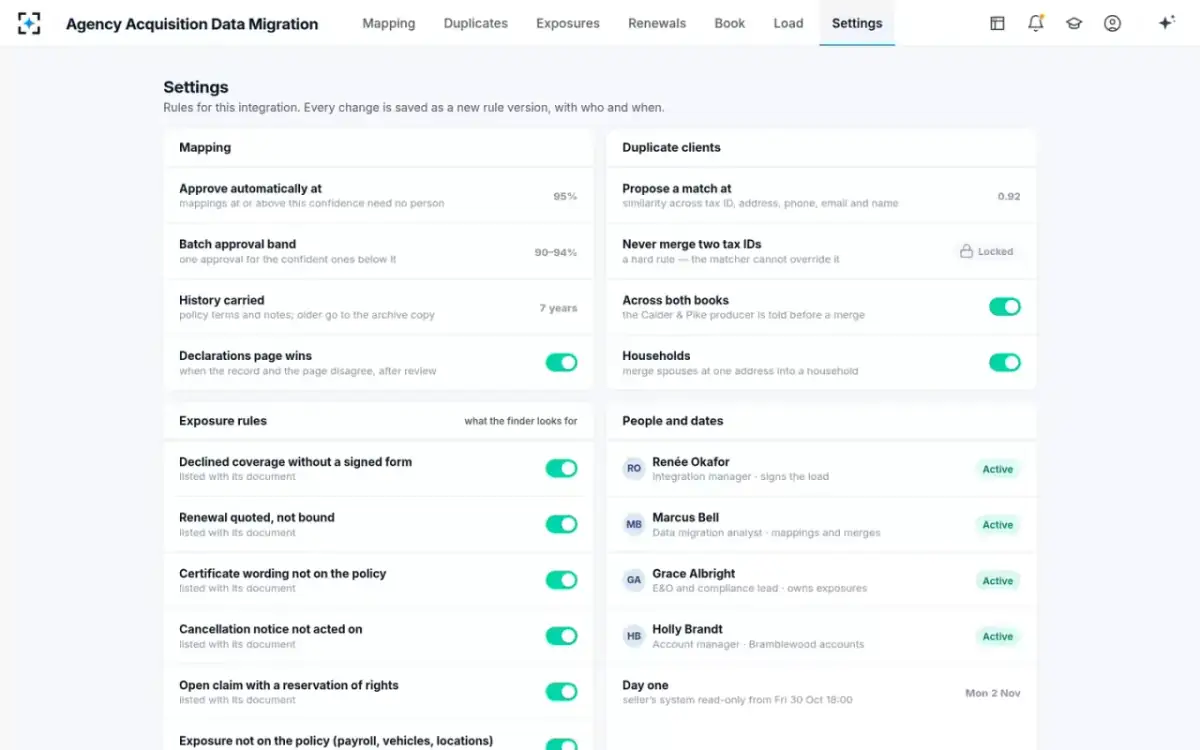
How much history goes live, and when the old system goes read-only, are settings
Who is responsible for the seller's records after a sale?
The purchase agreement should say, and it should say it by record type. The retention duty attaches to the licensee that transacted the business, and the seller may cease to exist as an operating agency soon after closing, so the agreement should give the buyer custody, the seller a right of access for its own defence, and both a date for the archive's end.
Carriers keep their own records of the same relationships, on their own clocks. New York's regulation requires an insurer to keep a licensing record "for six calendar years after the relationship is terminated for each Insurance Law licensee with which the insurer establishes a relationship", kept so that it shows when each licensee was appointed and when terminated (11 NYCRR §243.2(b)(5)). When the seller's appointments are ended at the sale, those records are what will show when each one ended; the buyer's own records should agree with them.
Compensation disclosures and fee agreements are worth singling out. New York's Regulation 194 requires a producer to keep a copy of a written compensation disclosure for at least three years after providing it (DFS, Regulation 194 FAQ), and §2119 requires a signed memorandum for any fee charged for advice or review, kept for at least three years after the services (N.Y. Ins. Law §2119). Both are attachments in most agency systems, and both define what the client was told about how the agency is paid.
What is secure disposal of client data?
Disposal that makes the data unrecoverable, using a method matched to its sensitivity. The federal standard most organisations follow is NIST's media sanitization guide, which defines three levels. Clear "applies logical techniques to sanitize data in all user-addressable storage locations for protection against simple, non-invasive data recovery techniques". Purge "applies physical or logical techniques to render target data recovery infeasible using state-of-the-art laboratory techniques". Destroy does the same "and results in the subsequent inability to use the media to store data" (NIST SP 800-88 Rev. 2, September 2025).
Disposing of an acquisition's extra copies
| Copy | Where it usually sits | Disposal step |
|---|---|---|
| Diligence extract | Deal team laptops and a data room | Delete from every location; purge or destroy portable media; record the date |
| Test-load staging copies | The buyer's or vendor's test environment | Purge after the day-one load is signed and the archive verified |
| Files sent to a migration vendor | The vendor's systems and backups | Written confirmation of disposal, as the vendor contract requires |
| Paper files from the seller's office | Boxes, after scanning | Destroy once the scans are verified and only if no rule requires the original |
Retiring the seller's agency system without losing a record
- Map every record type to its rule and clock
Policy records, premium records, disclosures, fee memoranda, notes and attachments.
- Make the old system read-only before the final changes load
So the archive and the last delta describe the same data.
- Export an archive that is readable without the old system
Fields and attachments, linked, with signatures and handwritten notes intact.
- Verify the archive against the live load
The same counts, client by client, before the old system is switched off.
- Keep the history of every change and merge
Original values, who changed them and when.
- Date the archive's end
The latest clock across the whole book, plus any longer period counsel sets.
- Destroy the extra copies
Extracts, test loads and vendor files, with the method and date recorded.
Policy Servicing's guide to legacy policy administration systems covers the carrier's version of the same archive problem. For the deal itself, the acquisition checklist asks where the seller's records are kept before closing.
Questions people ask
How long do insurance agents have to keep records?
It depends on the state and the record. In Florida an agent keeps policy records for at least five years after policy expiration and premium payment records for at least three years after payment; in New York, compensation disclosures and fee memoranda are kept for at least three years.
Does the record retention period restart when an agency is sold?
No. Each clock runs from the event its rule names, such as a policy's expiration or a payment, so the sale does not shorten or restart it. It only changes who holds the records and who must be able to produce them.
Can we keep the seller's records only in the old system?
Only if the old system stays readable for the whole retention period, licence and all. The sample integration switched it to read-only before the final changes loaded; moving its contents to an archive that does not depend on the old software removes the licence from the retention problem.
Do we need to keep paper originals after scanning?
Not necessarily, if the scan accurately reflects the original and stays accessible for the period. Florida allows records kept by electronic or photographic means, and the E-SIGN Act treats an accurate, accessible electronic record as meeting a rule that requires a record to be retained; check for any rule that demands the original itself.
Is the seven-year history in a migration the same as retention?
No. How much history goes into the live system is a servicing choice; retention is a legal floor. In the solution's sample, seven years of terms and notes went live and older history went to an archive copy, which still has to be kept and readable for as long as its own clock runs.