A post acquisition integration plan template for an insurance agency should be a dated calendar from close to day one, with one deliverable per week, a named person who signs each one off, and the evidence that sign-off rests on. Day one is the morning the seller's staff work in the buyer's agency management system and the seller's clients are serviced from it; everything before it is about making the book that loads on that morning the book the buyer paid for. The plan below runs six weeks: export and map in week one, match clients and reconcile policies in weeks two and three, inherited errors-and-omissions exposures and renewals in week four, test loads and tie-out in week five, cutover in week six. Six weeks is the design target of Botminds' Agency Acquisition Data Migration, in which six agents read, map, match and check the seller's book and people sign each step; the template works with or without it.
The reason to plan in weeks rather than phases is the renewal calendar. Renewals arrive every week of the integration, and each one processed in the seller's system before cutover has to be carried over again. A plan with dated sign-offs is a plan whose slippage shows up in days, not at the end.
Six weeks from close to day one: the data, and the sign-off each week ends with
- Read and mapWk 1
- Match clientsWk 2
- Reconcile policiesWk 3
- Exposures and renewalsWk 4
- Test load, tie-outWk 5
- CutoverWk 6
- Field mapAnalyst
- Merge listAnalyst
- Differences decidedAnalyst
- Exposure ownersE&O lead
- Tie-out acceptedManager
- Day-one loadManager
What should be in a post acquisition integration plan?
Seven things: the day-one date and the dates that lead to it, the deliverable for each week, the person who signs each one, the evidence behind each signature, the open items with an owner, the client and carrier communications with their dates, and what happens after day one. A plan that lists tasks without signatures tends to drift, because nobody owns the moment a week's work becomes the next week's input.
The Government Accountability Office, drawing on organisations that had run mergers, recommended thinking "in terms of multiple 'Day Ones' to determine—and focus attention squarely on—critical phases and the essential activities that need to be completed by and on any given date" (GAO-03-669, July 2003). The report addressed federal agencies, but the advice fits an agency integration well: the export, the field map, the merge list, the exposure list and the tie-out are each a small day one of their own, and each has a date.
The sections of an agency integration plan template
- Dates
Close, export received, each test load, seller system read-only, final changes loaded, day one.
- Weekly deliverables
One per week, each the input the following week depends on.
- Owners and sign-offs
A named person for every deliverable; the integration manager signs the day-one load.
- Evidence
What each signature rests on: counts, rules, the documents behind each exposure.
- Open items
Each with an owner, a due date and, if still open at sign-off, an accepted reason.
- Communications
Staff, clients, carriers and regulators: what each hears, from whom, and when.
- After day one
Appointments, licence changes, renewals under the seller's codes, archive and disposal.
The template: six weeks, one deliverable and one sign-off each
Copy the table into your own plan and replace the owners with your people. The evidence column is what makes it a plan rather than a to-do list: it says what someone would have to show to prove the week was done.
Post acquisition integration plan template for an insurance agency
| Week | Deliverable | Signed by | Evidence |
|---|---|---|---|
| 1 | Export read; field and code map with the doubtful items listed | Data migration analyst | Every table profiled; each mapping with its confidence; each doubtful one with a drafted rule |
| 2 | Duplicate clients grouped; merge list approved | Data migration analyst | Each cluster with its matching evidence; cross-book merges cleared with the buyer's producer |
| 3 | Policies reconciled to declarations pages | Data migration analyst | Each difference cited to its page, with the decision taken |
| 4 | Inherited exposure list owned; renewal and appointment gaps listed | E&O and compliance lead | Each exposure with its source document and owner; renewals by carrier and week |
| 5 | Test load tied out to the export | Integration manager | Clients, policies, premium to the cent, claims, notes and attachments counted both sides |
| 6 | Seller system read-only; final changes loaded; day one | Integration manager | The signed day-one load, with each open item cleared or accepted with its reason |
Week 1: get the export, read it and map it
The first week has two deliverables that depend on the seller: the export itself, and answers about what its codes mean. The purchase agreement should name the export's contents and its date; the integration plan should name the seller's person who will answer code questions in week one. The most common cause of a slipped day one is an export that arrives late or incomplete.
Once the export is in, it is read whole: every table profiled, every attachment linked to its client and policy, damaged files named. In the solution's sample acquisition, the seller's export of 41 tables, 212,406 rows and 58,214 attachments arrived four days after close and was read whole, and the mapper proposed a target for each of 146 fields and 1,094 code values. Eleven fields were left doubtful for a person. The week ends when the analyst signs the field map, with the doubtful items either decided or listed with a date. The data mapping template shows what that map should record.
Weeks 2 and 3: match clients and reconcile policies
Week two settles which records are the same insured, and week three settles which version of each policy is true. Both are judgements, so both end with a person's signature on a list, not with a job finishing.
Client matching produces clusters of records that probably describe one insured, within the seller's book and against the buyer's. In the sample, 401 records formed 187 clusters, 38 of them across both books. The analyst approves merges; for clusters that include one of the buyer's existing clients, the buyer's producer hears about it first. Policy reconciliation compares each policy record with its declarations page; in the sample, 142 policies disagreed with their pages, from a missing vehicle to a different limit. The reconciler cites each difference to its page and changes nothing; the analyst decides, and in the sample setting the declarations page wins after review.
Nothing about either list reaches a client in these weeks. A client who hears about the acquisition from the buyer while their record is still split across three accounts will get the wrong account manager's name, and possibly two letters.
Week 4: inherited E&O exposures and renewals
Week four turns two kinds of risk into owned lists: the errors-and-omissions exposures the buyer inherits, and the renewals that will land where the buyer cannot yet write them. Both must be owned before cutover, because after it the buyer's staff are the ones answering the client.
The exposure list comes from reading every note, email, certificate, notice and open claim for things such as coverage declined without a signed form, quotes never bound and certificates that promise more than the policy. In the sample, 27 exposures were listed, six of them high, each with the document it came from; the E&O and compliance lead's sign-off is that each has an owner. The renewal list compares upcoming renewals with the buyer's carrier appointments. Under the NAIC's model producer licensing act, the insurer files a notice of appointment within fifteen days of the agency contract or the first application (NAIC Model #218, §14), so requests made in week four can be in place for renewals a few weeks out. E&O tail coverage and the exposures it will not see explains why the list matters even when the seller has bought tail cover.
Weeks 5 and 6: test loads, tie-out and cutover
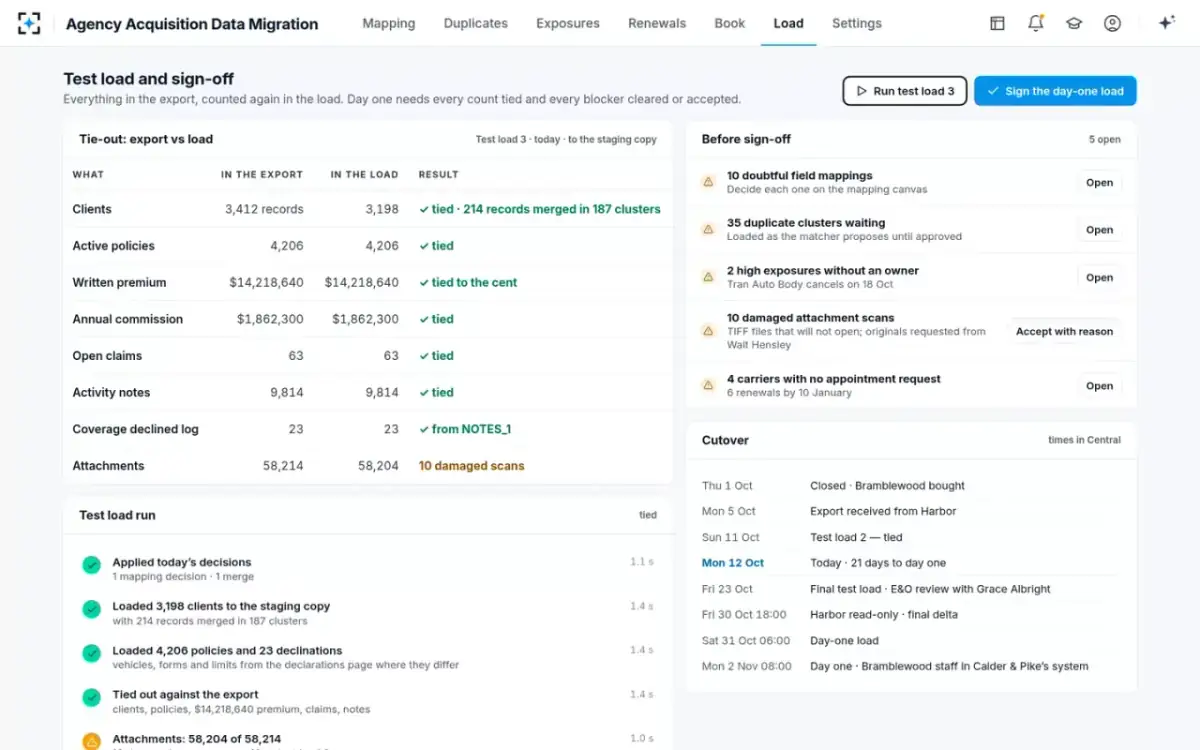
Week five proves the load; week six performs it. A test load goes to a staging copy of the buyer's system, then everything in the export is counted again in the load: clients, policies, written premium to the cent, commission, open claims, notes and attachments. Run at least two test loads, so the second confirms the fixes from the first.
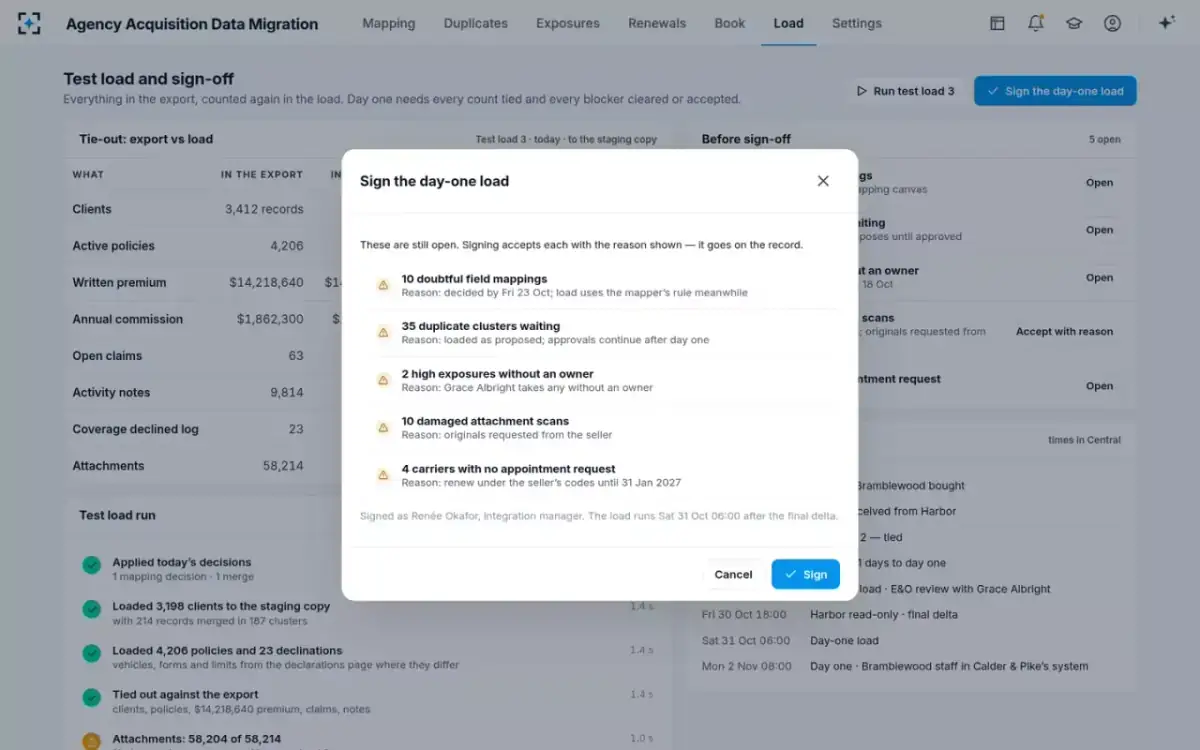
Cutover is a short sequence with fixed times. In the sample plan, the seller's system went read-only at 18:00 on the Friday, the final changes made since the export were loaded overnight, the day-one load ran at 06:00 on the Saturday, and the seller's staff started in the buyer's system at 08:00 on the Monday. The integration manager signed the load beforehand, with five items still open, each accepted with its reason: ten doubtful field mappings, 35 duplicate clusters waiting, two high exposures without an owner, ten damaged attachment scans and four carriers with no appointment request.
The last sign-off: every open item accepted with its reason, in writing
When should clients be told about an acquisition?
Staff should hear first and early; clients should hear once their record is right, usually around day one, in a message from the account manager they will actually deal with. GAO's list of merger practices includes "Communicate early and often to build trust", and for staff that is the right rule. For clients, early is less important than correct: one letter, naming the right account manager, sent after the merge list is signed.
Privacy rules can set a deadline of their own. Under the NAIC's privacy model regulation, a licensee owes a new customer an initial privacy notice when the customer relationship begins, but may send it "within a reasonable time after" when the relationship "is not at the customer's election", and the model's example is a licensee that "acquires or is assigned a customer's policy from another financial institution" (NAIC Model #672, §5). The same model relieves an agent whose principal insurer sends the notices and who shares the information only with that principal, so whether the buyer owes a notice depends on its role and its state's version of the rule; the compliance lead decides, and the date goes in the plan.
Some carriers' programmes need the client's signature to move the business. The National Flood Insurance Program, for one, requires the policyholder to sign a general change endorsement form "when there is a request to reduce policy limits, increase the deductible, assign the policy, or change the agent of record" (FEMA, NFIP Flood Insurance Manual, October 2025). Those signatures are a client communication with a deadline, and belong in the plan by carrier.
Who signs off the data migration?
The integration manager signs the day-one load; the data migration analyst signs the field map, the merge list and the policy differences; and the errors-and-omissions and compliance lead signs that every inherited exposure has an owner. Splitting the signatures this way puts each decision with the person who can judge it, and leaves the manager accountable for the whole.
Who signs what in the six-week plan
Today
Builds the field map, code lists and merge list by hand, in spreadsheets.
With agents
Signs the field map in week 1, the merge list in week 2 and the policy differences in week 3, from proposed rules with evidence.
Still theirs: Every doubtful mapping and every merge
Today
Reads a sample of the seller's files for exposures, as time allows.
With agents
Signs in week 4 that every listed exposure has an owner; dates any privacy notice owed.
Still theirs: Inherited exposures and the report to the E&O carrier
Today
Answers open-ended questions about codes and clients between renewals.
With agents
Answers specific questions in weeks 1 to 3; plans renewals without an appointment; tells clients after day one.
Still theirs: The client conversation
Today
Learns the true state of the book at the first test load.
With agents
Accepts the tie-out in week 5 and signs the day-one load in week 6, each open item cleared or accepted with its reason.
Still theirs: The date and the final signature
Week five's evidence: the export counted again in the load
What happens in the first 90 days after acquiring an agency?
The first six weeks end at day one; the next six or seven finish what day one could not. Expect to close the items accepted at sign-off, move renewals off the seller's carrier codes, complete appointments and licence changes, send any notices the compliance lead has dated, and put the seller's old system into a read-only archive.
Licensing deadlines run on their own clocks. The NAIC's model act gives a licensee thirty days to report a change of address, and gives an insurer thirty days to notify the regulator when it ends a producer's appointment (NAIC Model #218, §§7 and 15); producers who leave in the deal, or whose agency moves, trigger both. Sanctions screening is the other clock: the Treasury's sanctions office expects screening at renewal and amendment as well as at the start (OFAC insurance FAQs), so the first renewal season under the buyer is a natural point to have screened every inherited client.
The seller's codes set the outer limit. In the sample acquisition, the purchase agreement let renewals continue under the seller's carrier codes until 31 January 2027, about thirteen weeks after day one, so the ninety-day plan ends with the last of those renewals on the buyer's own appointments. For the carrier-side version of a cutover plan, see Policy Servicing's data migration plan template.
Questions people ask
Is there a free integration plan template?
The table on this page is one: six weeks, each with a deliverable, the person who signs it and the evidence behind the signature. Copy it into your own document and replace the owners and dates with yours.
How long should an agency integration take?
Long enough to read, map, match, check and tie out the book. The solution's design target is six weeks from close to day one for a mid-sized agency; a book with many duplicates across both books or many carriers without an appointment needs more time in weeks two to four.
What is day one in an acquisition?
The first working day on which the acquired business operates as part of the buyer. For an insurance agency that means the seller's staff work in the buyer's agency management system and its clients are serviced from it, on a load the integration manager has signed.
What are the integration milestones?
Six, one per week: the signed field map, the approved merge list, the decided policy differences, the owned exposure list, the accepted tie-out and the signed day-one load. Each is the input to the next.
Can day one be moved if the data is not ready?
Yes, but the renewals do not move with it, so each week of delay adds renewals processed twice. Often the better choice is to sign the load with the remaining items accepted with reasons and owners, and close them in the weeks after day one.