E&O tail coverage, formally an extended reporting period, is an addition to a claims-made errors-and-omissions policy that lets claims made after the policy ends be treated as made during it, as long as the act behind them happened while coverage was in force. When an insurance agency is sold and the seller's E&O policy ends, the tail is what answers for a claim that arrives next year about advice the seller gave last year. What tail coverage does not do is find anything. It waits for a claim. The exposures that decide whether a claim ever arrives, such as an umbrella a client declined by phone with no signed form, or a renewal quoted and never bound, are sitting in the seller's notes and files on the day the buyer takes over the clients. Botminds' Agency Acquisition Data Migration includes an E&O exposure finder agent that reads every note, email, certificate, notice and open claim in the seller's book and lists each exposure with the document it came from, for the buyer's E&O lead to own.
The figure below is the working tool this page argues for: an inherited exposure register, one row per exposure, built before day one. The examples are from the solution's fictional sample acquisition.
An inherited exposure register: each item, where it was found, who owns it and what happens next
| Exposure | Found in | Owner | Action before or at renewal |
|---|---|---|---|
| Umbrella declined by phone, no signed declination | Activity note: "$2M quote ... Decl. due to cost. Will send form." | E&O lead | Offer the umbrella again at renewal with a declination form to sign |
| Property renewal quoted, never bound; policy expired | Quote in the attachments; status "quoted, not bound" | Account manager, with the E&O lead | Confirm with the client in writing whether cover was placed elsewhere |
| Flood declined for a building in a high-risk zone, no signed declination | Note and flood zone on the application | E&O lead | Offer flood again; keep the signed answer |
| Certificate names an additional insured the policy does not endorse | Certificate issued against the policy's forms | Account manager | Request the endorsement or correct the certificate holder's understanding |
| Cancellation for non-payment with a near effective date | Carrier notice in the attachments, no follow-up note | Account manager | Contact the client before the effective date |
| Open claim under a reservation of rights; insured blames the agency | Carrier letter and claim notes | E&O lead | Report to the seller's E&O carrier under the tail, as the policy requires |
What is E&O tail coverage?
It is coverage for claims first made after a claims-made policy has ended, for acts that happened while it was in force. New York's regulation on claims-made policies defines it precisely: "Extended reporting period coverage, tail or tail coverage means coverage for that period of time specified in the policy wherein claims first made after termination of coverage under the policy, for injury or damage that occurs during the policy term, or that occurs on or after the retroactive date, if any, will be considered made during the policy term" (11 NYCRR §73.1(d)).
The tail matters only where the E&O policy is written on a claims-made basis, and errors-and-omissions cover is one of the lines that can be. New York lists "errors and omissions liability" among the coverages that may be written that way (11 NYCRR §73.2(a)). The NAIC describes the coverage itself as liability cover for a professional or quasi-professional insured against loss "arising from the performance of services for others, errors in judgment, breaches of duty, or negligent or wrongful acts in business conduct" (NAIC glossary). Under a claims-made policy, it is the date the claim is made, not the date of the mistake, that decides which policy responds.
What is the difference between tail and prior acts coverage?
Tail coverage looks forward from the end of an old policy; prior acts coverage looks backward from the start of a new one. The tail extends the time to report claims under the seller's expiring policy. Prior acts coverage, which New York's regulation also calls nose coverage, is cover under the new policy for injury or damage that happened between its retroactive date and its effective date (11 NYCRR §73.1(c)).
Tail and prior acts coverage answer the same gap from opposite ends
Tail (extended reporting period): The seller's policy that is ending.
Prior acts (nose) coverage: A policy that is starting, such as the buyer's or a new one for the acquired agency.
Tail (extended reporting period): How long after the policy ends a claim can still be reported.
Prior acts (nose) coverage: How far back before the policy starts an act can have happened, to the retroactive date.
Tail (extended reporting period): The seller's, since it answers for the seller's acts.
Prior acts (nose) coverage: The buyer's or the continuing agency's, if its carrier agrees to the retroactive date.
Tail (extended reporting period): The end of the reporting period.
Prior acts (nose) coverage: The retroactive date, which in New York may not change during the claims-made relationship or any extended reporting period.
In an acquisition the two can overlap or leave a gap. If the seller buys a tail and the buyer's carrier also extends prior acts cover to the acquired agency's past work, a claim may find two policies; if neither happens, it may find none. The E&O lead's job is to know which one applies to each exposure in the register, which is why the register records the date of the act.
Who buys tail coverage when an agency is sold?
The seller is the natural buyer of a tail, because it extends the seller's own policy and answers for the seller's acts; but the purchase agreement decides, and a buyer can make a tail a condition of closing. What the rules decide is the timetable, and it is short.
In New York, cancelling the seller's E&O policy at the sale is a "termination of coverage", which the regulation defines to include "cancellation or nonrenewal of a policy" (11 NYCRR §73.1(n)). On termination the insurer must provide a 60-day automatic extended reporting period, must advise the insured in writing within 30 days of the option to buy more and its price, and must offer a three-year extended reporting period for most coverages; the insured then has the greater of 60 days from termination or 30 days from that notice to accept in writing (11 NYCRR §73.3). A seller who lets those weeks pass without deciding may be left with the automatic sixty days.
New York's clocks for a claims-made tail once a policy ends
60days
automatic extended reporting period the insurer must provide on termination
30days
for the insurer to tell the insured, in writing, about buying more tail and its price
3years
extended reporting period the insurer must offer for most claims-made coverages
How long should E&O tail coverage last?
Long enough to cover the period in which a claim about the seller's work can still realistically arrive, and that depends on the lines the seller wrote and the claims rules in the states where its clients are. No single number is right for every book, and the length a policy offers may be shorter than the period a claim can be brought, so this is a question for the buyer's and seller's counsel and the E&O carrier, not a default.
Two facts help frame it. New York requires the offer of a three-year extended reporting period for most claims-made coverages, which sets a common minimum there. And the records that would defend a claim have their own clocks: Florida, for example, requires agents to keep records of policies transacted for at least five years after policy expiration (Fla. Stat. §626.748). In the solution's fictional sample, the seller bought a three-year extended reporting period at closing. The record retention guide shows which of the seller's records must outlive its system.
Does the buyer inherit the seller's E&O claims?
It depends on how the deal is structured and on the purchase agreement, which is a question for counsel. What does not depend on structure is the day after closing: the buyer's staff now service the seller's clients, so an exposure left open in the files becomes something the buyer's people do, or fail to do, from day one.
Take a client who declined an umbrella by phone with no signed form. Before the sale, any claim about that conversation is about the seller's act, and the seller's tail is where it goes. After the sale, if the buyer's account manager renews the account without offering the umbrella again or getting the declination signed, the next conversation is the buyer's. The tail covers yesterday; the exposure register is how the buyer avoids creating tomorrow's version of the same claim.
Each exposure opens on the document it came from
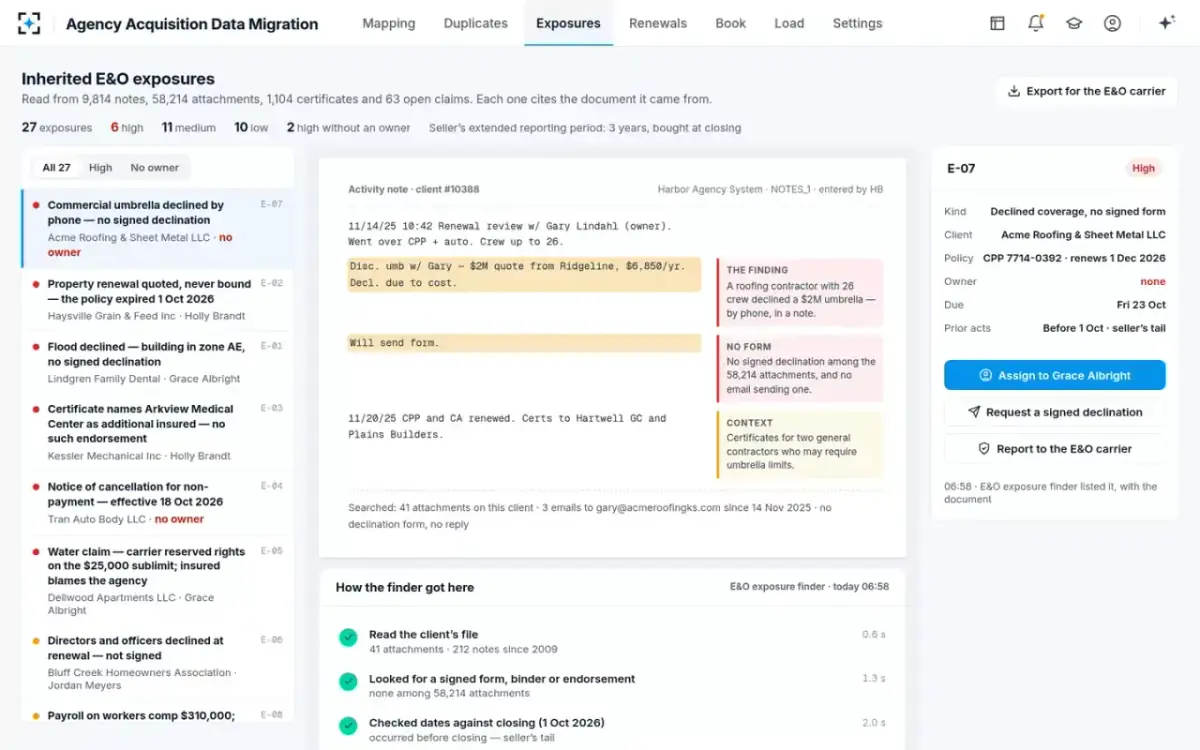
What tail coverage will not see: the exposures still open on day one
Tail coverage answers a claim; it does not prevent one, and it does not tell the buyer where the next one will come from. Six kinds of open item recur in agency files: coverage declined without a signed form, quotes never bound, certificates that promise more than the policy gives, cancellation notices not acted on, open claims under a reservation of rights, and exposures the policy does not reflect, such as payroll, vehicles or locations that grew.
Each one has the same shape: a promise, a request or a risk recorded in a note or a document, with nothing to show it was resolved. In the sample book the finder listed 27 such items from 9,814 notes, 1,104 certificates and 63 open claims; six were high, and two of the high ones had no owner when the integration manager first looked.
Inherited exposures in the sample book, by severity
How do you find E&O exposures in an acquired agency?
Read everything the seller wrote down about what clients asked for and were told, and look for the places where nothing shows it was resolved. That means activity notes and emails first, then the attachments that would close each item: signed declinations, binders, endorsements, certificates and carrier notices. A sample of files will find the kinds of exposure; only a full read finds the instances.
The order matters because the evidence is scattered. A note says "will send form"; the finder then searches the client's attachments for a signed form, and the emails to the client for one sent. In the sample, the umbrella note on a roofing contractor with a 26-person crew led to a search of 41 attachments and three emails, with no declination found, and the item was listed as high. That is the work that is impossible by hand at the scale of tens of thousands of attachments, and routine for an agent that cites what it read.
Finding inherited exposures before day one
- Read every note and email for declined, quoted and promised
"Decl.", "will send", "quoted", "per client", "to follow" are the words to start from.
- Look for the document that would close each item
A signed declination, a binder, an endorsement or a carrier confirmation.
- Compare certificates with the policy's forms
An additional insured or limit on a certificate that no endorsement supports is a promise the buyer inherits.
- Check carrier notices against later notes
A cancellation or nonrenewal notice with no follow-up is time-critical on day one.
- Read open claims for coverage disputes
A reservation of rights where the insured blames the agency belongs on the register and with the tail.
- Date each act
The date decides whether the seller's tail or the buyer's own cover responds.
- Give every item an owner before cutover
An unowned high exposure is a sign-off item, accepted with a reason or fixed.
What is a declined coverage form, and why does its absence matter?
A declined coverage form is a document the client signs to say that a coverage was offered and refused. It matters because a failure-to-procure claim turns, in New York at least, on what the client specifically asked for, and the signed form is the best evidence of the answer.
New York's highest court shows why. To bring a claim against a broker for coverage not provided, the client must show a specific request for a certain type of coverage; a general one is not enough (American Bldg. Supply Corp. v Petrocelli Group, 19 NY3d 730 (2012), read in full in failure to procure insurance in New York). In that case the court also held that a client's failure to read the policy did not on its own defeat the claim, and noted that the case "would be a more difficult case if it rested on plaintiff's uncorroborated word alone." Agency files are where corroboration lives, on both sides: a note that says the client asked is evidence for the client; a signed declination is evidence for the agency. A buyer that finds the note without the form has found an exposure. That is New York law; other states differ, which is one more reason the E&O lead, not the migration team, owns each item.
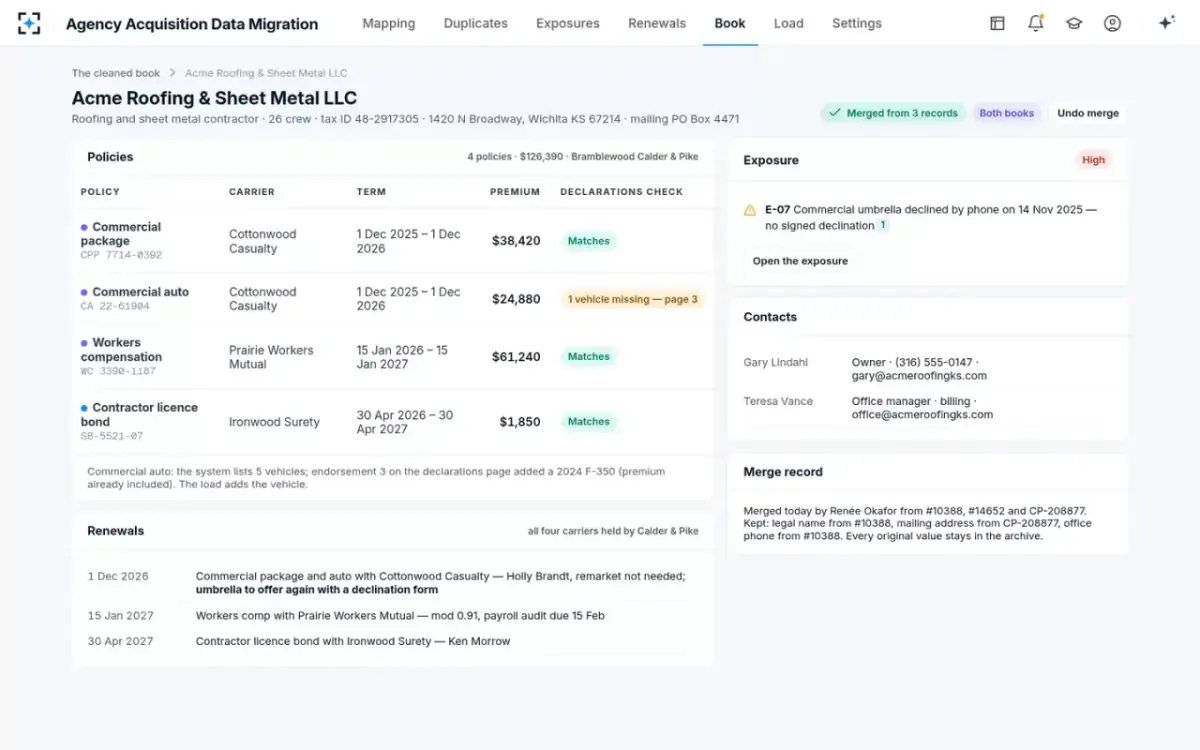
The exposure travels with the client into the buyer's book
Questions people ask
What is prior acts coverage?
Cover under a current policy for acts that happened before it started, back to its retroactive date. New York's regulation calls it nose coverage. In an acquisition it is the buyer's side of the gap the seller's tail covers from the other end.
Is tail coverage a one-time fee?
Under New York's rules it is priced as a premium for the reporting period, based on the rates in effect when the policy was issued or last renewed, unless the tail runs at least five years with a full separate aggregate limit; the cost must be reduced if coverage ends on a date other than the policy's anniversary.
Does tail coverage have its own limit?
It depends on the policy and the state. Under New York's rules, after a claims-made relationship of at least three years, the tail's aggregate limit must be at least the policy's annual aggregate for most coverages; shorter relationships carry a lower floor.
Should the buyer report inherited exposures to its own E&O carrier?
The buyer's E&O lead should read both policies and the purchase agreement first. Items that concern the seller's past acts may belong with the seller's tail; items the buyer will now service may need to be disclosed to the buyer's own carrier, as its policy's notice terms require.
Can an agent find exposures in the seller's notes without contacting clients?
Yes. The finder in Agency Acquisition Data Migration only reads: notes, emails, certificates, notices and claims. It never contacts a client or carrier, and every exposure it lists cites the document it came from.