Failure to procure insurance in New York is a claim by a client against its insurance agent or broker, in negligence, breach of contract or both, for not obtaining coverage the client specifically requested, or not telling the client within a reasonable time that it could not be obtained. In 2012 the state's highest court held that a client who made such a request and never read the issued policy may still sue: failure to read is at most comparative negligence, not a bar. The practical effect is that the duty to check what the carrier issued against what the client asked for sits with the agency. Botminds' Insurance Policy Checking was built to discharge it on every policy, reading each issued policy the day it arrives against the quote, the binder and the client's own request, with every difference cited to its page.
This page reads the New York Court of Appeals' decisions that define the claim, from the specific-request rule to the time limits, and turns each into what an agency's checking file needs to show. It is a reading of published decisions for agency staff, not legal advice; the facts of any real dispute belong with counsel.
"The failure to read the policy, at most, may give rise to a defense of comparative negligence but should not bar, altogether, an action against a broker."
New York Court of Appeals, American Bldg. Supply Corp. v Petrocelli Group, Inc., 19 NY3d 730 (2012)
What is failure to procure insurance?
It is the claim that a broker was asked for a particular coverage and did not get it, or did not say it could not. New York's rule has two halves. The broker's common-law duty is to obtain requested coverage within a reasonable time or inform the client it cannot; there is ordinarily no continuing duty to advise the client what else to buy. And the request must be specific. The court, quoting its own 2006 decision in Hoffend & Sons v Rose & Kiernan, put the second half bluntly: "A general request for coverage will not satisfy the requirement of a specific request for a certain type of coverage" (American Bldg. Supply, 19 NY3d at 735).
The claim can be framed in negligence or in contract, and in New York the choice affects the time limit, as the section on limitations below explains. Either way the plaintiff must show the request, the coverage that was missing from the policy, and that the gap caused its loss. Each of those is a question of documents: what the client asked for, what the carrier issued, and what the agency did in between.
The 2012 decision: American Building Supply v Petrocelli
A building-supply company in the Bronx subleased premises whose lease required general liability insurance with a minimum of $5,000,000. Its previous broker's policy did not meet the lease requirements and was cancelled for non-payment. The new broker reinstated the same carrier's policy and, the company said, assured the city development agency that was its landlord's lessor that the deficiencies would be corrected at renewal. The renewal was "essentially the same" policy, with a cross-liability exclusion removing cover for injuries to employees. Only employees ever entered the premises. In October 2005 one was injured, the carrier disclaimed on the exclusion, and the courts upheld the disclaimer.
The company sued the broker. The Appellate Division dismissed the claim because the company had received the policy and not read it. The Court of Appeals reversed, four judges to two: "The facts as alleged here, that plaintiff requested specific coverage and upon receipt of the policy did not read it and lodged no complaint, should not bar plaintiff from pursuing this action." While reading one's policy is "certainly the better practice", the majority wrote, an insured should have a right to "look to the expertise of its broker with respect to insurance matters" (19 NY3d at 736).
The court also explained why the client's word was credible. The company testified that it asked for liability cover in case any employee was hurt, and since nobody but employees entered the building, a policy that excluded injuries to employees "hardly made sense". That detail matters for agencies: a court weighs a claimed request against the client's operations, and a policy that does not fit the business it insures invites the inference that the request was made.
From request to suit: where the 2012 case could have been stopped
| Step | What happened | What a check of the issued policy would have shown |
|---|---|---|
| The request | Liability cover in case any employee was hurt, as the lease required; the broker knew only employees used the premises. | The promise to search for: injuries to employees covered. |
| The placement | The broker renewed the same carrier's policy, which had not met the lease requirements before. | A lease requirement the policy had already failed once. |
| The issued policy | A cross-liability exclusion for injuries to employees. Neither client nor broker read it. | The exclusion, with its page, against the request: the policy excludes the only people the client asked to cover. |
| The loss | An employee was injured; the carrier disclaimed; the courts upheld the exclusion. | Nothing a check could change by then. |
| The suit | The client sued the broker; failure to read was held no bar, and summary judgment for the broker was denied. | The file would have shown the request, the finding and what the broker did about it. |
Does the insured have a duty to read the policy?
In New York, not one that defeats a claim against the broker. Before 2012 the Appellate Division's departments disagreed: some held that an insured who received the policy is presumed to have read and understood it and cannot rely on the broker's word; others held that receipt and presumed reading do not bar a negligence claim. The Court of Appeals had left the question open in Hoffend and settled it in American Building Supply for the second view.
The dissent shows how close the question was. "It seems to me elementary that before you can complain about the contents of any contract, you should at least have read it," Judge Pigott wrote, relying on a 1920 decision that an insured is conclusively presumed to know the contents of a policy it accepts. Two of the six judges agreed with him. For agencies the majority's answer is the one that counts, and it has a plain operational meaning: the agency cannot rely on the client to find the exclusion it should have found, and the person paid to find it is the policy checker, whose job is described in insurance policy checking jobs.
What is a specific request for coverage?
A request that names a type of coverage the policy then lacks, rather than a general wish to be "fully covered". The building-supply company's request qualified because it was for liability cover for injuries to its employees and the policy excluded exactly that. A request for "the right insurance" or "the same as last year" generally does not.
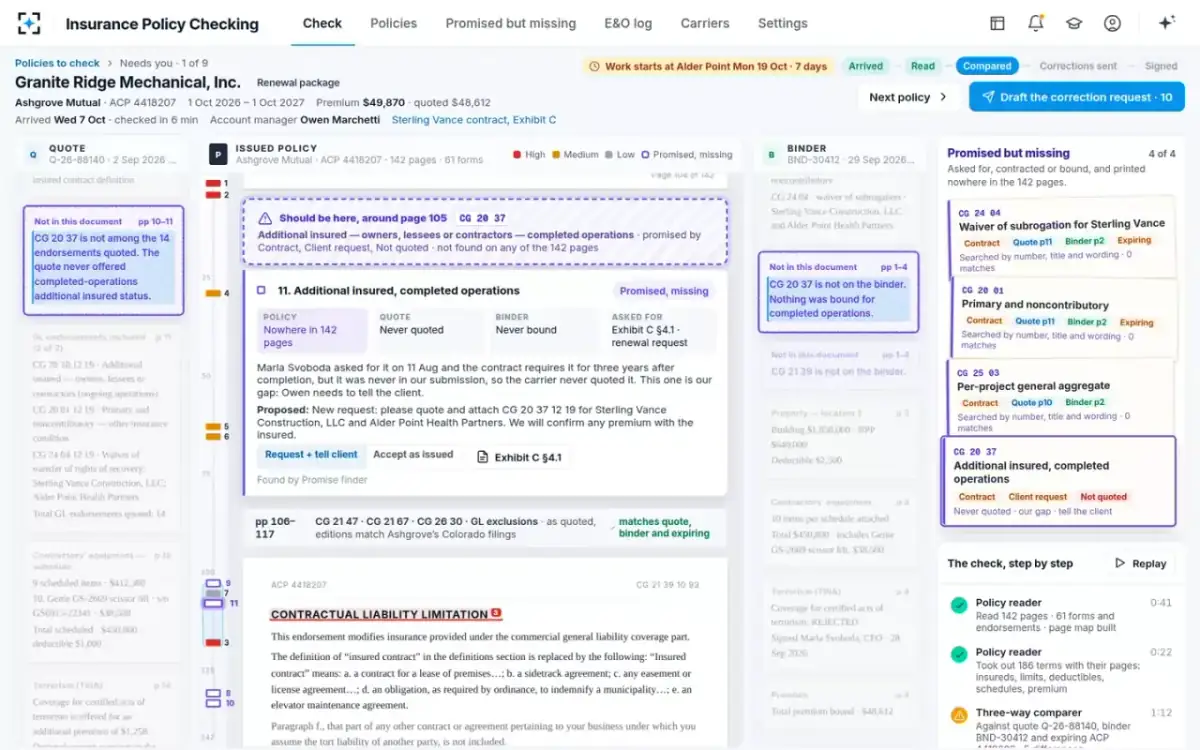
The most specific request an agency ever receives is usually a contract. A subcontract that requires a waiver of subrogation for named parties, primary and noncontributory wording, completed-operations additional insured status for three years and a $2,000,000 products-completed aggregate is four specific requests in one exhibit, and when the client sends it with the renewal request it becomes the agency's to procure. Turning that exhibit into a list the check can search for is the subject of contractual insurance requirements.
A specific request the quote never carried, found and flagged as the agency's own
What is a special relationship with a broker?
It is the exception that gives a broker a duty to advise, not merely to procure what was asked for. In Voss v Netherlands Insurance Co. (2014), the court repeated the three situations, first set out in Murphy v Kuhn (1997), that may create one: the broker is paid for advice apart from the premium; the client asked a coverage question and relied on the broker's expertise; or a long course of dealing would have told a reasonable broker that its advice was being sought and specially relied on (Voss, 22 NY3d at 735). Each is worked through, with what the file should hold, in the insurance broker's duty of care.
In Voss a broker had asked for the client's sales figures, calculated her business interruption limit at $75,000, assured her it was adequate and promised to review it as her businesses grew; at a later renewal the limit fell to $30,000. The court held the broker had not shown the absence of a special relationship, while stressing that such relationships remain the exception in insurance brokerage. It also held that the client's awareness of the limits did not defeat her claim. For an agency, the lesson is that advice given, and promises to keep reviewing, change what the agency owes, and a renewal that quietly cuts a limit the agency once recommended is exactly what a check against the expiring policy should catch.
What is the statute of limitations for failure to procure in New York?
Three years for a negligence claim and six years for a contract claim. In 2001 the Court of Appeals held that "insurance agents and brokers are not within the ambit of CPLR 214 (6)", the three-year malpractice statute for professionals, so claims against them are governed by the ordinary limits for negligence, CPLR 214(4), and for breach of contract, CPLR 213(2) (Chase Scientific Research, Inc. v NIA Group, Inc., 96 NY2d 20). When the negligence clock starts can be argued: the brokers in Chase said it ran from the policy date; the parties to the appeal agreed it ran from the loss.
Five New York Court of Appeals decisions that define failure to procure
| Decision | Year | What it decided |
|---|---|---|
| Murphy v Kuhn | 1997 | Agents must obtain requested coverage or say they cannot; no continuing duty to advise; three situations that may create a special relationship (as later quoted by the court) |
| Chase Scientific Research v NIA Group | 2001 | Agents and brokers are not professionals for CPLR 214(6); three years in negligence, six in contract |
| Hoffend & Sons v Rose & Kiernan | 2006 | A general request is not a specific request; left open whether receiving the policy bars a claim (as later quoted by the court) |
| American Bldg. Supply v Petrocelli Group | 2012 | Failure to read the policy is not a bar; at most comparative negligence |
| Voss v Netherlands Ins. Co. | 2014 | Special relationships are the exception; awareness of the limits does not defeat a special-relationship claim; proximate cause is for the factfinder |
How do brokers defend failure to procure claims?
On the request, on the relationship, on the policy, on causation and on time. Each defence in the decisions above is a question the agency's own documents answer, which is why the file matters more than the argument.
The request: there was none, or it was general. The relationship: there was no compensation for advice, no reliance on the broker's expertise and no long course of dealing, so no duty beyond procuring what was asked. The policy: the coverage obtained did satisfy the request, as the broker in American Building Supply maintained. Causation: the loss came from something else, such as the carrier's slowness in paying, the argument the Appellate Division accepted in Voss and the Court of Appeals sent back to the factfinder. Comparative fault: the client did not read the policy, which after 2012 reduces a recovery rather than barring it. And time: the claim was brought outside three or six years. A broker with a signed checking file can answer the third defence with documents instead of recollection; a broker without one is left with recollection against recollection, the contest Judge Pigott predicted in his dissent. What such a claim costs when it is lost is priced in the cost of an errors and omissions claim against an insurance agent.
What the decision asks of the checking file
If the client need not read the policy, the agency must, and must be able to show it did. A checking file that answers the New York cases has five things in it, each dated.
A checking file built for a New York failure-to-procure claim
- The client's request, in its own words
Emails, the application, the renewal request and any contract with insurance requirements. This is the specific request, or the proof there was none.
- What was quoted and bound, with pages
So a difference can be shown to be the carrier's error rather than the agency's, or the agency's own gap where it never asked.
- A comparison of the issued policy with all of them
Every term and every promised endorsement, including changes from the expiring policy, each with its page.
- What the agency did about each difference
The correction request, the carrier's reply, and the endorsement when it arrived; or the reason a difference was accepted as issued.
- What the client was told, and when
Especially where the gap was the agency's own. A client told before the loss can act; one told after can sue.
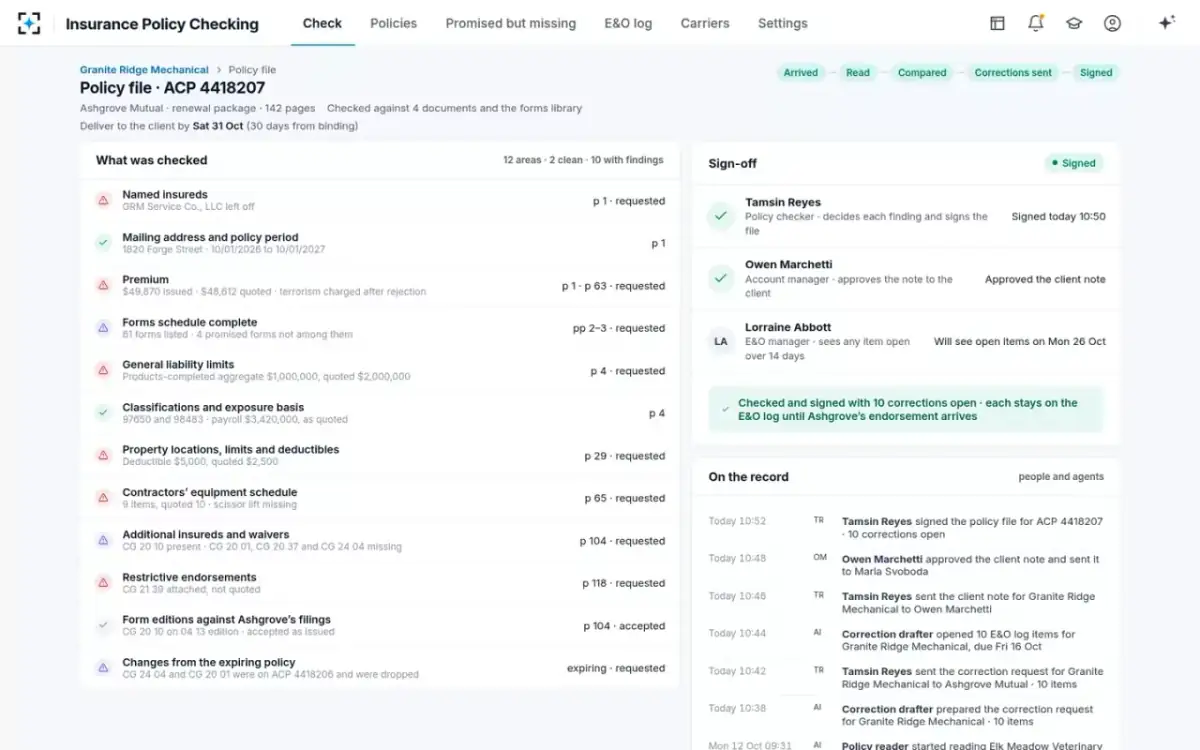
Insurance Policy Checking produces that file as a by-product of the check. Each finding cites its page in the policy, the quote and the binder; the correction request and client note are drafted for a person to approve; acceptances carry their reasons; and every open difference stays on an exposure log, with the date the client relies on the cover, until the endorsement arrives. The checker signs the file, and the record of who decided what and when is kept with it.
The signed file: what was compared, found, decided and told
Questions people ask
Can you sue an insurance broker in New York for not getting coverage?
Yes, if you made a specific request for the coverage and the broker failed to obtain it or to tell you it could not, or if you can show a special relationship that gave the broker a duty to advise. The claim can be brought in negligence, within three years, or in contract, within six.
What is American Building Supply v Petrocelli?
A 2012 New York Court of Appeals decision, 19 NY3d 730, holding that an insured who specifically requested coverage and did not read the issued policy is not barred from suing its broker. The failure to read may at most support a comparative-negligence defence. Two judges dissented.
Is a broker liable if the carrier refused to offer the coverage?
Not for failing to obtain it, if the broker told the client within a reasonable time that it could not be obtained: the duty is to procure or to inform. A broker that neither obtains the coverage nor says so is exposed, which is why a carrier's declination belongs in the file with the date the client was told.
Does New York's rule apply in other states?
No; each state has its own case law on a broker's duties and on whether an insured must read the policy, and they differ. The New York decisions are widely discussed because they state the rules clearly, but an agency should read its own state's cases with counsel.
Does receiving the policy without complaint protect the broker?
Not in New York since 2012. The client in American Building Supply received the renewal, did not read it and lodged no complaint, and the court still allowed the claim to go forward; the broker's protection lies in having checked the policy itself.