Insurance policy checking jobs sit in the service side of an agency or brokerage: the checker takes each policy the carrier issues and proves that it matches what was quoted, what was bound and what the client asked for, from the named insureds and limits to every form, edition and endorsement. The work is hard because a commercial package can run past 100 pages and the mistakes that matter are the forms that are absent, not the numbers that are wrong. Botminds' Insurance Policy Checking exists for that seat: five agents read the policy the day it arrives, compare it with the quote, binder and expiring policy, search for every promised endorsement, and leave the checker to decide each finding and sign the file.
The job titles vary. Agencies advertise for policy checkers, policy analysts, commercial lines processors and account assistants, and federal occupation data have no category of their own for the work; the nearest is insurance claims and policy processing clerks. What does not vary is where the seat sits in the chain. The producer sells, the account manager services, the carrier issues, and the checker is the last person who can still catch the gap before a claim finds it. The examples below come from the solution running on a fictional sample agency, Tallis Reed Insurance Partners in Denver, and its fictional clients and carriers.
Around one issued policy: what the checker waits on, and what waits on the checker
Today
Waits on the carrier to issue, then reads 142 pages against the quote and binder to find the handful that matter, when the backlog allows.
With agents
Starts from the findings, each with its page in all three documents, decides each one and signs the file.
Still theirs: every decision, the correction request and the signature
Today
Waits on the checker to learn whether what was promised arrived, and hears about a missing endorsement when the client's general contractor asks for it.
With agents
Gets a drafted client note to approve, including the items that were the agency's own gap.
Still theirs: what the client is told, and when
Today
Waits on a backlog to clear, with a median of 23 days from arrival to a checked policy in the sample agency's April.
With agents
Sees every open policy ranked by the date the client relies on it.
Still theirs: staffing, priorities and the checking rules
Today
Learns about coverage not procured when the claim comes in.
With agents
Sees every open difference with its age and the date the client relies on it.
Still theirs: escalation of anything open too long
What does a policy checker do?
A policy checker reconciles an issued policy against everything that preceded it. The Department of Labor's O*NET profile for the nearest occupation lists the core of it among its tasks: reviewing a policy to determine coverage, and verifying the names, addresses and insured values on applications and policies (O*NET OnLine, 43-9041.00). In a commercial agency the comparison is wider than that list. The checker sets the issued policy beside the carrier's quote, the binder, the client's request or application, any contract that dictates insurance terms, and the expiring policy.
Each area of the policy has its own question. Are the named insureds the ones that were bound, spelled as on the binder? Do the limits, aggregates and deductibles match the quote? Is every scheduled location, vehicle or item of equipment on the schedule? Is each form the one quoted, in the edition the carrier files in that state? And is every endorsement the client was promised actually printed somewhere in the package? The last question is the hardest, because the answer is a page that does not exist.
When the checker finds a difference, the job turns from reading to writing: a correction request to the carrier's underwriter citing the page in each document, a note to the account manager about what the client needs to hear, and an entry on the agency's errors and omissions log until the corrected endorsement arrives. A full walk through the twelve areas a commercial package is checked against is in the annotated policy checking checklist.
Why the checker is the last reader
The policy checker is often the only person who reads the issued policy at all. New York's highest court described a renewal that nobody read, in a case about a building-supply company's general liability policy whose cross-liability exclusion removed cover for injuries to its own employees, the only people who ever entered the premises: "Plaintiff did not read the insurance policy upon receipt, nor did the broker" (American Bldg. Supply Corp. v Petrocelli Group, Inc., 19 NY3d 730, 2012). An employee was hurt, the carrier disclaimed, and the client sued the broker.
The court let the suit go forward. It held that the client's failure to read the policy was not an absolute bar to a claim against the broker that had been asked for the coverage. That moves the burden of reading onto the agency. A client may skim the declarations, but the agency cannot rely on the client to find the exclusion it should have caught, and in most agencies the person paid to find it is the checker. How the case reached that answer, and what it means for the checking file, is set out in failure to procure insurance in New York.
That is why the seat matters more than its pay grade suggests. A producer who sold the account and an account manager who serviced it each saw the quote and the binder. Only the checker sees the policy as issued, with the forms the carrier actually attached, and only the checker can compare that against what the client relies on.
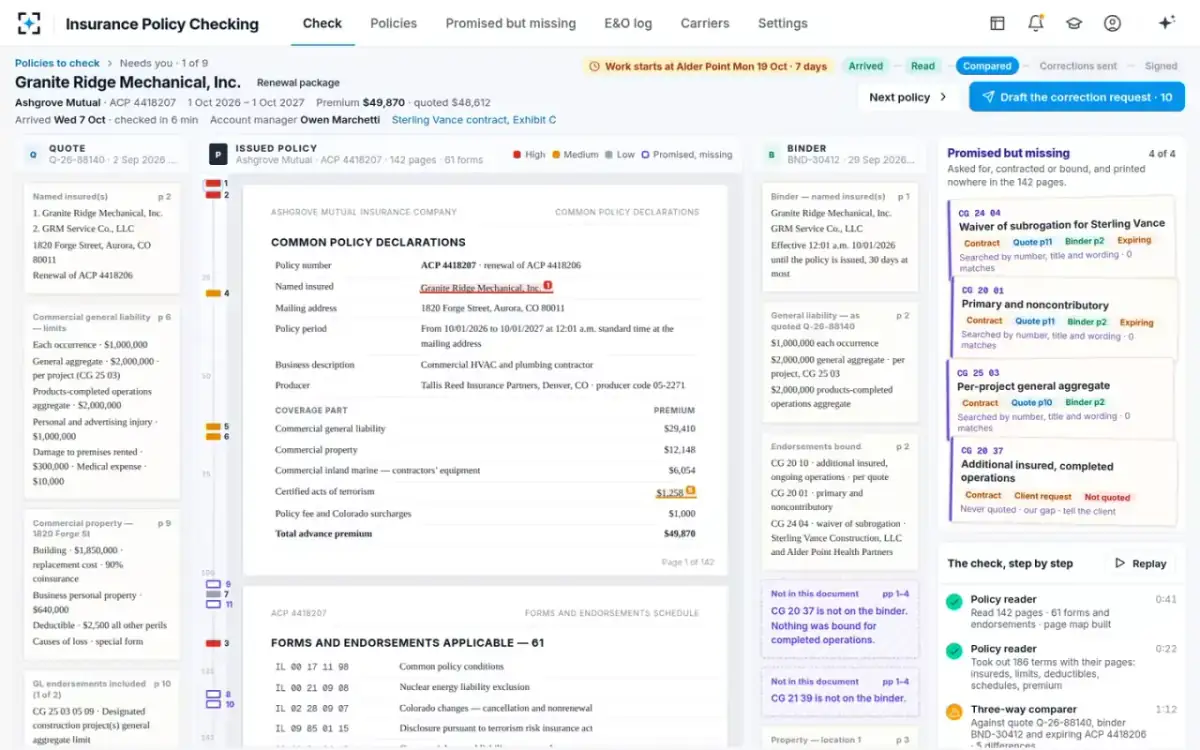
The checker's screen: quote, issued policy and binder side by side
Is policy checking a good job? Pay, numbers and outlook
Policy checking is steady work with modest pay, counted inside an occupation that is projected to shrink, and its value inside an agency is larger than its wage. Federal data do not count policy checkers separately; the nearest occupation, insurance claims and policy processing clerks, also includes claims processors and underwriting assistants. For that group, O*NET reports a 2025 median wage of $49,230 a year ($23.67 an hour), 239,100 people employed, and a projected decline of 1% or more between 2025 and 2035.
The occupation policy checkers are counted in, and the licensed one beside it
$49,230
median annual wage, insurance claims and policy processing clerks, 2025
239,100
people employed in that occupation, 2025
$62,280
median annual wage, insurance sales agents, May 2025
63%
of insurance sales agent jobs are in agencies and brokerages
The comparison with the licensed seat is the useful one. The Bureau of Labor Statistics counts about 572,600 insurance sales agent jobs in 2025 with a median wage of $62,280, and 63% of those jobs are in agencies and brokerages (BLS Occupational Outlook Handbook). Agencies and brokerages as an industry employed 995,254 people in 160,547 establishments in 2024, up from 705,734 people in 2014 (BLS employment and wages data (QCEW), NAICS 524210). The checking seat sits inside that growth, but the occupation counts suggest it is not where the hiring goes.
A shrinking occupation is not a dying job. It means each checker's work is expected to cover more policies, which is exactly where the backlog in most agencies comes from. A checker who can read forms well, write a clean correction request and explain a finding to an account manager is hard to replace; a checker whose day is spent paging through declarations is the role the numbers say is shrinking.
Do policy checkers need an insurance license?
Usually not, under the model law most states built their licensing on, as long as the checker earns no commission and does clerical work only indirectly related to selling. The NAIC Producer Licensing Model Act exempts an employee of an insurer or producer who "does not receive any commission on policies written or sold" and whose work is executive, administrative, managerial or clerical and only indirectly related to selling, soliciting or negotiating (NAIC Model #218, Section 4; compare who can make changes to an insurance policy).
Two cautions follow. States enacted the model with their own changes, so the agency's home-state statute, not the model, is the rule to read. And the exemption depends on what the person does, not on the job title. A checker who explains to a client what an exclusion means for their cover is closer to the model's definition of negotiating than one who drafts a correction request to an underwriter. Most agencies draw the line so that the licensed account manager speaks to the client about coverage and the checker speaks to the carrier about what was issued, which is also how the solution routes its drafts.
What skills does a policy checker need?
A policy checker needs to read insurance forms the way a lawyer reads a contract, keep five documents in mind at once, and write requests a busy underwriter can act on without a call. Formal education is not the barrier: in O*NET's survey of the occupation, 55% of respondents said a high school diploma or equivalent was required and 21% an associate's degree. The skills below are what separates a checker who finds the missing waiver from one who confirms the premium.
What a strong policy checker can do
- Read a forms schedule and know which forms change cover
A 61-form schedule is mostly boilerplate; the checker spots the three that restrict or extend cover and the one that should be there and is not.
- Tell a form number from its edition
The same number in a different edition can carry different wording, and a carrier may file only one edition in a given state.
- Hold the client's promises separately from the carrier's documents
The quote can be wrong too. Endorsements promised in a contract or a client email have to be searched for even when the quote never mentioned them.
- Cite the page
A correction request that names the page in the policy, the quote and the binder is answered faster than one that says "please review".
- Know what the agency did wrong
When the agency never asked the carrier for an endorsement, the honest finding is "our gap", and it goes to the account manager to tell the client.
- Close only on paper
A promise is kept when the endorsement arrives, not when the underwriter says it will.
How many policies can a checker review a day?
There is no published standard for checking throughput, and any figure without the mix of business behind it is meaningless. A personal auto renewal with no changes is a short job; a commercial package with general liability, property, inland marine and a contractor's contract requirements can take most of a day. The honest way to size a desk is to time the agency's own work by policy type and divide the hours available.
Our estimate for one complex commercial package, checked by hand, is about eight hours: three to read the policy and its forms schedule, two to compare terms with the quote, binder and expiring policy, one and a half to search for every promised endorsement, one to write the correction request and client note, and half an hour to decide each item and sign. On that estimate a checker clears one such package a day, before interruptions. The same estimate with agents doing the reading, comparing and searching falls to about 1.2 hours, and almost half of what remains is the checker's own decisions.
Where a checker's hours go on one complex package, by hand and with agents
| Task | By hand | With agents | Who does it with agents |
|---|---|---|---|
| Reading the policy and its forms schedule | 3 h | 0.1 h | Policy reader |
| Comparing terms with the quote, binder and expiring policy | 2 h | 0.25 h | Three-way comparer |
| Searching for every promised endorsement | 1.5 h | 0.1 h | Promise finder |
| Writing the correction request and the client note | 1 h | 0.25 h | Correction drafter, then the checker edits |
| Deciding each item and signing the file | 0.5 h | 0.5 h | The checker, unchanged |
| Total | about 8 h | about 1.2 h |
The second bar is the argument for the job's future. Deciding stays at half an hour in both rows because the agents do not decide: they find, cite and draft. What the checker loses is the reading; what the checker keeps is judgment about whether a difference matters, whether to accept a carrier's edition, and what the client must be told.
What software do policy checkers use?
Most checkers work from the agency management system, the carrier's portal or email for the issued PDF, a PDF viewer with search, and a checklist in a spreadsheet or the management system's activity notes. Some agencies use document-comparison tools that highlight text changes between the expiring and renewal policies. Those tools help with wording that moved, but they cannot see an endorsement that was promised in a contract and never printed, because there is no text to compare.
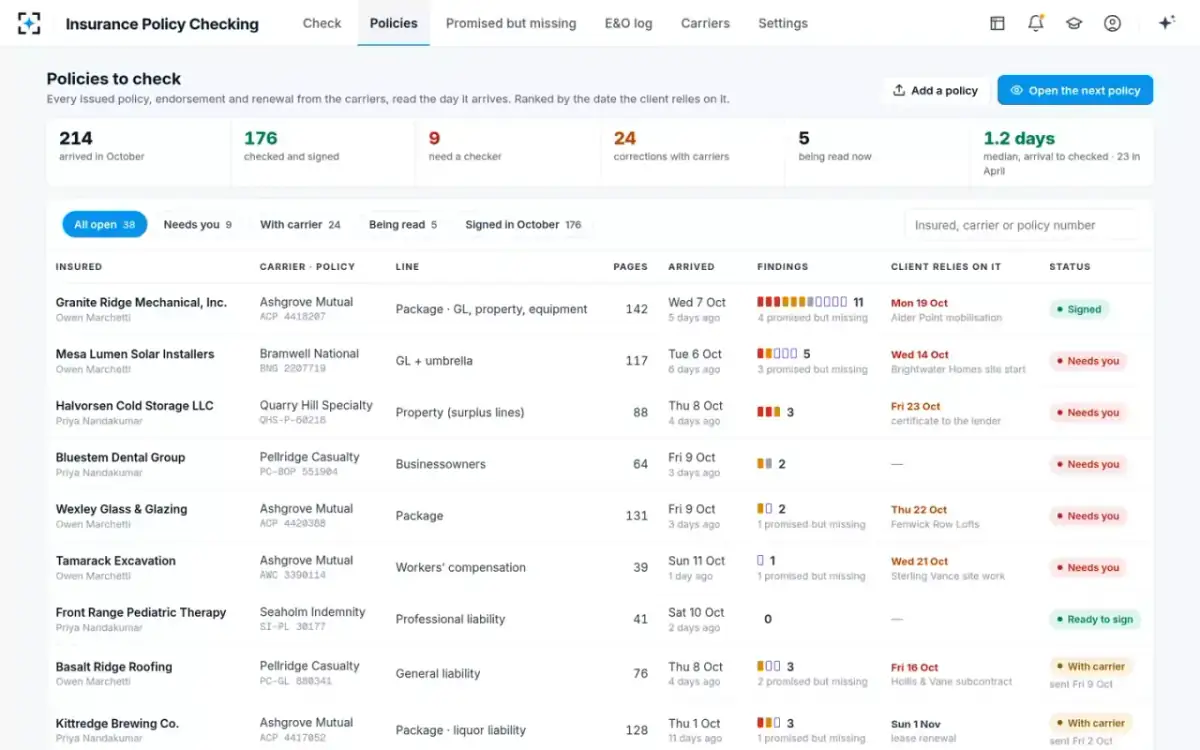
Insurance Policy Checking adds the missing step. Its policy reader builds a page map of every term in the issued policy; its three-way comparer sets each term against the quote, binder and expiring policy; its promise finder lists what the client was promised and searches the policy for each item by form number, title and wording; its forms library checker compares each form and edition with what the carrier files in the state; and its correction drafter writes the request and the client note. None of them sends anything. On the sample renewal the whole run took six minutes for 142 pages, and the checker's queue shows every open policy ranked by the date the client relies on it.
A checker's queue ranked by when the client relies on the cover
Where the job goes next: career paths, remote work and the agents
The policy checker's job is a training ground for the rest of the agency. A checker learns more about forms than most producers, and the usual moves are to account manager or account executive (which needs a producer licence), to an E&O or quality role, to a team-lead seat in a service centre, or across to a carrier's underwriting or policy-issuance team. Each of those roles uses the checker's core skill: knowing what a policy actually says.
Checking is also one of the agency tasks most easily sent to a service firm, onshore or offshore, because the documents travel as PDFs. Outsourcing moves the reading, not the duty to the client; what an agency must keep when it outsources checking covers which steps a service desk can hold and which it cannot.
The agents change the shape of the seat rather than removing it. A checker who once read one complex package a day now decides several, each from a list of cited findings. The checker who thrives is the one who can say, for each finding, whether it matters, and who can tell an account manager in two sentences what to tell a client. That is a more senior job than the one the backlog made it.
Questions people ask
What does a policy checker do at an insurance agency?
A policy checker compares each policy the carrier issues with the quote, the binder, the client's request and the expiring policy, and reports every difference. The checker then asks the carrier to correct what was issued wrongly, tells the account manager what the client needs to know, and keeps each item open until the corrected endorsement arrives.
Is policy checking an entry-level job?
It is often a first job in agency operations, and O*NET's survey of the occupation found 55% of respondents requiring only a high school diploma or equivalent. Commercial lines checking is harder than it looks, though: the checker has to read forms and editions well enough to see which ones change cover, which usually takes a season or two of renewals to learn.
Is policy checking done remotely or offshore?
Often, because issued policies, quotes and binders all arrive as documents. Agencies that send checking to another location or a service firm still own the duty to the client and the client's data, so they need the findings back with page citations, the correction request and a sign-off they can file.
What is the career path from policy checker?
The common moves are to account manager or account executive after obtaining a producer licence, to an E&O or quality-control role, to a service-centre lead, or to a carrier's underwriting or policy-issuance team. All of them reward the checker's knowledge of forms and endorsements.
Will AI replace policy checkers?
AI takes the reading and searching, not the decisions. In Insurance Policy Checking the agents cite every finding to its page and draft the correction request, but they never send anything and never accept a difference as issued; the checker decides each item and signs the file, so the role moves from reading pages to judging findings.