An errors and omissions claim against an insurance agent is a client's demand or lawsuit alleging that the agent's mistake left it without the cover it needed, most often because coverage the client asked for was never obtained, or was issued wrongly and nobody caught it. The cost to the agency is not the premium on the account: it is the loss the policy should have paid, the defence of the claim, the deductible on the agency's own E&O policy, the hours spent, and usually the client. In New York the client can bring that claim even if it never read the policy. Botminds' Insurance Policy Checking exists to stop the claim at the cheapest moment, the day the policy arrives, and it keeps every unresolved difference on an exposure log with the date the client relies on the cover.
No government, academic or non-profit source publishes how often agents face such claims or what they cost on average, so this page builds the cost from the agency's own numbers. The worked example is a renewal from the solution's fictional sample book: Granite Ridge Mechanical, Inc., a mechanical contractor whose renewal from the fictional Ashgrove Mutual arrived a week before its crew was due on a hospital project. Its subcontract requires specific endorsements. Four of them were not right.
One renewal, four gaps, and who would pay for each
Products-completed operations aggregate issued at $1,000,000
Promised in$2,000,000 on the quote, the binder, the expiring policy and the subcontract, which requires it for three years after completion
What it leaves uncoveredAny completed-operations loss in the policy year above $1,000,000 is the client's own, and the client asked for $2,000,000 in writing.
Who bears itClient, then the agency
Waiver of subrogation (CG 24 04) not issued
Promised inQuote page 11, binder page 2, Exhibit C §4.3, and on the expiring policy
What it leaves uncoveredAfter paying a claim, the carrier keeps the right to pursue the general contractor or the owner, the parties the client promised to protect.
Who bears itClient in breach of the subcontract, then the agency
Primary and noncontributory wording (CG 20 01) not issued
Promised inQuote, binder, contract, and on the expiring policy
What it leaves uncoveredThe general contractor's own insurer can be drawn into sharing a loss the subcontract put on the client's policy first.
Who bears itGeneral contractor, then the client, then the agency
Additional insured, completed operations (CG 20 37) never quoted
Promised inClient's renewal request and Exhibit C §4.1, never in the agency's own submission
What it leaves uncoveredThe general contractor and owner are not insureds for injury after the work is finished, which the contract requires for three years.
Who bears itThe agency: its own gap
What is an E&O claim against an insurance agent?
It is a claim that the agent or broker failed in a duty to the client, brought in negligence, in breach of contract or both. In the agency setting the duty that matters most is the duty to obtain the coverage the client asked for. New York's Court of Appeals states it as a common-law duty to obtain requested coverage within a reasonable time or to tell the client it could not be obtained, with no continuing duty to advise on further coverage (American Bldg. Supply Corp. v Petrocelli Group, Inc., 2012); a wider duty to advise arises only from a special relationship (Voss, 2014).
The cases the court has decided on that rule show the shape of the typical claim. A building-supply company asked for liability cover for its employees and received a policy that excluded injuries to them (American Building Supply, 2012). A manufacturer's property cover was too small for its specialised inventory after a storm (Chase Scientific Research, 2001). A building owner discovered only after someone slipped and fell in his building that he had no general liability cover at all (Gugliotta v Apollo Roland Brokerage, decided with Chase). A business owner's interruption limit was cut at renewal from $75,000 to $30,000 while her businesses grew into a larger building (Voss, 2014). Each is a policy that did not match what the client believed it had bought, and each was visible in the policy before the loss.
Can I sue my insurance agent for not getting coverage?
In New York, yes, if you specifically asked for the coverage and the agent did not obtain it or tell you it could not, and the court will not treat your failure to read the policy as a complete defence. A general request for "full coverage" is not enough; the request has to be specific. Without one, the client has to show a special relationship with the broker, which the court calls the exception rather than the norm. Other states draw these lines differently, and the details of the New York rule, case by case, are in failure to procure insurance in New York.
For the agency, the practical consequence is that the client's file decides the case. A written request, a contract with insurance requirements, an email asking for a waiver: each turns a vague expectation into a specific request the agency can be held to. The same documents are what a policy check reads, which is why the check and the defence rest on the same file.
How much does an E&O claim cost an agency?
It costs the uncovered loss (or the share of it a court puts on the agency), plus defence, plus the agency's deductible, plus time, plus the account; the first is paid by the agency's E&O insurer above the deductible, if the policy responds, and the rest largely by the agency. Because no regulator or independent study publishes averages, the table sets out where each figure comes from in the agency's own records.
The cost of one failure-to-procure claim, built from your own numbers
| Cost | How to estimate it | Where the figure comes from |
|---|---|---|
| The uncovered loss | What the missing endorsement or limit would have paid on the claim that exposed it | The client's claim and the carrier's disclaimer |
| Defence of the E&O claim | Counsel's fees until settlement or judgment; check whether your E&O policy pays them inside or outside the limit | Your E&O policy's declarations and defence provisions |
| The agency's deductible or retention | Paid by the agency on each claim before the E&O insurer pays | Your E&O declarations |
| Time | Hours of the account manager, the principal and the E&O manager, at loaded cost, for the life of the claim | Your own time records on past claims |
| The account and its referrals | Annual commission on the account times the years you would have kept it, plus any accounts the client referred | Your agency management system |
| Future E&O premium | The change at your next E&O renewal after a reported claim | Your E&O renewal history |
The arithmetic shows why prevention is cheap by comparison. On the sample renewal, the correction request went to the carrier the Monday after the policy arrived, drafted by the agents with every page cited, a week before the crew was due on site. The same four gaps found after a loss on the job site would each have started a claim whose first row is set by the size of the loss, not by the agency.
How long does a client have to sue an insurance agent?
In New York, three years for negligence and six years for breach of contract. The Court of Appeals held in 2001 that insurance agents and brokers are not "professionals" for the state's three-year malpractice statute, so claims against them fall under the ordinary periods for negligence (CPLR 214[4]) and contract (CPLR 213[2]) (Chase Scientific Research, Inc. v NIA Group, Inc., 96 NY2d 20, 2001). When the clock starts can itself be contested: in Chase the broker argued the claim accrued when the policy was issued, while the parties to the appeal agreed the negligence claim accrued on the date of the loss.
Either way, the exposure outlives the policy. The two cases decided together in Chase show how long the gap between issue and suit can be: in one, more than three and a half years; in the other, more than three years, with a $767,900 default judgment against the building owner in between after the defence counsel it engaged failed to appear.
From issued policy to suit against the broker, in two New York cases
- Policy (May 1995) to storm loss8 mo
- Loss (Jan 1996) to suit against the broker (Jan 1999)36 mo
- Policy (Dec 1994) to the fall2 mo
- Fall (Feb 1995) to the injured man's suit (Dec 1995)10 mo
- To the owner's suit against the broker (Mar 1998)27 mo
The documents that decide the case
A failure-to-procure claim is decided on what can be proved about the request and about what the agency did with the policy. Judge Pigott, dissenting in American Building Supply, warned that letting a client sue after receiving and not reading the policy "will almost always result in a "he said-she said" battle of what occurred during coverage discussions between the insured and broker" (19 NY3d 730, 738). The majority accepted that risk. An agency's defence against it is a file that answers the question before it is asked.
That file has four parts: what the client asked for, in writing; what the carrier quoted and bound; what the carrier issued; and what the agency did when they differed, including what it told the client and when. States set minimum retention for agents' policy records: Florida, for instance, requires agents to keep records of the policies they transact, including applications and change endorsements, for at least five years after the policy expires (Florida Statutes § 626.748). A signed policy file with each finding, its pages and its outcome is the record that period was written for.
The agency's own gap, flagged and told to the client
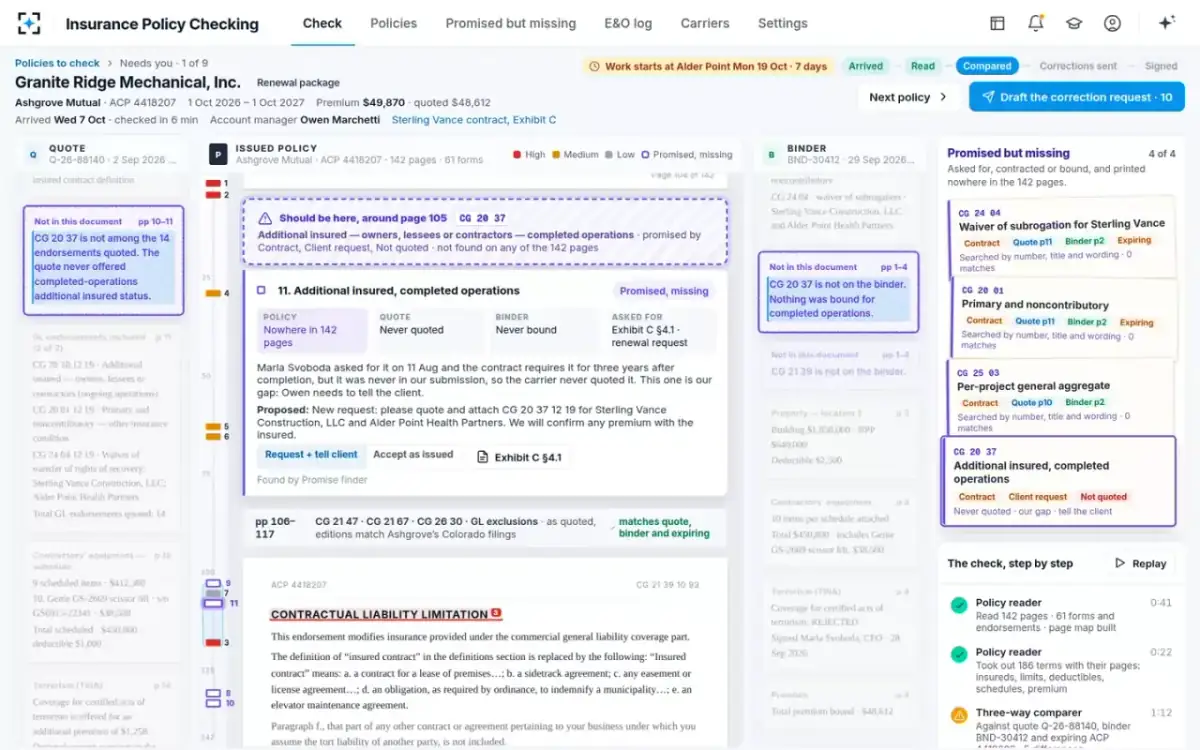
An agent is not a backup insurer, until the file says otherwise
New York's courts have kept agents' duties narrow on purpose. Dissenting in Voss, Judge Smith explained why: "if lawsuits by clients against their agents are welcomed by the courts, the consequence may be to make the agent into a kind of backup insurer, a result neither sensible nor fair" (Voss v Netherlands Ins. Co., 22 NY3d 728, 738–739, 2014). The majority did not disagree with the principle; it held that the facts in Voss, a broker who calculated the client's business interruption limit and promised to revisit it each year, might show the special relationship that creates a wider duty.
The narrow duty is still a duty to obtain what was specifically requested. When the client's contract requires a waiver of subrogation and the agency quoted and bound it, the agency owes it, and a carrier's failure to print it becomes the agency's problem the moment the agency could have seen it and did not. The policy check is where an agent stays an agent: it catches the carrier's error while correcting it costs a letter.
How do agencies prevent E&O claims?
By checking every issued policy against what was requested, keeping each difference open until the corrected endorsement arrives, and telling the client the truth, including about the agency's own gaps. Most E&O risk management advice reduces to those three; the hard part is doing them on every policy in a renewal season.
Five controls that keep a missed form from becoming a claim
- Capture every request in writing
A coverage request on a call becomes a note on the file the same day. It is what a court will ask for, and what a policy check searches for.
- Check every issued policy against the request, quote, binder and expiring policy
Not a sample: the dropped waiver is on the policy nobody had time for.
- Search for promises, not only differences
An endorsement never printed has no line to compare. List each promise and search for it.
- Close an item only when the endorsement arrives
An underwriter's "will do" is not cover. The exposure stays open, with an owner and the date the client relies on it.
- Tell the client, including about your own gap
A client told before the job starts can delay mobilising or buy the cover; one told after a loss sues.
The last control is the one agencies find hardest. On the sample renewal, CG 20 37 was in the client's request and the contract but never in the agency's submission, so the carrier never quoted it. The solution marks such items "never quoted, our gap" and routes the drafted client note to the account manager, who approves what the client is told before it goes.
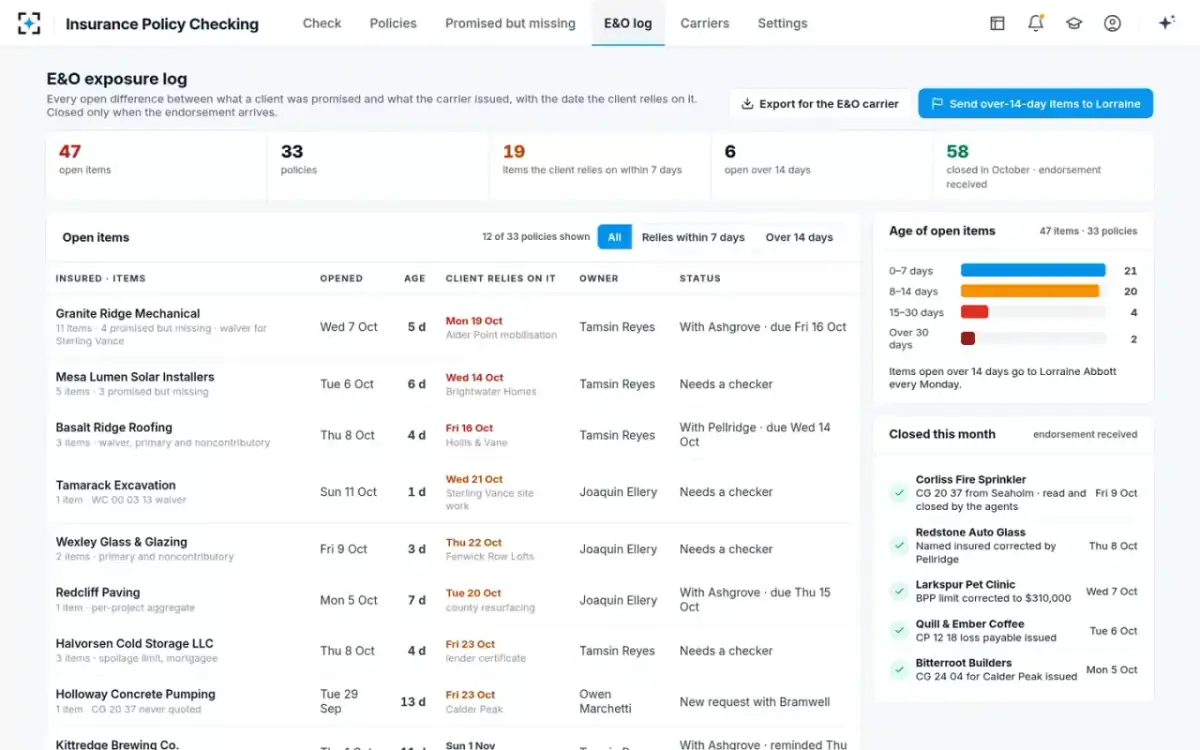
An exposure log shows the agency its own risk, by age
The E&O exposure log: every open difference, its age and the date it matters
Does E&O insurance cover failure to procure?
It usually can, but the answer is in the agency's own policy wording, not in general advice. Read four things on your declarations and form: whether the insuring agreement covers negligent acts in rendering professional services as an insurance agent or broker, whether defence costs are paid inside or outside the limit, what the deductible or retention is per claim, and what the policy requires you to report and when. A claim reported late, or a known circumstance not disclosed at renewal, can leave the agency paying the whole cost itself.
Even where the E&O policy responds, the agency pays the deductible, the time and usually the account. That is why the cheapest E&O control is the one that keeps a claim from existing: finding the difference while the carrier can still correct it.
Does policy checking reduce E&O claims?
No allowed study measures it, so treat any claimed percentage with caution. What can be measured is the agency's own exposure: the number of open differences between what clients were promised and what carriers issued, how long each has been open, and how many the client relies on in the next week. A policy check turns an unknown exposure into a list with owners and dates, and the list shrinks only as endorsements arrive. On the sample book, 58 items closed in October with the endorsement received; each is a gap that existed, was known, and was closed before a loss could find it.
Agencies that want a sharper number can take it from their own history: the E&O notices of the past five years, and for each one whether a check of the issued policy against the request would have shown the gap. That review is also the seed for testing any checking tool; how to test policy checking software on your own policies explains how.
Questions people ask
What are the most common E&O claims against insurance agents?
No government, academic or non-profit source publishes the mix. The cases New York's highest court has decided against brokers concern coverage the client asked for and did not get, or limits that did not match the client's business: an employee exclusion, too little property cover, no liability cover at all, a business interruption limit cut at renewal.
Can an insurance agent be sued if the client never read the policy?
In New York, yes. In American Building Supply (2012) the Court of Appeals held that a client who asked for specific coverage and did not read the issued policy is not barred from suing the broker; failure to read may at most reduce the recovery through comparative negligence.
Is an insurance agent liable for the full uncovered loss?
Not automatically. The client has to prove the request or a special relationship, the agent's failure, and that the failure caused the loss, and in New York the client's own failure to read may reduce what it recovers. In Voss the court left proximate cause to the jury rather than deciding it.
Who pays an E&O claim, the agency or its E&O insurer?
Usually both. The agency's E&O insurer pays covered loss and, depending on the policy, defence above the deductible; the agency pays the deductible, its own time and the cost of losing the account.
How long should an agency keep policy checking records?
At least as long as the state requires and as long as a claim could be brought. Florida requires agents to keep policy records for at least five years after expiration, and New York allows six years for a contract claim, so a signed checking file should outlast both.