Insurance policy checking services are firms that check an agency's issued policies for it, onshore or offshore: the agency sends the policy with its quote and binder, and the service returns a list of differences for the agency to act on. They solve a real problem, the backlog that builds whenever renewals peak, but they move only the reading. The duty to obtain the coverage the client asked for, and the client's claim if it was not obtained, stay with the agency. Botminds' Insurance Policy Checking is the other way to clear the backlog: five agents read every policy in-house the day it arrives, compare it with the quote, binder, client request and expiring policy, search for every promised endorsement, and leave each decision to the agency's own checker.
Whichever route an agency takes, the questions are the same: which steps the outside party holds, what the agency must keep, and what evidence comes back. The grid below answers them step by step.
Who holds each step of a policy check when a service does the reading
Assemble what was promised
A service can holdOnly what the agency sends: usually the quote and binder
The agency keepsThe client's request, application and contracts, and any promise made by email or phone
Evidence to demand backThe list of promises the service actually checked against
Read the policy and compare
A service can holdYes: the core of the service
The agency keepsNothing, if the service is good
Evidence to demand backEvery finding with its page in the policy and in each source
Search for promised endorsements
A service can holdOnly those on the documents it received
The agency keepsThe promises it never sent
Evidence to demand backFor each promise, where it was searched for and what was found
Check form editions
A service can holdIf it holds the carrier's forms by state
The agency keepsThe view on whether an edition matters for this client
Evidence to demand backIssued and quoted editions, side by side
Decide each difference
A service can holdNo: it does not know the client
The agency keepsCorrect, or accept as issued with a reason
Evidence to demand backA decision and reason on every finding
Ask the carrier to correct
A service can holdCan draft, or send under the agency's instruction
The agency keepsApproval of what goes out in the agency's name
Evidence to demand backThe request as sent, and the endorsement when it arrives
Tell the client
A service can holdNo
The agency keepsEverything said to the client, by licensed staff
Evidence to demand backThe note as approved and sent, with its date
Sign and retain the file
A service can holdNo
The agency keepsThe signature, and the file for as long as the state requires
Evidence to demand backA complete file the agency can keep without the service
What are policy checking services?
A policy checking service is a back-office firm, or a team inside a larger outsourcing provider, that compares each issued policy with the documents the agency sends and reports what differs. Most work from the declarations, the forms schedule, the quote and the binder; some also take the expiring policy and the application. The output is usually an exception report per policy, which the agency's own staff then turn into correction requests and client conversations.
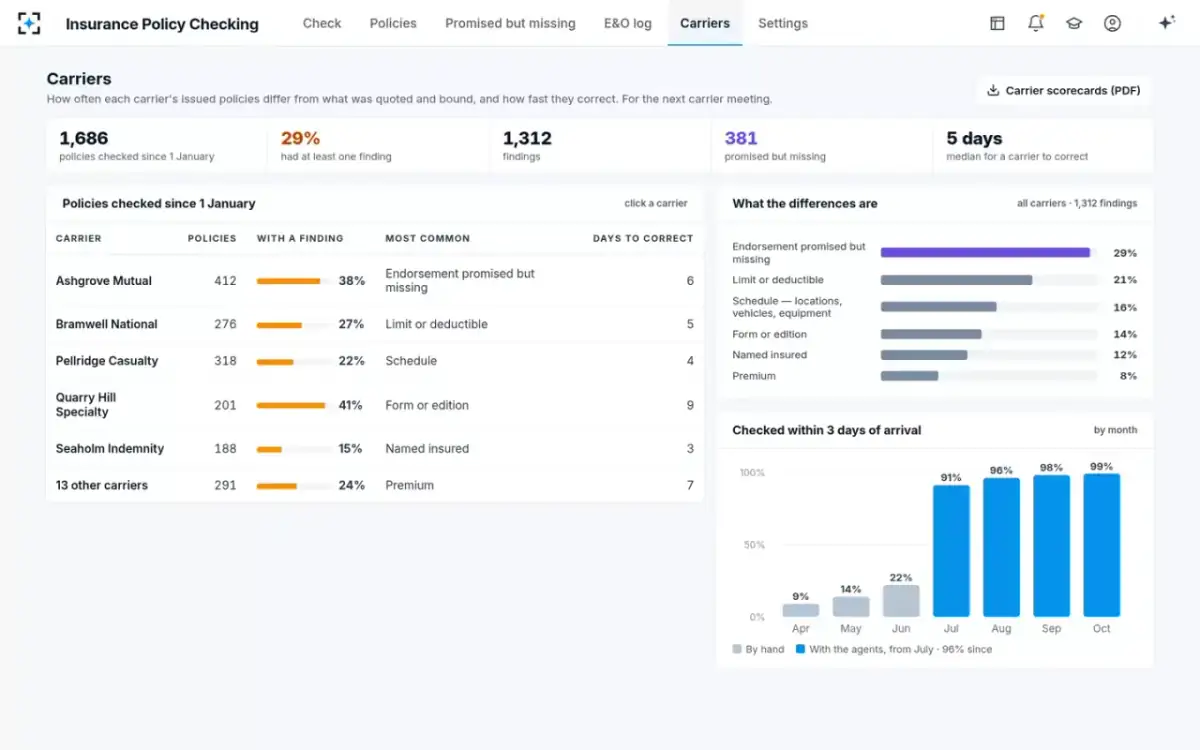
What decides the value of a service is what it is given. A service that receives the quote and binder can find a halved aggregate or a dropped named insured. It cannot find a waiver of subrogation that a client's subcontract required and the agency never asked the carrier for, because nothing it was sent mentions the waiver. On the solution's fictional sample book, endorsements promised but not issued were 29% of all findings since 1 January, and some of those were never on any quote. The promise list is the step most often left at home when checking is sent away.
Who is liable if an outsourced checker misses an error?
To the client, the agency. The client's claim is for failure to procure the coverage it requested, and the duty to procure belongs to the agent or broker it hired; New York's highest court held in 2012 that the client need not even have read the policy to bring that claim (American Bldg. Supply Corp. v Petrocelli Group, Inc.). A contract between the agency and its checking service may give the agency recourse against the service, and the service may carry its own professional liability cover, but neither changes who the client sues.
That has two consequences for the service contract. The agency should know what the service promises to check, in writing, so that a miss can be traced to the service's work or to the documents the agency failed to send. And the agency should read the service's limitation of liability before relying on it: a cap at a month's fees does little against a claim measured by an uncovered loss. What such a claim costs is set out in the cost of an errors and omissions claim against an insurance agent.
Can an outsourced checker request corrections from the carrier?
Usually it can draft them, and the agency should decide who sends them; what an unlicensed outside checker should not do is advise the client about its coverage. The line comes from producer licensing law. Under the NAIC's model act, to "negotiate" is to confer with or advise a buyer directly about the substantive benefits, terms or conditions of a particular policy, when done by someone who sells insurance or obtains it for buyers (NAIC Producer Licensing Model Act #218, Section 2); what an unlicensed insurance CSR can do draws the same line for service staff.
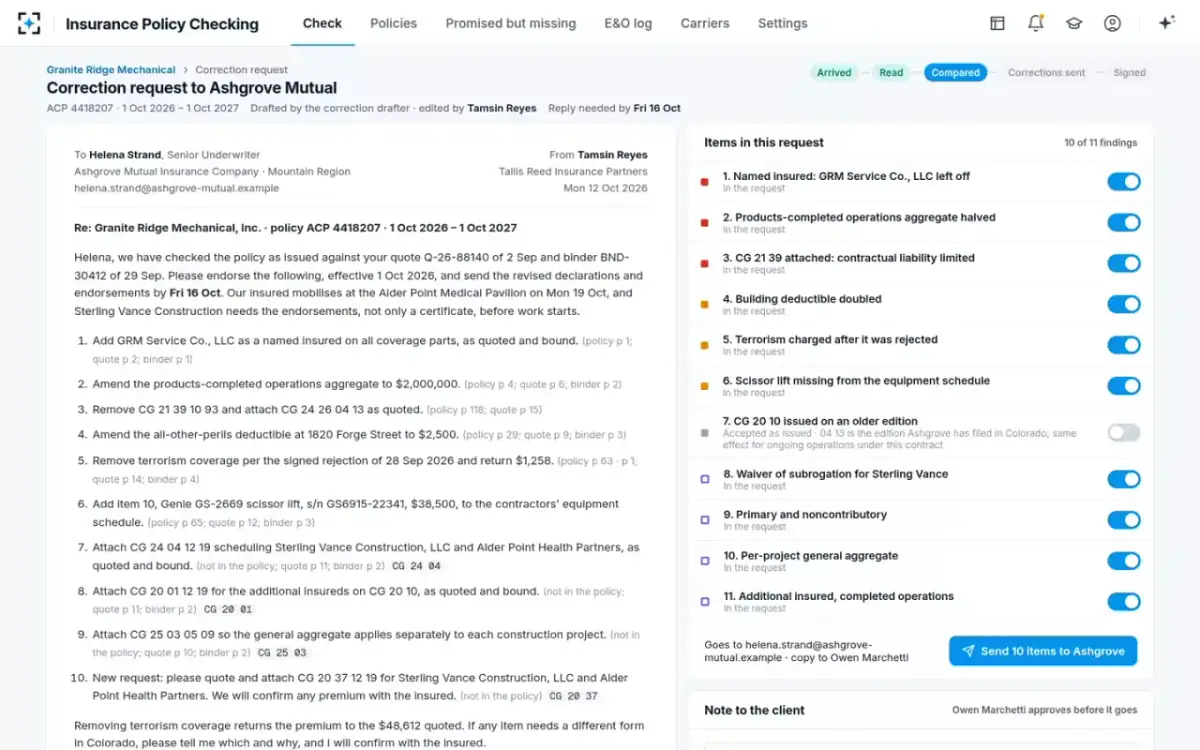
A letter to an underwriter asking that an issued policy be corrected to match the quote and binder is a request about issuance, addressed to the insurer, not advice to the purchaser. A call to the client explaining what a missing waiver means for its contract is much closer to the definition. Most agencies therefore let a service draft correction requests, send them under the agency's name after a licensed person approves them, and keep every client conversation with licensed staff. States enacted the model with their own changes, so the agency's state law, not the model, is the rule to check before a service writes to anyone.
One correction request, every item with its page, sent under the agency's name
Is outsourced policy checking safe for client data?
It can be, if the agency does the due diligence the law increasingly expects and writes the safeguards into the contract. Issued policies carry clients' names, addresses, payrolls, property values and sometimes drivers' details. The NAIC's Insurance Data Security Model Law, adopted in a number of states, requires a licensee, a term that includes producers and agencies, to exercise due diligence in choosing a third-party service provider and to require that provider to protect the systems and nonpublic information it can reach (NAIC Model #668, Section 4). The model exempts licensees with fewer than ten employees from that section, so a small agency should check its own state's version.
Whatever the state, the practical questions are the same. Where will the documents be stored and read, and in which country? Who at the service can see them? How are they deleted when the work is done? What happens, and how fast is the agency told, if the service has a breach? An in-house tool does not remove these questions, because it too is a service provider, but it keeps the documents inside the agency's own environment and access controls.
What should a policy checking service deliver?
A file the agency can defend without the service. States require agents to keep records of the policies they transact; Florida's statute requires every agent to keep, for at least five years after a policy expires, records full enough for the policyholder and the department to learn what was transacted, applications, change endorsements and signed documents included (Florida Statutes § 626.748; the full list is in insurance agency record retention guidelines). A checking report that cannot be understood without the vendor's system fails that test the day the contract ends.
What to require back from any outsourced policy check
- Every finding with its page in each document
Policy, quote, binder and, where used, the expiring policy. A finding without a page has to be checked again.
- The list of promises it checked against
So the agency can see at once which promises, such as a contract's waiver, were never in scope.
- A statement of what was clean
Areas checked with no difference, not only the exceptions, so silence is not mistaken for a check.
- Form editions, issued against quoted
And whether the carrier files the issued edition in the state, if the service holds that list.
- A drafted correction request
Every item with its pages, ready for a licensed person to approve and send under the agency's name.
- Turnaround measured from the policy's arrival
Not from when the service opened the file, and reported against the date the client relies on the cover.
- A file the agency can keep
In a format the agency can store and read for the retention period, without access to the service's system.
How long do policy checking services take?
As long as the contract says, which is why the contract should say it from the policy's arrival and against the client's dates. The clock that matters is the client's: a general contractor that needs endorsements before work starts, or a binder that has already ended because the policy issued. On the solution's fictional sample agency, checking by hand ran at a median of 23 days from arrival to a checked policy in April; with the agents, the October median was 1.2 days, against a design target of three days for every policy. A service that returns a report in ten business days has used most of the time in which a correction is cheap. How the binder's clock and the checking clock interact is worked through in how long a binder is good for.
How much does outsourced policy checking cost?
The fee is the visible part; the agency's own time around the service is the rest, and both should be counted per policy. No government or research source publishes market prices for checking services, so build the comparison from the agency's quotes and its own hours.
The full cost of one checked policy, three ways
| Cost per policy | In-house, by hand | Outsourced service | In-house, with agents |
|---|---|---|---|
| Reading and comparing | Checker's hours: about 6.5 on a complex package, our estimate | The service fee | Minutes of agent time |
| Assembling the promises | Inside the checker's hours | Agency staff time to gather and send requests and contracts | Read by the agents from the documents already on file |
| Deciding findings | Checker's time | Agency staff time, often a second read to trust the report | Checker's time: about 0.5 hours on a complex package |
| Correction request and client note | About 1 hour | Agency time, unless the service drafts | Drafted; about 0.25 hours to edit and approve |
| Misses that become claims | The agency's exposure | The agency's exposure, with any recourse the contract gives | The agency's exposure |
The row that decides most comparisons is the second. A service is cheaper per hour of reading, but if agency staff spend an hour per policy assembling what the service needs and re-reading what it returns, the saving shrinks, and the promise list is still the agency's work. The last row is the same in every column, which is the point of this page's title.
Should we outsource policy checking or automate it?
Outsource if the problem is only volume and the book is simple; automate in-house if the problem is the missing endorsements, the promise list and the time to a checked file. Many agencies do both for a while, keeping a service on simple personal lines while agents take the commercial packages, where contract requirements make the promise list long.
An outsourced service against in-house agents, on the questions that decide
Outsourced service: The service's staff, from what the agency sends.
Insurance Policy Checking, in-house: Five agents, the day the policy arrives, from the agency's own documents.
Outsourced service: Only promises in the documents sent; the agency must assemble the rest.
Insurance Policy Checking, in-house: Built from the client's request, application, contracts, quote and binder.
Outsourced service: Found if the quote or binder named them.
Insurance Policy Checking, in-house: Searched for by form number, alternatives, title and wording, including never-quoted promises.
Outsourced service: Set by the contract, often in business days.
Insurance Policy Checking, in-house: Read on arrival; the checker decides; target three days for a checked file.
Outsourced service: Back with the agency, often after a second read.
Insurance Policy Checking, in-house: With the agency's checker and account manager, from cited findings.
Outsourced service: Leaves the agency, under the service contract's safeguards.
Insurance Policy Checking, in-house: Read where the agency's documents already are.
Outsourced service: The agency's.
Insurance Policy Checking, in-house: The agency's.
How each carrier's policies differ from what was quoted and bound
Questions people ask
Are offshore policy checking services allowed?
The NAIC licensing model requires a licence to sell, solicit or negotiate insurance, and comparing documents for an agency is none of those, wherever it is done. The harder questions are about client data: any state version of the NAIC data security model applies to how the agency chooses and oversees the provider. Keep client conversations with licensed staff, and read your state's law and your E&O policy's conditions before sending client documents abroad.
Does a policy checking service need an insurance licence?
Not for comparing documents, in most cases, since that is clerical work for the agency rather than selling, soliciting or negotiating. Work that strays into advising the client on its coverage is a different matter, which is why client contact usually stays with the agency's licensed staff.
Can we outsource only part of the check?
Yes, and many agencies do: the service reads and compares, the agency assembles the promise list, decides each finding and handles the carrier and the client. The grid above shows where the handovers fall and what evidence to require at each.
How do we test a checking service before signing?
The same way as software: send it policies your team has already checked, with known errors planted, including a missing endorsement and a promise the quote never carried, and score what comes back. The seeded-error test sets out the error list and the scoring.
What happens to our files if we end the service contract?
That depends on the contract, so settle it at the start. The agency needs every checked file in a format it can keep and read for the state's retention period, five years after expiration in Florida, without the service's system.