AI insurance policy checking uses software agents to read an issued policy, compare each term with the quote, the binder and the expiring policy, and search the whole package for every endorsement the client was promised, citing the page for each finding so a person can decide it. The comparison of limits and premiums is the easy part; the hard part is a waiver of subrogation or an additional insured endorsement that was quoted, bound or required by contract and simply is not there. Botminds' Insurance Policy Checking was built around that problem: five agents read every policy the day it arrives, and one of them, the promise finder, does nothing but hunt for promises. This is the agency's check on what it ordered; an insurer reading a policy against a claim does a different job, covered in AI insurance policy review.
The example on this page is a renewal from the solution's fictional sample book: Granite Ridge Mechanical, Inc., a mechanical contractor insured by the fictional Ashgrove Mutual, whose 142-page, 61-form renewal arrived on 7 October. Its subcontract for a hospital project requires a waiver of subrogation for the general contractor and the owner. Here is how the agent looked for it.
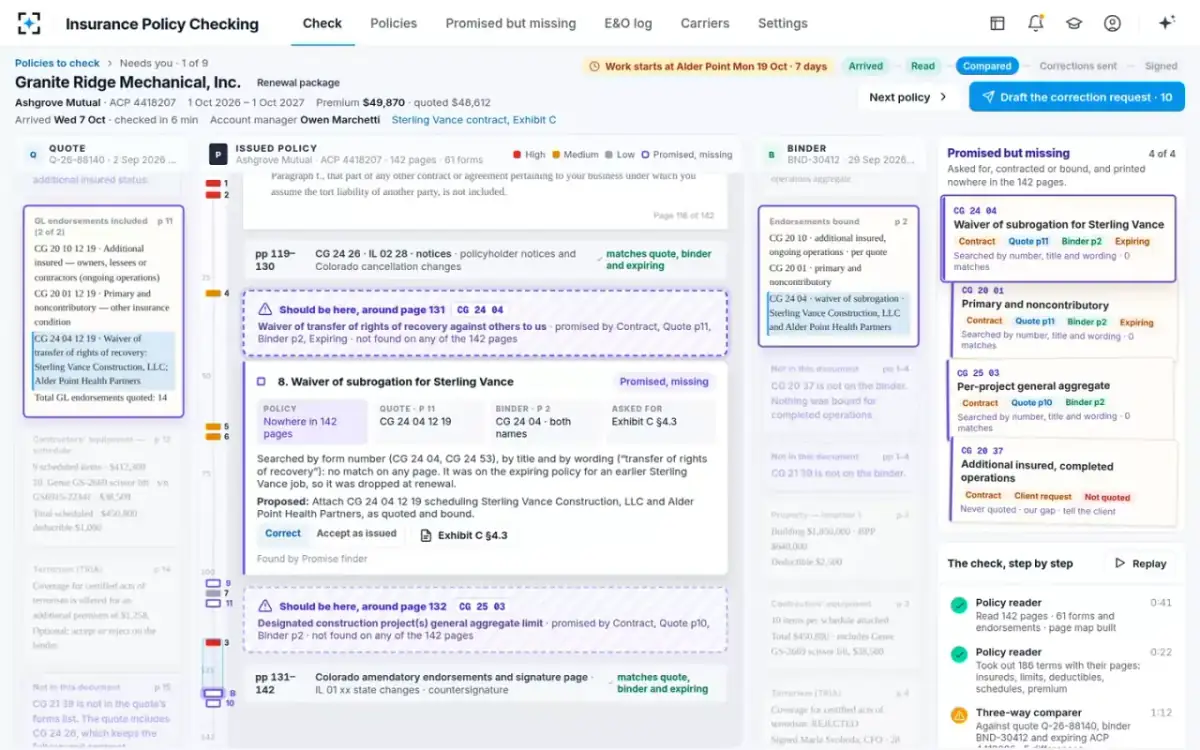
One promise, searched through 61 forms: how the promise finder looks for a missing waiver
- 1
List the promise
Waiver of subrogation for Sterling Vance Construction, LLC and Alder Point Health Partners, read from four places: the subcontract's Exhibit C §4.3, the quote (page 11, CG 24 04 12 19 naming both), the binder (page 2) and the expiring policy.
1 promise, 4 sources
- 2
Search by form number
The forms schedule on pages 2–3 lists 61 forms. The agent looks for CG 24 04 and for CG 24 53, the alternative waiver form, in the schedule and on every form's footer.
No match
- 3
Search by title
A carrier's own waiver form can carry any number. The agent looks for the title, "Waiver of transfer of rights of recovery against others to us", on every page.
No match
- 4
Search by wording
Last, the wording that waives the carrier's recovery rights for a named party, so that a renamed or manuscript endorsement is still found.
No match on 142 pages
- 5
Place the gap
The general liability endorsements end on page 130, before the Colorado amendatory forms, so the agent marks a slot "around page 131" and notes that the expiring policy carried the waiver: it was dropped at renewal.
Promised but missing
Can AI check insurance policies?
Yes, for the reading, comparing and searching; the decisions about what a difference means still need a person. A language model can read a 142-page package, extract the named insureds, limits, deductibles, schedules and forms with their pages, and set each one beside the same term in the quote and the binder. What it should not do is decide that a difference is acceptable, write to the carrier on its own, or tell the client anything. In Insurance Policy Checking those limits are written into each agent, and the checker decides every finding.
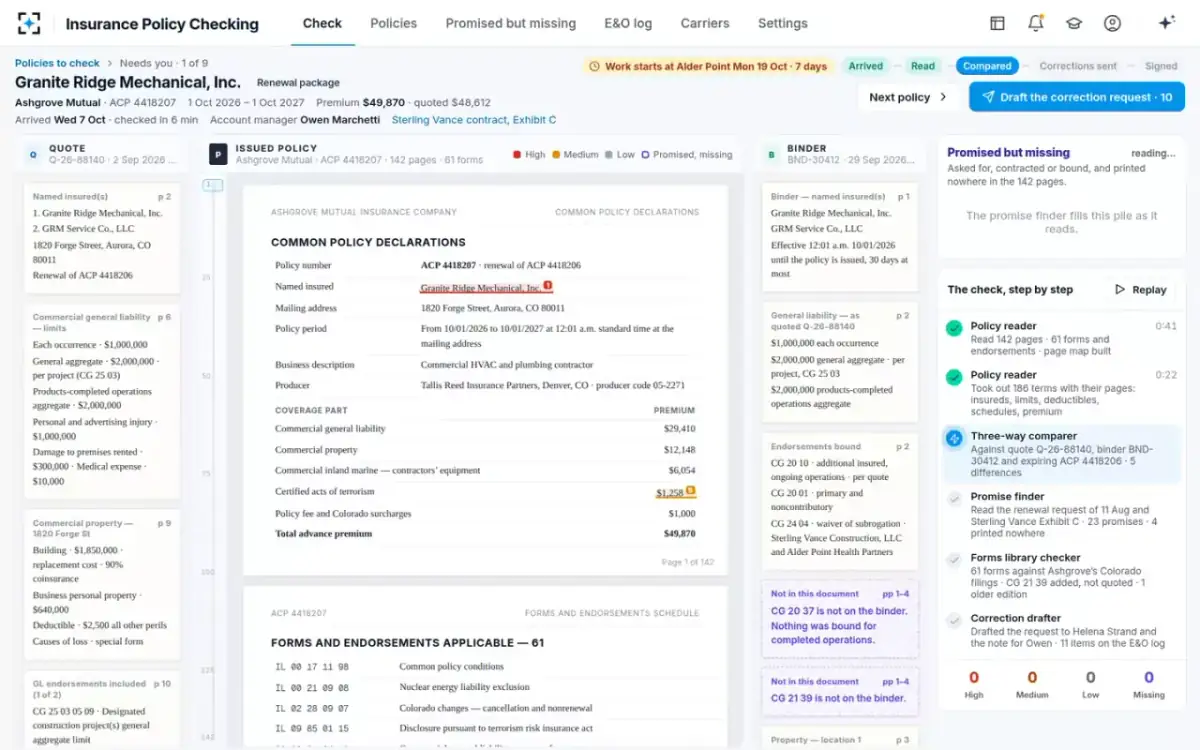
How the AI compares a policy to a binder is the plainest part of the job. The policy reader builds a page map of every term; the three-way comparer finds the same term in the quote, the binder and the expiring policy and reports what each document says, with its page, ranked by the agency's own severity rules. On the sample renewal it found the products-completed operations aggregate printed at $1,000,000 on page 4 of the policy against $2,000,000 on page 6 of the quote and page 2 of the binder, and one click opens all three documents at that passage.
One renewal through the agents, in numbers
142pages
and 61 forms read by the policy reader
186terms
taken out with their pages and compared three ways
23promises
listed from the client's request and the contract; 4 printed nowhere
6min
from arrival to a checked file, ready for the checker
Why a missing endorsement is the hard case
A comparison works on what is printed. If a limit is wrong, there is a number on a page to compare with the quote. If an endorsement was never attached, there is nothing on any page to compare at all: the forms schedule simply lists 61 forms instead of 62, and none of the 61 is wrong. That is why a checker reading line by line catches a halved aggregate and misses a dropped waiver.
In the sample book the pattern is plain. Of 1,312 findings on 1,686 policies checked since 1 January, 381, or 29%, were endorsements promised and not issued, more than any other kind of difference. Those are also the findings that reach a job site: a general contractor asking for the waiver before work starts, or an owner's claim tendered to a policy that never named it. The agent that searches for them is the one worth evaluating.
The gap, marked where the missing waiver should have been
Why search by number, title and wording?
Because the same promise can be kept on a form with a different number, and a search on one key misses it. Standard form numbers are the common language of a contract's insurance clause, but the buyers who write those clauses usually accept equivalents. The County of Sonoma's contract insurance guide says so directly: "We often refer to ISO additional insured endorsements but do not require that endorsements be on ISO forms. We accept other endorsements that have equivalent or similar language" (County of Sonoma, Contract Insurance Requirements Reference Guide).
The same guide notes that "Many blanket additional insured endorsements are insurer proprietary endorsements, not ISO endorsements," and that on a blanket endorsement "The additional insured's name is not on the endorsement." Put those together and three searches are needed. The number search finds the standard form and its known alternatives. The title search finds a carrier's own form with a familiar heading. The wording search finds a blanket or manuscript endorsement that grants the same thing in different words, and a name search alone would never find it, because the name is in the contract, not the policy.
The wording search also guards against the opposite error. A forms schedule can list a waiver form that turns out to be a blanket version, applying only where a written contract requires it, and whether it reaches the promise then depends on the contract, not the policy. The agent reports the form it found and what it is conditioned on; whether it keeps the promise is a judgment the checker makes with the contract open beside it.
How does AI handle different form editions?
It treats the edition as part of the form's identity and checks it against what the carrier files in the state, rather than against the quote alone. A state's insurance code usually requires that a changed form carry a changed designation; Florida's says that "Whenever any change is made in any such form, the designating letters, figures, or terms thereon shall be correspondingly changed" (Florida Statutes § 627.413(4)). Under a rule like Florida's, a new edition is a changed form with its own designation, not a reprint.
Insurance Policy Checking's forms library checker compares every form and edition in the issued policy with the carrier's filed forms in the state, and flags restrictive endorsements that were attached without being quoted. On the sample renewal it found CG 21 39, a contractual liability limitation that narrows the definition of an insured contract, attached though never quoted, and one older edition: the quote offered CG 20 10 in the 12 19 edition and the policy carried 04 13. The checker accepted the edition as issued, and her reason went on the file: in the sample, 04 13 is the edition the carrier files in Colorado. Edition differences are low severity by default in the solution's settings; a restrictive endorsement that was not quoted is high. Why an edition can decide a claim is worked through in what insurance policy endorsements are, and why the edition decides.
Where the list of promises comes from
The promise finder cannot search for a promise nobody wrote down, so its first job is to build the list. It reads the client's request or application, any contract that sets insurance requirements, the quote and the binder, and records each promise with every place it was made. On the sample renewal that was 23 promises from the client's renewal request of 11 August and the subcontract's Exhibit C.
Building the list from the client's side as well as the carrier's matters, because the quote can be wrong too. CG 20 37, additional insured status for completed operations, was in the client's request and in Exhibit C §4.1 but never in the agency's submission, so the carrier never quoted it. A three-way comparison of policy, quote and binder would never raise it: all three agree. The promise finder marks it "never quoted, our gap", and the draft to the carrier words it as a new request rather than a correction. Turning a contract's insurance clause into that kind of list is the subject of contractual insurance requirements as a promise list.
Insurance Policy Checking's five agents, and where the checker takes over
Agent
Policy readerReads the declarations, forms schedule and every form; builds a page map of named insureds, limits, deductibles, schedules and premium.
Never: infer a form that is not printed
Agent
Three-way comparerMatches each term with the quote, binder and expiring policy and ranks each difference by the agency's severity rules.
Never: decide which document is right
Agent
Promise finderLists every promise from the request, application, contract, quote and binder and searches for each by number, alternatives, title and wording.
Never: count a certificate as proof
Agent
Forms library checkerCompares each form and edition with the carrier's filed forms in the state and flags restrictive endorsements that were not quoted.
Never: give legal advice on what a form means
Agent
Correction drafterDrafts one request to the underwriter and the client note, and opens an exposure item for each finding.
Never: send anything
A person decides
Policy checkerDecides each finding, accepts with a reason or corrects, sends the request and signs the file.
What does AI miss in policy checking?
An AI checker misses what is not in its documents, what it cannot read, and what needs judgment it was not given. Each is predictable, and each is something to test before buying.
The first is the unwritten promise. A coverage the client asked for on a phone call and nobody noted is invisible to any search; the cure is a request captured in writing, which is also what a court will ask for if the policy turns out short. The second is the unreadable page: a scanned endorsement with a stamp across its footer, or a schedule printed as an image, can defeat number search and leave only the title and wording searches. The third is judgment about equivalence. Whether a carrier's proprietary waiver gives the same thing as the standard form, or whether an older edition has the same effect for this contract, is a reading a checker or counsel signs, not a match score. The fourth is a stale forms library: an edition check is only as current as the list of what the carrier files.
Accuracy figures quoted without these cases tell a buyer little. The fair test is the agency's own policies, with known errors planted in them, including at least one blanket endorsement, one scanned form and one never-quoted promise; how to run that test on policy checking software sets out the error list and the scoring.
A document comparison against a promise search, on the same renewal
Comparing printed terms: Found: $1,000,000 against $2,000,000 on the quote and binder.
Searching for each promise: Found, and tied to the contract's requirement of $2,000,000.
Comparing printed terms: Not found: there is no printed line to compare.
Searching for each promise: Found: promised in four places, printed in none.
Comparing printed terms: Not found: policy, quote and binder agree.
Searching for each promise: Found, and marked as the agency's own gap.
Comparing printed terms: Shown, if the forms lists are compared, as one more form among 61, with no view on what it does.
Searching for each promise: Flagged high: it narrows cover and was never quoted.
Comparing printed terms: Shown as a text change, with no view on whether it matters.
Searching for each promise: Checked against the carrier's filed forms; the checker decides.
Does AI policy checking replace the checker?
No. It replaces the reading, and it changes what the checker spends the day on. Every agent in Insurance Policy Checking stops short of a decision: it finds, cites and drafts. The checker decides each finding, may accept a difference as issued only with a reason that goes on the file, sends the correction request, and signs. Anything addressed to the client goes to the account manager first.
That split is also what regulators expect. The UK's Financial Conduct Authority calls itself technology-agnostic and says its rules do not usually require or forbid particular technologies, while firms remain responsible for treating customers fairly (FCA, AI Update, 2024). In the United States, 29 jurisdictions had adopted the NAIC's model bulletin on insurers' use of artificial intelligence by 8 October 2026, and the NAIC AI model bulletin adoption map lists them one by one. Neither changes who answers to the client for a policy that does not match the request: the agency does.
The check, replayed step by step, with each agent's time
What to ask before you buy AI policy checking
Ask to see a missing endorsement found, not a wrong limit. Any tool that compares two documents will find a changed number; the question is whether it builds a list of promises from the client's request and contracts, searches by number, alternatives, title and wording, and tells you where the gap should have been.
Then ask how it handles the cases above: a blanket endorsement conditioned on a written contract, an edition the carrier files in one state and not another, a scanned form, a promise the quote never carried. Ask whether every finding cites its page in each document, whether anything is ever sent without a person, and whether a checker can accept a difference only with a stated reason. And ask what happens after the check: a finding that closes when the underwriter replies, rather than when the corrected endorsement arrives, has not closed anything.
Questions people ask
Can AI find missing endorsements in an insurance policy?
It can, if it starts from a written list of what was promised and searches for each item by form number, alternative forms, title and wording. In Insurance Policy Checking's sample book, endorsements promised but not issued made up 29% of all findings, the largest single kind, which is why the promise search matters more than the comparison of limits.
How fast can AI check a policy?
On the solution's fictional sample renewal, 142 pages and 61 forms were read, compared and searched in six minutes, with the agents' steps timed in seconds. The checker's decisions take as long as they take; the solution's target is a checked and signed file within three days of the policy's arrival.
Is AI policy checking accurate?
Accuracy depends on the agency's carriers, forms, scans and promises, so a vendor's figure on its own samples says little. The reliable measure is a seeded test on policies the agency has already checked, scored separately for misses and for invented findings, with zero missed high-severity items as the bar.
Does AI policy checking work on personal lines?
The same method applies, but the payoff is smaller: personal auto and homeowners policies are shorter and usually carry fewer contract-driven endorsements. The case for agents is strongest on commercial packages, where a contract can require half a dozen specific endorsements and a renewal can drop one silently.
Can the AI accept a difference on its own?
Not in Insurance Policy Checking. The agents never accept a difference as issued and never send anything; a checker who accepts one must give a reason, which is kept on the file with the finding, the pages and who decided.