The policy checking process is the routine an agency runs on every policy a carrier issues: receive it, read it, compare it with the quote, binder, client request and expiring policy, search for every endorsement the client was promised, decide each difference, ask the carrier to correct what is wrong, tell the client what matters, sign the file, and keep each open item until the corrected endorsement arrives. Done by hand it is a page-by-page read that falls behind every renewal season. Botminds' Insurance Policy Checking hands the reading, comparing and searching to agents and leaves every decision with the checker, which turns the hard question from "how do we keep up" into "when do we trust what the agents found".
Trust is not a switch. Research on decision aids in medicine and aviation finds that people lean too hard on a system that is usually right, and that what corrects it is accountability and visible reasoning. The ladder below is our recommendation for moving a checking team from reading every page to deciding from findings, with a measure that must be met before each step up.
The trust ladder: four steps from shadow running to sampled review, each with its exit measure
Step 1Shadow
How the checker worksCheckers work exactly as today. The agents check the same policies in parallel and nobody looks at their findings until the checker has signed.
Exit measureOver two to four weeks, the agents found every high-severity item the checkers found, and each item the checkers missed is confirmed as real.
Step 2Side by side
How the checker worksThe checker reads the policy as before, with the agents' findings open beside it, and confirms or rejects each one in a click.
Exit measureEvery finding can be verified on its page without searching, and invented findings are fewer than real ones.
Step 3Findings first, full review
How the checker worksThe checker starts from the findings, decides each one, then still pages through the forms schedule and the endorsements before signing.
Exit measureA monthly seeded spot test shows no missed high-severity item, and every acceptance has a written reason.
Step 4Findings first, sampled review
How the checker worksFor each line of business that passed step 3, the checker decides from the findings and signs; a lead re-reads a sample of signed files in full each month.
Exit measureStays only while the sample finds nothing the agents missed. One high-severity miss sends that line back to step 3.
What is the policy checking process?
It is the agency's proof that what the carrier issued is what the client was promised, run on every policy and every endorsement, not a sample. The process starts when the issued policy arrives, from the carrier's portal or by email, and it ends only when every difference is either corrected by an endorsement or accepted with a reason. In between, the process produces three documents that matter later: a correction request to the carrier's underwriter, a note to the client, and a signed policy file listing what was checked and what was found.
The process exists because the policy is the contract and the quote and binder are not. Once the policy issues, the binder that held cover in the meantime has done its job; what the client has is whatever the carrier printed. How the binder's own clock bears on when the check must happen is set out in how long a binder is good for.
How do you check a commercial insurance policy, step by step?
Compare twelve areas of the policy with their sources, search for each promise, then decide, request, tell and sign. On a commercial package the twelve areas are the named insureds, the mailing address and policy period, the premium, the forms schedule, the liability limits, the classifications and exposure basis, property locations with their limits and deductibles, the equipment or vehicle schedules, additional insureds and waivers, restrictive endorsements, form editions against the carrier's filings, and changes from the expiring policy. Each is compared with the quote, the binder and the client's request, and the expiring policy shows what was dropped. The annotated version of that list, with where each item sits in a real package, is the insurance policy checking checklist.
The policy checking process in Insurance Policy Checking: what agents do, what people decide
Agent
Read on arrivalThe policy reader maps every term in the issued policy to its page: insureds, limits, deductibles, schedules, forms and premium.
Never: infer a form that is not printed
Agent
Compare three waysEach term is set against the quote, the binder and the expiring policy and ranked by the agency's severity rules.
Never: decide which document is right
Agent
Search for promisesEvery endorsement promised in the request, contract, quote or binder is searched for by number, title and wording.
Never: count a certificate as proof
A person decides
Decide each findingThe checker opens each finding in all three documents, then corrects it or accepts it as issued with a reason.
Agent
DraftOne correction request to the underwriter with every page cited, and a plain note for the client.
Never: send anything
A person decides
Send and tellThe checker sends the request; the account manager approves the client note before it goes.
A person decides
Sign and followThe checker signs the file; each open item stays on the exposure log until the endorsement arrives.
Why checkers distrust a finding they did not make
Because a checker who signs a file is answerable for it, and a finding from software arrives without the reading that would let the checker vouch for it. That instinct is healthy; the risk is what replaces it once the software has been right for a few weeks. A systematic review of 74 studies of decision support, mostly in healthcare and aviation, defined automation bias as "the tendency to over-rely on automation" and found that complacency errors rise when a system is "highly (but not perfectly) reliable" (Goddard, Roudsari and Wyatt, Journal of the American Medical Informatics Association, 2012).
The same review points at the cure. "Increasing accountability for decisions may also prevent AB," the authors write, and people who perceived themselves to be accountable made fewer such errors; making users aware of the system's reasoning increased appropriate reliance. Translated to a checking desk: the checker, not the software, signs; every finding shows its reasoning as pages in each document; and a rejected finding, like an accepted difference, carries a reason. A process built that way earns trust without dulling the checker's attention.
How do you get checkers to use a new checking tool?
By letting them prove it on their own work before they rely on it, one line of business at a time. The ladder above does that. In shadow running, nobody changes how they work, and the only question is whether the agents found what the checkers found. Side by side, the checker reads as before but can confirm each finding in a click, which shows quickly whether the findings are checkable. Only then does the checker start from the findings, first with a full page-through and, for the lines that earn it, with a lead's monthly sample of signed files.
The exit measures matter more than the pace. A team that reaches step 4 on personal auto in a month and stays at step 3 on construction packages all year has used the ladder correctly. A seeded spot test, a handful of known errors planted in policies the team has already signed, keeps step 3 honest; how to build one is described in testing policy checking software on policies you checked.
What makes a finding checkable in one click
A finding is checkable when the checker can see, without searching, the passage that supports it in every document it cites. In Insurance Policy Checking every difference is a tick on the issued policy's page rail; clicking it scrolls the quote, the policy and the binder to the same passage and highlights it in each, with a note on what differs and the proposed correction. A promised-but-missing finding shows every place the promise was made and the searches that found nothing.
Two design rules follow from the research above. Nothing is a finding without its page, so the checker is never asked to trust a summary. And the checker's options are explicit: correct, accept as issued with a reason chosen from set reasons or written in full, or for the agency's own gaps, request and tell the client. A finding the checker cannot verify in a click is a finding the checker will learn to skip.
Who signs off a policy check?
The policy checker signs the file, the account manager approves anything said to the client, and the E&O manager sees whatever stays open too long. That division is deliberate: the person closest to the documents vouches for the comparison, the person who owns the client relationship owns the words the client reads, and the person who owns the agency's exposure sees the items that are not closing.
Three signatures on one policy check, and what each one means
Today
Signed a file after reading what time allowed, with no list of what was compared.
With agents
Signs a file of twelve areas, each with its page and outcome, after deciding every finding.
Still theirs: the decision on every finding and the signature on the file
Today
Learned of a gap when the client's contractor asked for an endorsement on site.
With agents
Approves a drafted note to the client, including any item that was the agency's own gap.
Still theirs: what the client is told, and when
Today
Learned of an open difference when a claim arrived.
With agents
Receives every item open longer than the agency's limit, 14 days in the sample, each Monday.
Still theirs: escalation and the agency's exposure
How do you document a policy check?
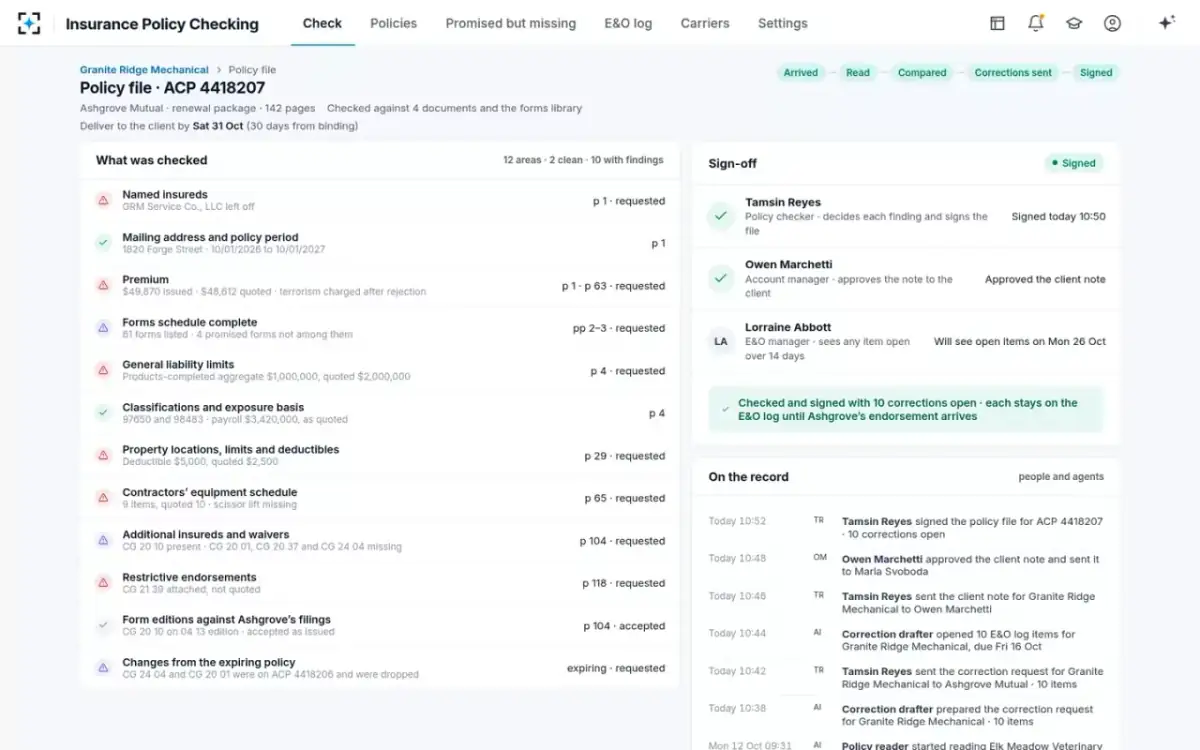
With a file that answers, for each area of the policy, what was compared, on which page, and what was decided, by whom and why. A checklist with ticks does not do that; a reader cannot tell from a tick whether the forms schedule was compared with the quote or glanced at. In the solution's sample, the signed file for one renewal lists twelve areas, two clean and ten with findings, each with its page and outcome, and records that the checker accepted one older form edition with the reason stated.
The file is also the agency's evidence if the client later says it asked for something it did not get. States require agents to keep records of the policies they transact, including applications and change endorsements, for set periods; in Florida it is at least five years after the policy expires. A signed file built during the check costs nothing extra to keep and is far stronger than a reconstruction made after a claim.
A signed policy file: twelve areas, each with its page and outcome
What happens when a policy check finds an error?
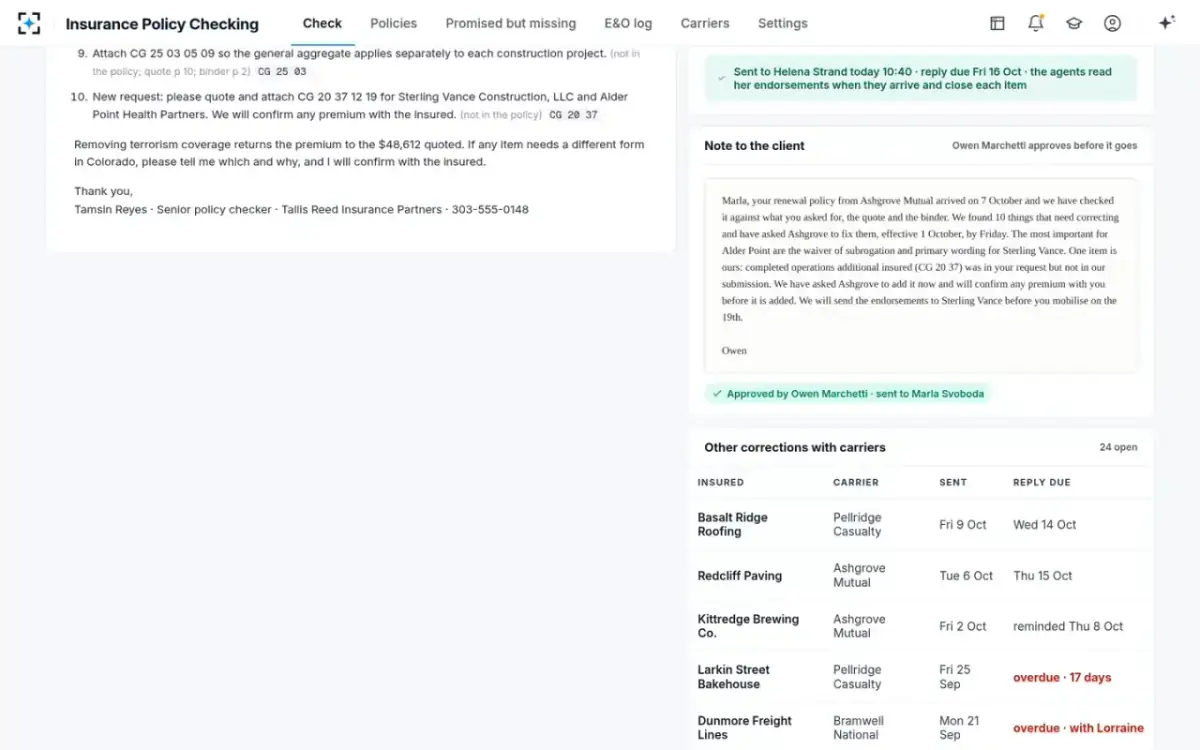
The checker decides it, the carrier is asked to correct it, the client is told what it needs to know, and the item stays open until the corrected endorsement is in the file. In the sample renewal, ten of eleven findings went to the carrier's underwriter in one request, each with its page in the policy, the quote and the binder, an effective date and a reply-by date four days out. The eleventh, an older edition of an additional insured form, was accepted as issued with its reason on the file.
One finding was handled differently because it was the agency's own: an additional insured endorsement for completed operations that the client had asked for and the agency had never submitted. It went to the carrier as a new request rather than a correction, and the client note said plainly that it was the agency's miss. Telling a client about an agency error before work starts is uncomfortable; hearing about it from a general contractor on the job site is worse.
The request sent, and the client note approved before it goes
How long should a policy check take?
Long enough to decide each finding, and short enough that the check is finished before the client relies on the cover. We know of no regulator that sets a deadline for an agency's own policy check, so agencies set their own; Insurance Policy Checking's design target is a checked file within three days of a policy's arrival, every policy, and its settings let an agency choose from one to ten days. The more useful clock is the client's: the date the general contractor needs the endorsements, the lender needs evidence, or the crew mobilises.
Arrival to a checked policy: the sample agency's median by hand, with agents, and the target
- Arrival to checked, by hand23 days
- Read on arrival, then decided1.2
- Checked and signed3 days
Questions people ask
What do you compare when checking a policy?
The issued policy against the carrier's quote, the binder, the client's request or application, any contract with insurance requirements, and the expiring policy, plus each form and edition against what the carrier files in the state. The expiring policy is the one most often skipped, and it is how a waiver dropped at renewal is found.
Should every policy be checked, or a sample?
Every policy. The error that matters, a missing endorsement on one contractor's renewal, is not spread evenly across a book, so a sample can miss it entirely. Sampling belongs to the review of the checking, as a lead re-reading signed files, not to the checking itself.
Who should check endorsements issued mid-term?
The same desk, by the same process. A mid-term endorsement adding a location or an additional insured is compared with the change request the agency sent, and it is often where a client's contract requirement first appears.
What if the carrier does not answer a correction request?
The item stays open with its owner and the date the client relies on the cover, and the agency escalates. In the solution, items open longer than a set number of days go to the E&O manager, and an item closes only when the endorsement arrives.
Can a checker accept a difference instead of correcting it?
Yes, when the difference does not matter for this client, such as an older form edition the carrier files in the state with the same effect for the contract at hand. The reason goes on the file with the finding, so anyone reviewing it later can see what was decided and why.